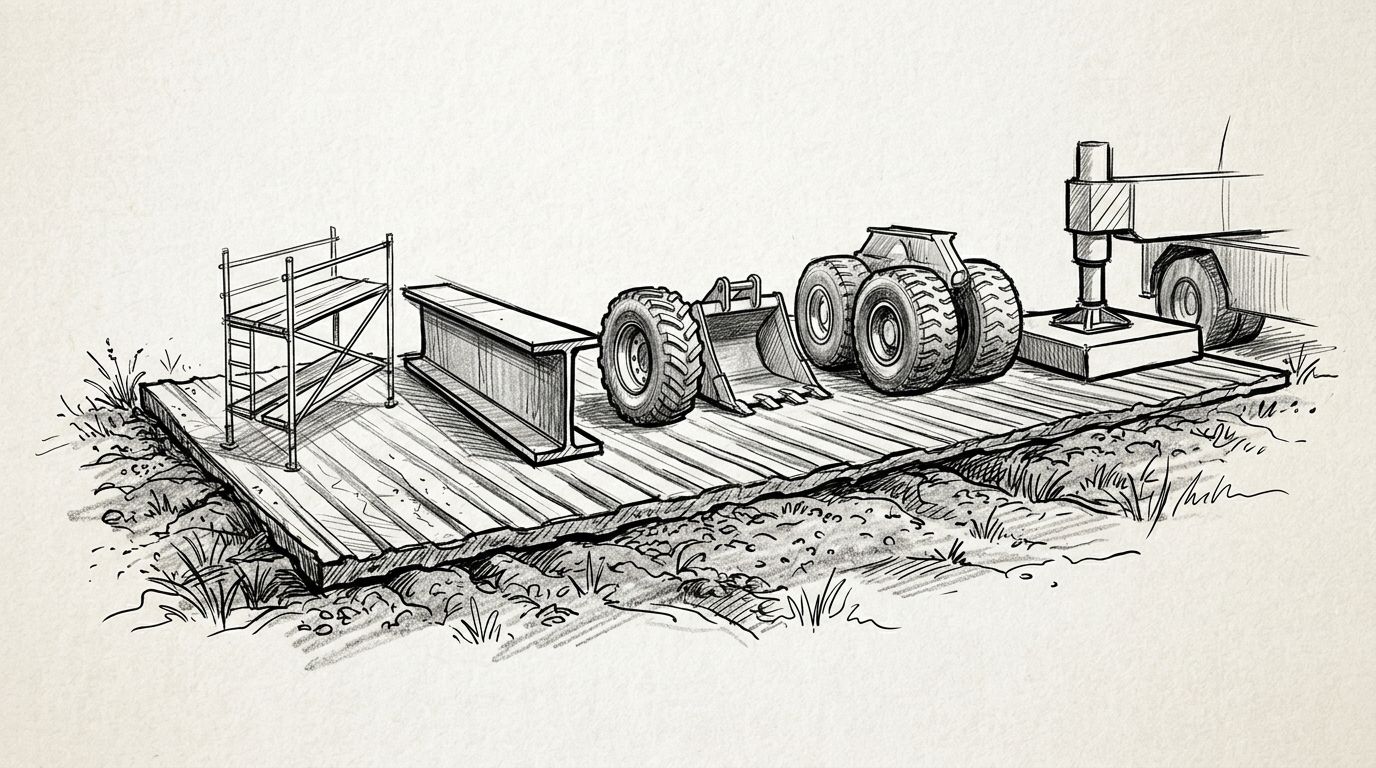
Ground protection mat rental in the Bay Area comes down to one question: how much weight does the mat need to hold before it cracks, sinks, or tears up the ground underneath. This guide ranks the five common mat types by load capacity, from pedestrian trackway to steel road plate, so you match the right mat to the right load on your 2026 job site or event.
- Composite ground protection mats handle most equipment access and event load-ins across the Bay Area in 2026.
- Timber crane mats carry the heaviest point loads, built for crane pads and outrigger support.
- Aluminum trackway suits pedestrian and ADA paths, not equipment traffic.
- Steel road plates cover trenches and legal highway loads, the heaviest option on this list.
- Match ground protection mat rental load capacity to your heaviest piece of equipment, not your lightest.
Why this matters
A mat rated for foot traffic will crack under a scissor lift. A mat rated for a forklift will still dent under a crane outrigger. Get the load capacity wrong and you're either paying for more mat than the job needs or replacing cracked panels mid-project.
Valley Services has run site service rentals out of the same San Jose yard since 1986, and the mat questions look the same on every job: what's rolling over this ground, how heavy is it, and how long does it sit there. Get those three answers before you call, and mat selection takes five minutes instead of a guess.
This matters more in wet months. Bay Area rain turns turf and unpaved lots soft by December, and a mat rated for a light equipment path won't hold a loaded concrete truck. Match capacity to your worst-case load, not your average day.
What makes the best ground protection mat rental
- Load rating matched to your heaviest equipment, not an average across the site
- Panel size and interlock system that create a continuous path without gaps at wheel width
- Surface texture for traction in wet weather, which matters across a Bay Area winter
- ADA-compliant flatness for events with pedestrian and wheelchair traffic
- Delivery, pickup, and placement logistics, including how many panels a crew can lay per hour
- Ground protection that avoids gouging turf or asphalt, which matters for HOA and municipal permit sign-off
Ground protection mats at a glance
| Mat type | Best for | Standout feature | Key limitation |
|---|---|---|---|
| Composite (HDPE) mats | Equipment access, event load-in | Lightweight interlocking panels, fast to place | Not rated for crane outrigger point loads |
| Aluminum trackway | Pedestrian and ADA paths | Flat, rigid surface for wheelchairs and carts | Cracks under vehicle or equipment weight |
| Laminated oak timber mats | Heavy equipment travel lanes | Handles repeated tracked equipment passes | Heavy to place and pick up |
| Timber crane mats | Crane pads and outrigger support | Highest point-load rating on this list | Requires equipment to set and move |
| Steel road plates | Trench covering, highway loads | Rated for legal highway loads over open trenches | Slick when wet, heaviest to handle |
1. Composite ground protection mats: best for equipment access and event load-in
Composite ground protection mats are interlocking HDPE panels that distribute the weight of forklifts, skid steers, scissor lifts, and delivery trucks across turf, gravel, or pavement. They're the mat most Bay Area contractors and event producers reach for first, covered in more detail on Valley Services' ground protection mat page.
Composite mat pros:
- Light enough for a two-person crew to place by hand
- Reusable across jobsite and event work without cracking under repeated equipment passes
- Works on turf, dirt, gravel, and pavement without separate hardware
Composite mat cons:
- Not rated for crane outrigger point loads
- Panels shift at path edges if not pinned down on soft ground
Best for: equipment access paths and event load-in on landscaped ground. Verdict: Buy for general jobsite and event use in 2026.
2. Aluminum trackway: best for pedestrian and ADA event paths
Aluminum trackway is a flat, rigid panel system built for foot traffic, wheelchairs, and carts, not vehicles or heavy equipment. Wedding and festival producers use it to create a level, ADA-compliant path from parking to the event floor.
Aluminum trackway pros:
- Flattest walking surface of any mat on this list
- Meets ADA path-of-travel requirements for guest access
- Low profile, easy for guests to cross without tripping
Aluminum trackway cons:
- Cracks or bends under vehicle or heavy equipment weight
- Limited to pedestrian-load applications only
Best for: guest walkways and ADA paths at outdoor events. Verdict: Buy for events, Skip for any equipment access.
3. Laminated oak timber mats: best for heavy equipment travel lanes
Laminated oak timber mats are thicker and heavier than composite panels, built to take repeated passes from tracked equipment like excavators and dozers moving between staging areas and the active work zone.
Timber mat pros:
- Holds up to repeated tracked equipment traffic better than composite panels
- Handles uneven or soft ground without cracking
- Long service life when picked up and stored between jobs
Timber mat cons:
- Heavier to place and move, usually needs equipment to set
- Not built for the point loads a crane outrigger applies
Best for: equipment travel lanes and staging zones on active construction sites. Verdict: Hold unless your equipment is tracked and heavier than a standard forklift.
4. Timber crane mats: best for crane pads and outrigger support
Thick, bolted oak crane mats carry the highest point loads on this list. They're built specifically to sit under crane outriggers and heavy lift equipment, spreading concentrated weight across a wider footprint so the ground underneath doesn't sink or shift mid-lift.
Crane mat pros:
- Highest rated point-load capacity of any mat type covered here
- Built for the concentrated weight of crane outriggers, not just distributed vehicle traffic
- Stable footing for a stationary lift over hours or days
Crane mat cons:
- Heaviest mat type to deliver, place, and remove
- Overkill and unnecessary cost for standard equipment access
Best for: crane pads, outrigger support, and any lift where the ground can't take a concentrated load. Verdict: Buy only when a crane or comparable heavy lift is staged on site.
5. Steel road plates: best for trench covering and highway loads
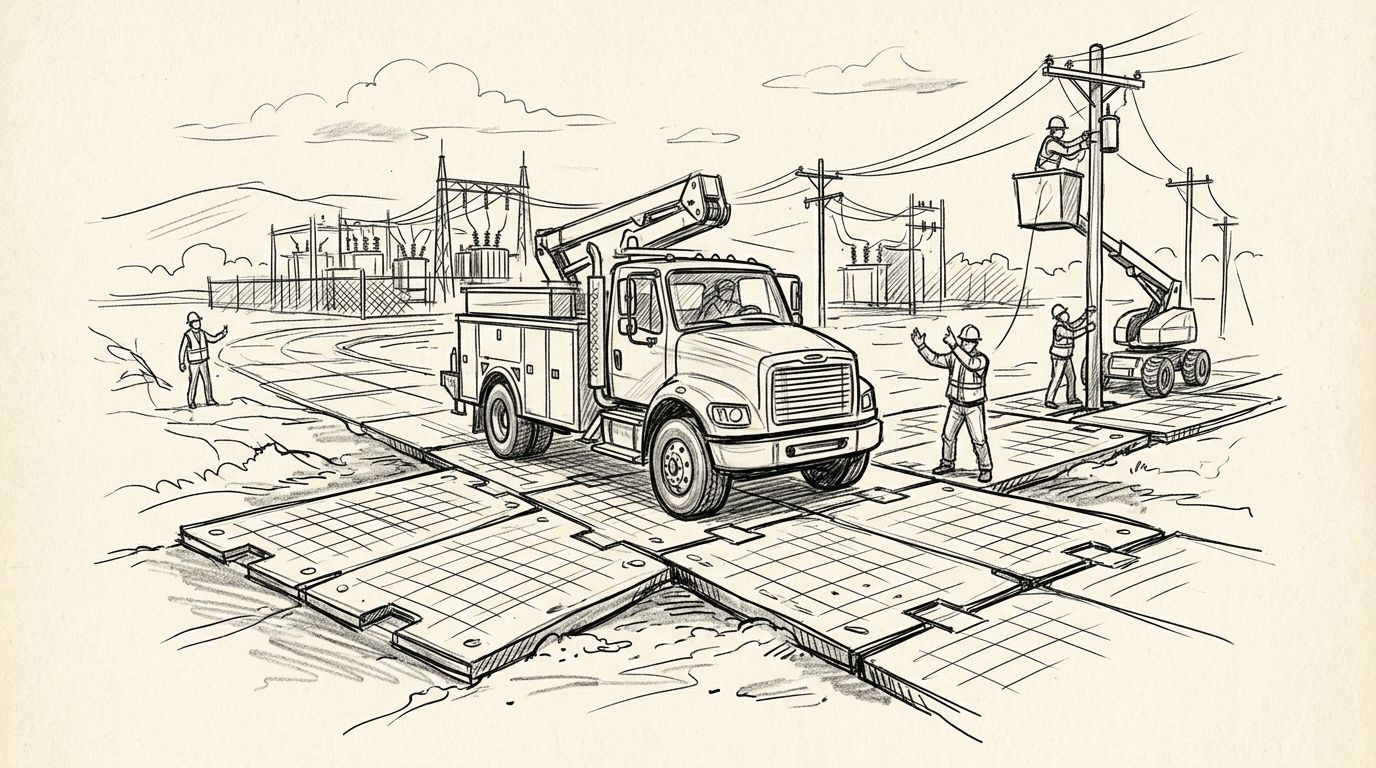
Steel road plates cover open trenches and utility cuts so vehicle and pedestrian traffic can cross safely while work continues underneath. They're rated for legal highway loads, which makes them the standard choice anywhere public traffic crosses an active excavation.
Steel plate pros:
- Rated for legal highway loads over open trenches
- Standard, widely recognized solution for utility and roadway cuts
- Handles continuous vehicle traffic without cracking
Steel plate cons:
- Slick surface in wet weather without traction treatment
- Heaviest option on this list, requires equipment to place and secure
Best for: trench covering and any crossing that carries public vehicle traffic. Verdict: Buy specifically for trench and roadway crossings, Skip for general jobsite ground protection.
How we ranked
Each mat type is ranked against the six criteria above: load rating, panel interlock, traction, ADA flatness, placement logistics, and ground protection. The order runs light to heavy, pedestrian to crane-rated, so you can find your load on the ladder instead of reading five equal options.
Which ground protection mat rental should you choose?
Default to composite ground protection mats if your job site or event involves forklifts, delivery trucks, skid steers, or general foot and cart traffic. That covers most Bay Area contractors and event producers running work in 2026.
Move up to timber crane mats only when a crane or comparable heavy lift is staging on site, and reach for steel road plates only when the mat needs to cover an open trench under vehicle traffic. Aluminum trackway stays in its own lane: pedestrian and ADA paths, never equipment.
Get the right mats for your job
Call to match mat type and panel count to your load before delivery.
FAQ
What's the best ground protection mat rental for a Bay Area construction site in 2026?
Composite HDPE mats cover most equipment access needs in 2026, handling forklifts, skid steers, and delivery trucks across turf, gravel, and asphalt without a crane on site.
How much weight can a ground protection mat hold?
Load capacity depends on mat type. Aluminum trackway is built for foot and wheelchair traffic, composite mats handle rubber-tired equipment access, and timber crane mats carry the point loads of crane outriggers.
Is timber crane mat rental better than composite mat rental?
Timber crane mats carry heavier point loads than composite mats, but they are heavier to place and pick up, so composite is the better fit unless a crane or heavy equipment is staged on site.
Do I need ground protection mats for an outdoor wedding or event in the Bay Area?
Yes, if the event sits on turf or landscaped ground. Guest traffic, catering equipment, and load-in trucks compact and damage grass without matting underneath.
How many ground protection mats does a job site need?
Panel count depends on the length and width of the equipment path, not just the load. Measure the full route from delivery point to work area before ordering.
Can ground protection mats replace temporary fencing on a job site?
No. Mats protect the ground surface, fencing controls site access, and most Bay Area job sites in 2026 need both to pass inspection and keep the site secure.
Is aluminum trackway rated for vehicle traffic?
No. Aluminum trackway is built for pedestrian and ADA foot traffic only and cracks or bends under vehicle or equipment weight.
One last thing
Most contractors mat the straight run and underestimate the turn. The tightest curve in an equipment path needs as much matting as the straight section, because tracked and wheeled equipment pivots at that point and grinds the mat edge if the path narrows. Mat the turns first, then fill the straight sections.
Valley Services has covered site services in San Jose since 1986, third generation, same yard. Call (408) 297-5404 or visit valleyservices.biz to talk through mat type and panel count for your 2026 job or event.