Heavy equipment sinks. Lawns rut, pavers crack, and utility access points get crushed the first time a skid steer or crane outrigger rolls across unprotected ground. Ground protection mats spread that load, and picking the right mat for the job in 2026 comes down to load rating, ground condition, and how fast your crew needs to move them.
- HDPE composite mats rated near 60,000 lbs per axle handle most equipment access routes in 2026: Buy.
- Timber crane mats carry the heaviest point loads under cranes and pile drivers, but weight makes them slow to reposition: Consider.
- Aluminum trackway wins for soft or muddy ground where one worker needs to carry and place mats alone: Consider.
- Steel road plates are the only option rated for public street crossings and traffic loads: Consider for right-of-way work, Skip for lawns.
- Rubber and geotextile combo mats handle foot and light-vehicle traffic only, not heavy equipment access: Skip for construction, Buy for events.
Why this matters
A cracked driveway or a torn-up lawn from a dumpster drop or a crane setup turns into a change order nobody budgeted for. The same logic applies before you prepare the surface for heavy equipment: the ground has to hold the load before the equipment ever shows up.
Ground protection mats aren't optional on turf, unpaved lots, or anywhere a utility line runs shallow. Skip them and you're paying for landscape repair, concrete patching, or a damaged storm drain grate on top of the original job.
Valley Services doesn't stock ground protection mats directly. What Valley Services does run across San Jose, Santa Clara, Sunnyvale, Mountain View, and Milpitas is everything else that access route needs: temporary fencing, K-rail, roll-off containers, and restroom rentals staged around the same equipment path.
How this list is ranked
Each mat type below is ranked on four factors that actually change outcomes on a jobsite in 2026: load rating per axle or point load, ground condition it's built for, install and removal speed, and how it holds up under repeated equipment passes versus a single crane pick. Specs come from standard industry mat construction, not brand claims, since mat rental is a specialty category separate from what Valley Services operates.
The ranked list
1. HDPE composite mats: the workhorse pick
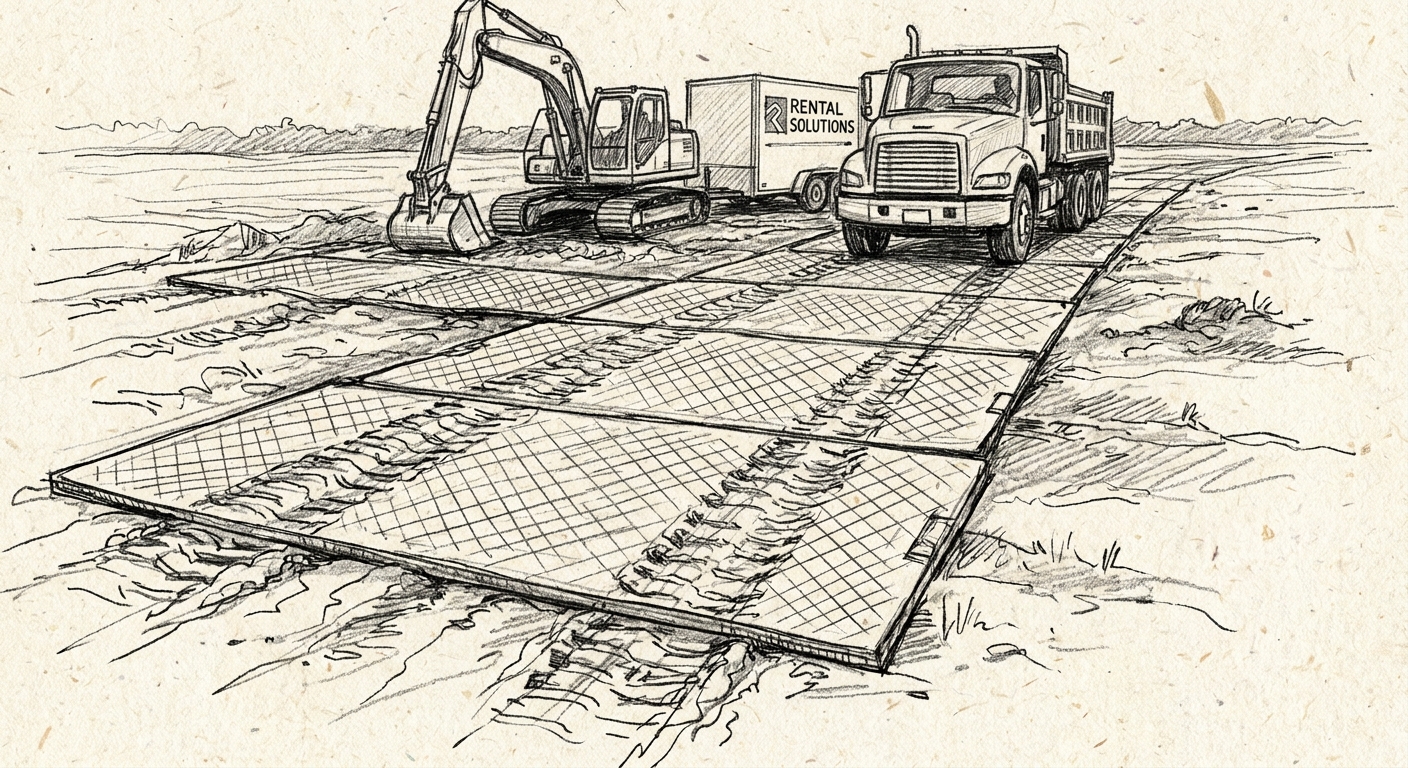
High-density polyethylene mats run 1 to 1.5 inches thick and typically carry rated loads up to 60,000 lbs per axle, enough for excavators, boom lifts, and delivery trucks on compacted soil or gravel. They're lightweight enough for two workers to place by hand and they don't absorb water like timber does.
They underperform on soft, saturated ground where a single mat can still punch through at the edges. Verdict: Buy for standard construction access routes and equipment staging in 2026.
2. Timber crane mats: the heavy-duty pick
Hardwood crane mats, usually 4x8 feet or larger and several inches thick, handle the highest point loads on a site: crane outriggers, pile drivers, and drill rigs. They outlast composite mats under sustained, concentrated weight.
The tradeoff is mass. A single timber mat can require a forklift or crane to reposition, which slows down a fast-moving schedule. Verdict: Consider when you're setting a crane pad or drill rig, Skip for routine equipment travel lanes.
3. Aluminum trackway: the lightweight wildcard
Aluminum trackway panels interlock and one worker can carry a section without machinery. They're built for soft, muddy, or sandy ground where composite mats would still flex too much.
They trade load capacity for portability, so they're not the right call under a stationary crane pad. Verdict: Consider for muddy access lanes and remote drop points, Wait if you're covering a large fixed staging pad instead of a travel path.
4. Steel road plates: the traffic-rated pick
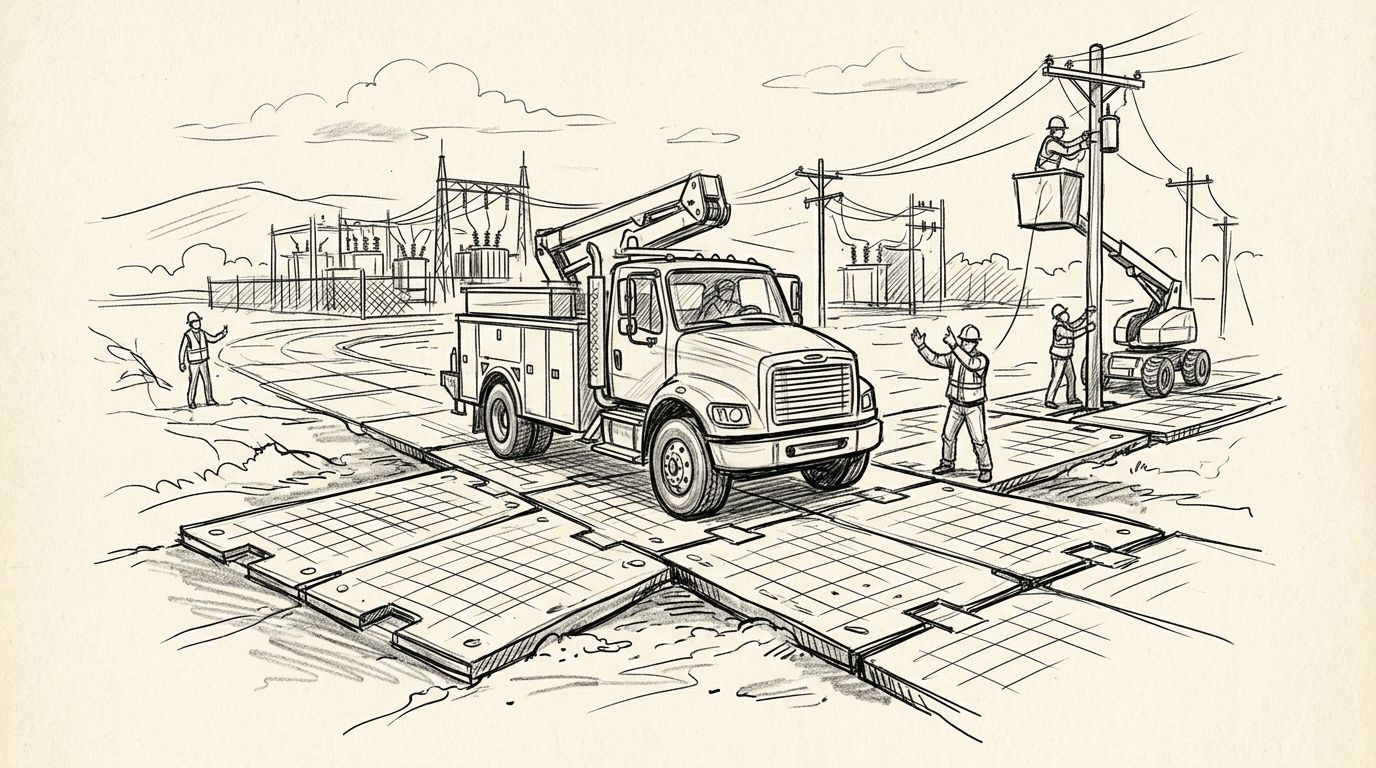
Steel plates are the only mat type rated for public street crossings under H-20 traffic loads, which matters when a trench or excavation crosses a road or driveway open to vehicle traffic. Municipalities in Santa Clara County typically require them for any open cut in a public right-of-way.
They're heavy, loud under traffic, and expensive to move without a plate hook and machine. Verdict: Consider for street and right-of-way crossings, Skip for lawns, landscaping, or interior lot work where they're overkill.
5. Rubber and geotextile combo mats: the budget pick
These mats handle foot traffic, ATVs, and light vehicles, and they're common at outdoor events and film sets rather than construction. They roll up flat for storage and transport easily in a pickup bed.
They are not rated for excavators, boom lifts, or loaded delivery trucks, and equipment will punch through them on soft ground. Verdict: Buy for pedestrian paths and light-duty events, Skip entirely for equipment access on an active jobsite.
Comparison table
| Mat type | Thickness/size | Load rating | Best use | Verdict |
|---|---|---|---|---|
| HDPE composite | 1-1.5 in | Up to 60,000 lbs/axle | General equipment access, staging | Buy |
| Timber crane mat | 4x8 ft, several inches | High point load | Crane pads, pile drivers | Consider |
| Aluminum trackway | Interlocking panels | Moderate | Soft, muddy, or remote ground | Consider |
| Steel road plate | Varies, H-20 rated | Highway traffic load | Street and right-of-way crossings | Consider |
| Rubber/geotextile | Rolled, thin | Light vehicle only | Foot traffic, events | Buy for events, Skip for equipment |
Where to source ground protection mats
Rent from a specialty ground protection supplier, not a general equipment yard. Mat rating and mat condition vary by vendor, and a worn composite mat with cracked ribs won't carry its rated load.
Match the mat rating to your heaviest axle weight, not your equipment's gross weight. A 40,000 lb excavator can still put more than 20,000 lbs on a single axle during a turn, which is where mats fail at the seams.
Coordinate mat delivery with the rest of your site services so the access route is protected before anything else rolls in. If you're staging containers, fencing, and restrooms on the same jobsite, plan site services across phases so the mat route, the fence line, and the container pad don't conflict once equipment starts moving.
“Match the mat rating to your heaviest axle weight, not the equipment's total weight.”
Once the ground is protected, the rest of the site still needs boundaries and access control. Valley Services can set up temporary fencing around the mat route and the equipment staging area on the same call as your container and restroom order.
Line up the rest of your site services
Fencing, K-rail, containers, and restrooms for San Jose and South Bay jobsites.
FAQ
What is the best ground protection mat rental for equipment access in 2026?
HDPE composite mats rated near 60,000 lbs per axle cover most equipment access routes in 2026. Timber crane mats take over for crane pads and other concentrated point loads.
How thick should a ground protection mat be for an excavator?
Most HDPE composite mats used under excavators run 1 to 1.5 inches thick. Thickness alone doesn't tell the whole story: check the axle load rating printed on the mat spec sheet.
Are timber mats better than composite mats?
Timber mats carry higher point loads and hold up better under a stationary crane pad. Composite mats are lighter, easier to move by hand, and better suited to routine equipment travel lanes.
Do I need permits for ground protection mats in San Jose?
Mats themselves typically don't require a permit, but any excavation, dumpster placement, or fencing tied to the same job often does. Check with the city before work starts.
Can steel plates be used on a residential driveway?
Steel plates are built for street and right-of-way traffic loads, which is overkill and hard to maneuver on a residential driveway. HDPE composite mats are the better fit for that scale of access.
How many mats do I need to protect an equipment access route?
It depends on the length and width of the travel lane, but most crews overlap mat edges by at least 6 inches at turns to keep equipment from catching a gap. Measure the full route before ordering.
Does Valley Services rent ground protection mats?
Valley Services doesn't stock ground protection mats. Valley Services does run temporary fencing, K-rail, roll-off containers, and restroom rentals around the same access route in San Jose and the South Bay.
What ground protection is used for events instead of construction equipment?
Rubber or geotextile combo mats handle foot traffic and light vehicles at outdoor events. They're not rated for excavators, boom lifts, or loaded trucks, so they stay out of active construction use.
One last thing
Most mat failures trace back to the seams, not the mat material itself. Overlap edges by at least 6 inches on every turning radius and re-check the overlap after the first few equipment passes, since traffic works mats apart faster on a curve than on a straight run.
For everything else on that jobsite, call Valley Services at (408) 297-5404 or visit valleyservices.biz to line up fencing, K-rail, containers, and restrooms around your access route.