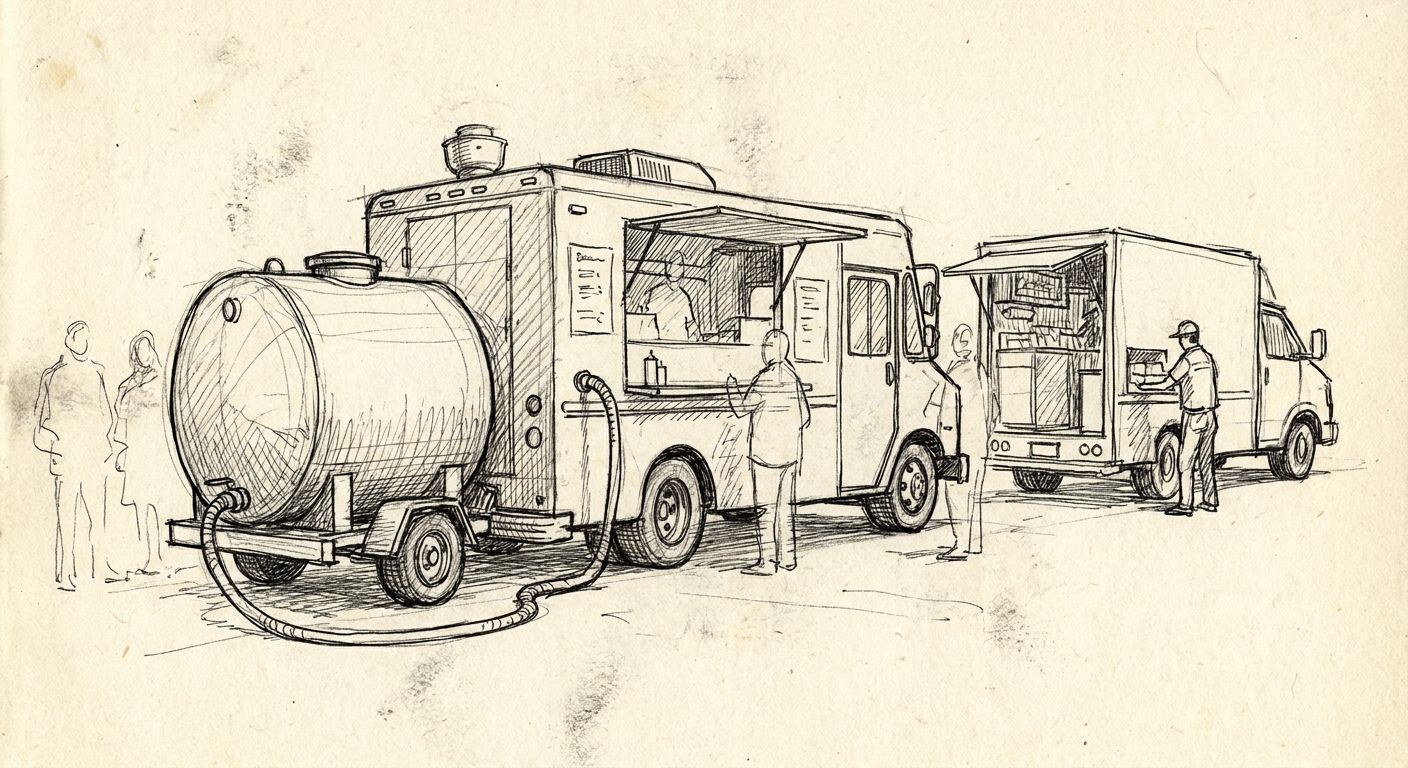
A food truck running lunch service five days a week generates gray water fast: fryer oil rinse, prep sink runoff, handwashing discharge. Get the holding tank size wrong and you're either paying for pump-outs you don't need or shutting down mid-shift because the tank filled at 1 p.m. This guide ranks the holding tank rental setups that actually match how food trucks operate in 2026, from the daily single-truck pick to the multi-vendor event tank.
- A 65-gallon single holding tank covers one food truck running daily lunch service, buy it for solo operators.
- A 200-gallon dual tank system is the right call for food truck rallies with four or more vendors sharing a lot.
- Skip a shared community tank with no dedicated pump schedule; overflow risk during peak service is real.
- Best holding tank rental for food trucks in 2026 pairs tank size to service days per week, not truck size.
- A hand wash station rental is required alongside the holding tank for most health department food truck permits.
Why this matters
A holding tank rental isn't a generic accessory you bolt onto a food truck permit checklist. Health departments in the Bay Area check gray water containment before they check anything else on inspection day, and a tank that runs out of capacity mid-shift means a truck that can't serve until it's pumped. Valley Services has run site service rentals out of the same San Jose yard since 1986, and the calls that come in from food truck operators almost always trace back to one mistake: sizing the tank to the truck instead of the schedule.
The difference between a smooth service day and a shutdown isn't the truck. It's whether the holding tank matches how many days a week you're running and how many trucks are sharing the lot.
How this list is built
Each pick below is ranked by how food trucks actually operate: solo daily service, multi-truck rallies, seasonal markets, and shared lots. Every entry names a specific tank configuration, states what it's built for, and closes with a plain verdict. No pricing is listed here because rates vary by service frequency and site access; call to confirm current terms.
The ranked list
1. The daily grind pick: 65-gallon single holding tank
Built for one truck running lunch service five days a week. A 65-gallon holding tank paired with a compact restroom handles a full day of fryer rinse water and prep sink discharge without the truck going down mid-shift.
The number that matters: 65 gallons covers a standard single-truck lunch rush before the tank needs a pull. Push past that and you're either pumping mid-week or risking a discharge valve backup right at the counter window.
Verdict: Buy. This is the default for any solo food truck on a five-day schedule.
2. The multi-truck event pick: 200-gallon dual tank system
Food truck rallies and lot events with four or more vendors need shared capacity that doesn't run dry by 1 p.m. A 200-gallon dual tank system, split between fresh water supply and gray water holding, handles the volume a rally generates without every truck hauling its own unit.
Pairing this with a food truck event restroom rental covers both the vendor side and the crowd side of a rally in one call, which matters when a producer is coordinating five or six vendors on one lot.
Verdict: Buy. Right sizing for anything past two trucks on the same site.
3. The compliance pick: hand wash station paired with the holding tank
Most health departments won't sign off on a food truck permit without a dedicated hand wash station separate from the prep sink discharge. Pairing a hand wash station rental with the holding tank keeps that discharge on its own line instead of overloading the truck's built-in gray water capacity.
This is the setup inspectors look for first, before they look at anything else on the truck.
Verdict: Buy. Treat this as a permit requirement, not an add-on.
4. The shared community tank
Some food truck parks run all vendors into one undersized tank with no dedicated pump schedule. It looks efficient on paper. In practice, one truck running a busy lunch can fill shared capacity before the other four even open, and nobody controls when the pump-out happens.
Verdict: Skip. A shared tank without a scheduled pump-out is the single most common cause of a mid-service shutdown at multi-vendor lots.
5. The seasonal pick: insulated holding tank
Bay Area nights in late fall and winter markets can dip close to freezing, and an uninsulated discharge line will freeze solid overnight, backing up gray water into the truck by morning setup. An insulated or winterized tank keeps the line clear through cold overnight stretches at outdoor winter markets.
Verdict: Consider. Only needed for events running through the colder months; skip it for spring and summer bookings.
Comparison table
| Pick | Capacity | Best for | Verdict |
|---|---|---|---|
| Single holding tank | 65 gallons | Solo truck, daily lunch service | Buy |
| Dual tank system | 200 gallons | Multi-truck rally, 4+ vendors | Buy |
| Hand wash station pairing | Separate line | Health department permit compliance | Buy |
| Shared community tank | Varies, unscheduled | Not recommended | Skip |
| Insulated tank | 65-200 gallons | Late-fall and winter markets | Consider |
Where to rent
- Size the tank to service days per week, not truck footprint. A truck running weekends only needs less capacity than one running five lunch shifts.
- Confirm the pump-out schedule before the event books, not the morning of. A tank with no pull scheduled is a shutdown waiting to happen.
- Ask whether the rental company controls its own disposal endpoint or hauls to a third-party site. Valley Services operates its own C&D transfer station in San Jose, which means the schedule doesn't depend on someone else's dump slot.
Line up your tank before the next event
Call to size a holding tank against your actual service schedule.
FAQ
What is the best holding tank rental for food trucks in 2026?
A 65-gallon single holding tank fits one truck running daily lunch service, while a 200-gallon dual tank system fits multi-vendor rallies. Match the tank to how many service days per week the truck runs, not the truck's size.
How often does a food truck holding tank need to be pumped?
A single-truck tank sized to daily lunch volume typically needs a pull once or twice a week, depending on service days. Confirm the pump schedule before the tank is placed so the truck never runs to capacity mid-shift.
Is a shared community tank a good option for food truck parks?
No, a shared tank without a dedicated, scheduled pump-out is the most common cause of mid-service shutdowns at multi-vendor lots. A dual tank system with its own schedule performs better for four or more trucks.
Do food trucks need a hand wash station separate from the holding tank?
Most health departments require a dedicated hand wash station on a separate discharge line from the prep sink. Pairing a hand wash station rental with the holding tank keeps the truck compliant on inspection day.
What size holding tank does a single food truck need?
A 65-gallon holding tank covers a standard single-truck lunch service running five days a week. Trucks running fewer days or lighter menus can often run smaller, but 65 gallons is the safe daily-service baseline.
Do food truck holding tanks need winterizing in the Bay Area?
Yes, for events running through late fall and winter, an insulated tank keeps the discharge line from freezing overnight. Skip the insulated setup for spring and summer bookings.
How does Valley Services handle food truck holding tank rentals?
Valley Services sizes holding tanks to a truck's actual service schedule and pairs them with restroom or hand wash station rentals when a permit requires it. The company has operated its own San Jose yard since 1986.
What's the difference between a fresh water tank and a gray water holding tank?
A fresh water tank supplies clean water into the truck for prep and hand washing, while a gray water holding tank stores used discharge until pump-out. A dual tank system runs both on separate lines.
One last thing
The detail most food truck operators miss isn't tank size, it's who controls the pump-out. A rental company that hauls to a third-party disposal site is at the mercy of that site's schedule, which is how a Friday pump-out slips to Monday. Valley Services runs its own transfer station in San Jose, so the pull happens on the schedule the truck needs, not whatever slot a broker can get.
Call (408) 297-5404 or visit valleyservices.biz to size a holding tank against your actual service days before the next booking.