Best overall: 6-foot chain link fence panels for general perimeter security. Best for backstage and vendor privacy: chain link panels with green privacy screening. Best for vehicle lanes and traffic separation: K-rail concrete barrier. Best for queue lines and stage-front crowd control: pedestrian barricade panels. Best for dust and wind exposure on open fairgrounds: windscreen fence.
- Temporary fencing for county fair events works best as a mix, not one product: chain link for perimeter, K-rail for vehicle lanes, screening for backstage.
- 6-foot chain link panels are the default perimeter choice for 2026 county fair season because they stand without digging or concrete.
- K-rail replaces fencing anywhere vehicles and pedestrians share a route, including load-in lanes and vendor parking.
- ADA walkways need a minimum 36-inch clear gap built into the fence line before the site plan gets submitted for inspection.
- Valley Services runs fencing, restrooms, and roll-off containers off the same San Jose yard, so one call covers the whole fairground.
Why this matters
A county fair site plan gets reviewed before gates open, and the fence line is usually the first thing a fire marshal or code inspector walks. Get the wrong fence type in the wrong spot and you're re-anchoring panels the morning of opening day, in front of vendors who already set up.
Fair boards and event producers juggle five site-service categories at once: perimeter security, vehicle separation, crowd control at gates, dust control on open lots, and backstage privacy. Most rental yards hand you one fence type and let you sort out the rest. Valley Services runs fencing alongside roll-off containers and restroom rentals out of the same San Jose yard, which matters when a fairgrounds contract has one delivery window and one contact number.
This guide ranks five temporary fencing rental types by the job each one actually does on a fairground, not by which one sounds most impressive on a spec sheet.
What makes the best temporary fencing for county fair events
- Panel height and wind load stability on open lots where gusts hit exposed midways
- Anchoring method that works on turf, asphalt, and gravel parking without core drilling
- ADA-compliant gaps built into the run at regular intervals, not added as an afterthought
- Screening options for sightline control behind stages and around vendor prep areas
- Vehicle and pedestrian separation at load-in gates and emergency access lanes
- Load-in and load-out speed that fits a fair's setup and teardown window
At a glance: temporary fencing for county fair events in 2026
| Fence type | Best for | Standout feature | Key limitation |
|---|---|---|---|
| Chain link panels (6-ft) | General perimeter security | Freestanding, no digging or concrete | No privacy or wind block on its own |
| Chain link with privacy screening | Backstage and vendor areas | Blocks sightlines, cuts wind-driven dust | Higher wind load, needs closer anchor spacing |
| K-rail concrete barrier | Vehicle lanes and traffic separation | Holds a line by weight alone | Not built for foot-traffic zones, slow to reposition |
| Pedestrian barricade panels | Queue lines and stage-front crowd control | Fast to reconfigure between acts and sets | Not rated as full perimeter security |
| Windscreen fence | Dust and wind exposure on open lots | Cuts dust drift across midways and food courts | Carries the highest wind load of any option here |
1. Chain link fence panels: best temporary fencing for general perimeter security
Standard 6-foot chain link panels are the workhorse of any fairgrounds perimeter. Panels stand on portable feet, link together without tools, and cover long straight runs fast, which matters when a crew has a single afternoon to fence a fairgrounds lot before vendor trucks arrive.
Chain link fence panel pros:
- Installs without digging, drilling, or concrete footings
- Covers long perimeter runs at a consistent height
- Reconfigures easily around gates, first-aid tents, and admission booths
- Holds up through a multi-day fair run without daily maintenance
Chain link fence panel cons:
- Offers no privacy or sightline control by itself
- Panels can be walked or climbed without added screening or height
- Bare wind load means loose gravel ballast can shift in a hard gust
Chain link is the fence a fairgrounds site plan defaults to for a reason: it satisfies a basic perimeter security requirement without turning into an engineering problem. Chain link fence panel rental for crowd control covers spacing and gate placement in more detail.
Best for: the outer perimeter line around any general-admission fairgrounds footprint.
Verdict: rent it as the default. Every other fence type on this list gets added on top of a chain link perimeter, not instead of it.
2. Chain link with privacy screening: best for backstage and vendor areas
Green privacy screening clips onto standard chain link panels and blocks the view into backstage, staging, and vendor prep zones. It also cuts wind-driven dust off unpaved fairgrounds lots, which matters for food vendors running open prep stations.
Privacy screening pros:
- Blocks sightlines into backstage and staging without a permanent structure
- Reduces dust drift into food vendor and prep areas
- Attaches to existing chain link runs, no separate fence system needed
Privacy screening cons:
- Adds wind load, so anchor spacing needs to tighten up compared to bare chain link
- Not a security upgrade by itself, just a sightline and dust barrier
Best for: backstage, greenroom, and vendor prep zones that need visual privacy, not additional security height.
Verdict: add it wherever a camera or a curious kid could see something the fair doesn't want visible. Skip it on open perimeter runs where wind exposure is already a concern.
3. K-rail concrete barrier: best for vehicle lanes and traffic separation
K-rail is concrete, not fence panel, and it does a job chain link can't: it stops a vehicle. Fairgrounds load-in lanes, vendor delivery routes, and any spot where trucks and pedestrians share pavement call for K-rail instead of a panel system.
K-rail pros:
- Holds a traffic line by weight, no anchoring required into pavement
- Withstands vehicle contact in a way fence panels can't
- Works on asphalt without drilling or surface damage
K-rail cons:
- Heavy to place and reposition once a layout is set
- Not appropriate for pedestrian perimeter zones, it reads as a traffic barrier, not a fence
Best for: load-in lanes, vendor delivery routes, and any point where vehicles and foot traffic cross on the same fairgrounds footprint.
Verdict: rent it specifically for vehicle lanes. Don't substitute it for perimeter fencing anywhere pedestrians need a climbable-height barrier instead of a traffic wall.
4. Pedestrian barricade panels: best for queue lines and stage-front crowd control
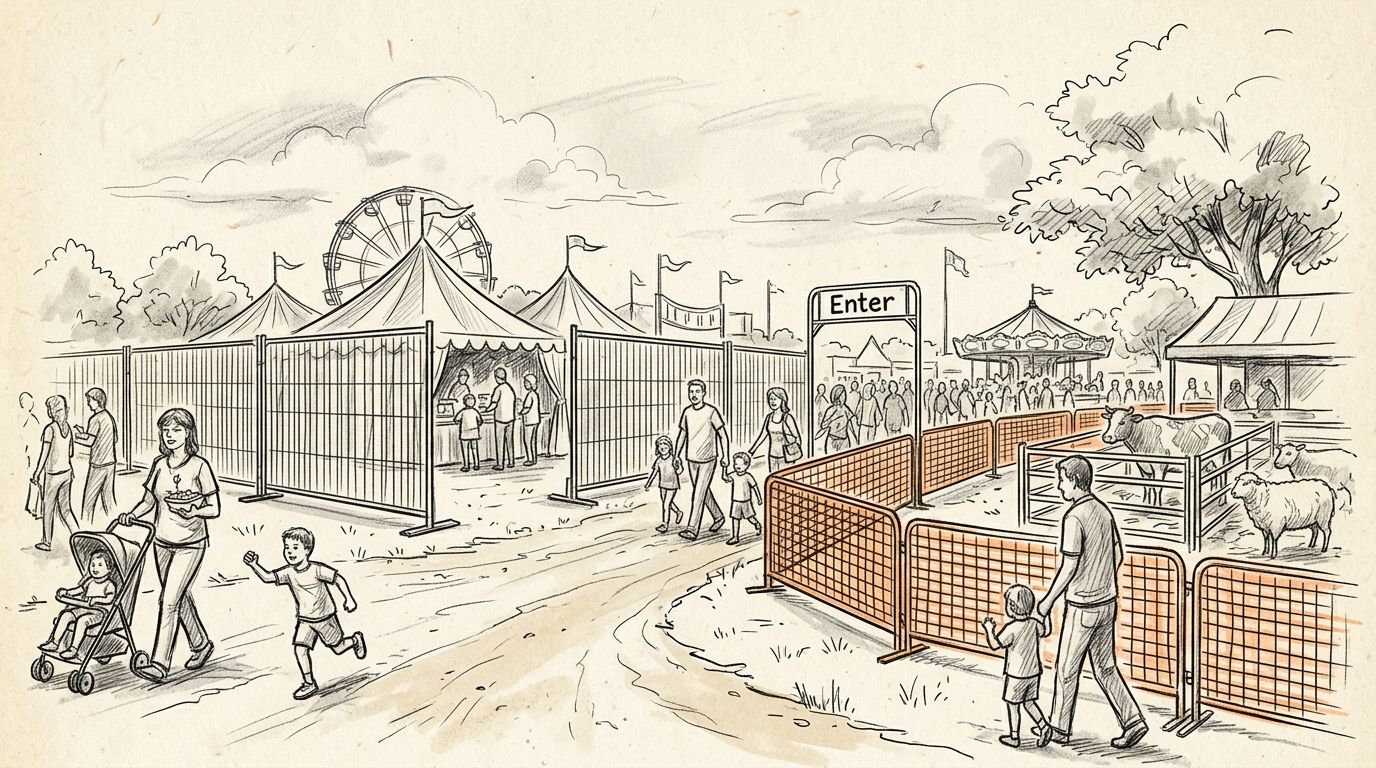
Barricade panels handle a different problem than perimeter fencing: managing where a crowd stands, not keeping people off the property. Ticket lines, stage-front pits, and beer garden entries all run on barricade panels because they reconfigure fast between shows.
Barricade panel pros:
- Reconfigures quickly between acts, sets, or daily schedule changes
- Lower profile than perimeter fencing, doesn't block sightlines to a stage
- Simple to stage in short runs for queue management
Barricade panel cons:
- Not rated as security fencing, it won't stop someone determined to get through
- Requires more linear footage than perimeter fence for the same footprint since it's used to shape lines, not enclose a lot
Best for: ticket queues, stage-front crowd management, and beer garden or age-restricted area entries.
Verdict: rent it for crowd flow, not security. Pair it with chain link wherever the boundary also needs to keep people out entirely.
5. Windscreen fence: best for dust and wind exposure on open fairgrounds
Windscreen fence is a mesh fabric system built to cut wind and dust across open lots, the kind of exposed asphalt or gravel footprint common to county fairgrounds outside a stadium or arena. It reduces dust drift across midways and food courts more aggressively than standard privacy screening.
Windscreen fence pros:
- Cuts dust drift significantly on exposed midways and parking lots
- Reduces wind exposure for food vendors and tented booths
- Works on the same panel infrastructure as chain link runs
Windscreen fence cons:
- Carries the highest wind load of any option in this list, which means the tightest anchor spacing requirement
- Not needed on fairgrounds with existing wind breaks like buildings or grandstands
Temporary fencing for outdoor events covers wind load anchoring in more depth for fully exposed sites.
Best for: open fairgrounds lots with no existing structures to block wind, especially food court and midway zones.
Verdict: rent it only on genuinely exposed lots. Skip it on fairgrounds with grandstands, buildings, or tree lines already breaking the wind.
How we ranked these
Each fence type above was scored against the six criteria listed earlier: panel height and wind stability, anchoring method, ADA gap compliance, screening capability, vehicle and pedestrian separation, and load-in speed. No single fence type wins on all six, which is the point. A county fair fence plan is a combination of at least three of these five types, not a single product decision.
Which temporary fencing should you choose?
For most Bay Area county fair sites in 2026, the default plan is 6-foot chain link for the full perimeter, K-rail at every vehicle lane and load-in point, and privacy screening added behind stages and vendor prep zones. Add windscreen fence only where the lot has no existing wind break, and pedestrian barricade panels wherever ticket lines or stage-front crowds need shaping.
The ADA gap requirement, a minimum 36-inch clear walkway at regular intervals, gets built into the perimeter plan from the start, not retrofitted after an inspector flags it. Valley Services has run fencing and crowd control for large-scale events including Super Bowl LX and the San Jose Marathon, and the same combination logic applies at fairgrounds scale: perimeter first, then vehicle separation, then privacy and wind control layered on top.
Plan your fair's fence line
Talk through perimeter, K-rail, and screening needs before your site plan goes in.
FAQ
What's the best temporary fencing for a county fair event?
6-foot chain link fence panels handle the general perimeter for most county fairs. Vehicle lanes need K-rail instead, and backstage or vendor areas get privacy screening added to the chain link run.
Is K-rail better than chain link fencing for fairgrounds?
K-rail and chain link do different jobs, so one doesn't replace the other. K-rail stops vehicles at load-in lanes, while chain link handles the pedestrian perimeter around the fairgrounds footprint.
How much fencing does a county fair need?
Fencing needs scale with the fairgrounds perimeter length plus any interior vehicle lanes and backstage zones. A site walk before the event determines the exact linear footage and gate placement.
Does temporary fencing for events need to be ADA compliant?
Yes. Fair site plans typically require a minimum 36-inch clear walkway gap in the perimeter at regular intervals so wheelchair and stroller access isn't blocked.
Can privacy screening be added to any chain link fence rental?
Yes, privacy screening clips directly onto standard chain link panels. Adding it increases wind load, so anchor spacing on that section usually needs to tighten up.
What's the difference between windscreen fence and privacy screening?
Windscreen fence is built specifically to reduce wind and dust drift on exposed lots, while privacy screening is primarily a sightline block. Windscreen carries a higher wind load and needs tighter anchoring.
Who delivers temporary fencing for county fairs in the Bay Area?
Valley Services delivers fencing, K-rail, restrooms, and roll-off containers to fairgrounds across San Jose, Santa Clara, Sunnyvale, Mountain View, and Milpitas from its San Jose yard.
How far in advance should fencing be booked for a fair?
Booking early in the planning cycle protects the delivery window against other event and construction demand in the same weeks. Call ahead of the site plan submission so fence layout and inspection timing line up.
One last thing
Most fence line deficiencies flagged on a pre-opening site walk aren't about the wrong fence type, they're about gaps: an unanchored panel, a missing ADA break, or a vehicle lane left without K-rail where foot traffic crosses it. Walk the full perimeter against the site plan before the inspector does, not after.
Valley Services has operated its San Jose yard since 1986, now in its third generation, and fields fencing, restroom, and roll-off container requests for fairgrounds and large public events across the Bay Area. Call (408) 297-5404 or visit valleyservices.biz to talk through a fence layout before your next fair's site plan is due.