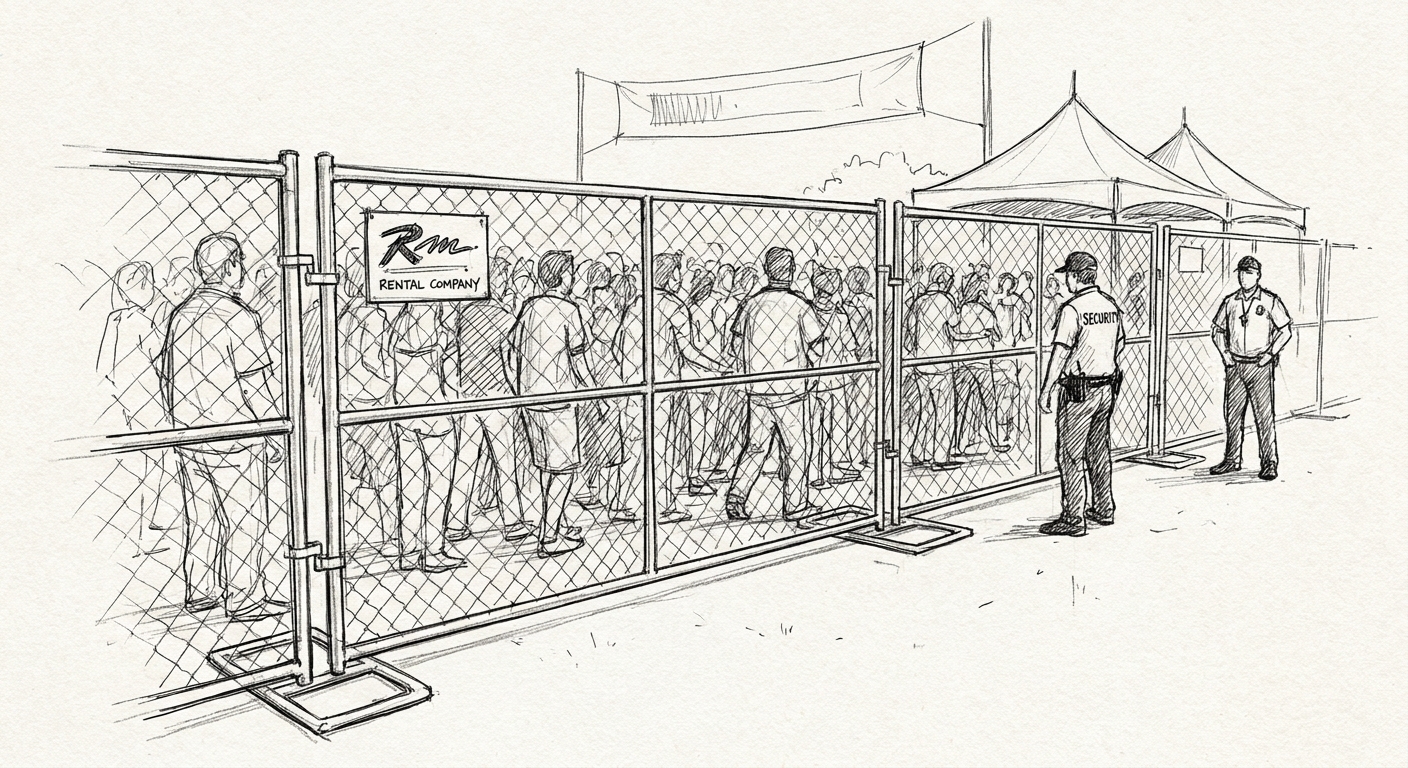
Event producers running festivals, marathons, or ticketed venues in San Jose and the South Bay need chain link fence panel rental for crowd control that stands up to wind, blocks sightlines where required, and lands on site before load-in deadlines. This guide breaks down what to book, what to skip, and how a fencing package holds a perimeter for a one-day event versus a multi-week installation.
- Standard 6-foot chain link panels with rubber feet cover most event perimeters in 2026: buy the package.
- Wind mesh screening cuts gust load but needs extra ballast: book it for open lots, skip it in wind tunnels between buildings.
- ADA-compliant gaps every 200 to 300 feet are non-negotiable for permitted events in San Jose.
- Chain link fence panel rental crowd control jobs under 48 hours still need the same lead time as a week-long run.
Why this matters
A fence line that looks fine on paper falls over in a gust off the Bay if the base weight is wrong. Crowd control fencing isn't decoration. It's the line between a controlled gate and a fire marshal shutting the event down.
Most rental catalogs list one panel type and call it done. Temporary fencing for outdoor events works differently at a farmers market than it does at a 10,000-person concert, and the difference shows up in base weight, gap spacing, and how fast the crew can strike it after load-out.
Valley Services runs containers, restrooms, and fencing off the same yard on 7th Street in San Jose. One call covers the perimeter fence, the restroom count, and the debris container for load-out, which matters when your event window is four hours long and every vendor on site has its own delivery clock.
Who this is for
This guide is for event producers, venue managers, and municipal event staff planning fenced perimeters for festivals, races, concerts, or community events in the Bay Area. If you're securing a construction site instead of an event, the panel math changes: check temporary fencing for construction sites for that use case.
What to look for in chain link fence panel rental for crowd control
Panel height and mesh gauge
Six-foot panels are standard for general crowd lines and hold back foot traffic without blocking sightlines from adjacent streets. Anything shorter invites climbers at a ticketed gate. Anything taller slows load-in and adds weight the crew has to move twice.
Base type and wind bracing
Rubber base feet work for short runs on paved lots. Open fields and waterfront sites in 2026 still see gusts that tip unweighted panels, so sandbag or water-filled base kits matter anywhere the fence runs more than 100 feet without a building to break the wind.
Sightline and privacy screening
Open chain link is fine for a general perimeter. VIP areas, backstage zones, and ticket-scan lanes need mesh or fabric screening clipped to the panel face so the crowd outside can't see through and crowd against the line trying to.
ADA-compliant gaps and emergency egress
Every permitted event in San Jose needs accessible gaps in the fence line, spaced roughly every 200 to 300 feet, wide enough for a wheelchair and clear of cable runs. Fire marshals check this on walkthrough. Missing gaps get flagged before the gates open.
Delivery lead time and load-in access
A one-day festival still needs the same delivery window as a week-long build: trucks need curb access, a place to stage panels before placement, and a load-out plan that doesn't fight the same crowd the fence just held back. Confirm access hours with the venue before booking, not after the truck shows up.
Fencing packages that work for crowd control
Standard 6-foot chain link perimeter, the workhorse. Ten-foot panel sections, rubber base feet, standard clip connections. Covers a straight perimeter run fast and strikes just as fast after load-out. Buy this for any general-admission event perimeter under 2,000 attendees.
Wind mesh screen add-on, the sightline fix. Same 6-foot panel, mesh fabric clipped to the face, sandbag ballast doubled at every joint. Cuts visibility through the line and cuts wind load at the same time, but the extra ballast weight slows the crew. Buy for VIP zones and backstage lines, skip it for a general perimeter where sightlines don't matter.
K-rail plus fencing combo, the vehicle separation. Concrete K-rail sets the vehicle barrier, fence panels sit on top or behind it for the pedestrian line. This is the setup for any site with vehicle load-in crossing a pedestrian path. Buy it whenever trucks and foot traffic share a route during the event.
Gated ADA sections, the accessibility fix. Swing-gate panels dropped into the standard run every 200 to 300 feet, wide enough for wheelchair access and marked for staff. Skipping this is the single most common permit rejection Valley sees on event walkthroughs. Buy, every time, on any permitted event.
For multi-day builds or anything running longer than two weeks, review setting up temporary fencing correctly before the crew shows up, since ground conditions change how the base kit gets anchored.
What to avoid
Residential-grade fencing borrowed from a hardware store rental counter. It looks like the same chain link, but the gauge is lighter and the panels aren't rated for the gust loads a 2026 outdoor event sees off an open lot.
Unweighted panels on any run over 100 feet. A single gust takes down a whole section, and once one panel goes, the crowd treats the gap as an open gate.
Skipping the ADA gap count to save panels. It reads as fewer feet of fence on the invoice and reads as a permit denial on the walkthrough.
Verdict comparison table
| Package | Height | Base type | Best for | Verdict |
|---|---|---|---|---|
| Standard 6-ft chain link | 6 ft | Rubber feet | General perimeter | Buy |
| Wind mesh screen add-on | 6 ft | Doubled sandbag | VIP/backstage lines | Buy for screened zones |
| K-rail plus fencing | 32-42 in rail, 6 ft fence | Concrete + rubber | Vehicle/pedestrian split | Buy |
| Gated ADA sections | 6 ft | Rubber feet | Permit compliance | Buy |
| Hardware-store fencing | Varies | Light/none | Nothing at scale | Skip |
Book your event perimeter
Call (408) 297-5404 or reach out online to plan panel counts and load-in access.
FAQ
What is the standard height for chain link fence panel rental crowd control?
Six-foot panels are standard for event crowd control in the Bay Area in 2026. Ten-foot sections cover more ground per panel, which speeds load-in on tight event windows.
How far apart should ADA gaps be in an event fence line?
Space accessible gaps roughly every 200 to 300 feet along the perimeter. San Jose fire marshals check gap spacing and width on the pre-event walkthrough.
Is chain link fencing or K-rail better for vehicle separation at events?
K-rail alone stops vehicles but doesn't stop pedestrians from stepping around it. A K-rail plus chain link fence combo handles both, and it's the standard setup when trucks and foot traffic share a route.
Do event fence panels need sandbags or water ballast?
Any run over 100 feet on an open lot needs sandbag or water-filled base kits. Rubber feet alone hold on paved, wind-sheltered sites but not on open fields near the Bay.
How much lead time does chain link fence panel rental crowd control need?
Confirm delivery and load-in access at least a week ahead for standard events. Multi-phase builds or sites with limited truck access need more lead time regardless of how short the event itself runs.
Can privacy screening be added to rented chain link panels?
Yes. Mesh or fabric screening clips directly to the panel face and works for VIP zones, backstage areas, or any line where sightlines need to be blocked.
What happens if a fence panel doesn't have enough base weight?
A single gust can tip an unweighted panel, and once one section goes down the crowd treats the gap as an open gate. Doubled ballast at every joint fixes this on exposed runs.
One last thing
The permit rejection Valley sees most often on event walkthroughs in 2026 isn't a wind or height issue. It's a missing ADA gap, caught by the fire marshal minutes before gates were set to open, on a fence line that otherwise looked correct.
Build the gap count into the panel order from day one instead of adding it after a walkthrough flag. It's cheaper in time than in panels.
Call (408) 297-5404 or reach out through valleyservices.biz to plan panel counts, ADA spacing, and load-in access for your next event perimeter.