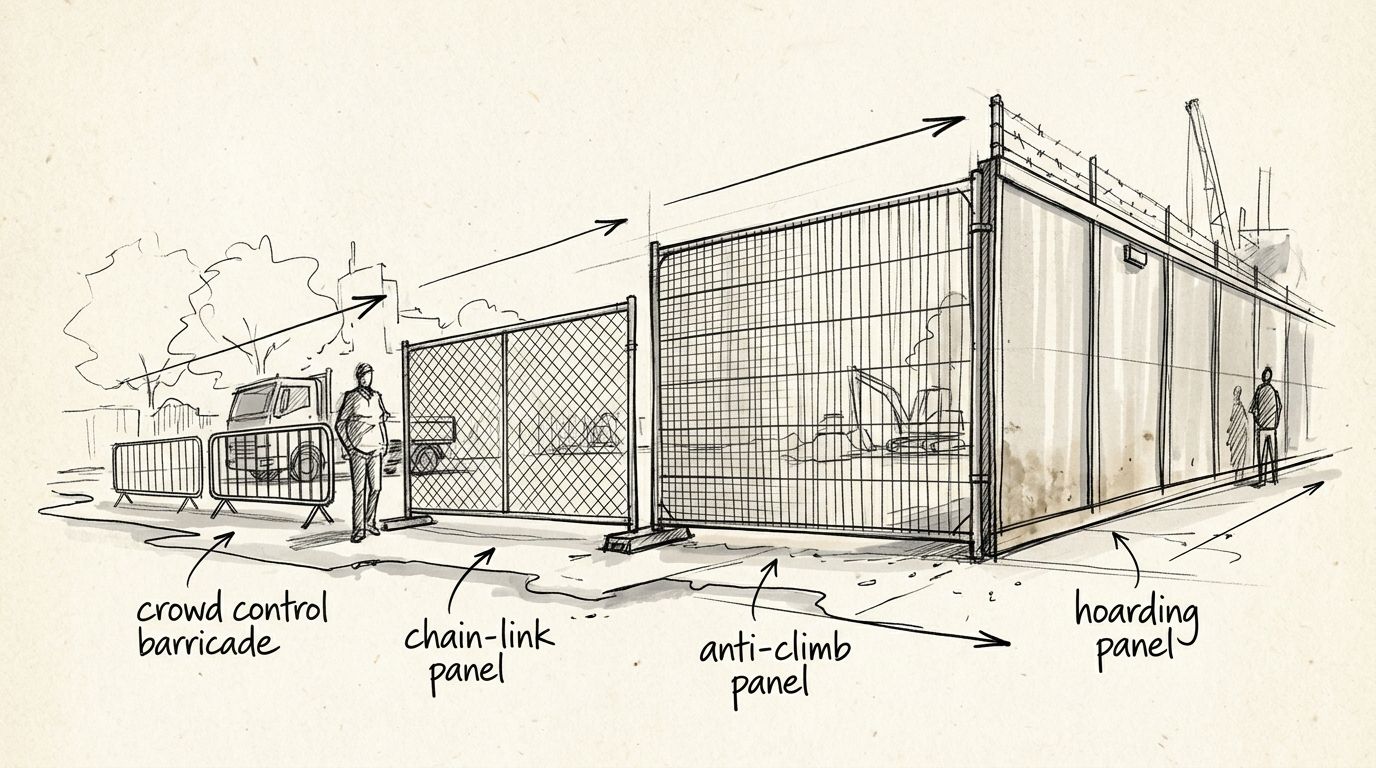
Temporary fencing on a Bay Area jobsite isn't one product, it's five different security levels built on a handful of base components. Valley Services ranks the temporary fencing security level that actually fits your site, from a standard construction perimeter to a K-rail barrier built to stop a vehicle, so you're not renting more fence than the job needs, or less than it does.
- Standard 6-foot chain link is the baseline temporary fencing security level for active construction sites in 2026.
- Chain link with green privacy screening blocks sightlines and dust on demolition sites.
- Windscreen-rated fencing holds up on open, wind-exposed lots and event grounds.
- K-rail concrete barrier is the highest temporary fencing security level, built to stop vehicle intrusion.
- K-rail paired with chain link on top is the max-security setup for storm and disaster recovery sites.
Why this matters
Fencing gets pulled off a truck and dropped along a property line, and most crews never think past that. The mistake shows up later: a chain link perimeter that's fine for keeping foot traffic off a foundation pour does nothing to stop someone from driving through a gate at a vacant property. The right temporary fencing security level depends on what you're actually defending against: foot traffic, sightlines, wind, or a vehicle.
Insurance carriers and property owners increasingly spell out fence requirements in 2026 coverage terms, especially after a break-in or a liability claim. Knowing how to secure a construction site with temporary fencing before the incident, not after, is the difference between a schedule that holds and a site shut down for a safety review.
Valley Services runs temporary fencing alongside roll-off containers and restrooms across San Jose, Santa Clara, Sunnyvale, Mountain View, and Milpitas, so one call covers the whole site instead of three separate vendors.
Best overall for active construction sites: standard 6-foot chain link. Best for demolition and dust control: chain link with green privacy screening. Best for wind-exposed lots and event grounds: windscreen-rated fencing. Best for vacant property security: K-rail concrete barrier. Best for storm and disaster recovery sites needing maximum security: K-rail paired with chain link on top.
What makes the best temporary fencing security level
- Panel height and gauge. Standard 6-foot chain link versus reinforced framing for higher wind or crowd loads.
- Base stability. Rubber feet for open mesh, concrete-filled or ballasted feet once a screen goes on.
- Privacy and wind rating. Open mesh does nothing for sightlines or dust; screened panels do, at the cost of added wind load.
- Vehicle resistance. Chain link stops people. Only a K-rail barrier stops a vehicle.
- Gate and access configuration. A single walk gate versus a rolling vehicle gate changes how the whole perimeter gets planned.
- Install and teardown speed across multi-phase jobs where fencing has to move as the site changes.
Temporary fencing security levels at a glance
| Fencing option | Best for | Standout feature | Key limitation |
|---|---|---|---|
| Standard 6-foot chain link | Active construction perimeters | Fast install, standard 12-ft panel sections | No privacy, no wind rating |
| Chain link with privacy screening | Demolition sites, dust control | Green mesh screen blocks sightlines | Adds wind load, needs heavier base |
| Windscreen-rated fencing | Wind-exposed lots, event grounds | Reinforced frame holds up in open wind | More anchoring time before load-in |
| K-rail concrete barrier | Vacant property security | Stops vehicles, no gate to breach | No effect on foot traffic or sightlines |
| K-rail plus chain link combo | Storm and disaster recovery sites | Vehicle barrier and foot barrier in one perimeter | Heaviest footprint, longest install |
1. Standard 6-foot chain link: best temporary fencing security level for active construction sites
Standard temporary fencing sections run 6 feet tall and 12 feet wide. Panels stand on rubber or concrete-filled feet and connect with clamps along the property line. It marks the site boundary, keeps foot traffic off active work areas, and meets what most municipal permits expect for temporary fencing for construction sites in 2026.
Standard 6-foot chain link pros:
- Fastest option to install and pull down between project phases
- Open mesh doesn't trap wind, so base weight stays standard
- Panels reconfigure easily as the site footprint changes
Standard 6-foot chain link cons:
- No privacy: neighbors and street traffic see straight through
- Won't stop a vehicle, only foot traffic
- No real deterrent against someone climbing over after hours
Best for: general contractors running an active jobsite perimeter with no privacy or vehicle-barrier requirement. Verdict: Buy.
2. Chain link with privacy screening: best for demolition sites and dust control
Same 6-foot chain link frame, with a green privacy screen woven through the mesh. It blocks sightlines from the street and holds back some dust and debris during demolition, which matters when a job sits next to a sidewalk or an occupied building.
Privacy screening pros:
- Blocks sightlines, keeps demo debris and dust off adjacent properties
- Reduces liability exposure from passersby watching an active demo
- Uses standard chain link hardware, so install time barely changes
Privacy screening cons:
- Screen catches wind, so panels need heavier base weight or extra staking
- Adds nothing against forced entry, it's a visual and dust barrier only
- Screen material can tear in sustained wind if it isn't rated for it
Best for: demolition contractors and jobsites next to sidewalks, schools, or occupied buildings that need sightline control, not just a boundary line. Verdict: Buy.
3. Windscreen-rated fencing: best for wind-exposed lots and event grounds
This is chain link built and anchored specifically to handle sustained wind, common on open lots with no adjacent buildings to break wind, and on event sites where organizers need a screen that won't tear or come down mid-event. It shares the same 6-foot chain link base hardware as a standard perimeter, with heavier anchoring behind it.
Windscreen fencing pros:
- Holds up on open, exposed sites where standard screening tears
- Works for both jobsites and outdoor events needing a wind-rated screen
- Same base hardware as standard chain link, upgraded anchoring only
Windscreen fencing cons:
- Needs more lead time to plan anchoring correctly on exposed ground
- Heavier base weights add to load-in time
- Still no vehicle-rated barrier if that's the actual risk on site
Best for: open lots, hillside sites, and outdoor events in wind-exposed parts of the Bay Area where standard screening won't survive the season. Verdict: Hold. Confirm the site's actual wind exposure before ordering screening you don't need.
4. K-rail concrete barrier: best for vacant property security
K-rail sections run roughly 32 to 42 inches tall and interlock end to end with no gate to breach. It's a vehicle-rated barrier used around vacant lots, foreclosed properties, and sites with a documented illegal dumping or unauthorized-access problem, the kind of job covered in vacant property security planning.
K-rail pros:
- Stops vehicles, not just foot traffic, no climbing over a locked gate
- No panels to steal or vandalize, concrete sections don't disappear overnight
- Minimal maintenance once placed, no fabric or mesh to replace
K-rail cons:
- Height alone doesn't stop someone walking around the end of a run
- No privacy or sightline control, it's a vehicle barrier, not a visual one
- Heavier equipment needed to place and remove sections
Best for: vacant lots, foreclosed sites, and properties with a documented trespass or dumping problem where the risk is vehicles, not foot traffic. Verdict: Buy.
5. K-rail plus chain link combo: best for storm and disaster recovery sites
K-rail forms the vehicle barrier at ground level, chain link goes up alongside it to add height and close off foot traffic. This is the setup for storm and disaster recovery sites, where the property has structural damage, exposed hazards, and a real risk of both vehicle intrusion and people walking in to look around.
Combo pros:
- Covers both vehicle and foot-traffic risk in one perimeter
- Matches the security level insurance adjusters and municipalities expect after major damage
- Scales section by section as a site gets stabilized in phases
Combo cons:
- Longest install of any option on this list, plan for extra load-in time
- Heaviest footprint, not practical for a small or short-duration job
- Needs coordination between two equipment types on one delivery
Best for: storm-damaged sites, disaster recovery zones, and any property with confirmed vehicle and trespass risk at the same time. Verdict: Buy, if the site genuinely has both risks. Skip it for a standard multi-week remodel.
“K-rail stops vehicles. Chain link stops people. Most sites only need one of those two problems solved.”
How we ranked
Ranking runs on four factors: what the fencing physically stops, foot traffic, sightlines, wind, or vehicles; how fast it installs against your schedule; how much base weight or anchoring it needs; and whether it matches what a permit or insurance carrier actually requires for the job. A taller fence that doesn't stop the actual risk on your site isn't a security upgrade, it's a bigger fence.
Which temporary fencing security level should you choose?
Default to standard 6-foot chain link in 2026 if you're running an active construction site with normal foot traffic and no special sightline or vehicle concern. It's the fastest to install and covers most municipal permit expectations in San Jose and the South Bay. Step up to privacy screening the moment a demo phase starts next to a sidewalk or occupied building. Move to K-rail the moment the actual risk is a vehicle, not a person, especially on vacant or foreclosed property. Combine K-rail and chain link only when a site genuinely carries both risks at once, storm damage and disaster recovery sites usually do.
Valley Services has fenced perimeters for events at the scale of Super Bowl LX and the San Jose Marathon, and just as often for a single vacant lot. The scale changes. The ranking logic doesn't.
Match fencing to the actual risk
Call Valley Services to set the right temporary fencing security level before delivery.
FAQ
What's the best temporary fencing security level for a construction site?
Standard 6-foot chain link is the right temporary fencing security level for most active construction perimeters. Step up to privacy screening or K-rail only when the site has a specific sightline, dust, or vehicle risk.
Is K-rail better than chain link for security?
K-rail stops vehicles, chain link doesn't. Chain link controls foot traffic and, with screening, sightlines. Pick based on which risk your site actually faces, not which fence looks more serious.
How tall is temporary construction fencing?
Standard temporary chain link panels run 6 feet tall and 12 feet wide. K-rail barriers run shorter, roughly 32 to 42 inches, but add vehicle resistance that chain link doesn't have.
Do I need a permit for temporary fencing in San Jose?
Permit requirements depend on the jurisdiction and whether the fencing blocks a sidewalk or right of way. Check with the local building department before placement, especially on public-facing sites.
Can chain link fencing stop a vehicle?
No. Standard chain link, screened or not, is built for foot traffic and visual control. K-rail concrete barrier is the option rated to stop vehicle intrusion.
What is windscreen fencing used for?
Windscreen-rated fencing is chain link anchored to handle sustained wind on open lots and event grounds where standard privacy screening would tear or come loose.
When should a jobsite use K-rail instead of chain link?
Use K-rail when the risk is vehicle intrusion, illegal dumping, or unauthorized vehicle access, common on vacant lots and foreclosed properties. Chain link alone doesn't address that risk.
One last thing: privacy screening turns a chain link fence into a sail. Crews scheduling fencing for 2026 storm season who skip the extra base weight find out on day two, when a gust walks the whole run off its line. Ask about anchoring before the green screen goes up, not after it's already down.