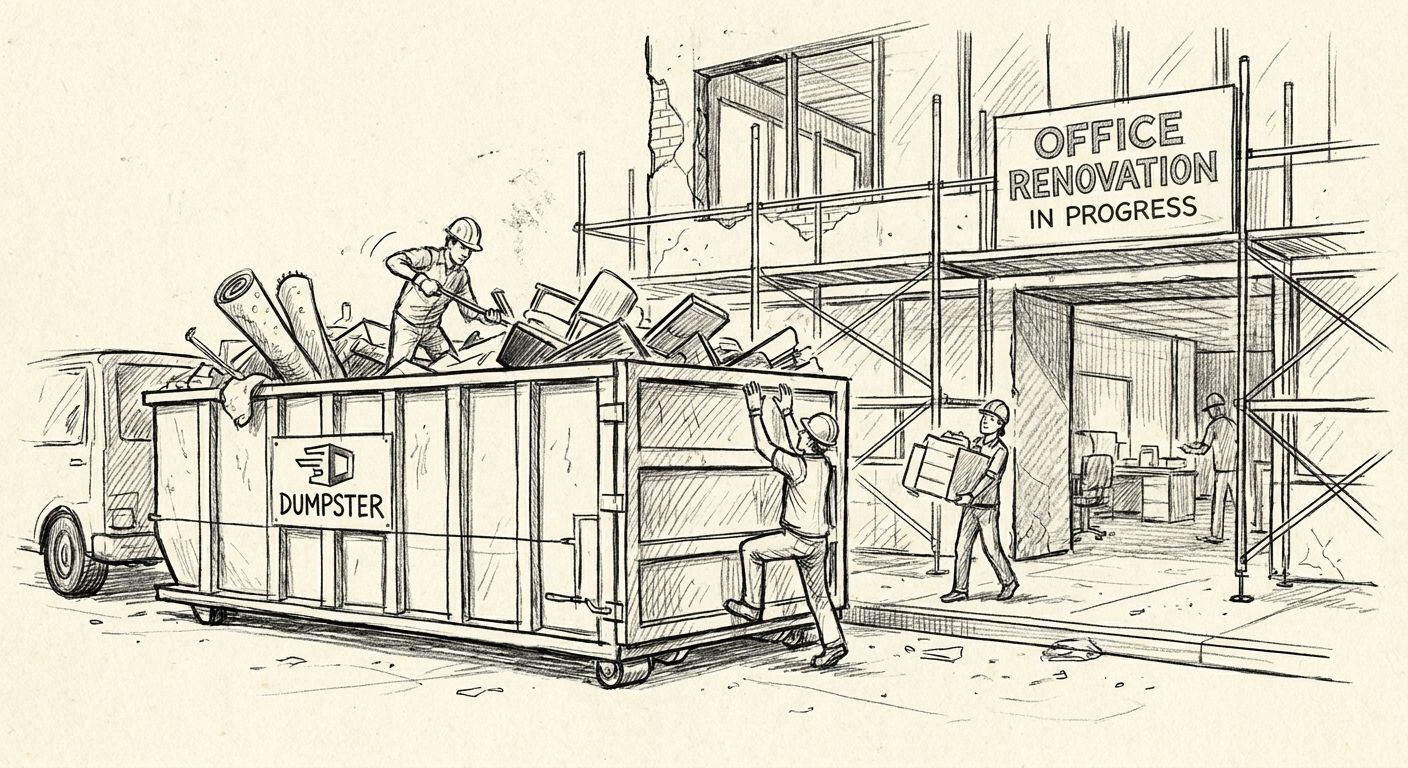
Office tenant improvement jobs generate a specific kind of mess: torn-out carpet tile, drywall dust, ceiling grid, old cubicle panels, and enough cardboard to fill a conference room. Picking the wrong container size on day one means a second pull mid-project or a truck that shows up half empty. This guide ranks the container sizes and service setups that actually fit office renovation work in San Jose and the surrounding Bay Area in 2026.
- The best dumpster rental for office renovation in 2026 is usually a 20-yard blue steel container: buy it for most tenant improvement jobs.
- 10-yard containers fit single-suite refreshes under roughly 1,500 square feet: buy for small-scope demo.
- 40-yard containers handle bulky, low-density debris but hit weight limits fast on flooring-heavy jobs: consider with caution.
- Skip any hauler who can't confirm where your office C&D debris actually lands: Valley Services runs its own San Jose transfer station.
- Street placement in San Jose usually needs a permit: confirm before delivery day, not after.
Why this matters
Office renovation debris is heavier and more mixed than a typical home remodel load. A single floor of demo can include ceiling tile, metal stud framing, old carpet glued to concrete, and electronics pulled from workstations. Get the container size wrong and you're either paying for a second delivery mid-schedule or watching a half-empty roll-off container sit in a loading zone, blocking access other trades need.
A roll-off container rental sized correctly for the scope keeps load-in and load-out moving and keeps the site compliant with San Jose placement rules. That's the whole game on a commercial TI job: schedule and site control, not just hauling debris away.
How this list is ranked
This ranking comes from decades of pulling containers for tenant improvement jobs across San Jose, Santa Clara, Sunnyvale, Mountain View, and Milpitas. The factors that matter for office renovation specifically: how much debris a typical scope generates, whether the debris mix is bulky-and-light or dense-and-heavy, how tight the loading dock or parking structure access usually is, and whether the job needs a street or lot permit.
The sizes below aren't ranked by popularity. They're ranked by fit against the office renovation scenarios Valley Services sees repeatedly: single-suite refreshes, full-floor tenant improvements, gut renovations down to the studs, and phased multi-floor buildouts.
The ranked picks
1. 10-yard blue steel container: the single-suite pick
This is the container for a small office refresh under roughly 1,500 square feet: new flooring in one suite, a break room update, or removing a handful of old cubicle walls. It's compact enough to fit in a standard parking stall and clears most garage entrances.
It fills fast on drywall-heavy jobs but handles light demo without wasting capacity. Verdict: Buy for single-suite refreshes and small scope-of-work punch lists.
2. 20-yard blue steel container: the workhorse pick
This is the size that shows up most often on office tenant improvement jobs in 2026, and for good reason. It handles a full floor's worth of carpet tear-out, drop ceiling removal, and drywall demo without running out of room before the job's done.
Most general contractors doing a 3,000 to 8,000 square foot office buildout land here. Verdict: Buy for the majority of standard office TI scopes.
3. 30-yard blue steel container: the gut renovation pick
When a floor is coming down to the studs, including HVAC ductwork, old partition walls, and flooring adhesive scraped off the slab, the 20-yard fills before the demo crew is done. The 30-yard gives enough headroom to finish the pull in one delivery.
Expect this size on floors over 8,000 square feet or any scope that includes structural interior demo. Verdict: Buy for full-floor gut renovations.
4. 40-yard blue steel container: the bulky-load pick
This is the largest container Valley Services runs, and it's built for volume, not weight. Ceiling grid, foam-core partition panels, and bulky low-density debris fill it efficiently. The catch: on any office job that includes tile flooring, concrete, or dense debris, the weight limit gets reached long before the container looks full.
A crew that mixes bulky demo with dense material should split loads across two smaller containers instead. Verdict: Consider for volume-heavy, low-weight jobs only; Skip if flooring or concrete tear-out is part of the scope.
5. Recurring container service: the multi-phase pick
Office buildouts that run in phases over several weeks, rather than one demo push, generate a steadier trickle of debris instead of one heavy load. A scheduled swap-out on a set cadence keeps the site clear without a container sitting mostly empty for days.
This setup depends on locking in a delivery and pickup schedule the property manager and GC both sign off on. Verdict: Buy for phased buildouts spanning three weeks or more.
6. Unpermitted street placement with an unknown disposal endpoint: the one to skip
Some haulers will drop a container curbside without checking San Jose's placement rules and without telling you where the debris actually goes. That's a compliance risk on top of a scheduling risk: if the container blocks a fire lane or sits without a permit, it can get flagged and delay pickup.
Ask before you book: does the hauler control the disposal endpoint, or are they brokering to a third party with its own schedule. Verdict: Skip.
Container size comparison for office renovation
| Size | Typical office scenario | Fills on | Verdict |
|---|---|---|---|
| 10-yard | Single-suite refresh, under ~1,500 sq ft | Drywall, small demo | Buy |
| 20-yard | Full-floor TI, 3,000-8,000 sq ft | Carpet, ceiling tile, drywall | Buy |
| 30-yard | Full-floor gut renovation, over 8,000 sq ft | Structural demo, ductwork | Buy |
| 40-yard | Bulky, low-density demo only | Ceiling grid, foam panels | Consider / Skip if dense debris |
| Recurring service | Multi-phase buildout, 3+ weeks | Steady mixed debris | Buy |
What to check before you reserve
Site access and permits decide more about scheduling than container size does. A few things worth confirming before delivery day:
- Loading dock height and door clearance. Office buildings often have tighter clearances than a standalone retail site or a house driveway.
- Street or lot placement permits. If the container sits on a public street rather than a private lot, San Jose requires a permit before drop-off, and getting it wrong on the day of delivery costs a scheduling slot, not just a fine. Details on the process are in how to permit a dumpster placement in San Jose.
- Business hours access. Office parks and multi-tenant buildings often restrict delivery windows to avoid blocking other tenants during business hours.
Talk through your office TI schedule
Call to size the container and confirm San Jose permit needs before delivery day.
How to reserve the right container in San Jose
- Call with the scope, not just the square footage. A demo-only job and a full gut-and-rebuild generate different debris mixes even at the same square footage.
- Confirm the disposal endpoint. A hauler that owns its own C&D transfer station controls the schedule end to end. One that brokers to a third-party site is at the mercy of someone else's intake hours.
- Book delivery around loading dock availability, not just around the demo start date. A container that arrives before the dock is clear just sits and blocks access.
FAQ
What size dumpster do I need for an office renovation?
A 20-yard blue steel container fits most office tenant improvement jobs between 3,000 and 8,000 square feet in 2026. Smaller suite refreshes under 1,500 square feet usually fit in a 10-yard container, while full-floor gut renovations often need a 30-yard.
How much debris does an office renovation generate?
It depends on the scope, but demo-heavy jobs involving drywall, ceiling tile, and flooring generate more volume than a cosmetic refresh. Structural interior demo, including partition walls and old ductwork, is the main driver that pushes a job from a 20-yard to a 30-yard container.
Do I need a permit for a dumpster on a San Jose street?
Yes, if the container sits on a public street rather than a private parking lot or driveway, San Jose requires a placement permit. Confirm this before delivery day since getting it wrong can delay the drop-off.
Can office renovation debris go straight to a transfer station?
Yes, mixed construction and demolition debris from an office TI job can go to a C&D transfer station. Valley Services operates its own transfer station in San Jose, which keeps disposal on one schedule instead of routing through a third-party site.
What's the difference between a 20-yard and 30-yard container for office TI?
A 20-yard container handles most standard tenant improvement scopes under 8,000 square feet. A 30-yard is for full-floor gut renovations that include structural demo like partition walls, ductwork, or flooring removal down to the slab.
How long can I keep a roll-off container on an office job site?
Rental duration depends on the job schedule and whatever is agreed at booking. Phased buildouts running several weeks typically use a recurring swap-out schedule instead of holding one container the entire time.
Is a 40-yard dumpster ever too big for an office remodel?
Yes, if the debris includes dense material like tile, concrete, or flooring adhesive, a 40-yard container hits its weight limit before it looks full. It works best for bulky, low-density demo like ceiling grid and foam-core partitions.
What items can't go in an office renovation dumpster?
Fluorescent light ballasts, batteries, and certain electronics typically can't go in a standard C&D container and need separate handling. Confirm restricted items with the hauler before demo starts to avoid a rejected load at the transfer station.
One last thing
Weight, not volume, is what actually triggers overage charges on office TI jobs. A container that looks half-empty can still be at its weight limit if the load includes old tile flooring or concrete patch material, which is why matching container size to debris density matters more than matching it to square footage alone. Details on avoiding that mistake are in how to load a dumpster safely and avoid overage fees.
Valley Services has run the same San Jose yard since 1986, third generation, same family. One call covers the container, the schedule, and the transfer station drop-off for the job. Reach out at (408) 297-5404 or valleyservices.biz to talk through the scope before you book.