Property managers do not shop for dumpsters the way homeowners do. You are booking for turnovers that repeat every month, apartment complexes with tight loading zones, and HOA cleanup days where the wrong container sitting on a fire lane becomes a code problem. The best dumpster rental for property managers is not one container size, it is a service setup that matches your turnover cycle, your site access, and how fast the hauler can pull a full container and drop an empty one.
- Valley Services runs the best dumpster rental for property managers who need repeat turnover pickups, not one-off jobs.
- A 20-yard roll-off handles a standard unit turnover; apartment complex-wide cleanouts need 30 or 40-yard capacity.
- Front-load dumpsters fit occupied communities with ongoing waste, not turnover debris. Buy for daily use, skip for one-time cleanouts.
- Valley Services owns its San Jose transfer station, which controls schedule reliability during peak turnover months in 2026.
- HOA cleanup days need a dedicated container booked in advance, not a shared bin. Buy ahead of the event date.
Why this matters for property management sites
A delayed container pickup on a construction site is an inconvenience. A delayed pickup on an occupied apartment complex is a liability, a blocked fire lane, or a resident complaint that lands on your desk. Property managers need haulers who show up on the day booked, not the day convenient for the hauler's third-party disposal site.
Valley Services has run its own yard in San Jose since 1986, now in its third generation of family ownership. The company owns its own C&D transfer station rather than brokering disposal to another site, which means the schedule for pickup and drop does not depend on a stranger's dock availability. For a property manager running six turnovers a month across three buildings, that scheduling control matters more than the container itself.
How this list is ranked
Each entry below is ranked by fit for property management operations specifically: unit turnovers, whole-complex cleanouts, HOA events, and ongoing community waste. The ranking weighs container capacity against typical property management constraints: parking lot access, resident foot traffic, permit requirements in San Jose, and how often the container needs to turn over in a single month. This is not a ranking of brands. It is a ranking of which container configuration solves which property management problem in 2026.
“If your crew fills a 20-yard container in under two days on a single unit turnover, you booked the wrong size.”
The ranked list
1. The 20-yard roll-off for standard unit turnovers
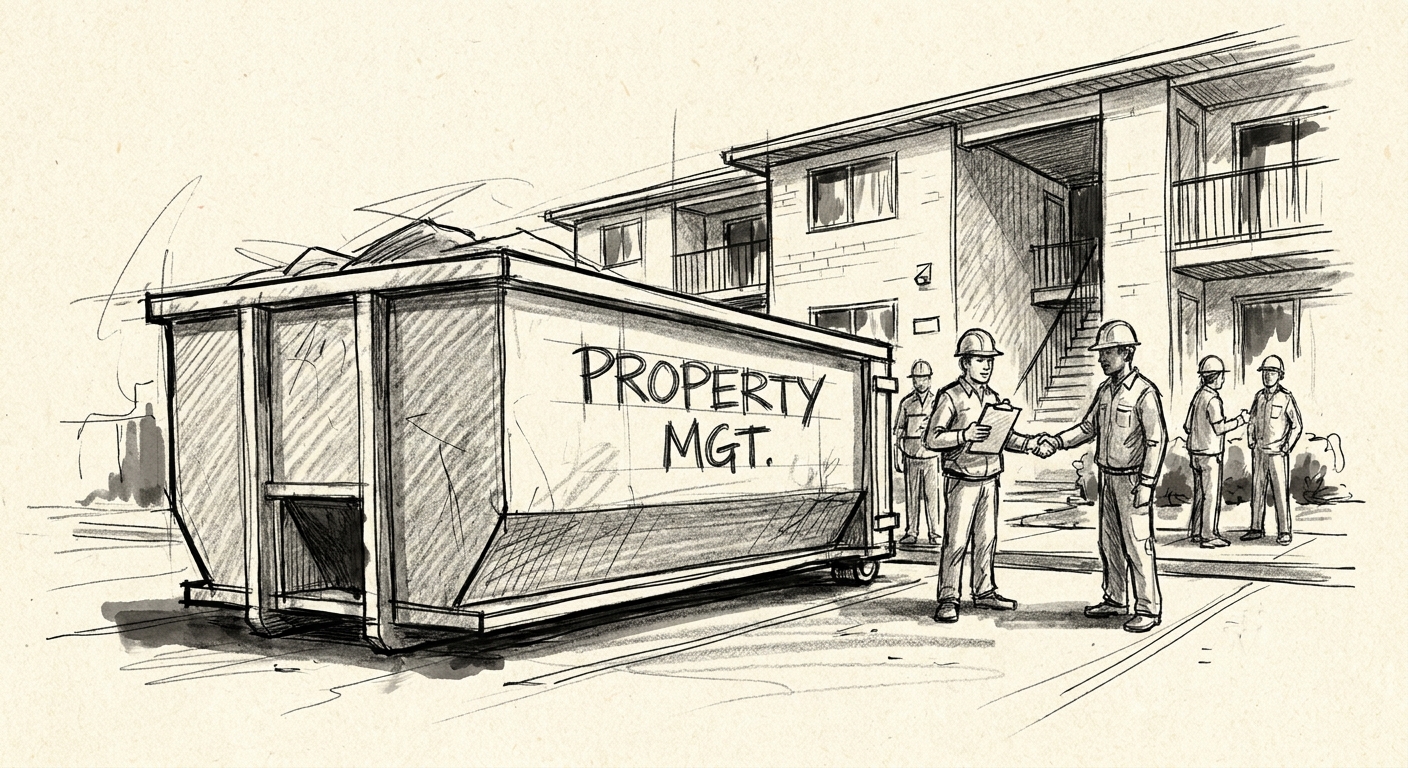
This is the default size for a single-unit turnover: flooring, cabinetry, appliances, and furniture from one apartment or townhome. A 20-yard blue steel container fits most standard parking stalls without blocking a second lane, which matters on properties where every space is assigned. Dumpster rental for property management turnover cleanouts covers the sizing math property managers use most often in 2026. Verdict: Buy for routine turnovers on a recurring schedule.
2. The 30 to 40-yard roll-off for complex-wide cleanouts
When a property is clearing multiple vacated units at once, ahead of a renovation or a mass move-out, one 20-yard container will not keep pace. A 30 or 40-yard unit handles bulk furniture, carpet tear-out, and appliance disposal across several units in a single placement window. Best dumpster rental for apartment complex cleanouts walks through the placement logistics for multi-unit jobs. Verdict: Buy when three or more units turn over in the same cycle.
3. The front-load dumpster for ongoing community waste
This is a different problem than a turnover. Occupied apartment communities generate daily household trash, not one-time renovation debris, and a roll-off dropped for a week is the wrong tool. A front-load container serviced on a set pickup schedule handles ongoing volume without a resident ever seeing a construction bin in the lot. Front-load dumpster rental for apartment communities breaks down service frequency options. Verdict: Consider for properties with 20 or more occupied units generating daily waste; Skip for a single-unit turnover.
4. The dedicated roll-off for HOA cleanup days
HOA cleanup days draw debris from dozens of households at once: old furniture, yard waste, appliances residents have been holding onto. A single shared bin gets overwhelmed by mid-morning. A dedicated container booked ahead of the event date, sized for the number of participating households, keeps the day moving instead of turning into a line at a full dumpster. Dumpster rental for HOA community cleanup days covers sizing by household count. Verdict: Buy, and book at least two weeks ahead of the event in 2026, since cleanup day weekends fill hauler schedules fast.
5. The compactor for retail-anchored mixed-use properties
Properties with a ground-floor retail tenant, a grocery anchor, or a food court generate a waste volume profile closer to commercial retail than residential turnover. A stationary compactor handles that daily volume without daily hauler visits. This is a narrower fit: most residential property managers will never need one, but mixed-use asset managers should evaluate it separately from turnover dumpster planning. Verdict: Consider only for properties with a retail or food tenant generating consistent daily waste; Skip for residential-only portfolios.
Book a turnover cleanout container
Call to size the container for your next unit turnover or complex cleanout.
Comparison table
| Configuration | Best for | Typical size | Verdict |
|---|---|---|---|
| Turnover roll-off | Single unit turnover | 20-yard | Buy |
| Complex cleanout roll-off | 3+ units, renovation clear-out | 30 to 40-yard | Buy |
| Front-load dumpster | Occupied community, daily waste | Serviced on schedule | Consider |
| HOA event roll-off | Community cleanup day | Sized to household count | Buy |
| Compactor | Retail-anchored mixed-use | Stationary unit | Consider |
Where to source it
- Book by turnover cycle, not by the job. Property managers who set a standing delivery and pickup schedule avoid the gap between move-out and move-in when a unit sits with debris in it. How to schedule a dumpster delivery and pickup covers how to set that cadence.
- Confirm permit needs before placement, especially in San Jose. Containers placed on a public street or fire lane often need a permit, and property managers who skip this step risk a fine that lands on the property, not the hauler.
- Ask whether the hauler controls its own disposal endpoint. A hauler that owns its transfer station controls the pickup schedule directly. A hauler that brokers disposal to a third party is at the mercy of that site's dock hours, which shows up as delayed pickups during your busiest turnover months.
FAQ
What is the best dumpster rental for property managers?
The best dumpster rental for property managers matches container size to the job: a 20-yard roll-off for single unit turnovers, 30 to 40-yard for complex-wide cleanouts, and a front-load dumpster for ongoing community waste. Sizing to the wrong category is the most common mistake property managers make in 2026.
What size dumpster do I need for an apartment turnover?
A 20-yard roll-off container handles a standard single-unit turnover, including flooring, cabinetry, and furniture. Multi-unit turnovers on the same cycle need 30 to 40-yard capacity instead.
Is a front-load dumpster better than a roll-off for apartment communities?
A front-load dumpster is better for ongoing daily waste from occupied units, while a roll-off is better for one-time turnover or renovation debris. Most apartment communities in 2026 use both: a front-load for daily trash and a roll-off during turnover cycles.
Do I need a permit for a dumpster on an HOA property in San Jose?
Placement on a public street or fire lane in San Jose typically requires a permit, while placement entirely on private property usually does not. Confirm placement location before the delivery date to avoid a fine.
How far ahead should I book a dumpster for an HOA cleanup day?
Book at least two weeks ahead of a scheduled HOA cleanup day, since community cleanup weekends fill hauler schedules quickly in spring and fall. Sizing should reflect the number of participating households.
Can property managers get same-week dumpster delivery for an urgent turnover?
Same-week delivery is possible when a hauler controls its own disposal endpoint rather than brokering to a third party. Call ahead to confirm availability, since urgent turnovers often need placement within a day or two.
What is the difference between a roll-off and a compactor for property management?
A roll-off is a temporary container dropped for a defined job like a turnover or cleanout, while a compactor is a stationary unit for continuous high-volume waste, typically at retail-anchored properties. Residential-only portfolios rarely need a compactor.
One last thing
The detail most property managers miss: a container that sits full for three extra days because the hauler's disposal site is backed up counts against your turnover timeline just as much as a slow contractor. Ask any hauler you're evaluating who controls the disposal endpoint, not just who drops the container. Valley Services runs its own transfer station in San Jose, so pickup timing does not depend on a third-party dock schedule. Reach the yard directly at (408) 297-5404 or through valleyservices.biz to talk through a turnover schedule for 2026.