Apartment communities generate two very different waste streams: routine resident trash picked up by a front-load dumpster under a city hauler contract, and project debris from unit turnovers, renovations, and cleanouts, which is where roll-off container rental for apartment communities actually matters in 2026.
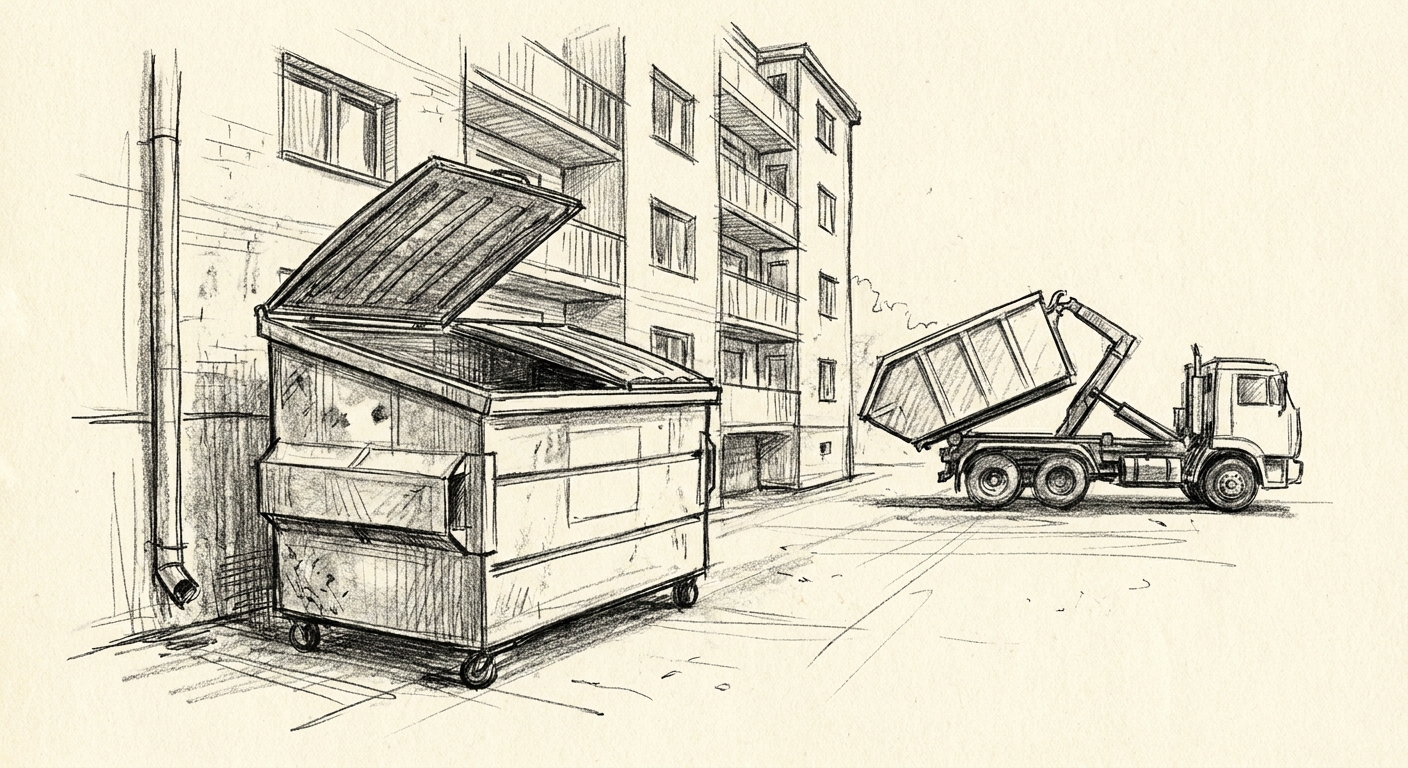
- Front-load dumpster rental for apartment communities usually runs through a city franchise hauler, not an independent yard.
- Roll-off container rental covers unit turnovers, capital improvement debris, and cleanouts. Valley Services handles that side.
- A 20-yard roll-off container clears a standard unit turnover in 2026, a 30-yard covers a multi-unit rehab.
- Check your city's franchise rules before assuming you can switch haulers for routine trash service.
- Placing a container in the street or a fire lane in San Jose usually needs a city permit.
Why this matters
Property managers search for front load dumpster rental for apartments because that is the term on their trash invoice. In most Bay Area cities, front-load bins are tied to an exclusive franchise agreement with the city's assigned hauler. You do not get to shop around for routine pickup the way you can for a roll-off container.
Roll-off containers cover a different job entirely: unit turnovers, common-area renovation, a full building rehab, a vacant-unit cleanout. That work sits outside the franchise, and it is where an independent yard like Valley Services fits into your operation.
Mixing up the two costs you time. Calling a front-load hauler about a 40-unit gut job gets you nowhere. Calling Valley Services about Tuesday's trash pickup gets you the same answer.
Who this is for
This guide is for property managers, facilities directors, and ownership groups running apartment communities in San Jose, Santa Clara, Sunnyvale, Mountain View, and Milpitas. It's built for whoever handles move-out season turnovers, a capital improvement project spanning several buildings, or a vacant-unit cleanout before re-leasing. If your search started with front-load dumpster rental for apartments, the roll-off side of the job is what Valley Services actually books out of its San Jose yard.
What to look for in roll-off container service for apartment communities
Container size matched to turnover volume
A single-unit turnover produces roughly the same debris every time: flooring, cabinets, appliances, drywall. A 20-yard roll-off container handles that load without running over. A gut job across four or more units at once needs 30 to 40 yards, or several pulls scheduled back to back.
Scheduling flexibility for swap-outs
Move-out season stacks turnovers on top of each other, often May through August. You need a vendor who can swap a full container for an empty one in a day or two, not a week. Ask about swap-out lead time before you sign anything for 2026.
Site access and placement
Apartment lots run tight. Garage clearance heights, narrow drive aisles, and reserved parking all limit where a container can sit. Walk the site with the driver, or send photos ahead of delivery day, so the container lands where it needs to without blocking a fire lane.
Permit and right-of-way rules
If the container has to sit on a public street or fire lane instead of a private lot, most Bay Area cities require a placement permit. Pull the permit before delivery. A container sitting without one can get tagged, and that delays the whole turnover.
Coordination across service lines
A renovation crew working through an occupied building needs restrooms on site. A vacant building mid-rehab needs temporary fencing to keep people out between phases. Running containers, restrooms, and fencing through one vendor means one delivery schedule instead of three.
Which setup fits your property
The standard turnover pick: 20-yard roll-off container. Holds the debris from one full unit gut, cabinets, flooring, drywall, without tipping into overage territory. Handles roughly 20 cubic yards, enough for a single unit in most Bay Area floor plans. See sizing detail in the apartment complex cleanout guide. Buy for one-off and rolling single-unit turnovers.
The multi-unit rehab pick: 30-yard roll-off container. Built for a building running four or more units through renovation at once. Cuts the number of swap-outs roughly in half compared to running 20-yard containers on the same job. Consider it when you're turning a whole floor or wing at once, skip it for a single unit.
The full-complex renovation pick: 40-yard roll-off container. Sized for a capital improvement project spanning an entire property: roofing, siding, flooring replacement across dozens of units. Moves 40 cubic yards per pull, which cuts truck trips on a large job. Consider for property-wide projects, skip for routine turnovers where it sits half empty.
The vacancy security add-on: temporary fencing. A gutted, vacant unit or building between renovation phases is an open invitation for trespassing and liability exposure. Fencing keeps the site closed until work resumes. Buy as a standing add-on for any project running longer than a few weeks.
Talk through your turnover schedule
Line up container sizing and swap-out timing for 2026.
What to avoid
- Assuming front-load and roll-off service are interchangeable. They run through different contracts and different vendors entirely.
- Locking in one container size for every turnover regardless of scope. A studio gut and a three-bedroom gut are not the same load, and guessing wrong means overage fees on one end or a second pull on the other.
- Skipping the permit check when a container has to sit on the street. Fines and delays cost more than the five minutes it takes to check with the city.
Verdict comparison
| Setup | Best for | Size | Verdict |
|---|---|---|---|
| 20-yard roll-off | Single unit turnover | 20 cubic yards | Buy |
| 30-yard roll-off | 4+ unit rehab | 30 cubic yards | Consider |
| 40-yard roll-off | Full complex renovation | 40 cubic yards | Consider |
| Temporary fencing | Vacant unit or building security | N/A | Buy add-on |
FAQ
What's the best dumpster size for apartment unit turnovers in 2026?
A 20-yard roll-off container handles a standard single-unit turnover in 2026, covering flooring, cabinets, and drywall from one unit. Larger jobs running multiple units at once need 30 to 40 yards or multiple pulls.
Is front load dumpster rental for apartments the same as roll-off container rental?
No. Front load dumpster rental for apartments covers routine resident trash and typically runs through a city franchise hauler. Roll-off container rental covers project debris from turnovers, renovations, and cleanouts, and isn't tied to that franchise agreement.
How many roll-off containers does a 50-unit renovation need?
It depends on how many units run through renovation at once rather than the total unit count. A property turning four to six units simultaneously typically runs one 30-yard container with scheduled swap-outs through the project.
Do I need a permit to place a roll-off container at an apartment complex in San Jose?
If the container sits on private property such as a parking lot, most complexes don't need a permit. If it has to sit on the street or in a fire lane, San Jose generally requires a placement permit before delivery.
Can container swap-outs be scheduled between unit turnovers?
Yes. Swap-outs get scheduled so a full container gets pulled and an empty one dropped without a property manager losing turnover time, which matters most during peak move-out months.
How much C&D debris comes out of a typical unit gut?
A full unit gut, cabinets, flooring, fixtures, and drywall, generally fills close to a 20-yard container. Larger units or units with more finish work can run higher.
Should property managers rent restrooms for onsite renovation crews?
Yes, if the renovation runs long enough that crews can't rely on unit-by-unit bathroom access. A portable restroom on site keeps crews working without walking off site during a shift.
Is temporary fencing necessary for vacant units during rehab?
It's necessary any time a vacant, gutted unit or building sits unsecured between renovation phases. Fencing limits liability exposure and keeps unauthorized people out of an active job site.
One last thing
Valley Services runs its own C&D transfer station in San Jose instead of hauling to a third party. During peak move-out months, that means container swap-outs don't get stuck behind someone else's disposal schedule. The yard has run under the same family since 1986, third generation now, a longer track record than most brokers offering the same roll-off container service.
Call (408) 297-5404 or visit valleyservices.biz to line up container sizing for your next round of turnovers.