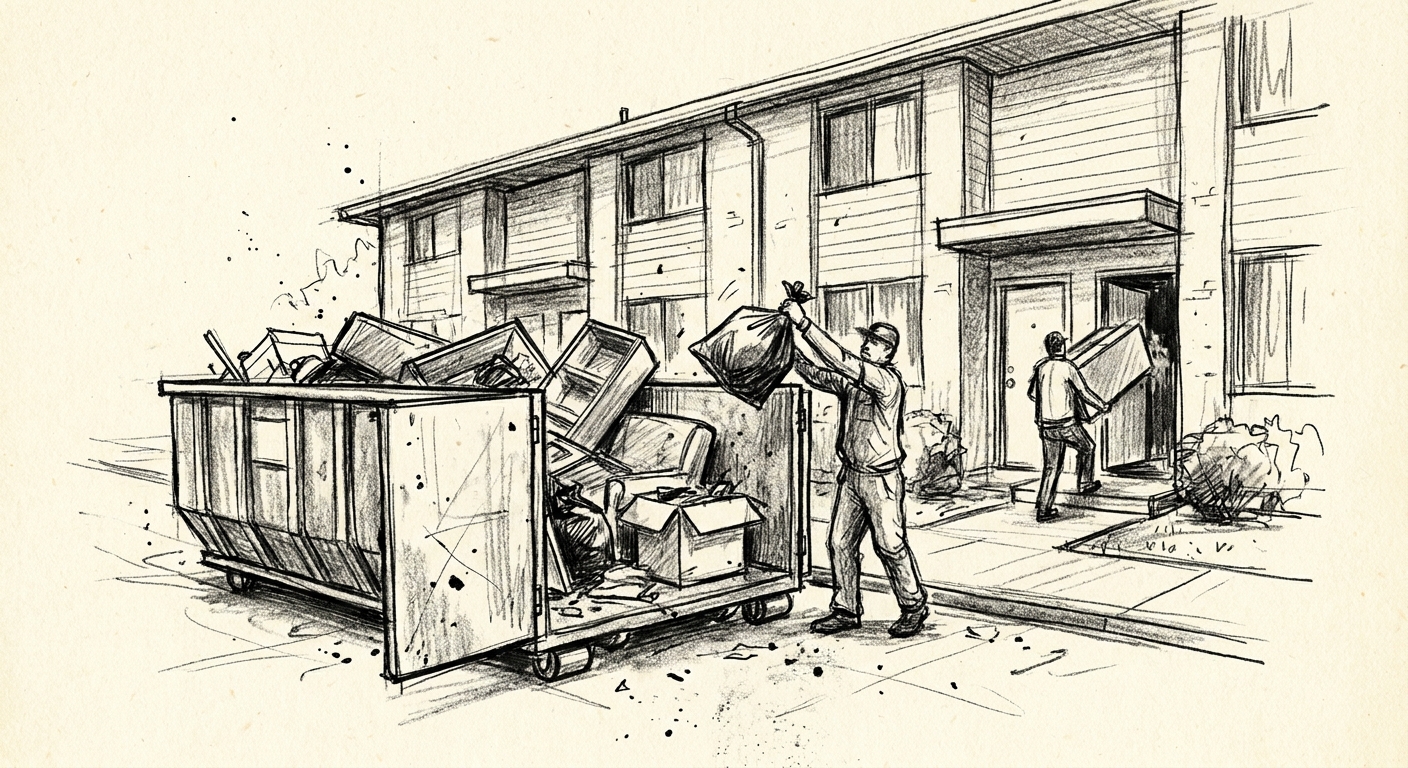
Property managers running turnover season in San Jose and the South Bay know the drill: a tenant moves out, leaves furniture and carpet padding behind, and the unit needs to be gutted before the next lease starts. Waiting on debris removal costs vacancy days. This guide breaks down how to size and schedule dumpster rental for property management turnovers so units turn faster and yards stay clean.
- A 10-yard roll-off container clears a single-unit turnover; a 20-yard handles a multi-unit batch. Buy the size that matches unit count, not guesswork.
- Front-load service works for standing complex-wide waste, not for one-time turnover debris spikes. Consider it only for ongoing volume.
- Same-day or next-day scheduling matters more than container size when a lease start date is fixed. Confirm delivery windows before you commit.
- Overage fees hit harder than size upgrades. Load flush with the container walls, never mounded over the top.
Why this matters
A vacant unit earns nothing. Every day a unit sits full of a prior tenant's abandoned furniture, mattresses, and trash is a day off the lease clock. In the Bay Area, where turnover cycles run tight between Santa Clara, Sunnyvale, Mountain View, and Milpitas properties, the container decision either keeps the schedule moving or adds a delay nobody budgeted for.
Most delays trace back to two mistakes: ordering the wrong container size for the unit count, or scheduling delivery without confirming pickup timing against the move-in date. Both are fixable before the order goes in.
Who this is for
This guide is for property managers and facilities teams handling apartment, condo, or multi-family turnovers in San Jose and the surrounding Bay Area, whether that means a single unit cleanout between leases or a batch of units turning at once after a lease-cycle wave. If you're coordinating dumpster rental for property management turnovers across more than one building, the same sizing logic applies, just scaled up.
What to look for in dumpster rental for property management turnovers
Turnover volume and timing
A single studio turnover with a mattress, a couch, and some trash bags fills a fraction of a 10-yard container. A batch of six units turning in the same week needs a plan that covers volume without paying for empty space you don't use. Match the order to the actual unit count on the schedule, not a standing default size.
Container size versus lot access
Roll-off containers need a clear delivery path and a flat surface to sit on. Parking lots, loading zones, and alley access all constrain which size fits without blocking tenant parking or fire lanes. Measure the drop zone before ordering, not after the truck arrives.
Delivery and pickup scheduling flexibility
Lease start dates don't move. If the container isn't picked up before the new tenant's move-in walkthrough, that's a visible failure on your end, not the hauler's. Confirm a firm pickup window when you book, and ask what same-day options exist if a turnover runs ahead of schedule.
Debris type restrictions
Turnover debris is usually general household waste and furniture, not construction and demolition (C&D) material. That distinction matters for what goes in the container and what doesn't. Mattresses, appliances, and hazardous items like paint or batteries often carry separate handling rules. Confirm what's allowed before your crew starts loading.
Standing account versus one-off order
A property with steady turnover volume, several units a month, benefits from a standing account with predictable delivery cadence. A property with occasional single-unit turnovers is better served ordering per job. Know which pattern matches your portfolio before you set up recurring service.
Top picks for turnover cleanouts
The single-unit pick: 10-yard roll-off container. This size handles one unit's worth of furniture, carpet, and general debris without paying for space you won't fill. It fits in a standard parking stall and doesn't require special access planning. Buy this size for single-unit turnovers under normal move-out volume.
The batch turnover workhorse: 20-yard roll-off container. When two or three units turn in the same week, a 20-yard container covers the combined volume in one placement instead of scheduling multiple 10-yard swaps. It still fits most multi-family lot layouts without blocking resident parking. Full sizing detail is in the guide on dumpster rental for apartment complex cleanouts. Buy this size for coordinated multi-unit turnovers.
The standing-account pick: front-load service. Properties with ongoing waste volume across a full complex, not just turnover spikes, run better on a scheduled front-load pickup than a one-off roll-off order. This isn't the right fit for a single vacancy, but it's the right fit for a building that generates steady weekly volume. Details on setup and cadence are covered in front-load dumpster rental for apartment communities. Consider this only if turnover volume is a small slice of total property waste.
The logistics pick: coordinated delivery and pickup scheduling. Container size means nothing if the timing doesn't match the lease calendar. Locking delivery and pickup dates against the move-in walkthrough prevents the container from sitting on-site past its use. The scheduling mechanics are laid out in how to schedule a dumpster delivery and pickup. Buy into a scheduling process before your next turnover wave, not during it.
Line up your next turnover order
Call to size the container and lock a delivery window before your next move-out.
What to avoid
- A container sized for daily trash, not turnover debris. Front-load bins built for routine weekly waste aren't built to absorb a mattress and a couch dropped in all at once. Match the tool to the job, not the closest thing already on-site.
- Assuming one size fits every unit. A studio and a three-bedroom unit don't generate the same volume. Sizing by unit count, not by habit, avoids paying for a swap mid-week.
- Skipping the overage check. Loading a container above the fill line, rather than flush with the walls, is the fastest way to turn a routine turnover into a billing dispute. The load rules are covered in how to load a dumpster safely and avoid overage fees.
Verdict comparison
| Option | Best for | Typical fit | Verdict |
|---|---|---|---|
| 10-yard roll-off | Single-unit turnover | One parking stall | Buy for standard vacancies |
| 20-yard roll-off | Multi-unit batch turnover | Two to three units | Buy for coordinated turnover weeks |
| Front-load service | Standing complex-wide waste | Full property, not one vacancy | Consider only for recurring volume |
| Scheduled delivery/pickup process | Any turnover with a fixed lease date | All property types | Buy into before the next cycle |
Every one of these decisions gets easier once the schedule and the container size are locked at the same time, not sequentially.
FAQ
What size dumpster do I need for an apartment turnover?
A 10-yard roll-off container handles a single-unit turnover with typical furniture and general debris. A 20-yard container covers a batch of two to three units turning in the same week.
Is front-load dumpster service better than roll-off for property management?
Front-load service fits properties with steady, ongoing waste volume across the whole complex. It is not built for the sudden debris spike of a single unit turnover, where a roll-off container fits better.
How far in advance should I schedule a dumpster for a turnover?
Book delivery as soon as the move-out date is confirmed, since lease start dates for the next tenant don't move. Same-day delivery is available for urgent turnovers in the San Jose service area.
Can I put mattresses and furniture in a roll-off container?
Yes, mattresses and furniture are standard turnover debris for a roll-off container. Appliances, paint, and other hazardous items often carry separate handling rules, so confirm before loading.
What happens if I overfill the dumpster during a turnover cleanout?
Debris loaded above the container's fill line, rather than flush with the top of the walls, typically triggers an overage charge. Keeping the load level with the walls avoids the issue entirely.
Do I need a permit to place a dumpster on a property lot?
Placement on private property, like an apartment lot or parking area, generally doesn't require a permit. Street placement in San Jose does require one, so check before ordering if the container will sit on the curb.
Can one company handle multiple units turning over in the same week?
Yes, a single order can be sized and scheduled to cover a batch of units turning in the same window, avoiding the need for multiple separate deliveries.
One last thing
The container size is rarely what causes turnover delays. It's the gap between when the container gets ordered and when the lease date was actually set. Property managers who lock delivery and pickup at the same time they confirm the move-out date run tighter turnovers than the ones who order the container as an afterthought.
Valley Services has run roll-off containers, restrooms, and fencing out of the same San Jose yard since 1986, third generation, same family. Call (408) 297-5404 or visit valleyservices.biz to size the next turnover order before the schedule tightens up.