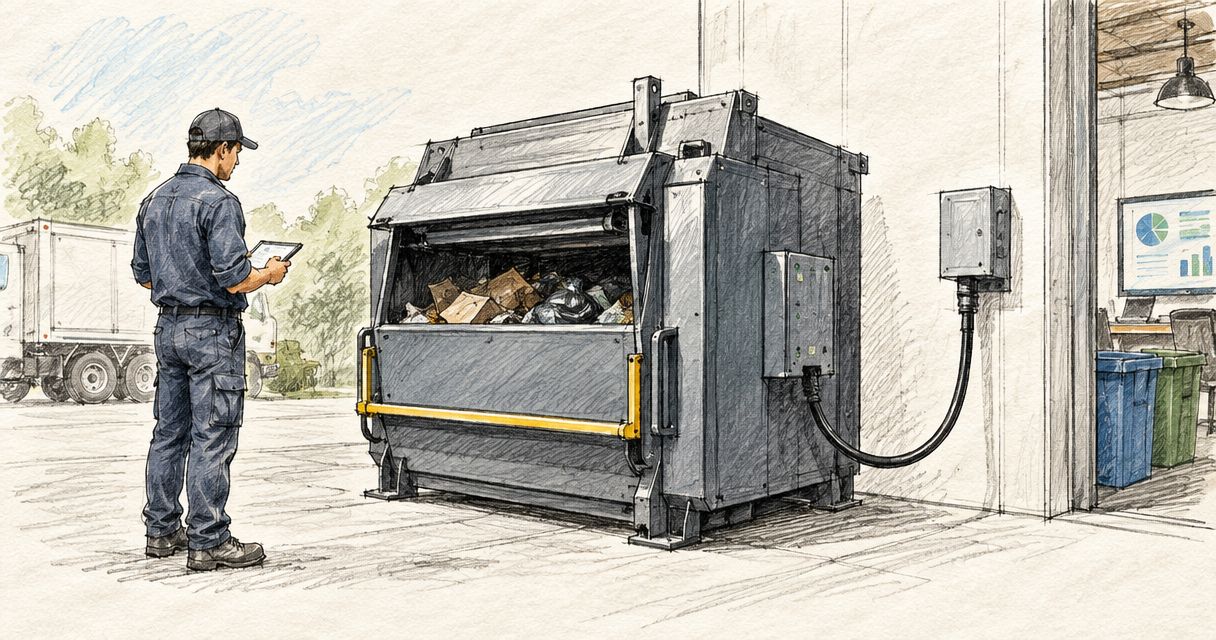
A trash compactor can run on a standard electrical outlet only if that specific model is rated for the outlet's voltage, phase, frequency, and circuit capacity. Some small compactors use ordinary household power; a commercial rental is not automatically compatible. Before delivery to a loading dock or jobsite, have the rental provider supply the electrical requirements and a qualified electrician verify the proposed connection.
- Can a trash compactor run on standard electrical power? Yes, but only when the model and circuit match.
- A 120-volt outlet does not establish compatibility with a commercial trash compactor rental.
- Verify voltage, phase, frequency, circuit capacity, and connection method before scheduling installation.
- Valley Services roll-off containers provide debris collection without an electrical connection for the container itself.
Can a trash compactor run on standard electrical power?
Yes, for a model designed for that supply. No, for a model requiring a different electrical service. In the United States, an ordinary household receptacle generally supplies nominal 120-volt, single-phase power at 60 hertz. Those facts describe the supply, not the requirements of the rental equipment.
Commercial buildings also have other electrical supplies. A nearby receptacle, an available panel space, or a working loading-dock outlet does not prove that a compactor can connect there.
For a 2026 rental, request the actual model's installation manual and electrical nameplate information. Do not approve the connection from a generic description such as standard power.
If your project needs debris collection rather than powered compaction, Valley Services offers roll-off containers. The container itself needs no electrical connection. That removes the compactor's power dependency, but it does not replace debris acceptance, placement, and pickup planning.
| Electrical arrangement | Appropriate use | Advantage | Limitation |
|---|---|---|---|
| Ordinary 120-volt supply | A compactor explicitly rated for that supply | Uses an existing circuit if the entire circuit meets the equipment requirements | Outlet voltage alone does not establish adequate capacity |
| Higher-voltage single-phase supply | Equipment whose nameplate specifies that configuration | Matches equipment designed for that voltage and phase | Requires a matching circuit and approved connection |
| Three-phase supply | Equipment whose nameplate specifies three-phase power | Provides the supply that the specified motor requires | A single-phase outlet is not an interchangeable source |
| Roll-off container without powered compaction | Debris collection where compaction is unnecessary | The container needs no electrical hookup | Stores material without mechanically compacting it |
These are electrical arrangements, not promises about a particular rental model. Match the equipment to the verified supply. Do not select a connection by appearance.
Why electrical compatibility matters before delivery
A compactor delivered beside the wrong power source is not ready for use. You still need to resolve the connection, assign the electrical work, and verify operation before staff begin loading it.
That distinction matters at an occupied retail property, a warehouse loading dock, or a Bay Area renovation. Delivery, electrical readiness, and permission to operate are separate milestones. Put each one on the schedule.
A useful 2026 installation plan identifies who supplies the equipment requirements, who verifies building power, and who accepts the completed installation. Do not leave those responsibilities to the delivery crew by default.
What does standard electrical power mean at your property?
Ordinary 120-volt power
Nominal 120-volt power is familiar because it supplies ordinary household receptacles in the United States. It is not a universal equipment connection.
A compactor rated for 120 volts still has requirements for its circuit, grounding, and connection method. The manufacturer's instructions determine whether the proposed circuit is suitable and whether other equipment can share it.
Ask your electrician to evaluate the complete circuit. A receptacle that operates a small appliance does not establish that it can supply a compactor motor during startup and operation.
A 240-volt supply
Nominal 240-volt power is another established U.S. supply configuration. It is not equivalent to an ordinary 120-volt receptacle, and it does not establish whether a machine requires single-phase or three-phase service.
The nameplate and installation instructions control. Do not treat a higher voltage as an upgrade that automatically makes an incompatible machine usable.
A plug adapter does not change the building's supply voltage or create the required phase configuration. Have a qualified electrician specify the connection rather than trying to make the connectors fit.
Three-phase building power
Three-phase service is a different supply configuration from single-phase service. Confirm that it is available at the proposed installation point, not merely somewhere in the building.
Even when a property has three-phase service, the compactor still needs matching voltage and a suitable branch circuit. Panel access, equipment placement, and the route to the connection all belong in the electrical review.
The presence of commercial building power is not approval to connect commercial equipment. Verify the particular machine and the particular circuit together.
How do you verify power before renting a compactor?
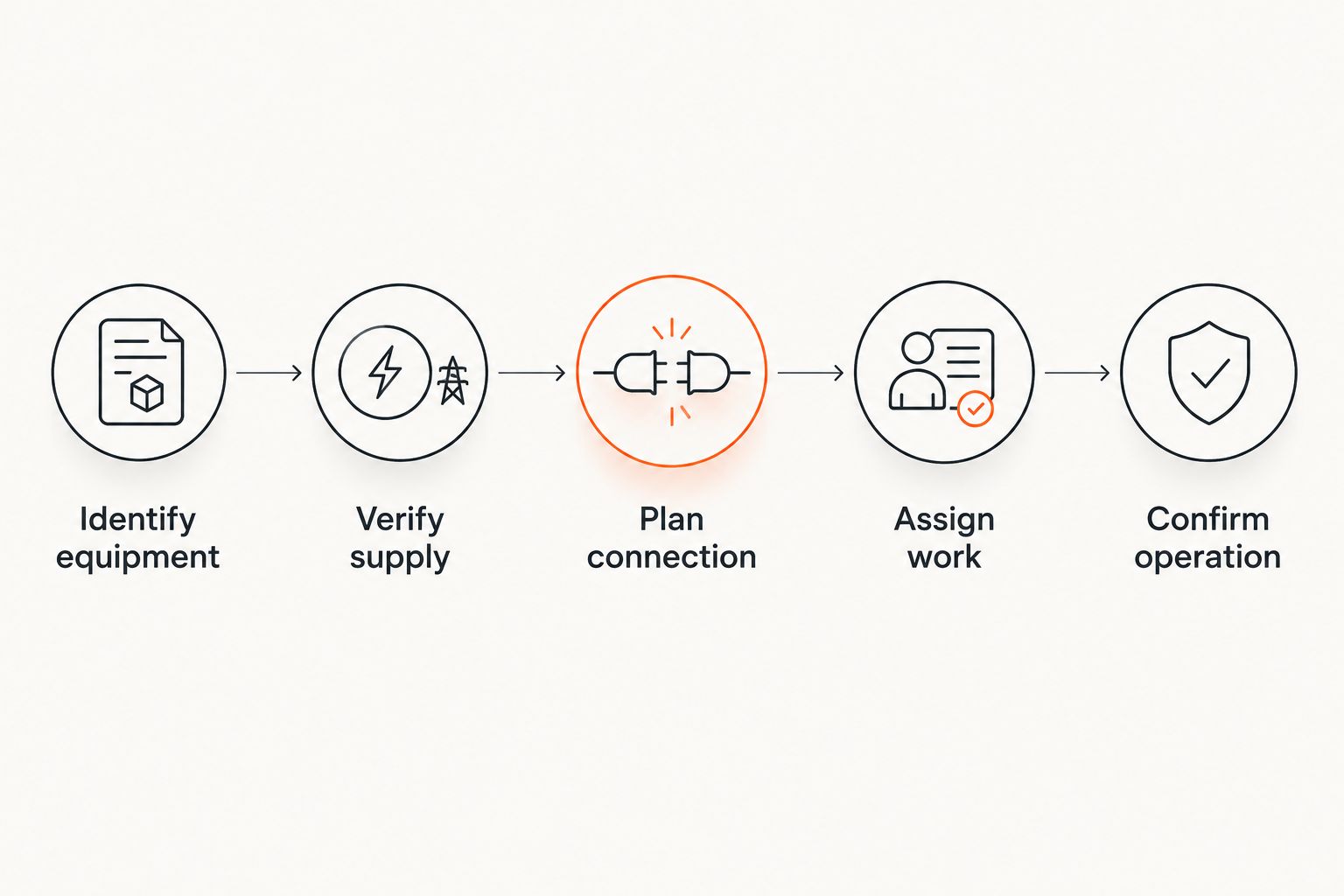
Follow this sequence before you commit to an installation date. It separates equipment selection from electrical work and keeps both tied to the actual placement location.
- Identify equipment. Obtain the proposed manufacturer and model. Request the installation manual and a readable electrical nameplate image. A similar machine's specifications are not a substitute.
- Verify supply. Give those documents to a qualified electrician. Have the electrician verify voltage, phase, frequency, circuit capacity, grounding, and the required protective devices at the proposed location.
- Plan connection. Establish whether the equipment uses an approved cord-and-plug connection or requires hardwiring. Identify the disconnect location and keep electrical access separate from the loading path.
- Assign work. Confirm who performs building electrical work, who handles the equipment connection, and who coordinates any required permits or inspections. Record those assignments before delivery.
- Confirm operation. Have the responsible installer complete the manufacturer's required checks before releasing the compactor for use. Give operators the operating instructions and emergency shutdown procedure.
The 2026 handoff should include a written record of the selected model and approved connection. If the rental model changes, repeat the compatibility review. Approval for one machine does not automatically transfer to another.
Keep the electrical review tied to the delivery schedule. The guide to trash compactor rental installation timing addresses the installation question separately from power compatibility.
Why trash compactor electrical requirements vary
The equipment nameplate and manufacturer's instructions determine the connection requirements. These factors explain why two machines described as trash compactors are not necessarily interchangeable:
- Motor design. The motor has a specified voltage, phase, and frequency. The supply must match the approved configuration.
- Starting demand. A motor draws current during startup as well as while running. Circuit selection must account for the equipment's stated electrical requirements, not just an assumption about normal operation.
- Control equipment. Controls can have different electrical requirements from the main motor. A control voltage shown in the documentation does not necessarily describe the building supply connection.
- Connection method. Cord-connected and hardwired equipment need the connection arrangements specified by the manufacturer. Do not assume every rental arrives ready to plug into a receptacle.
- Installation location. Indoor, outdoor, and wet-location conditions affect the suitability of electrical equipment and its installation. The proposed location must match the installation instructions and applicable requirements.
- Circuit and cable route. Available capacity, conductor selection, and the distance to the machine are part of the electrician's review. An outlet nearby does not settle these questions.
Do not infer electrical requirements from container size, the loading opening, or the machine's footprint. Those characteristics help with site planning, but they do not identify the correct supply.
What should a Bay Area property manager send the rental provider?
Send the equipment location and the operational requirements first. Include a site photo showing the loading area, vehicle access, pedestrian routes, and the proposed electrical connection area.
For a San Jose or Silicon Valley property, identify the person authorized to approve building electrical work. A tenant, property manager, and facilities team can have different responsibilities. Resolve that before anyone schedules modifications.
Use this checklist for a 2026 request:
- Property address and proposed placement location.
- Material you intend to load into the compactor.
- Proposed equipment model, if already selected.
- Manufacturer's electrical documentation.
- Electrician's verified description of the available supply.
- Required delivery, connection, and operational handoff dates.
- Responsible contacts for property access and electrical work.
Do not open an electrical panel to collect photos yourself. Have the qualified electrician document the supply. A clear equipment nameplate photo and a site layout are useful; an unverified guess about building power is not.
Can I plug a commercial trash compactor into a regular outlet?
A nominal 120-volt outlet is suitable only for a compactor explicitly rated for that supply and a circuit that meets its installation requirements. A regular-looking receptacle is not proof of compatibility.
Get written confirmation for the actual rental model. If the equipment requires another voltage, three-phase power, or hardwiring, a regular outlet is not the approved connection.
Can a generator power a rental trash compactor?
A generator is suitable only when its output and capacity meet the compactor's requirements, including motor starting demand. The manufacturer and a qualified electrician must evaluate the proposed setup.
Do not choose a generator from the motor's running demand alone. Connection arrangements, grounding, protective devices, and the installation location also need review before operation.
What if the site has no suitable electrical connection?
Do not energize the compactor until the supply and connection are approved. Either arrange the required electrical work or choose a waste-handling method that does not depend on powered compaction.
Valley Services roll-off container rental fits contractors and property managers who need debris collection without a powered compactor. Valley Services also owns and operates its C&D transfer station in San Jose. That provides a defined disposal endpoint for C&D work, but it does not establish whether a particular compactor or material stream is suitable.
A roll-off container's limitation is straightforward: it does not compact the load. Plan container sizing, accepted materials, safe loading, and pickup access separately. Electrical simplicity does not remove those operating requirements.
FAQ
Can a trash compactor run on standard electrical power?
Yes, if the specific compactor is rated for that supply and the circuit meets its installation requirements. Confirm voltage, phase, frequency, circuit capacity, and connection method before delivery.
Will a commercial compactor work on a normal 120-volt outlet?
A commercial compactor works on a nominal 120-volt outlet only if its documentation specifies that supply and the circuit is suitable. Do not assume commercial rental equipment uses household power.
Does every trash compactor need three-phase power?
No. The specific model's nameplate and installation manual determine whether it needs single-phase or three-phase power. Equipment size alone does not establish the requirement.
Can I use an adapter to connect a compactor to a different outlet?
An adapter does not make an electrically incompatible compactor compatible. It does not change supply voltage or create the required phase configuration. Have a qualified electrician specify the connection.
Can I use an extension cord for a rental compactor?
Do not use an extension cord unless the manufacturer's instructions permit the arrangement and a qualified electrician verifies it. A cord that physically connects is not proof of a suitable installation.
Who should check the electrical connection before delivery?
A qualified electrician should verify the building supply against the rental model's electrical requirements. The rental provider should supply the equipment documentation and clarify installation responsibilities.
What should I do if the compactor keeps tripping the breaker?
Stop using the compactor and have the fault evaluated by a qualified electrician or the responsible equipment technician. Do not repeatedly reset the breaker or replace it with a larger one to keep the machine running.
Does a roll-off container need electrical power?
A roll-off container itself does not need electrical power because it stores debris without powered compaction. You still need suitable placement, accepted materials, and access for delivery and pickup.
One last thing
Confirm the motor supply, not just the control voltage. A low-voltage control label can describe the switches or control circuit rather than the electrical service that powers the motor. Ask for the complete equipment documentation.
For your 2026 project, keep that documentation with the site plan and rental schedule. If placement changes after the electrical review, have the connection route reviewed again. Moving the machine can change the installation even when the model stays the same.
Related guides
- How to choose a compactor size for a retail or grocery store
- Trash compactor rental for warehouses and distribution centers
- How to schedule pickup for a hotel or restaurant compactor
To talk through debris collection and site access for your Bay Area job, call Valley Services at (408) 297-5404.