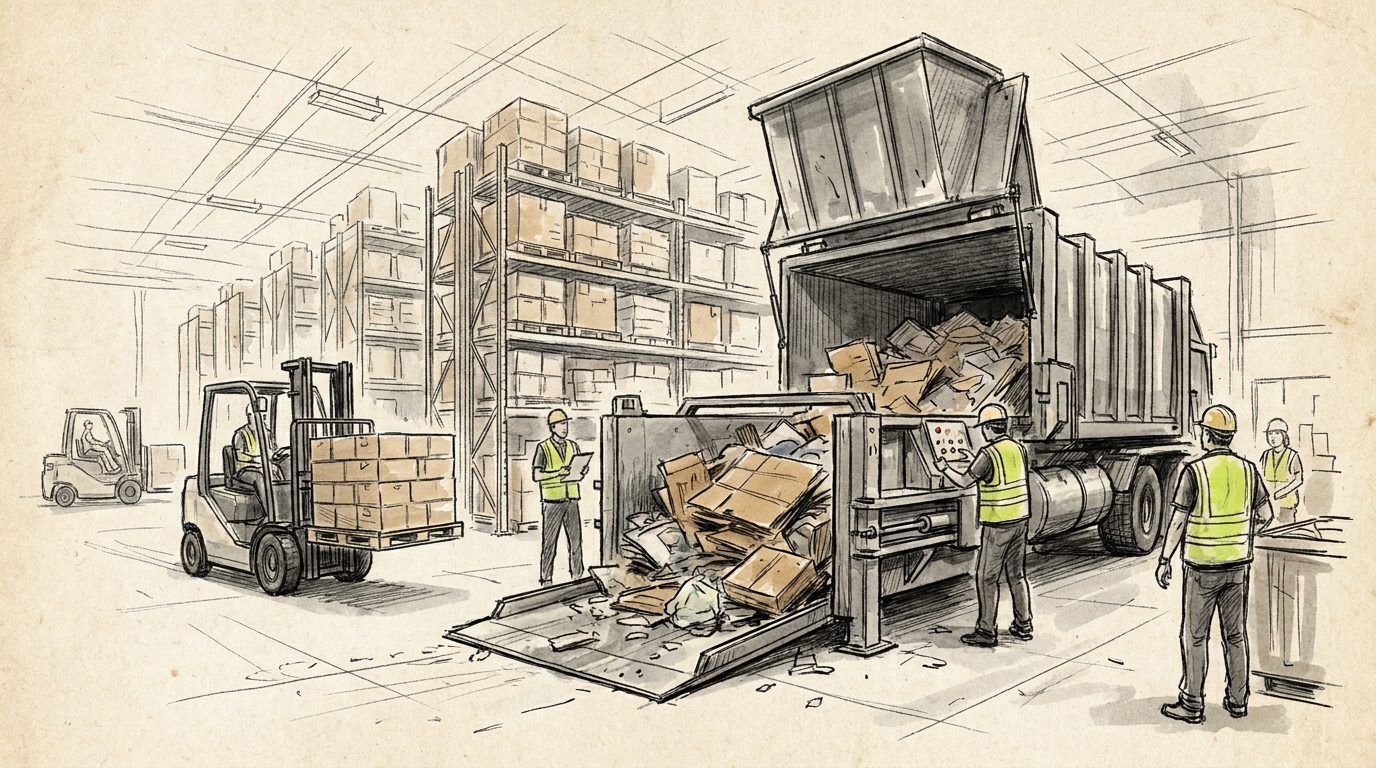
Warehouse and distribution center managers searching for trash compactor rental are usually staring at a dock full of cardboard, pallet wrap, and mixed packaging waste that piled up faster than the last pickup could clear it. Valley Services does not lease stationary compactors, but the roll-off container service run out of the San Jose yard solves the same overflow problem for Bay Area facilities without the concrete pad, the permit, or the maintenance contract a compactor requires in 2026.
- Valley Services does not rent trash compactors; it runs roll-off container service for warehouses and distribution centers instead.
- A 40-yard roll-off container clears the same weekly cardboard and pallet volume a stationary compactor is built for. Buy the swap-out schedule over the lease.
- Compactors advertise 3:1 to 6:1 compaction, but real ratios drop once shrink wrap and foam show up in the stream.
- Dock footprint and permit timelines usually decide the question faster than volume does.
- Valley Services owns its own San Jose transfer station, so container swaps don't wait on a third party's disposal slot.
Why this matters
A stationary compactor sounds like the tidy answer to warehouse waste until the site visit happens. It needs a concrete pad, three-phase power in some cases, a permit from the city, and a maintenance contract for the ram and the hydraulic seals. None of that shows up in the search results for "trash compactor rental."
Roll-off container rental skips the installation step entirely. A truck drops a blue steel container at the dock, your crew loads it during normal operations, and a driver swaps it on a schedule you set. For most distribution centers under 100,000 square feet, that's less equipment to own and less to break down during a peak shipping week.
Who this is for
This guide is for warehouse operations managers, distribution center facility leads, and 3PL site supervisors in the San Jose, Santa Clara, Sunnyvale, Mountain View, and Milpitas area who are comparing a stationary compactor lease against container service before committing to either one. If your dock generates a steady stream of cardboard, stretch wrap, and broken pallets rather than daily wet trash, keep reading.
What matters when you're weighing compactor rental against container service
Weekly volume, not daily volume
Daily trash counts don't tell you much. What matters is how many cubic yards move through the dock in a seven-day stretch, because that number decides whether you need a compactor's continuous processing or a scheduled container swap. Facilities running two or three trailers a day usually generate enough cardboard alone to fill a 30 or 40 yard container weekly.
Dock door clearance and container footprint
A compactor sits in one spot permanently and needs clear access for the hauler's hook truck on collection day. A roll-off container needs the same truck access but none of the fixed footprint, so it works on sites where dock configuration changes as tenants or operations shift. Measure clearance before you commit to either option, not after delivery.
Waste stream mix
Cardboard, shrink wrap, and pallets behave differently than mixed C&D debris or wet trash. A container dedicated to cardboard and paper compacts better on its own than when it's mixed with broken pallets and strapping, and separating the streams cuts down on contamination charges from the hauler.
Pickup frequency and swap-out scheduling
Compactors get emptied on a fixed hauler route, often weekly regardless of how full the unit actually is. Container service lets you call for a swap when the unit is full, which matters during a seasonal volume spike around Q4 receiving or a facility relocation.
Permitting and site placement in San Jose
A stationary compactor installation typically triggers a building permit review because it's a fixed structure with electrical and sometimes plumbing tie-ins. A roll-off container placed on private property inside a warehouse yard usually doesn't need a city permit at all, only a permit if it sits in the public right-of-way.
Equipment ownership and maintenance
A leased compactor is still your crew's problem when the ram jams or a hydraulic hose fails mid-shift. A roll-off container has no moving parts, so the only maintenance question is whether the unit shows up clean and undamaged on delivery.
The container options that actually fit a warehouse
The high-volume swap: 40-yard roll-off container. A 40-yard unit holds roughly the same weekly cardboard and pallet volume a mid-size stationary compactor is rated to process, without the installation. It's the closest direct substitute for compactor rental on a facility running multiple trailers a day. See 40-yard container service for commercial volume for sizing details. Buy this size if your dock clears more than five pallets of packaging waste per day.
The packaging-heavy pick: dedicated cardboard and paper container. Warehouses that run mostly inbound freight generate cardboard as the dominant waste stream, and keeping it separate from mixed debris compacts tighter in the container and simplifies the pickup. Check cardboard and paper container rental if packaging is 60% or more of your waste stream. Consider this if your facility already sorts at the source.
The one-time reset: warehouse cleanout container. Facility turnovers, tenant changeovers, and end-of-lease resets generate a spike of mixed debris that a standing compactor isn't built to absorb in a single week. Container rental for warehouse cleanouts covers that surge without adding a second piece of standing equipment. Buy for any one-time reset over 20 cubic yards.
The wildcard: leasing a stationary compactor anyway. For facilities running consistent volume above 200,000 square feet with dedicated maintenance staff, a compactor's continuous processing can still make sense if the site already has the concrete pad and power in place. Valley Services doesn't provide this equipment, so this option means sourcing a separate equipment vendor and coordinating two different service schedules. Skip it for anything under that footprint in 2026.
“If the compactor needs its own concrete pad and its own permit, a roll-off container already solved that problem in the time it took to schedule the pour.”
What to avoid
- A compactor sized for peak season, run year-round. Oversized equipment sitting mostly empty still needs the same maintenance contract and pad space.
- Mixing cardboard with broken pallets in one container. It looks efficient but drives up contamination charges and cuts real compaction below what the container's rated for.
- Skipping the permit check before ordering equipment. A stationary compactor installed without a permit review can trigger a stop-work order mid-project, which costs more downtime than any equipment choice saves.
Talk through your warehouse waste setup
Call to size a container swap schedule for your dock before peak season hits.
Verdict comparison
| Option | Best fit | Service frequency | Verdict |
|---|---|---|---|
| 40-yard roll-off container | High trailer volume, daily pallet turnover | Swap on call | Buy |
| Cardboard and paper container | Packaging-dominant waste stream | Weekly to biweekly | Consider |
| Warehouse cleanout container | Tenant turnover, facility reset | One-time or short-term | Buy |
| Stationary compactor lease | 200,000+ sq ft, dedicated maintenance staff | Fixed hauler route | Skip under that size |
FAQ
Does Valley Services offer trash compactor rental for warehouses?
No, Valley Services does not rent stationary trash compactors. The company runs roll-off container service for Bay Area warehouses and distribution centers instead, which covers most of the same volume without the installation.
What size roll-off container replaces a warehouse compactor?
A 40-yard roll-off container handles the weekly cardboard and pallet volume most mid-size compactors are rated for. Facilities with lighter packaging waste often do fine with a 30-yard unit instead.
Is a roll-off container cheaper than leasing a compactor?
A roll-off container avoids the installation, permitting, and maintenance costs a stationary compactor carries, though exact rates depend on volume and service term. Call (408) 297-5404 for current container availability in your area.
Do I need a permit for a compactor at my San Jose warehouse?
A stationary compactor installation usually triggers a building permit review because it's a fixed structure with electrical tie-ins. A roll-off container placed on private property inside your own yard typically doesn't need a city permit.
What waste can go in a warehouse roll-off container?
Cardboard, shrink wrap, broken pallets, strapping, and general packaging waste are standard. Hazardous materials, liquids, and electronics need separate disposal and shouldn't go in a standard container.
How often should a distribution center swap its container?
Swap frequency depends on trailer volume, but facilities running multiple trailers a day often need a swap two to three times a week during peak season. Container service lets you call for a swap when the unit is full instead of waiting on a fixed route.
Can I get a container delivered fast if my compactor breaks down?
Container availability depends on current scheduling, so calling ahead of an equipment failure gives more options than waiting until the dock is backed up. Same-day delivery isn't guaranteed but is worth asking about directly.
What's the difference between a compactor and a roll-off container for a warehouse?
A compactor is fixed equipment that compresses waste on-site continuously, while a roll-off container is a standing unit that gets swapped out full for empty on a schedule. Containers need no installation and no maintenance contract.
One last thing
Valley Services owns and operates its own C&D transfer station in San Jose. Competitors that offer container service typically broker disposal to a third-party site, which means their schedule depends on someone else's dump slot. When a distribution center needs an emergency swap during a peak receiving week in 2026, that difference is the whole reason the truck shows up on time.
Related guides
For a warehouse or distribution center weighing compactor rental against container service, call Valley Services at (408) 297-5404 or visit valleyservices.biz to talk through the volume and schedule before committing to either one.