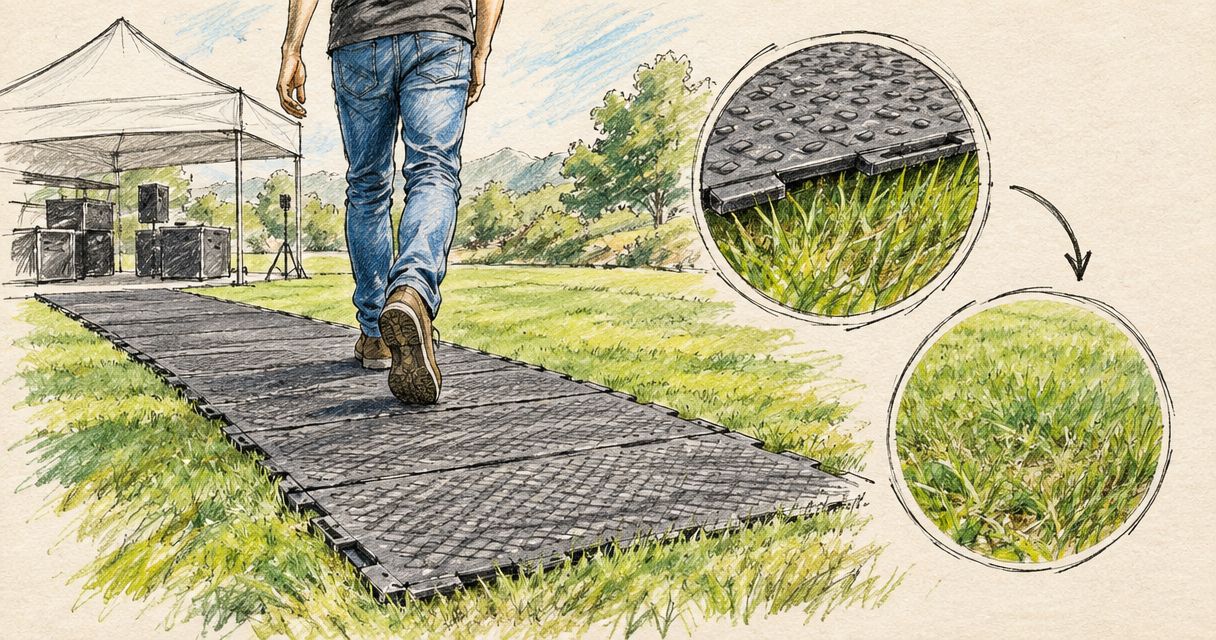
Yes. Ground protection mats can be used on grass, but they cannot guarantee that the grass will remain undamaged. They spread contact across a defined route and reduce direct wear; heavy loads, wet ground, repeated traffic and time under the mats can still leave ruts or stressed turf. In 2026, the safest plan is to inspect the ground, match the mats to the actual load and lift them as soon as the route is no longer needed.
- Ground protection mats can be used on grass, but no mat guarantees undamaged turf.
- Use mats for a defined access route; check ground conditions, equipment loads and turns before traffic starts.
- Keep loaded roll-off containers and other stationary heavy loads off grass unless the placement is specifically assessed.
- For Bay Area events, plan mat removal as part of load-out, not as an afterthought.
Why this matters on a working site
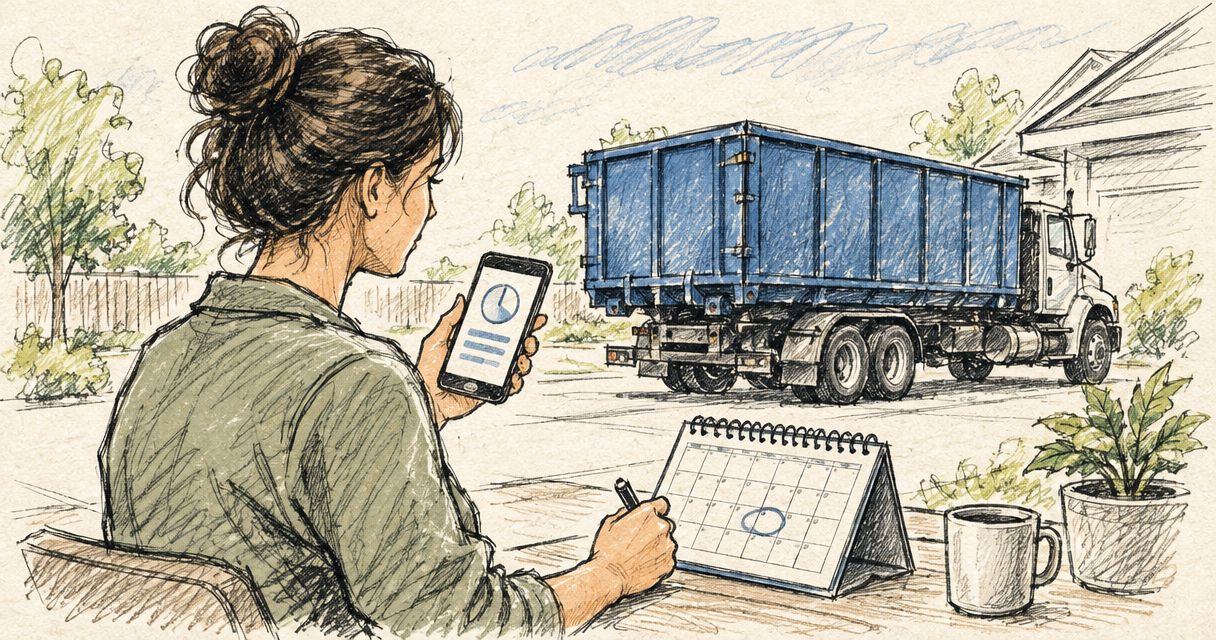
A San Jose event load-in can put carts, delivery vehicles and crews across the same lawn. A construction access route can do the same with different equipment. In either case, placing mats is only part of the job. You need to decide where traffic enters, where it turns and when the route comes out. The outdoor event ground protection mat planning guide covers the wider rental sequence.
The risk is not limited to visible tire tracks. Grass underneath a mat still needs light and air, while the soil beneath it can compress under traffic. If you are responsible for returning a park, venue lawn or managed property in acceptable condition, treat mat placement as a site-control decision. Put the route on the load-in plan and assign someone to inspect it during use.
Can ground protection mats be used on grass without damage?
Yes, when the route, ground and load suit the mats, grass can come through a short installation without obvious damage. No mat makes grass damage impossible. Follow this sequence before you put traffic on a lawn in 2026:
- Inspect turf. Walk the full route. Look for saturated patches, existing ruts, uneven ground, irrigation heads and soft areas near turns. A mat covers these conditions; it does not correct them.
- Check loads. Identify what will cross the route, including loaded vehicles on their way out. Confirm the mat manufacturer's load and installation guidance for that equipment and the ground beneath it.
- Set route. Make the path continuous where traffic needs to travel. Plan entry, turns, unloading and exit before laying mats so drivers do not cut across exposed grass.
- Monitor surface. Check for shifting mats, pooled water, sinking edges and traffic leaving the route. Stop and reassess if the surface changes.
- Lift mats. Remove them when access is finished. Inspect the turf and address displaced soil or surface damage before the area returns to normal use.
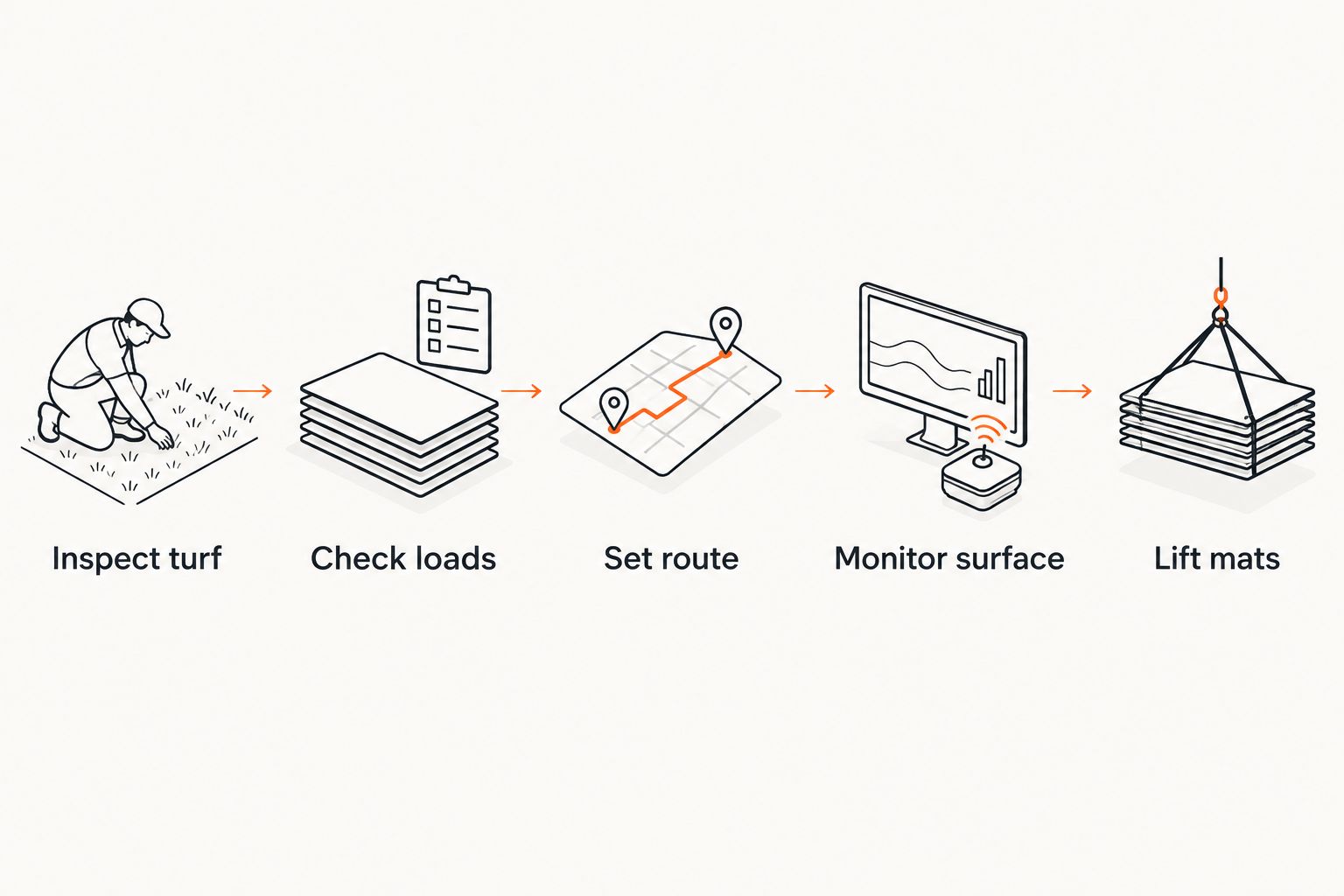
That sequence gives you inspection points. It does not replace a mat supplier's installation instructions or a site-specific assessment for heavy equipment. If you do not know the equipment load or the condition below the grass, resolve that before delivery.
Where should the route begin and end?
Start on a firm access point and end where vehicles can unload or turn without leaving the protected route. Walk both ends from a driver's perspective. A straight run of mats does little good if the vehicle must swing onto exposed grass to make the final turn.
For an event, include service access during the event and removal access afterward. For a jobsite, include the return trip when equipment or vehicles carry a load. In 2026, mark those movements on the same site plan used for deliveries so the route does not disappear beneath later staging decisions.
What should you check during use?
Look at mat edges, joints, turns and low spots. These are the places where a driver can leave the route or where a mat can lose support. If a section rocks, sinks or shifts, keep traffic off that section while the layout and ground are reassessed. Do not assume that covering a soft patch makes it capable of taking a heavier load.
Mats versus an unprotected grass route
The choice is not simply whether mats are available. It is whether the planned traffic needs a defined surface and whether the lawn can support that surface in its current condition.
| Option | Best for | Advantage | Limitation |
|---|---|---|---|
| Ground protection mats | A planned route across grass with loads checked against the mat guidance | Define where traffic travels and reduce direct contact with turf | Can still allow compaction or turf stress; require inspection and removal |
| Unprotected grass | Foot access where the property owner accepts the surface condition | No mat layout or removal | Exposes grass and soil directly to wear, especially at repeated crossings |
Use mats when vehicle or repeated equipment access across grass is necessary and the ground can support the proposed route. If the lawn is already too soft for the load, change the route or the equipment plan. A mat is not permission to drive over ground that has not been assessed.
Why grass damage varies
Two lawns can react differently to the same load. Check these factors before you approve the route:
- Soil moisture. Wet ground deforms more easily under a wheel or mat. Recheck conditions after rain or irrigation.
- Load and contact points. A vehicle, its cargo and the way its weight reaches the ground all matter. Use the actual equipment details when checking mat guidance.
- Traffic pattern. Repeated passes and tight turns concentrate wear in a small area. A clear route keeps drivers from creating new tracks.
- Time covered. Mats block light while installed. Schedule removal for when access ends rather than leaving the route in place without a purpose.
- Existing turf condition. Thin grass, old ruts and soft spots give you less margin. Photograph and note those areas before load-in.
- Installation quality. Gaps, unsupported edges and shifting sections interrupt the route. Inspect the layout before the first crossing and during use.
None of these factors yields a universal safe duration or vehicle weight. Those depend on the mat, the equipment and the site. In 2026, use the manufacturer's instructions and the conditions underfoot, not a generic promise that mats will protect every lawn.
Should a roll-off container sit on grass mats?
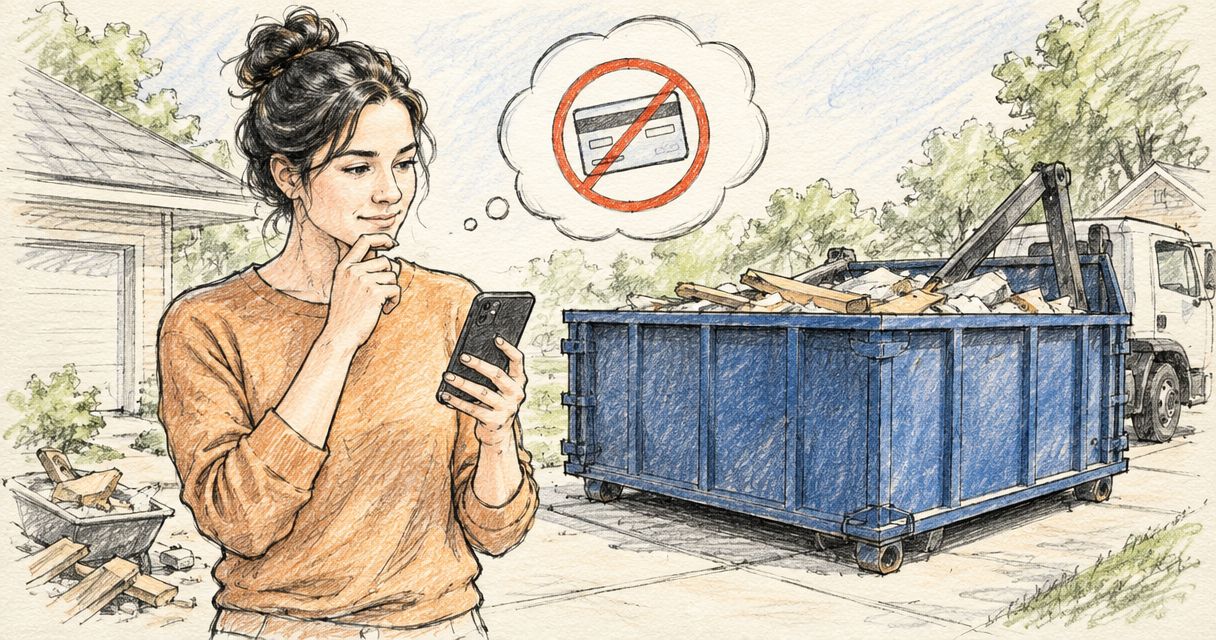
Do not treat a mat route as automatic approval for a stationary roll-off container on grass. A container stays in one place while its load changes, and delivery and pickup also require vehicle access. Assess the placement, the loaded condition and the pickup path separately. If a firm placement area is available, plan around it rather than assuming grass is suitable.
Valley Services rents blue steel roll-off containers in sizes from 8 to 40 yards. For a Bay Area jobsite using a container alongside lawn access, settle the container position before drawing the mat route. Keep the delivery approach and pickup path clear. The container and the access route are connected decisions, but a mat specification for moving traffic does not establish that a loaded container can stand on the same grass.
The same distinction applies to restrooms, fencing and other site equipment. Identify where each item will stand, then identify what must cross the lawn to place or service it. This prevents a planned pedestrian path from becoming an improvised delivery lane.
How do you plan grass access for an outdoor event?
Start with load-in and work backward from the final equipment position. List the vehicles and carts that need lawn access, the direction of travel and where each one will turn. Then plan load-out. A route that works for an empty arrival vehicle still needs checking for the trip out.
At a San Jose or South Bay venue in 2026, confirm the property manager's conditions before scheduling deliveries. Ask which grass areas can be crossed, where irrigation features sit and whether the venue requires an inspection after removal. These are questions to settle with the venue, not permissions to assume from a mat rental.
Keep restrooms, temporary fencing and other event infrastructure on the same layout. Valley Services provides restrooms and fencing for events, but that does not establish a ground protection mat offering. If your plan also calls for mats, confirm their availability and specifications with the mat provider separately. One route drawing should show every load-in movement, regardless of who supplies each item.
Can you leave mats down through the event?
Only if the turf condition and mat provider's guidance support that plan. Check the route during the event and set a removal time in the load-out schedule. The question is not whether the mats are still useful; it is whether the ground underneath remains suitable for the traffic and time planned.
Will grass recover if it looks flattened afterward?
Flattened blades are not the same as undamaged soil. Lift a section when use ends and inspect for ruts, soft spots and displaced ground. Do not promise the property owner recovery on a set timetable without a site assessment.
What belongs on the site plan before delivery?
In 2026, a workable grass-access plan should answer these questions before trucks arrive:
- Who controls the lawn? Get the property owner or venue manager's instructions for access and restoration.
- What crosses it? Identify vehicles, carts, equipment and their loaded trips. Do not plan from the empty delivery trip alone.
- Where does traffic turn? Draw the full movement, not just a straight line between the gate and destination.
- What is under the route? Mark visible irrigation components, drains, slopes, low spots and existing damage for on-site review.
- Who checks the mats? Assign a person to inspect placement before traffic and watch for changes during use.
- When do they come out? Put removal and turf inspection on the load-out schedule.
For general contractors, that plan also needs to account for delivery windows and other site services. Valley Services operates its own C&D transfer station in San Jose and provides roll-off containers, restrooms and fencing. Coordinate those movements with the grass-access route so a container pickup or restroom service vehicle does not cross an unprotected section. Valley Services has operated from the same family yard since 1986, but each new site still needs its own access assessment.
The Valley Services site services homepage is the place to discuss its listed rentals. Confirm mat supply with a provider before including it in any order or site schedule.
FAQ
Can ground protection mats be used on grass without damage?
Yes, they can be used on grass, but they cannot guarantee no damage. Check soil conditions, load, route and time covered before traffic starts.
Do ground protection mats stop grass from getting muddy?
They keep traffic on a defined surface, but they do not make wet soil firm. Reassess the route if mats sink or water collects.
Can vehicles drive over mats laid on a lawn?
Only when the mat manufacturer's guidance and the ground beneath it support the specific vehicle and load. Include turning and the loaded return trip in that check.
Can you put a roll-off container on mats over grass?
Do not assume a mat route is suitable for a stationary roll-off container. Assess the container placement, changing load, delivery approach and pickup path separately.
How long can ground protection mats stay on grass?
There is no universal safe duration for every lawn and mat. Follow the mat provider's guidance, inspect the turf during use and remove the mats when access is finished.
What should you inspect after removing mats from grass?
Check for ruts, soft spots, displaced soil and areas where traffic left the planned route. Record the condition before the lawn returns to normal use.
Does Valley Services rent ground protection mats?
Ground protection mats are not among the Valley Services offerings confirmed here. Valley Services lists roll-off containers, restrooms, temporary fencing, K-rail and C&D drop-off; confirm any additional rental directly before planning around it.
One last thing
Check the exit, not just the entrance. Load-out and pickup can put different loads through the same turn that looked sound during setup. Inspect that turn before the final vehicle moves, then lift the mats and check the grass. For help coordinating Valley Services rentals with your site plan, call (408) 297-5404 to talk through the job.