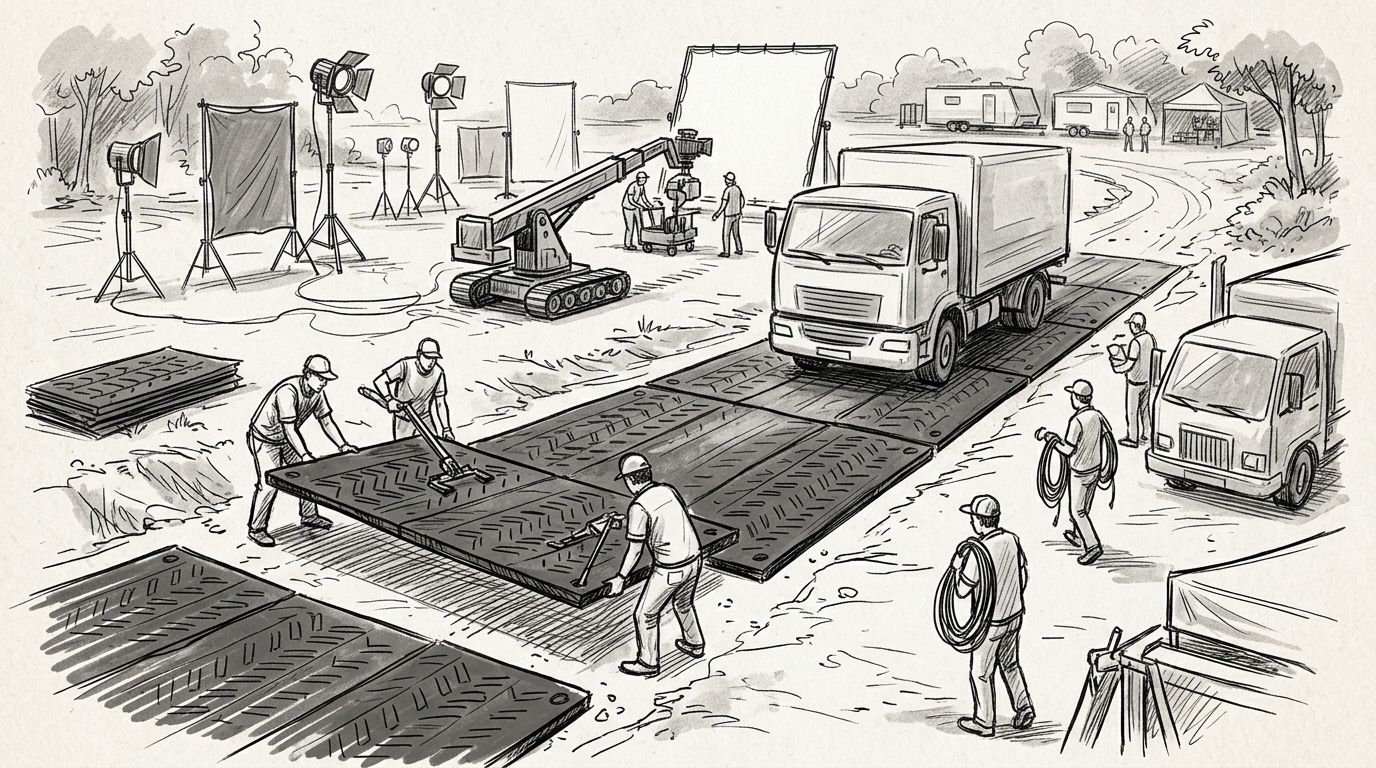
Ground protection mat rental for film sets means laying temporary panels of composite or plywood matting across lawns, parkways, and paved surfaces so grip trucks, generator trailers, and honeywagons can park and drive without rutting turf or cracking a homeowner's driveway. A residential street closure for a two-day shoot has different mat needs than a six-week studio lot buildout, and the location agreement usually spells out exactly what condition the ground has to be in when your crew rolls out.
- Ground protection mat rental for film sets keeps turf, sidewalks, and asphalt intact under grip trucks and honeywagons during load-in and load-out.
- Mat footprint needs to cover parking, staging, and travel paths, not just the camera position.
- Valley Services supplies mats alongside fencing and restrooms for Bay Area production sites from one call.
- Skipping ground protection on a residential location is the fastest way to lose that location for the next shoot.
Why ground protection mat rental matters for film sets
A location manager who damages a lawn or cracks a curb doesn't just pay for the repair. They lose the location for the next production, and location scouts in the Bay Area talk to each other. Insurance certificates for film permits in San Jose, Santa Clara, and Mountain View routinely require proof that surfaces will be restored to original condition, and mats are the standard way to meet that condition without renegotiating the location agreement mid-shoot.
Production schedules also don't leave room for delay. A generator trailer that sinks into wet turf during a night shoot in 2026 can cost hours of setup time that a tight call sheet doesn't have. Mats solve a scheduling problem as much as a surface problem.
How to plan ground protection mat rental for a production set
Scout the location before the mat order goes out
Walk the site with the location manager and note every surface type the production will touch, not just the hero shot location.
- Lawn, gravel, dirt, or paved surface at each stopping point
- Slope and drainage, since standing water changes which mat type holds up
- Existing hardscape features (sprinkler heads, drain covers, tree roots) that need separate protection
- Access points where trucks will turn, back in, or park overnight
- Any permit language specifying restoration condition
Match mat type to the surface you're protecting
Plywood works for short, light-duty pedestrian paths. Composite or high-density polyethylene panels handle repeated heavy vehicle traffic across turf and gravel without the panels themselves failing.
- Turf and soft ground: composite mats spread the load and keep tires from sinking
- Gravel and dirt lots: mats prevent rutting that turns into a mud problem after rain
- Existing pavement: mats prevent point-loading from stabilizer jacks and generator feet
- Sidewalks and ADA paths: lighter-duty panels keep pedestrian access clear during load-in
Calculate square footage for every vehicle on the call sheet
A grip truck, a generator trailer, a honeywagon, and a base camp trailer each need their own footprint plus room to maneuver. Underestimating this is the single most common ordering mistake on a film site.
- List every vehicle expected on set, including vendor trucks
- Add the turning radius for trucks that back into position
- Include the path from the street to the parked position, not just the parking spot
- Add staging area for equipment carts moved by hand
Schedule mat delivery around load-in and load-out
Mats need to be down before the first truck arrives and picked up after the last one leaves, which means the delivery window has to sit ahead of crew call time.
- Confirm delivery at least a day before principal load-in on multi-day shoots
- Coordinate mat crew arrival with the location manager's access hours
- Build in time for mat placement crews to walk the site once before trucks arrive
- Flag any night shoot logistics that affect delivery timing
Protect turning radii and staging areas separately from parking spots
A truck that's parked correctly can still tear up ground while turning into position. Staging areas where crew stack equipment carts see as much foot and wheel traffic as the parking spot itself.
- Map turning arcs for the largest vehicle on the call sheet
- Extend mat coverage past the parked footprint on both ends
- Cover cart paths between the truck and the set separately
- Reassess coverage if the shot list changes vehicle positions mid-shoot
Plan for multi-day or multi-location shoots
A production moving between two or three Bay Area locations in the same week needs a mat plan for each site, not one mat order stretched thin.
- Confirm each location's surface type before mats move
- Build in a same-day pickup and redelivery window between locations
- Track which mats go where if different surface types need different mat classes
- Reconfirm restoration requirements at each address
Coordinate mat rental with fencing and restrooms for full site control
Ground protection is one piece of site logistics. A production locking down a residential street or a lot for several weeks in San Jose or Santa Clara typically needs temporary fencing for crowd and equipment control and portable restrooms for cast and crew, ordered from the same yard so delivery windows line up. Some productions also need roll-off containers for wrap-out debris once the shoot closes.
Confirm pickup timing and site restoration before wrap
The location agreement usually sets a restoration deadline. Mat pickup has to happen early enough that any remaining cleanup, striping, or turf repair fits inside that window.
- Confirm exact pickup date with the mat vendor before wrap day
- Walk the site with the location manager before mats come up
- Photograph the surface condition before and after for the location file
- Flag any surface issue immediately rather than waiting for the location owner to notice
Line up mats for your next shoot
One call covers mats, fencing, and restrooms for Bay Area production sites.
Comparing ground protection options for a production set
| Option | Best for | Key limitation |
|---|---|---|
| Composite/HDPE mats | Turf, gravel, repeated heavy vehicle traffic | Requires enough lead time to size and deliver correctly |
| Plywood sheeting | Short, light-duty pedestrian paths | Doesn't hold up under repeated truck traffic or rain |
| Steel road plates | Short spans over trenches or utility cuts | Heavy to move by hand, not practical for wide lawn coverage |
| No protection | Paved lots already rated for heavy vehicles | Any lawn, gravel, or landscaped surface is at risk |
For a full breakdown of load ratings across mat types, see the ground protection mat rental ranked by load capacity.
Verdict: for any Bay Area production touching turf, gravel, or a residential street, composite ground protection mats are the only option that survives multi-day heavy vehicle traffic without a restoration bill.
Common mistakes film productions make with ground protection
- Sizing mats to the camera position instead of the full vehicle footprint. Grip trucks and generator trailers need coverage the shot list doesn't show.
- Forgetting the turning radius. A truck that arcs into position tears ground the parked footprint never touched.
- Ordering mats the same week as the shoot. Lead time matters more on locations with strict permit conditions.
- Treating base camp and staging as low-risk. Foot and cart traffic there can do as much damage as vehicle traffic on set.
- Skipping the pre- and post-condition photos. Without them, a damage dispute with a location owner has no record to point to.
FAQ
What is ground protection mat rental for film sets?
It's the temporary placement of composite, plywood, or steel panels across turf, gravel, or pavement so production vehicles and equipment don't damage the surface. Productions in 2026 typically build this into the location agreement's restoration terms.
How much ground protection does a film shoot actually need?
Enough to cover every vehicle on the call sheet, its turning radius, and the cart paths between parking and set, not just the parked footprint. Multi-truck shoots almost always need more square footage than the initial location scout estimate.
Do ground protection mats work on wet or muddy ground?
Composite and HDPE mats are built for soft, wet ground and spread vehicle weight across a wider surface than plywood can handle. Plywood breaks down fast under repeated traffic in rain.
How far in advance should a production order mats?
Order as soon as the location is locked, ideally a week or more before load-in on multi-day shoots. Locations with strict permit or restoration language need extra lead time to size the order correctly.
Can the same mat order cover multiple film locations?
Yes, but each location needs its own surface assessment since a lawn and a gravel lot call for different coverage. Productions moving between Bay Area locations in the same week should confirm a same-day pickup and redelivery window.
What happens if a production skips ground protection and damages a location?
The production typically covers restoration costs under the location agreement, and the location manager may decline to work with that production again. Repeat film work in the same neighborhood depends on leaving the surface the way it was found.
Do ground protection mats replace the need for temporary fencing?
No. Mats protect the ground surface; fencing controls access and crowd movement around the set. Most multi-week Bay Area shoots need both.
Who supplies ground protection mats for film sets in the Bay Area?
Valley Services supplies ground protection mats for San Jose, Santa Clara, Sunnyvale, Mountain View, and Milpitas production sites, alongside fencing and restroom rentals for the same location.
One last thing
Valley Services has handled site logistics for Super Bowl LX and the San Jose Marathon, events with the same load-in windows, tight restoration deadlines, and location-preservation rules a studio production runs under. That's the same planning that goes into sizing a mat order for a two-day shoot on a residential street in 2026: measure every vehicle, cover the turning arcs, and confirm pickup before the location owner walks the site.
Call (408) 297-5404 or reach out through valleyservices.biz to talk through mat, fencing, and restroom logistics for your next shoot.