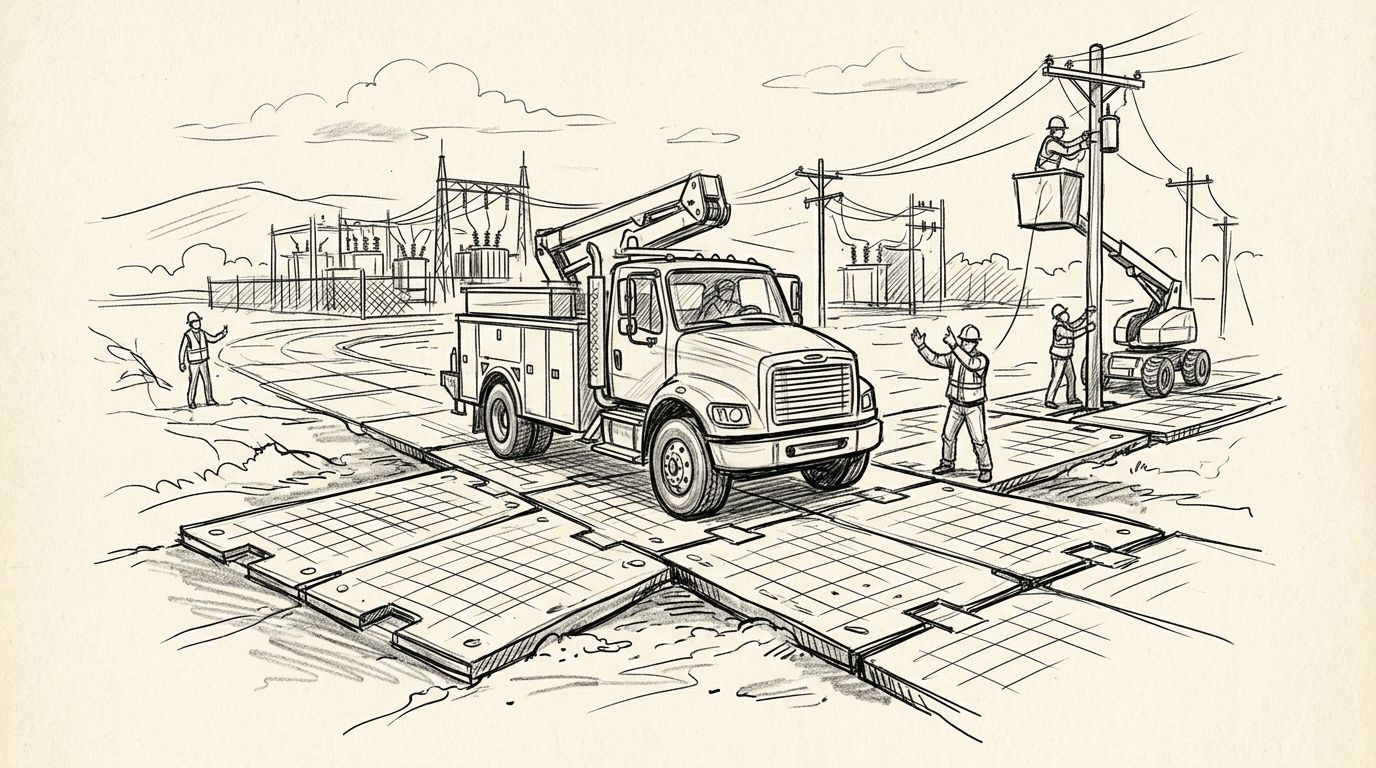
Ground protection mats for utility companies protect turf, pavement, and soft ground from digger derricks, bucket trucks, and crane outriggers during transformer swaps, joint trench work, and storm restoration. Bay Area utility crews use them to keep equipment moving without tearing up easements, HOA common areas, or private lawns they have to restore when the job closes out.
- Ground protection mats for utility companies spread equipment load across turf, wetlands, and easements to stop rutting and restoration disputes.
- Size mats to the heaviest point load on site in 2026: digger derrick outriggers, not the truck's gross weight.
- Composite mats hold up to repeat crossings and wet ground; timber mats work fine for a single storm restoration pass.
- Valley Services rents ground protection mats alongside temporary fencing for utility and pipeline crews working San Jose, Santa Clara, and the South Bay.
Why ground protection mats matter for utility companies
Utility crews rarely work on a blank job site. Transformer replacements happen in someone's side yard. Joint trench work cuts through a business park's landscaped frontage. Storm restoration sends a digger derrick across a homeowner's lawn at 2 a.m. Every one of those sites has to look the way it did before the crew arrived, or the utility company answers for it.
Ground protection mat rental exists for exactly that gap. Mats distribute a vehicle's weight over a wider footprint so the ground underneath does not compress, rut, or fail. On a joint trench job that means the equipment access lane; on a substation build it means the crane pad; on storm restoration it means whatever path gets a bucket truck to a downed line before daylight.
Cal/OSHA equipment stability rules require full bearing surface under outriggers and stabilizers before a crane or derrick can lift. Soft or uneven ground without mats does not meet that standard, and a shifted outrigger during a lift is not a paperwork problem, it is a safety incident.
Assess your ground conditions before you order
Mat selection starts with the ground, not the catalog. A crew that skips this step ends up ordering twice, once for the wrong mat and once for the right one.
- Walk the access route and note soil type: clay, loam, sand, or fill
- Check for standing water, recent rain, or a high water table
- Flag slopes over roughly 10 degrees where mats need pinning
- Identify sensitive surfaces: irrigation lines, septic fields, root zones, pavers
- Confirm whether the ground is a protected easement or wetland buffer
Match mat capacity to your heaviest point load
The number that matters is not the vehicle's total weight. It is the load at the heaviest single contact point, usually an outrigger pad or crane track.
- Pull the outrigger or track load rating from the equipment spec sheet, not the curb weight
- Add a margin for uneven ground where load concentrates on one edge
- Confirm mat bearing capacity against that number before booking, not after delivery
- Ask whether multiple pieces of equipment will cross the same mat run
- Check for ground protection sized for equipment access rather than foot traffic only
Plan mat routes for the whole job, not just one pad
A single mat under one outrigger solves one problem. Utility jobs usually need a continuous route: staging area, access lane, and work pad, planned together.
- Map the full path from street or staging area to the work zone
- Plan for return trips and material deliveries, not just the initial setup
- Leave room for a second vehicle to pass if the crew runs two trucks
- Coordinate mat placement with any temporary fencing so the two do not conflict
- Confirm the route clears meters, valve boxes, and vaults that cannot bear weight
At this stage, renting from a single vendor for mats and site control saves a step. Valley Services delivers ground protection mats and temporary fencing together for utility and pipeline crews working the same footprint, which cuts down on coordinating two separate trucks to the same address.
Coordinate mat delivery with crew mobilization
Storm restoration does not run on a two-week lead time. Planned transformer or substation work does, but the mats still need to land before the equipment does.
- Confirm delivery access for the mat truck itself, which is heavier than most job vehicles
- Schedule mats to arrive ahead of the crane or derrick, not alongside it
- For emergency restoration, confirm same-day or next-day availability before the storm hits, not during it
- Verify quantity against the full route length, including staging, not just the work pad
Interlock and pin mats for crane and derrick loads
A mat that shifts under an outrigger during a lift is worse than no mat at all. Interlocking and pinning keep the surface stable under repeated load cycles.
- Use interlocking edges or pins on any slope or soft-soil placement
- Overlap mat joints under the heaviest expected load path
- Re-check pinning after the first equipment pass, before the crew starts the actual work
- Inspect for cracked or warped mats before placing them under a crane pad
Monitor mat performance as work progresses
Ground conditions change during a multi-day job. Rain, repeated crossings, and equipment idling in one spot all shift the load picture.
- Re-walk the route after any rain event during the job
- Check for sinking or visible compression at mat edges
- Reposition or add mats if traffic concentrates in one lane
- Log any mat damage so it gets addressed before pickup, not after
Remove mats and restore the site at close-out
Restoration is the step that determines whether the property owner, the HOA, or the city calls back with a complaint. Do not skip it because the visible work is done.
- Wait until the ground has drained before pulling mats, not just until the crew is ready to leave
- Inspect the surface under each mat for compaction or rutting before removal
- Regrade and reseed turf areas as part of close-out, not as a follow-up trip
- Photograph the restored area for the utility company's own records
Line up mats and site control together
Call to plan ground protection and fencing for your next utility job.
Comparison: mat options for utility work
| Option | Best for | Key limitation |
|---|---|---|
| Timber mats | One-time storm restoration or short-duration access | Heavier to move, degrade faster under repeat crossings |
| Composite/HDPE mats | Repeat crossings, wet or soft ground, multi-day jobs | Higher unit weight per mat than timber for the same footprint |
| Aluminum mats | Crane pads and high point-load lifts | Cost to replace if damaged is higher than timber |
| Steel plates | Short paved-surface crossings, trench covers | Poor traction and load spread on unpaved or wet ground |
Common mistakes utility crews make with ground protection mats
- Sizing for truck weight instead of point load. A digger derrick's outrigger can concentrate more force on one spot than the truck's total weight suggests.
- Skipping mats on wetland or protected easements. Rutting on a protected buffer triggers restoration claims that cost more than the mat rental would have.
- Treating storm restoration like a scheduled job. Crews that wait to source mats after an outage hits lose hours a planned job would never lose.
- Not interlocking mats on slopes. Equipment shifting a loose mat mid-lift is a stability failure, not a minor inconvenience.
- Pulling mats before the ground drains. Removing mats too early just moves the rutting problem to the last step of the job.
FAQ
What are ground protection mats used for on utility jobs?
Ground protection mats spread the weight of trucks, digger derricks, and cranes across a wider footprint so turf, soil, and pavement do not rut or crack. Utility crews use them for transformer work, joint trench access, substation builds, and storm restoration in 2026.
How heavy do ground protection mats need to be for a digger derrick?
Mat capacity should match the outrigger or track point load from the equipment spec sheet, not the vehicle's total weight. That figure is usually higher per square foot than most crews assume.
Are composite mats better than timber mats for utility work?
Composite mats hold up better under repeat crossings and wet ground. Timber mats work fine for a single storm restoration pass or a short-duration job where the mat comes out within a day or two.
Can ground protection mats be used on wet or muddy ground?
Yes, that is one of their main uses. Composite mats in particular are built for soft, saturated ground where a truck would otherwise sink or rut the surface.
How long can utility companies keep mats rented on a job site?
Rental duration depends on the job, from a single overnight restoration call to a multi-week substation build. Confirm the timeline when booking so mats stay on site through the full access period.
Do ground protection mats replace the need for a permit?
No. Mats protect the ground surface but do not substitute for any encroachment or right-of-way permit the job already requires from the city or property owner.
What size are standard ground protection mats?
Most rental fleets run mats in the 3-foot by 8-foot and 4-foot by 14-foot range, sized to match common truck and crane track widths. Larger crane pads may combine several mats into one continuous surface.
One last thing
The mat is only half the equation. The route planning that happens before the mats ever get pinned down is what actually prevents the callback, because most restoration disputes trace back to a route nobody walked first, not a mat that failed. Valley Services has been running site logistics out of the same San Jose yard since 1986, third generation, same family, which means the person answering the phone has seen what happens when a utility crew skips that walk-through.
Related guides
- Ground protection mats ranked by load capacity
- Temporary fencing for utility companies
- Portable restroom rental for utility and pipeline crews
Call (408) 297-5404 or visit valleyservices.biz to plan mats, fencing, and restrooms for your next utility job.