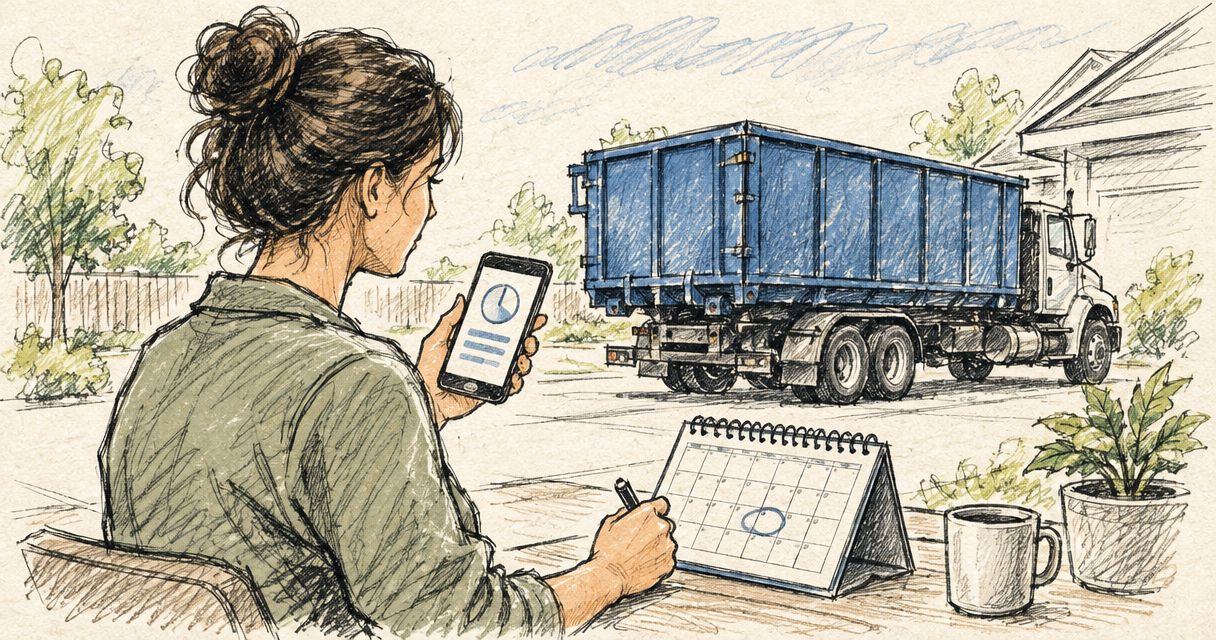
Yes. You can rent a roll-off container without a driveway if you have an authorized placement area and the delivery truck can safely reach it. For a 2026 renovation or cleanout, confirm property permission, any public right-of-way approval, and truck access before scheduling delivery.
- A driveway is not required for roll-off container rental. Authorized placement and truck access are required.
- Street placement requires a local approval check. An open parking space is not permission.
- Shared parking requires property approval and a plan that preserves access through pickup.
- Valley Services fits Bay Area contractors coordinating roll-off container rental with an owned San Jose C&D transfer station.
Can I rent a roll-off container without a driveway?
Yes. The deciding factors are permission, surface suitability, and truck access, not whether your property has a driveway. A street space, private parking lot, or accessible work area can be a candidate. Each needs a placement review before you commit.
Start with the property boundary. A curb beside your house is not automatically yours to occupy, and an apartment parking space does not automatically allow equipment placement. For a San Jose street location, review the San Jose container placement permit guide before arranging delivery.
| Placement option | Suitable for | Practical advantage | Limitation to resolve |
|---|---|---|---|
| Street or curbside space | Properties with no usable private placement area | Keeps the container near the work | Public right-of-way approval, restrictions, and truck approach need review |
| Private parking lot | Apartment turnovers and commercial renovations | Provides an alternative to driveway placement | Owner approval, circulation, and surface suitability need review |
| Accessible private work area | Renovations with usable space inside the property | Keeps loading within the site | Gates, overhead obstructions, ground conditions, and retrieval access need review |
| C&D transfer station drop-off | Projects with no workable container location | Avoids storing a container at the property | You must arrange transport and confirm material acceptance and unloading requirements |
Do not book a location simply because a container appears to fit. The truck must place it, and later retrieve it when loaded. Those operations need their own space.
Why this matters on a Bay Area jobsite
Demolition starts inside the building. The placement problem starts outside it. If the container location is unresolved, your crew has no confirmed destination for debris coming through the door.
Treat placement as part of the work plan, not an instruction left for the driver. Identify who approves the space, who clears it, and who keeps it clear through pickup. On a shared property, those responsibilities often belong to different people.
For a 2026 project in San Jose, Santa Clara, Sunnyvale, Mountain View, or Milpitas, check the rules for the actual placement address. Do not apply a neighboring city's instructions to your site. Property permission and public-space authorization are separate questions.
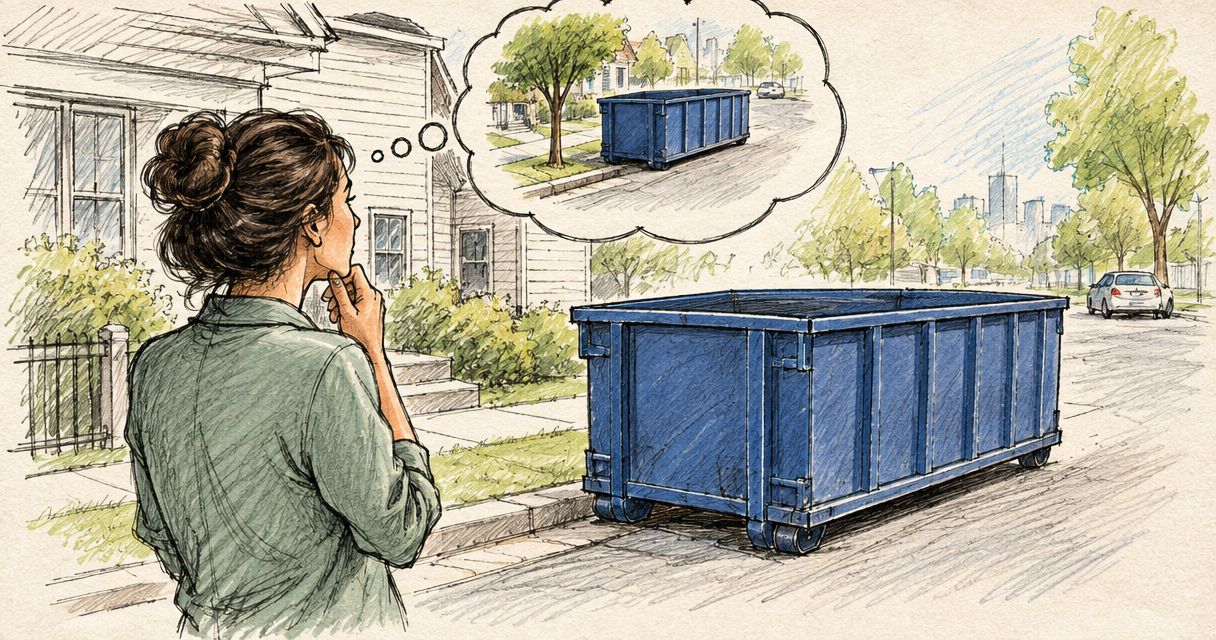
Can I put a roll-off container on the street?
Street placement is an option only after the responsible authority and rental provider confirm the location. Ask the city or other road authority what approval applies to a temporary container in the public right-of-way. Then give the provider the proposed position and access details.
Describe the exact space. Include the street address, side of the street, nearby driveways, parking restrictions, and anything that affects the truck's approach. A photo of an empty curb is useful, but it does not establish authorization.
Before delivery, resolve these points:
- Placement approval: Determine what authorization applies and who obtains it.
- Parking restrictions: Check posted restrictions and any conditions attached to the placement approval.
- Access routes: Keep neighboring driveways, entrances, and required emergency access unobstructed.
- Pedestrian movement: Do not treat the sidewalk or curb ramp as spare container space.
- Delivery and pickup: Confirm how the location will remain accessible for both visits.
Do not move cones into a public parking space and assume the space is reserved. Ask the responsible authority how any required reservation or traffic control must be handled.
Can I use an apartment or commercial parking lot?
A private parking lot can work if the property owner or authorized manager approves the placement and the provider accepts the access conditions. Your permission to park a vehicle does not establish permission to place a roll-off container.
For an apartment turnover, show management the proposed container position and the route from the unit. Identify which parking spaces and travel paths the operation affects. Give management the delivery and pickup plan before notifying residents.
For a commercial renovation, review the placement against normal operations. Customer parking, receiving activity, service entrances, and emergency access still need to function. A location that works before opening can become blocked once the business is operating.
Get the approval in writing and keep the approved position specific. A marked site photo or simple sketch reduces confusion between the owner, contractor, and delivery driver. It also gives you a reference if someone asks to move the container later.
Can I place a container in a yard or behind a gate?
An accessible private work area is another candidate, but an open yard is not automatically suitable. Ask the provider to review the surface, approach, gate opening, overhead conditions, and space needed to place and retrieve the container.
Measure the narrowest point along the route, not just the final location. Show the provider fences, gates, retaining walls, low branches, overhead lines, slopes, and changes in surface. Let the provider specify the required clearance for the assigned equipment.
Do not use a generic clearance figure from another rental listing. Truck requirements and container dimensions need confirmation for your order. Likewise, do not assume that boards or ground protection make an unsuitable surface acceptable.
Keep the approach available after delivery. Stored materials, parked vehicles, scaffolding, and temporary fencing can change the route during a project. The pickup path belongs in the site plan from the start.
How do I confirm a placement before booking?
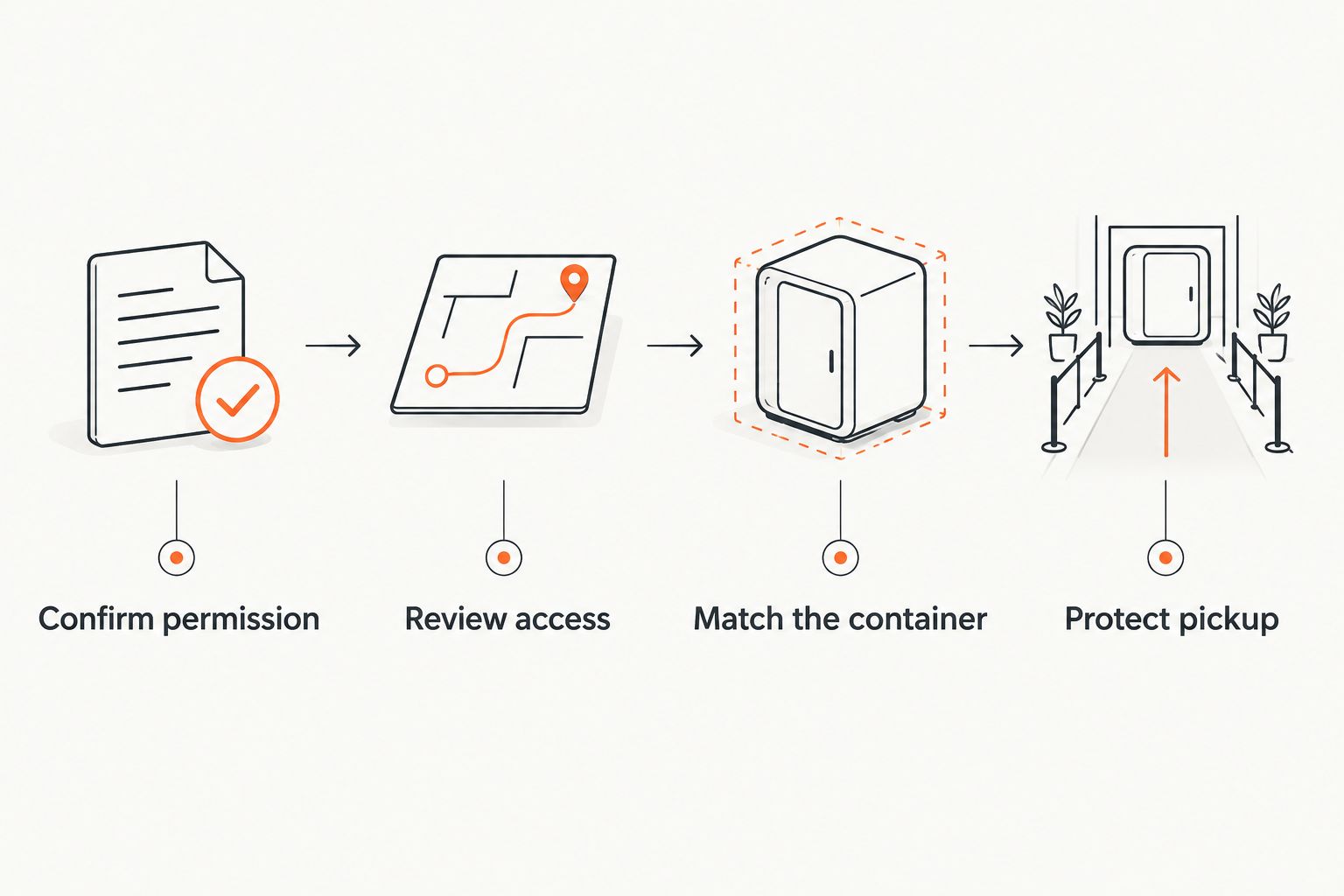
Use this sequence before committing your demolition or cleanout schedule. Resolve the location first, then match the container and delivery plan to it.
- Confirm permission. Identify who controls the placement area. Obtain property approval and check public right-of-way requirements where applicable.
- Review access. Photograph the truck approach, proposed position, gates, surface, and overhead obstructions. Send measurements for the narrow points.
- Match the container. Describe the debris and project scope. Ask the provider to confirm container dimensions, loading restrictions, and placement requirements.
- Protect pickup. Assign someone to keep the approach clear. Coordinate the removal plan with parking, trades, deliveries, and property operations.
The sequence matters. Choosing a container before checking the location can leave you with a unit that suits the debris but not the site.
Does a smaller container solve an access problem?
A smaller container does not automatically solve restricted truck access. Container capacity and delivery clearance are different measurements. You need both confirmed.
Valley Services offers blue steel roll-off containers from 8 cubic yards to 40 cubic yards. Those figures describe capacity, not the street space or truck operating area required. For a 2026 order, request the actual dimensions of the proposed unit rather than selecting by cubic-yard capacity alone.
Describe what you are removing. Bulky cleanout material and dense demolition debris create different loading decisions. Ask which materials can share the container, what loading restrictions apply, and how the provider wants the load prepared.
A tight site also changes the loading route. Check whether workers can reach the container without crossing active vehicle paths or blocking building access. The placement must work for the crew as well as the truck.
Why placement requirements vary
There is no single placement plan for every property without a driveway. Review these factors against the actual site:
- Who controls the space: Public curbside space, shared parking, and private work areas have different approval paths.
- Truck approach: Turns, gates, parked vehicles, and overhead obstructions affect delivery and retrieval.
- Surface conditions: The provider must assess whether the proposed ground or pavement is suitable for the operation.
- Container and debris: Capacity, physical dimensions, material type, and loading restrictions need to match the work.
- Site schedule: Other deliveries, occupied parking, property operations, and changing work areas affect access.
Do not solve one factor by ignoring another. A nearby curb is not useful without authorization. A permitted location is not useful if the truck cannot service it.
What if there is nowhere to place a container?
If no placement area passes the permission and access checks, review a transport-and-drop-off plan instead. That changes the work: debris leaves in your hauling vehicle rather than remaining in a rented container at the property.
Valley Services owns and operates its C&D transfer station in San Jose at 1611 S 7th St, San Jose, CA 95112. The company has operated from the same yard since 1986 and is third-generation family owned. In 2026, that is 40 years at the same yard.
Valley Services suits Bay Area contractors who need roll-off container rental and an owned San Jose C&D disposal endpoint. The limitation is geographic: the transfer station is in San Jose, even though the rental service area extends across surrounding Bay Area cities.
For a no-driveway project, confirm accepted materials, vehicle access, and unloading instructions before hauling. Owning the disposal endpoint does not authorize street placement or make a restricted site accessible. Discuss both ends of the job through Valley Services.
What should I send before delivery?
Send a placement brief that lets the provider review the site without guessing. For your 2026 project, include the work dates and identify who will be present to resolve access questions.
- The property address and proposed container position.
- Photos showing the full truck approach and placement area.
- Measurements at gates and other narrow points.
- Surface conditions and visible overhead obstructions.
- The debris type and scope of the renovation or cleanout.
- Property approval and the status of any public-space authorization.
- The delivery contact and the person responsible for keeping pickup access clear.
Avoid vague instructions such as placing the container wherever it fits. Agree on the position before arrival. If conditions change, notify the provider rather than substituting a new location without review.
Can I use my neighbor's parking area?
You can propose a neighbor's private parking area if the person authorized to approve its use agrees and the provider accepts the placement. Neighbor consent does not authorize occupying adjacent public space.
Record the exact location and how long you intend to use it. Make sure the arrangement preserves access for everyone affected, including during delivery and pickup.
Can I move the container after delivery?
Do not attempt to reposition a delivered roll-off container yourself. Contact the provider if the location needs to change. The new position requires the same permission and access review as the original one.
Plan around that restriction before the truck arrives. Place temporary fencing, material deliveries, and parking assignments so they do not force a later move.
FAQ
Can I rent a roll-off container if my house has no driveway?
Yes, if you have an authorized placement area and the delivery truck can safely place and retrieve the container. Review street space, approved private parking, or another accessible work area before booking.
Do I need a permit to place a container on the street?
Check with the authority responsible for the street before scheduling placement. Confirm the requirements for your exact address and proposed location in 2026 rather than assuming that an open parking space is authorized.
Can a container go in my apartment parking space?
An apartment parking space needs approval from the property owner or authorized manager before container placement. The provider also needs to review truck access, surface suitability, and pickup access.
Will a smaller container fit on a narrow street?
A smaller container does not establish that the delivery truck can service a narrow street. Ask for the proposed unit's dimensions and the assigned truck's access requirements.
Can I place a roll-off container on grass?
Ask the provider to review the ground conditions before approving grass placement. Do not assume that ground protection makes every surface suitable.
What can I do if there is no container placement area?
Review a transport-and-drop-off plan for your C&D material. Confirm material acceptance, vehicle access, and unloading instructions before arranging the haul.
Who should keep the pickup area clear?
Assign a named site contact to keep the truck approach and retrieval area clear. Coordinate that responsibility with the property manager, occupants, and other trades.
One last thing
Check the pickup route as carefully as the delivery route. A container can sit in the correct place while the truck's approach becomes blocked by the next phase of work.
Put retrieval access on the same site sketch as placement. Before installing fencing, staging materials, or changing parking assignments, check that sketch again. The location decision remains active until the container leaves.
Related guides
- Schedule container delivery and pickup
- Load a roll-off container safely
- Plan C&D disposal in San Jose
Have the placement photos and debris description ready, then call (408) 297-5404 to talk through your job.