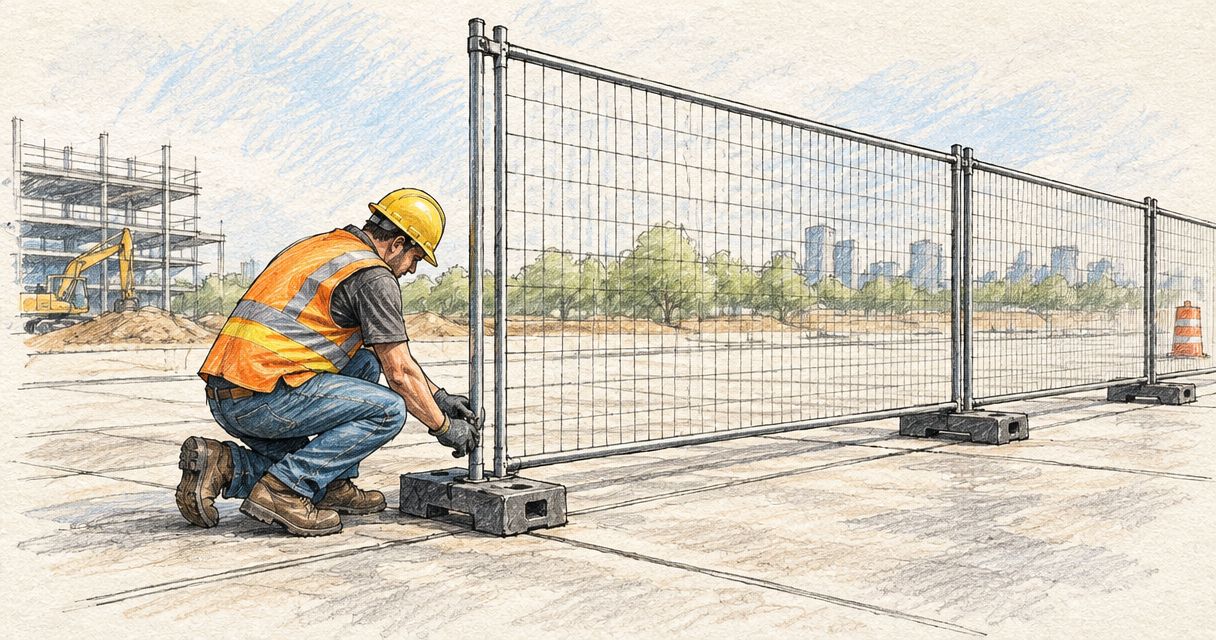
Yes. Temporary fencing can be installed on concrete or pavement using freestanding panels with suitable bases and ballast, without drilling into the surface. Anchored installation is another option when the property owner approves it and the site conditions support the attachment. The right setup depends on access, wind exposure, surface condition and what the fence must keep separate.
- Yes, temporary fencing can be installed on concrete with freestanding bases and suitable ballast.
- Drilled anchors require approval and a surface that can support the specified attachment.
- Valley Services temporary fencing fits Bay Area jobsites that also need coordinated containers and restrooms.
- Keep gates, pedestrian routes and delivery access in the fence plan before installation.
Can temporary fencing be installed on concrete or pavement?
Yes. For a paved jobsite in 2026, start with a freestanding layout when drilling is not approved or the surface must remain intact. Panels need a support arrangement suited to the site. A row of panels set on pavement without adequate support is not a finished installation.
The choice changes when the fence must stand through exposed weather, carry a privacy screen or sit beside moving vehicles. Those conditions affect the support plan. This jobsite fencing setup guide covers the broader installation sequence; for pavement, settle the surface and access questions before panels arrive.
| Installation approach | Appropriate when | Advantage | Limitation to resolve |
|---|---|---|---|
| Freestanding panels with bases and ballast | The surface must stay intact and there is room for supports | No pavement penetration | Bases take up space; stability depends on the complete layout |
| Panels with approved anchors | The owner permits penetration and the substrate supports the specified attachment | Keeps support concentrated at the attachment points | Drilling can affect the surface and requires an approved repair plan |
| K-rail as a separate site-control element | The project needs a distinct barrier at a traffic interface | Defines a vehicle-side boundary | It is not a substitute for a specified fence support system |
Choose the support method before choosing the panel line. A fence that fits on a site plan can still block a loading door, narrow a walkway or put a base in a vehicle path. Mark the usable ground, not just the boundary you want to draw.
Why this matters on a paved Bay Area site
On a San Jose renovation, the fence often sits beside active deliveries, parked vehicles and people using the same pavement. An unplanned base can obstruct a route. A gate in the wrong place can force crews to move panels during load-in.
In 2026, treat the fence line as part of the site logistics plan. Identify where people enter, where equipment turns and where the work area ends. Then check whether the support arrangement fits inside that line without putting components in a travel path.
For an event, the priorities shift toward guest circulation, vendor access and load-out. For a property turnover, the fence may need to separate an active work area from occupants or building operations. The installation method still starts with the same questions: who controls the surface, what must remain open and what happens when the site gets busy?
How do you plan installation on concrete?
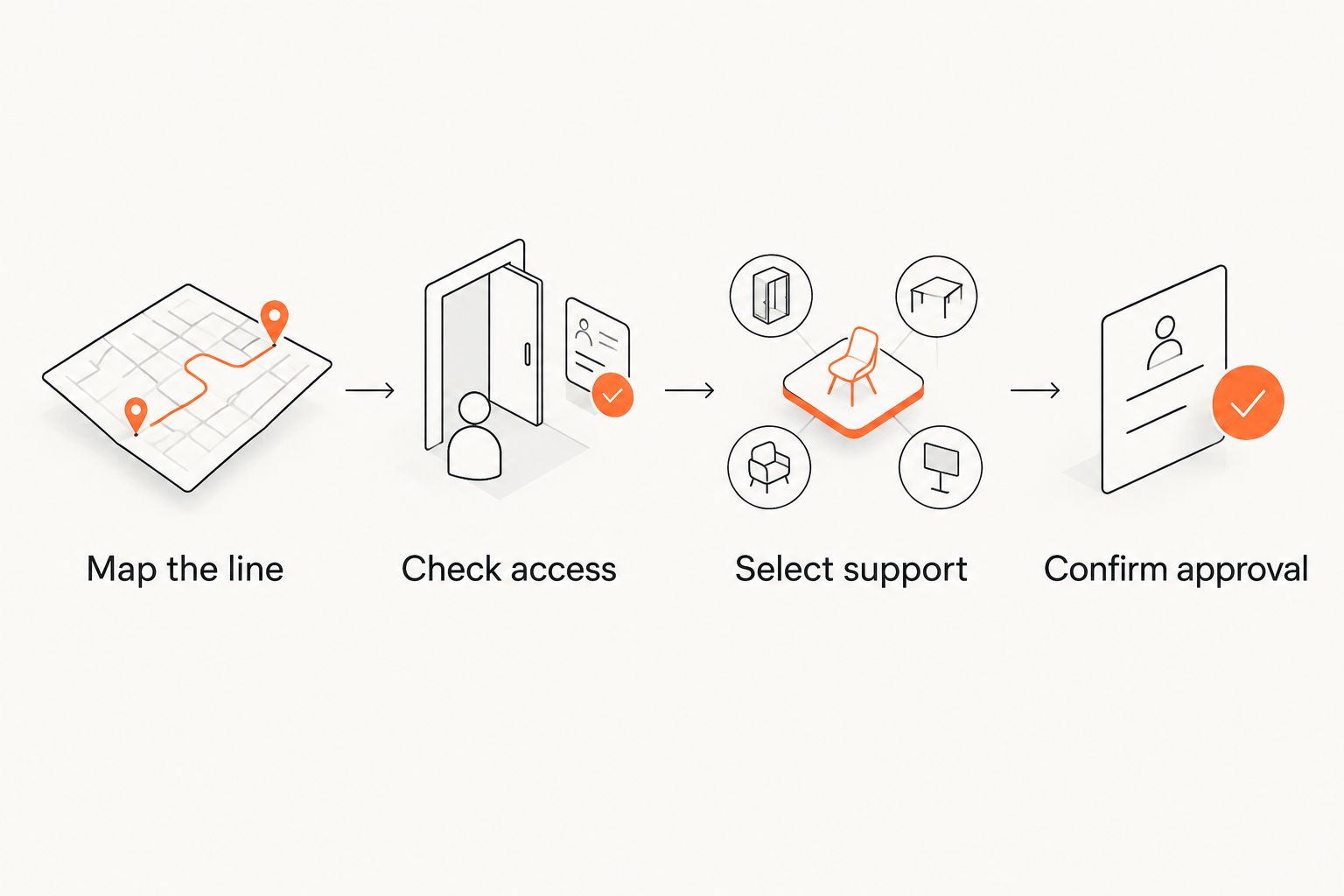
Walk the proposed line before delivery. A paved surface makes panel placement possible, but it does not settle permission, stability or access. Use this sequence for a 2026 jobsite or event footprint.
- Map the line. Mark the work boundary, gates, corners and the space available for bases. Check the line against doors, loading areas and routes that must stay open.
- Check access. Follow the paths for workers, pedestrians, delivery vehicles and emergency access. Do not place a base where a wheel, door or footpath needs that space.
- Select support. Decide whether the layout uses freestanding bases and ballast or an approved anchored arrangement. Identify wind exposure and any proposed screen before settling the support plan.
- Confirm approval. Establish who can authorize pavement penetration, where supports can sit and who handles any required surface repair. Confirm site-specific requirements before installation.
A straight run is not the only part that needs attention. Corners, gates and changes in grade alter how the fence is supported and used. Review those points on site rather than assuming the same arrangement works along the entire line.
Freestanding panels: keep the pavement intact
Freestanding panels are the direct answer when the owner does not allow drilling. The panels stand on bases, with ballast selected for the layout and site conditions. The advantage is that installation does not require holes in concrete or asphalt. The trade-off is the space taken by the supports.
Freestanding fencing fits a paved area with room for bases and a clear access plan. It does not fit every narrow walkway or vehicle edge. On a tight site, moving the fence line inward can be more practical than forcing supports into a route that must stay open.
Ask how gates and corners will be supported, not just straight panels. A gate changes where people move through the line, and repeated opening makes that location operationally important. Keep its support clear of the path it serves.
Privacy screens need separate attention. A screen changes how wind acts on a fence. Do not add one to a planned freestanding run without reviewing the support arrangement for the screened layout. The fact that panels stand on pavement does not establish that they will stand with a screen attached.
Anchored panels: get permission before drilling
Anchoring can be appropriate where the property owner allows penetration and the surface can accept the specified attachment. That decision needs more than a visual check of the pavement. Confirm the substrate, the permitted drilling locations and the repair obligation before work starts.
Anchored fencing fits an approved attachment plan, not an assumption that concrete is available to drill. The surface may cover utilities or other features that affect where holes can go. A tenant, event producer or subcontractor should not treat access to the pavement as authority to alter it.
Asphalt and concrete also need separate review. Do not carry an attachment detail from one surface to the other without confirmation that it applies. If approval or substrate information is missing, leave anchoring off the installation plan until those questions are answered.
For a 2026 project with a short occupancy window, removal matters as much as installation. Agree on what happens to holes or attachments when the fence leaves. That prevents the handoff from becoming a dispute between the site operator, installer and property owner.
What if the fence borders vehicle movement?
A temporary fence defines a boundary. It does not become a vehicle barrier because it sits beside a driveway or parking lane. Where vehicles can reach the work area, review the traffic interface separately and determine whether the project calls for K-rail or another specified barrier.
Keep this distinction clear in the site plan: fence for separation and access control, barrier for the vehicle-side condition when required by the project. Do not assume a freestanding panel, an anchored panel or a privacy screen answers a traffic-protection requirement.
Valley Services offers temporary fencing and K-rail rental alongside roll-off containers and restrooms. That combination is relevant when a Bay Area contractor needs to coordinate the fence line with deliveries, container placement and crew access. It does not remove the need for a site-specific support and traffic plan.
Why does the installation method vary?
The surface is only one input. These conditions decide whether a freestanding or anchored layout makes sense:
- Surface control. The property owner's approval determines whether drilling is an option.
- Available space. Freestanding bases need room that does not obstruct access.
- Wind exposure. The support plan must account for the site and any proposed privacy screen.
- Gate use. A gate needs a location and support arrangement that work with the expected movement through it.
- Traffic and delivery routes. Panel lines and bases must stay clear of vehicle paths and loading activity.
- Removal requirements. Anchored work needs an agreed plan for the surface after the fence comes out.
No single pavement detail answers all six. For 2026 planning, send the installer a marked site plan and identify the surface owner, gate positions and access routes. Those details make the installation discussion specific.
Can you install temporary fencing without drilling into concrete?
Yes. Freestanding panels with suitable bases and ballast can stand on concrete without drilled attachments. Confirm that the full layout has room for supports and that its stability is appropriate for the site conditions.
Can temporary fencing be installed on asphalt?
Yes. A freestanding layout can sit on asphalt, subject to the surface condition and support plan. If anchoring is proposed, confirm that the attachment is specified for that surface and approved by the property owner.
Does K-rail replace temporary fencing on pavement?
No. K-rail and temporary fencing address different site-control needs. Specify the fence line and any vehicle-side barrier separately rather than treating one as an automatic substitute for the other.
FAQ
Can temporary fencing be installed on concrete without holes?
Yes. Freestanding panels with suitable bases and ballast can be placed on concrete without drilling. The layout still needs room for supports and a stability plan suited to the site.
Can temporary fencing be installed on pavement for an event?
Yes. Plan the panel line around guest movement, vendor access, load-in and load-out. Confirm the pavement owner's rules before choosing an anchored layout.
Can you anchor temporary fencing into a parking lot?
Only with permission and an attachment plan suited to the surface. Check the approved drilling locations and surface repair requirements before installation.
Are freestanding fence panels enough in an exposed area?
That depends on the full support arrangement and site conditions. Review wind exposure, corners, gates and any proposed screen before installation.
Can you attach a privacy screen to fencing on concrete?
Yes, if the specified fence and support arrangement account for the screened layout. Do not assume a support plan for unscreened panels also covers a privacy screen.
Does a temporary fence protect workers from vehicles?
A temporary fence marks a boundary; it is not automatically a vehicle barrier. Review traffic protection separately where vehicles can reach the work area.
What should I tell a fencing provider before delivery?
Provide the surface type, proposed fence line, gate locations, access routes, wind exposure and any restrictions on drilling. Identify who can approve changes to the pavement.
Related guides
- Temporary fencing for construction sites
- Temporary fencing for outdoor events
- Fence rental for road and highway construction projects
One last thing
The first decision is not where the panels stand. It is where the supports can stand without disrupting the site. Mark that space before fixing the fence line.
Valley Services owns and operates its San Jose C&D transfer station and provides temporary fencing, roll-off containers and restrooms for Bay Area sites. If those services share a 2026 jobsite, discuss their placement together so deliveries and access use the same plan. Call (408) 297-5404 or visit Valley Services to talk through the job.