A Cal/OSHA inspector doesn't care how good your framing is. If your crew doesn't have compliant restroom access, you get a citation and a stop-work conversation on a day you can't afford one.
- OSHA 1926.51 sets restroom ratios: 1 unit per 20 workers, 1 per 40 for crews of 20-249, 1 per 50 plus extra fixtures above 250.
- Servicing frequency, not just unit count, is the most common citation trigger on Bay Area sites in 2026.
- Valley Services delivers and services blue steel restrooms on the same schedule as roll-off containers, one call for both.
- ADA-compliant units are required whenever a site has workers with disabilities or the project is open to the public.
Why this matters
Cal/OSHA and federal OSHA both enforce sanitation standards under 29 CFR 1926.51 for construction sites. The rule isn't about comfort. It's about preventing illness, keeping crews on site instead of driving to find a restroom, and giving inspectors nothing to write up.
General contractors carry the citation risk even when a subcontractor's crew is the one short on facilities. If you're the GC of record in San Jose or anywhere in the South Bay in 2026, restroom count and servicing records are your problem the moment an inspector shows up.
What you'll need
- A headcount for the largest single shift on site, not your average crew size
- A site map showing where workers actually work, not just where the trailer sits
- A servicing schedule that matches your work week, including weekends if crews are on site
- Handwashing capability separate from restroom units
- ADA-compliant units if the project is open to the public or any crew member needs one
- A vendor that services on a fixed schedule and can add units mid-project without a week's delay
Valley Services delivers standard and ADA-compliant restrooms across San Jose, Santa Clara, Sunnyvale, Mountain View, and Milpitas, and services them on the same route as roll-off container swaps.
The steps
1. Count your peak shift, not your average shift
OSHA 1926.51(c)(1) sets the ratio by employees, and the standard doesn't average across a project's life. If your framing crew peaks at 45 workers for two weeks in the middle of a six-month job, you size for 45, not for the 18-person crew that starts and finishes the work.
Common mistake: contractors order restrooms based on their own payroll and forget subcontractor crews working the same site the same day. Count everyone on the property, not just your own W-2s.
2. Apply the OSHA ratio table
The federal standard breaks down like this:
- 20 or fewer workers: 1 restroom facility
- 20 to 249 workers: 1 facility per 40 workers
- 250 or more workers: 1 facility per 50 workers, plus additional urinals
A 60-person site needs at least 2 restrooms. A 150-person site needs at least 4. Round up, never down, when the math lands on a fraction.
3. Add handwashing stations separately
Restroom units and handwashing are two different line items under the standard. Some jobs handle both with a single wash station, but you need to confirm capacity matches headcount, not just presence.
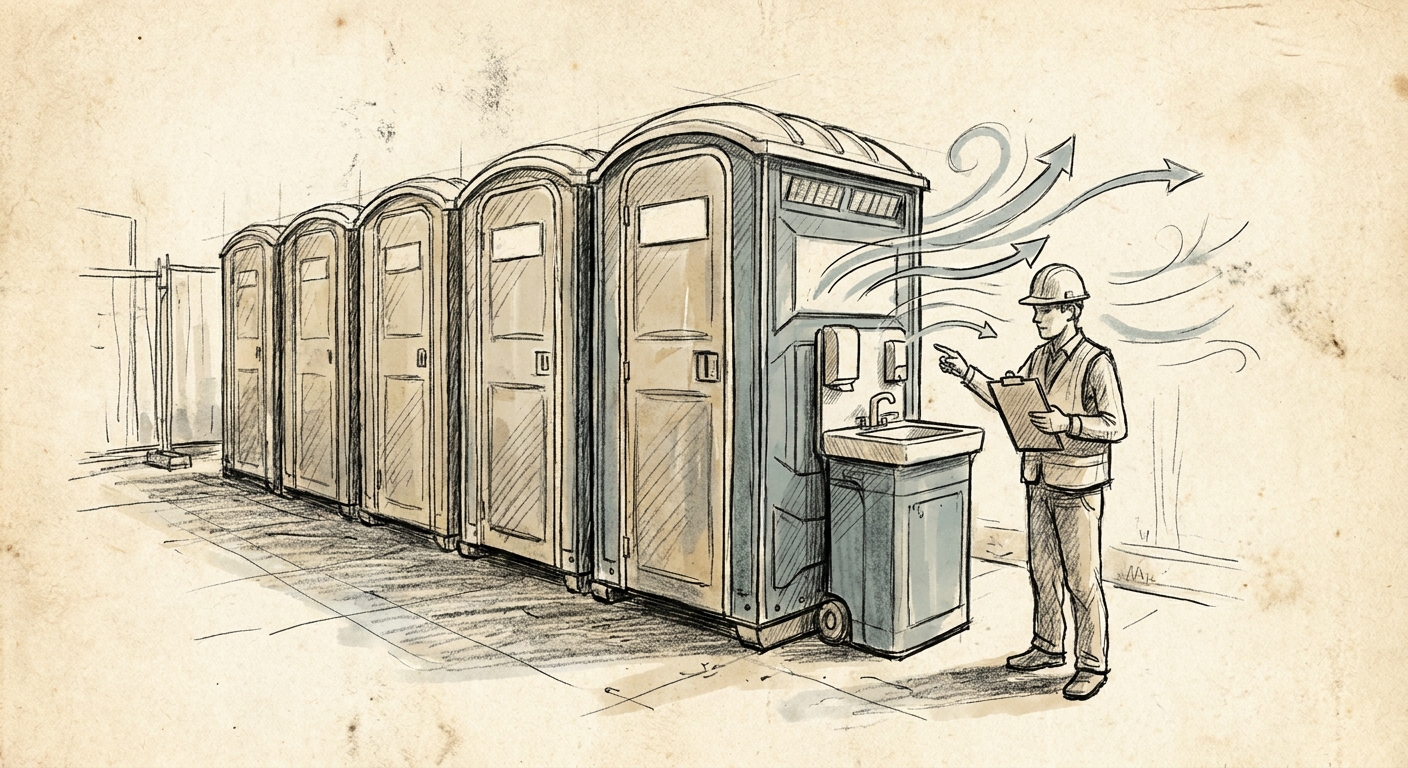
On sites where crews handle food, chemicals, or work in confined spaces, a dedicated hand wash station next to the restroom bank closes the gap inspectors look for first.
4. Confirm ADA compliance before delivery, not after a complaint
If any worker on site needs an accessible unit, or if the project is open to the public in any way, you need at least one ADA-compliant restroom positioned on an accessible path, not tucked behind a stack of pallets.
Most Bay Area jobsites default to standard units and add ADA capacity only after someone flags it. Order ADA-compliant portable toilets at project start. Retrofitting mid-schedule costs you a delivery delay you didn't plan for.
5. Lock a servicing schedule that matches your work week
Unit count gets you compliant on paper. Servicing frequency is what an inspector actually checks when they open the door. A restroom that's clean on delivery day and neglected by week three is a citation waiting to happen.
Standard service intervals run weekly for light-use sites and twice weekly for crews over 30 workers. Long jobs need this locked in before mobilization, not renegotiated after a complaint.
6. Position units on the accessible path of travel
Distance and placement matter as much as count. Units buried behind material staging or across an active traffic lane get skipped by crews, which defeats the compliance math entirely. Put restrooms within a reasonable walk of every active work zone, with a clear path that doesn't cross forklift routes or K-rail barriers.
7. Document delivery, service dates, and unit count
Keep a simple log: delivery date, unit count, service dates, and any additions. If Cal/OSHA asks, a paper trail showing you sized correctly and serviced on schedule is the difference between a warning and a citation. This takes five minutes a week and saves a project manager's afternoon during an audit.
Get restrooms sized and scheduled
Talk through headcount, ADA needs, and service frequency for your San Jose site.
Troubleshooting
Problem: Crew size grew mid-project and units are now short. Add units as soon as headcount crosses a ratio threshold. Don't wait for the next scheduled review, request an add-on delivery the same week the crew grows.
Problem: Units are clean on delivery but dirty by week two. Your servicing interval doesn't match actual use. Bump weekly service to twice weekly for crews over 30, and confirm the vendor's route actually hits your site on the day scheduled.
Problem: An inspector flags handwashing as inadequate. A single wash station for 40 workers reads as inadequate on a busy site. Match wash station capacity to headcount the same way you match restroom count.
Problem: ADA unit was ordered late and delivery is delayed a week. Order ADA-compliant units at the same time as your initial restroom order, not as an afterthought. Vendors that stock these units separately can turn them around faster.
Problem: Units are placed too far from active work zones. Walk the site the way a worker would mid-shift. If the restroom requires crossing an active excavation or a K-rail barrier, move it. Compliance on paper doesn't help if nobody uses the unit.
Problem: No documentation exists when an inspector asks for records. Start a delivery and service log now, even mid-project. A partial record beats no record.
Tools and resources
- OSHA 29 CFR 1926.51, the federal sanitation standard for construction
- A site map marking active work zones and accessible paths of travel
- A weekly service log template, delivery date, unit count, service date
- Monthly portable toilet service for multi-month jobs that need a fixed schedule locked in from day one
- A single point of contact for containers, restrooms, and fencing so schedule changes don't require three phone calls
Valley Services has run its own San Jose yard since 1986, third generation, same family. One call covers containers, restrooms, and fencing for the same jobsite, which matters when a crew grows mid-project and you need an add-on delivery the same week.
What to do next
If you're still sizing the project, work out headcount and servicing cadence before you place the first order. A site that starts compliant rarely needs a mid-project scramble.
FAQ
How many portable toilets does OSHA require per worker?
OSHA 1926.51 requires 1 restroom for 20 or fewer workers, 1 per 40 workers for crews of 20 to 249, and 1 per 50 plus additional urinals for crews over 250. Round up whenever the math lands on a fraction.
Does OSHA require handwashing stations separate from restrooms?
Yes. Handwashing capacity is a separate requirement from restroom count under 1926.51, especially where crews handle food or chemicals. Match wash station capacity to headcount the same way you size restrooms.
Are ADA-compliant portable restrooms required on every construction site?
ADA-compliant units are required whenever a worker on site needs one or the project is open to the public. Order these at project start since retrofitting mid-schedule causes delivery delays.
How often do portable restrooms need to be serviced on a job site?
Light-use sites run on weekly service, crews over 30 workers typically need twice-weekly service. Servicing frequency, not unit count, is the most common citation trigger in 2026.
Who is responsible for OSHA sanitation compliance, the GC or the subcontractor?
The general contractor of record generally carries the citation risk for the whole site, even when a subcontractor's crew falls short on facilities. Count every worker on the property, not just direct payroll.
What happens if a Cal/OSHA inspector finds a sanitation violation?
An inspector can issue a citation and, in serious cases, halt work until facilities are corrected. A documented delivery and service log is the fastest way to show good-faith compliance during an audit.
Can portable restroom needs change mid-project?
Yes. Crew size fluctuates through demo, framing, and finish phases, so restroom count should be reviewed at each phase change, not set once at mobilization.
Do event sites follow the same OSHA restroom ratios as construction sites?
Events follow different local health code ratios based on attendee count rather than 1926.51 worker ratios, though the same servicing-frequency logic applies to keeping units usable through a multi-day event.
One last thing
The unit count almost never triggers the citation. The service log does. A site with the right ratio but a missed service week looks worse on paper than a slightly short site with documented weekly service. Fix the schedule before you fix the math.
Related guides
- Monthly portable toilet service for long-term job sites
- How to budget for portable toilet rental on a job site
Call (408) 297-5404 or reach out at valleyservices.biz to talk through headcount, ADA needs, and a servicing schedule for your San Jose site.