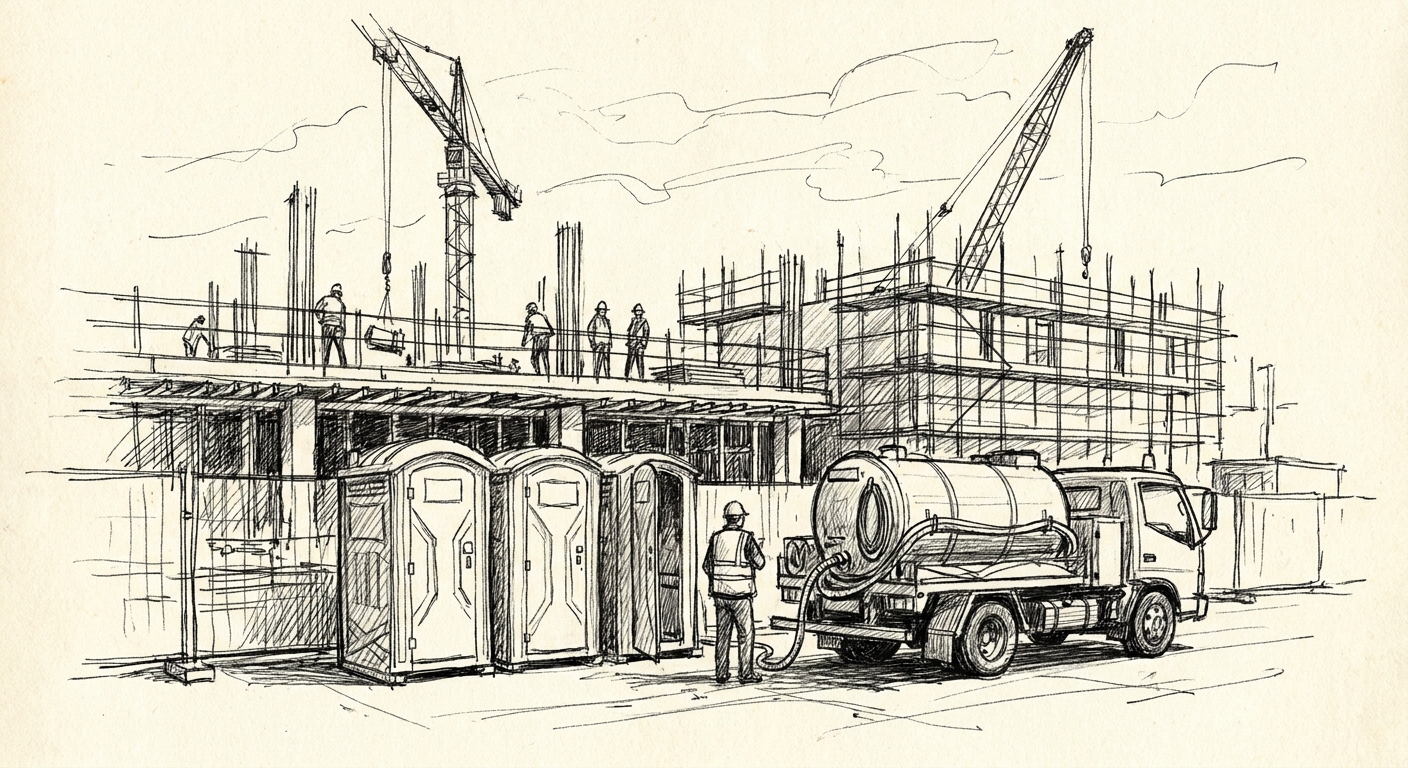
A single portable restroom sitting on a job site for six months isn't a rental. It's an asset your crew uses daily, your foreman inspects weekly, and your safety plan depends on. Monthly portable toilet service for long-term job sites means the units, the cleaning schedule, and the service contract are all built for a project that runs past 90 days, not a weekend pour.
- Monthly portable toilet service for job sites should include weekly cleaning at minimum, not one-time drop-off with no service plan.
- One standard unit covers roughly 10 workers on an 8-hour shift before you need a second.
- ADA-compliant units are required on many public and municipal jobs, not optional add-ons.
- Remote sites with no sewer tie-in need a holding tank rental, not a standard portable unit.
- Valley Services has run job site restroom service out of San Jose since 1986.
Why this matters
A long-term job site changes the math on portable restroom service. A one-week bathroom remodel needs a unit and a pickup. A six-month tenant improvement or a multi-phase build needs a service contract: scheduled cleaning, a plan for crew growth, and a backup if a unit gets damaged or vandalized mid-project.
Get the sizing or the service frequency wrong and you're not dealing with an inconvenience. You're dealing with a Cal/OSHA sanitation complaint, a foreman pulling crew off task to find a working restroom, or a general contractor eating a change order because nobody planned for month four. Budgeting for portable toilet rental on a job site starts with getting the service plan right before the first invoice.
Who this is for
This is for general contractors and subcontractors running jobs that last longer than a standard 4-week rental cycle: multi-phase commercial builds, tenant improvements, road and utility work, and residential projects that stretch past a single season. It's also for facilities and property managers overseeing renovation work on occupied sites, and for any crew lead who has to answer for restroom access when an inspector or a client walks the site in 2026.
What to look for in monthly portable toilet service for job sites
Cleaning frequency that matches crew size
A unit serviced once a month works for a two-person crew checking on a vacant lot. It does not work for 15 framers working five days a week. Weekly service is the standard for active construction crews. Confirm the service interval in writing before the unit lands on site, not after the first complaint.
Unit count per headcount
Crews of 10 or fewer generally run fine on one standard unit serviced weekly. Add a second unit once you cross 20 workers on an 8-hour shift, not at 15, and add a third for two-shift operations. Undercounting units is the single most common mistake on long-term sites, because crew size creeps up as a project moves from foundation to framing to finish.
ADA accessibility
Municipal jobs, public works, and many commercial general contracts require at least one ADA-compliant unit on site regardless of total headcount. ADA-compliant portable toilet rental for construction sites covers spacing and access requirements. Confirm this before mobilization, not during a walkthrough.
Access and site logistics
A long-term site changes layout as work progresses: fencing moves, staging areas shift, a slab gets poured where the unit used to sit. Monthly service means the vendor needs a standing plan for where units relocate as the site evolves, and a route the service truck can run every week without a new access conversation each time.
Remote or no-sewer-tie-in sites
Sites without a nearby sewer connection, or sites at the edge of a job with long haul distances for the service truck, need a holding tank rental instead of a standard unit. Renting a holding tank for a construction project covers when tank capacity outruns a standard unit's servicing interval.
Hand wash stations for food-adjacent or larger crews
Crews over 20, or any site with food service, catering, or public-facing work, need a hand wash station in addition to restroom units. Hand wash station rental for construction sites is a separate line item most crews forget to budget until an inspector asks for it.
Top picks for long-term job site restroom service
The baseline pick: standard unit on weekly service. One blue steel portable restroom, serviced once a week, covers crews up to roughly 10 workers on an 8-hour shift through a project running 6 to 12 months in 2026. Buy if your crew size is stable and your site has standard truck access.
The compliance pick: ADA-compliant unit. Required on most municipal and public works jobs, and increasingly expected on commercial general contracts even without a specific mandate. One ADA unit alongside your standard units satisfies most inspection requirements. Buy if the job is public, municipal, or has any public foot traffic near the site. Full detail on spacing requirements is in ADA-compliant portable toilet rental for construction sites.
The add-on pick: hand wash station. A standalone hand wash station next to your restroom bank covers crews over 20 workers and any site with food handling nearby. It's a small monthly add, not a standalone rental most contractors think to request until a client or inspector flags it. Consider for crews over 20, Skip for crews under 10 on a straightforward remodel. See hand wash station rental for construction sites.
The remote-site pick: holding tank rental. For sites with no sewer access or long haul distances for the service truck, a holding tank rental extends capacity between visits and avoids overflow on a 30-day cycle. Buy if your site sits more than 20 minutes off a standard service route. Detail on tank sizing is in how to rent a holding tank for a construction project.
The scale pick: multi-phase site service plan. Projects running through multiple construction phases in 2026, foundation to framing to finish, need a service plan that adjusts unit count and cleaning frequency as headcount and site layout change, not a static contract set at mobilization. Buy for any job over 6 months with more than one construction phase. Full planning detail is in how to plan site services for a multi-phase construction project.
Talk through your job site restroom plan
One call covers restrooms, containers, and fencing for your site.
What to avoid
- A one-time drop-off with no standing service schedule. It looks cheaper on paper, but a unit that only gets serviced when someone remembers to call is a liability on a 6-month job, not a cost saver.
- Sizing units for day one crew count and never revisiting it. Crews grow as a project moves from demo to framing to finish. A count that worked in month one is often short by month four.
- Skipping the ADA unit because "nobody's asked yet." On municipal and public-facing jobs, that's the kind of gap an inspector flags during a walkthrough, not before.
Verdict comparison
| Service option | Best for | Cleaning frequency | Verdict |
|---|---|---|---|
| Standard unit, weekly service | Crews up to 10, stable site | Weekly | Buy |
| ADA-compliant unit | Public, municipal, or public-facing jobs | Weekly | Buy |
| Hand wash station add-on | Crews over 20, food-adjacent work | Weekly with unit service | Consider |
| Holding tank rental | Remote or no-sewer-tie-in sites | Per tank capacity | Buy for remote sites |
| Multi-phase service plan | Jobs over 6 months, multiple phases | Adjusts by phase | Buy |
FAQ
What's the best portable toilet service for a long-term construction job site?
A weekly-cleaned standard unit sized to crew headcount is the baseline for any job running past 90 days. Add an ADA-compliant unit for public jobs and a holding tank for sites without sewer access.
How many portable toilets do I need for a job site crew?
Plan on one standard unit per 10 workers on an 8-hour shift. Add a second unit at 20 workers rather than waiting until crew complaints start.
Is a holding tank better than a standard portable toilet for remote sites?
Yes, for sites without sewer tie-in or with long haul distances for the service truck. A holding tank extends capacity between service visits and avoids overflow on a standard 30-day cycle.
How often should a job site portable restroom be serviced?
Weekly is standard for active construction crews. Lower-traffic sites with two or fewer workers can sometimes run on a longer interval, but weekly is the safe default for any crew over five.
Do I need an ADA-compliant portable restroom on a private construction job?
Not always, but municipal, public works, and many commercial general contracts require at least one ADA-compliant unit regardless of total crew size. Confirm the requirement with your general contractor before mobilization.
What's the difference between a standard portable toilet and a restroom trailer for a job site?
A standard unit covers day-to-day crew needs on an active construction site. A restroom trailer is typically reserved for events or upscale settings where amenity level matters more than job site durability.
Can I add a hand wash station to a monthly restroom service contract?
Yes, most vendors add a standalone hand wash station as a line item alongside standard units, and it's worth including for crews over 20 or any site with food handling nearby.
What happens if my job site crew size grows partway through the project?
A multi-phase service plan should account for this by adjusting unit count as headcount changes, rather than locking in the day-one count for the life of the contract.
One last thing
The detail contractors miss most isn't unit count, it's location planning. A restroom placed too close to material staging gets moved, relocated, or blocked mid-project, and every relocation resets the service truck's route. Plan the restroom position against your full site logistics plan for 2026, including fencing and container placement, before the units arrive, not after the first move request.
Valley Services has run site service logistics out of the same San Jose yard since 1986, now in its third generation of family ownership. Call (408) 297-5404 or visit valleyservices.biz to talk through restroom counts, service frequency, and the rest of your site plan for 2026.