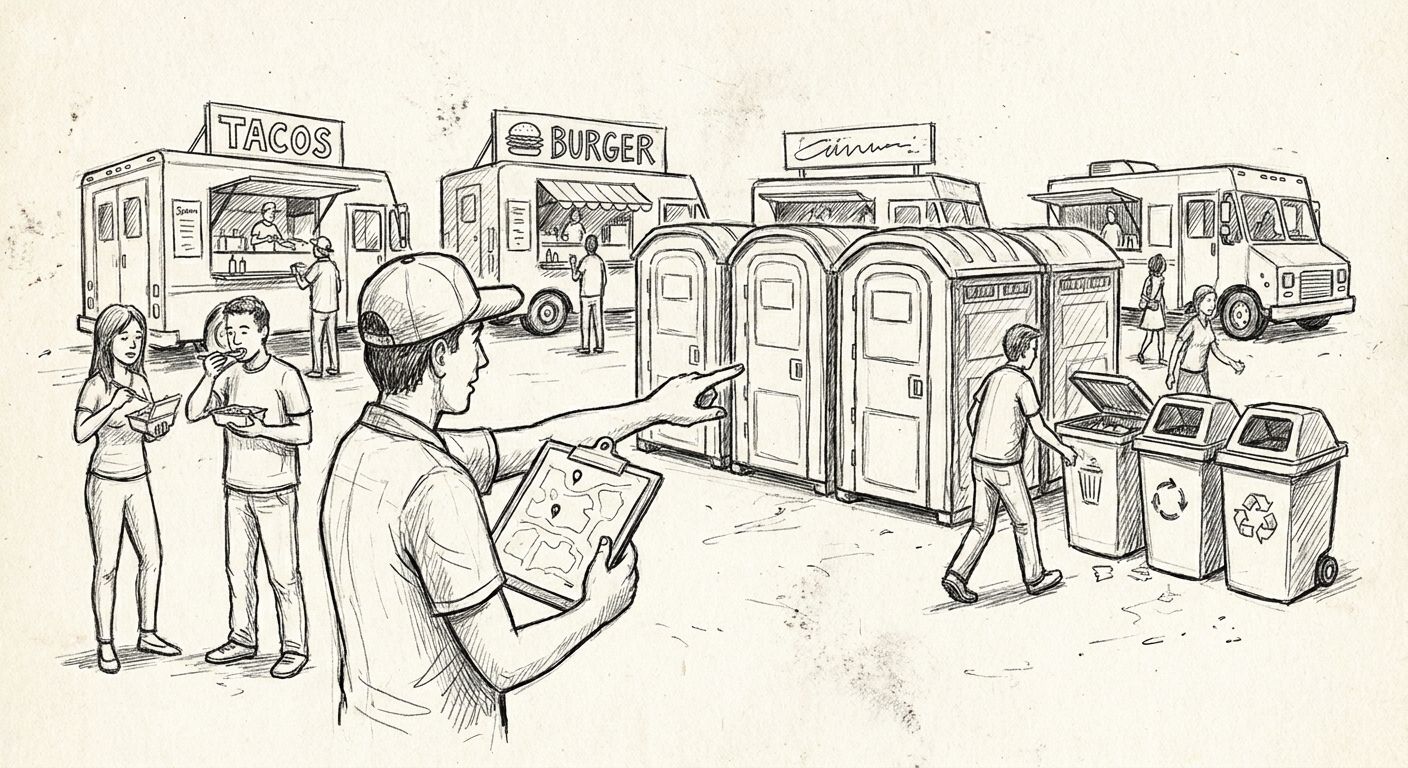
Food truck events look simple from the sidewalk: trucks, tables, a crowd. Behind the fence line, the event runs on the same logistics as a construction site. Waste, water, and restrooms have to be planned before the trucks roll in, not fixed after a line forms at 1pm.
- Plan restrooms at one unit per 50-75 guests for a four-hour food truck event and add units past that mark.
- Grease and food waste need a dedicated roll-off container, never a shared trash bin, to keep vendors compliant.
- Hand-wash stations are a county health department requirement for food trucks, separate from restroom counts.
- Book restrooms, waste, and fencing through one vendor so load-in and load-out run on the same schedule.
Why this matters
A food truck event that runs short on restrooms or waste capacity does not fail quietly. Lines back up into the vendor row, grease pools next to a truck's grey water bucket, and the health inspector who shows up mid-event has grounds to shut a vendor down. San Jose and Santa Clara County health departments check for handwashing access and waste containment as part of a temporary food facility permit, and they check it on site, not on paper.
The planning problem is that food trucks generate three different waste streams at once: guest trash, vendor food waste and grease, and greywater from each truck's holding tank. Each one needs its own equipment. Treating them as one "waste plan" is the most common mistake event producers make heading into the 2026 season.
What you'll need
- Guest count and event duration (hours, not just a date)
- Number of food trucks and whether each has its own holding tank
- Site map showing vendor row, guest area, and load-in access
- Portable restroom rental for food truck events, sized to guest count
- A hand-wash station rental for food truck events, separate from restroom units
- A roll-off container or bin service for guest trash and vendor food waste
- Temporary fencing for crowd control and vendor row separation, if the site is open to public streets
- Lead time: 2 to 3 weeks for standard events, longer for events over 2,000 guests
The steps
1. Count your guests, then count again by the hour
A one-day festival pulling 1,500 people over six hours needs a different restroom count than a lunchtime pop-up with 200 people over three hours. Industry guidance from portable sanitation associations calls for roughly one restroom unit per 50 to 75 guests for events running up to four hours, with additional units added as hours climb past that mark or alcohol is served. Underestimating this number is the single biggest driver of lines and complaints at food truck events.
Common mistake: planning restroom count off total expected attendance instead of peak concurrent attendance. A ticketed event with rolling entry has fewer people on site at once than the ticket count suggests. Ask your producer for the peak-hour number, not the total.
2. Separate guest waste from vendor food waste
Guests generate cups, napkins, and food containers. Food trucks generate grease, food scraps, and packaging at a volume that overwhelms a standard trash can within an hour of service starting. Route guest trash to bins spaced through the guest area and route vendor food waste to a dedicated roll-off container placed at the back of vendor row, away from foot traffic.
Mixing the two streams into one container fills it early and leaves grease residue that draws pests before the event ends. A roll-off staged specifically for dumpster rental for special events and fairs keeps vendor waste contained and out of the guest sightline.
3. Confirm each truck's holding tank plan before the event, not on site day
Most food trucks carry an onboard greywater holding tank that fills over a multi-hour service window. On a hot day with high volume, a tank built for a half-day event can hit capacity before service ends, and a truck with a full tank either stops cooking or dumps illegally. Ask every vendor how large their tank is and how many hours it holds before pump-out is needed.
For events longer than four hours or with more than six trucks, a shared holding tank rental for food trucks gives vendors a pump-out point on site instead of forcing them to break service and drive off to empty a tank.
4. Place hand-wash stations at vendor row, not just the restroom bank
County health departments require handwashing access at each food truck's point of service, separate from guest restroom facilities. This is a permit condition, not a courtesy. A hand-wash station placed only near the restrooms does not satisfy the requirement if it sits 100 feet from vendor row.
Budget one hand-wash station per two to three trucks along the service line, positioned where vendors can reach it between orders without leaving their station unattended.
5. Fence the site to control access and separate vendor row from guests
Open-air food truck events on streets or public lots need temporary fencing to define the event boundary, protect vendor equipment overnight, and keep guest lines from blocking truck service windows. Temporary fencing for outdoor events also gives event staff a clear line to manage entry and exit, which matters for permit compliance if the city requires controlled access.
Common mistake: fencing the guest perimeter but leaving vendor row open to the parking lot. Trucks left unfenced overnight before a multi-day event are a theft risk that a single fence run around vendor row solves.
6. Schedule delivery for setup day, not event morning
Restrooms, fencing, and waste containers need to land on site with enough lead time for staff to walk the layout and adjust before doors open. Scheduling delivery for the morning of the event leaves zero margin if a truck is delayed or a unit needs repositioning. Build delivery into your setup day, at minimum the afternoon before a single-day event.
7. Plan pickup and pump-out for the end of service, not the next morning
Grease and food waste sitting overnight in California heat draws pests and creates a smell problem before your next event on the same lot. If your event runs into a second day, schedule an overnight or early-morning pump-out and waste pickup rather than letting containers sit full until final teardown.
Troubleshooting
- Restroom lines forming within the first hour: you undercounted peak attendance. Add units mid-event if the vendor can deliver same day, and flag the correct count for next time.
- Grease smell near vendor row by midday: the food waste container is undersized or too close to service stations. Move it back 15 to 20 feet and confirm pickup timing.
- A truck's holding tank alarm going off early: the tank was undersized for the event length. Arrange a shared holding tank or a mid-event pump-out for that vendor.
- Guests wandering into vendor row: the fence line does not separate the two zones. Add a fence run specifically between guest area and vendor row, not just around the event perimeter.
- Health inspector flags missing hand-wash access: a station is out of reach of one or more trucks. Reposition stations so every truck has one within a few steps of its service window.
Tools and resources
- Portable toilet rental for food truck events
- How to calculate portable toilets needed for an event
- Hand-wash station rental for food truck events
- Best holding tank rental for food trucks
- Local county environmental health department, for temporary food facility permit requirements
Talk through your 2026 event lineup
Restrooms, waste, and fencing scheduled on one delivery plan.
What to do next
Once restroom count, waste containment, and hand-wash placement are set, the next planning step is fencing the vendor row for crowd control if your event runs on a public street or open lot. Read temporary fencing for outdoor events for layout guidance before you finalize your site map.
FAQ
How many portable restrooms does a food truck event need?
Plan on one restroom unit per 50 to 75 guests for an event running up to four hours in 2026, and add units as event length or alcohol service increases. Peak concurrent attendance, not total ticket count, should drive the number.
Do food trucks need a separate hand-wash station from guest restrooms?
Yes. County health departments require a hand-wash station at each truck's point of service, separate from guest restroom facilities, as a condition of the temporary food facility permit.
What happens if a food truck's holding tank fills up mid-event?
The truck has to stop service until the tank is emptied, which cuts into vendor sales and slows the whole event. A shared holding tank rental on site lets vendors pump out without leaving the event.
Can guest trash and food truck waste share one dumpster?
No. Vendor food waste and grease fill a container fast and create odor and pest problems if mixed with guest trash. Route them to separate containers, with the food waste unit placed at the back of vendor row.
Do I need temporary fencing for a food truck event on a public street?
Most cities require a defined event boundary for street closures or lot events with public access, and fencing also separates vendor row from the guest line. Check with your city's event permit office for the specific requirement.
How far in advance should I book restrooms and waste service for a food truck event?
Book 2 to 3 weeks ahead for standard single-day events in 2026, and longer for events over 2,000 guests or multi-day festivals, since delivery slots fill fastest in peak summer months.
Who handles pump-out and pickup if the event runs two days?
Schedule an overnight or early-morning pump-out and waste pickup between event days rather than letting containers sit full, especially for grease and food waste in warm weather.
One last thing
The detail most event producers miss until year two: vendor row needs its own waste and hand-wash plan, separate from the guest-facing setup, because health inspectors check vendor compliance independently of how clean the guest area looks. Get that split right on the first event and every event after runs off the same template.
For a 2026 food truck event in San Jose, Santa Clara, Sunnyvale, Mountain View, or Milpitas, call Valley Services at (408) 297-5404 or reach out through valleyservices.biz to build a restroom, waste, and fencing plan around your actual guest count and vendor lineup.