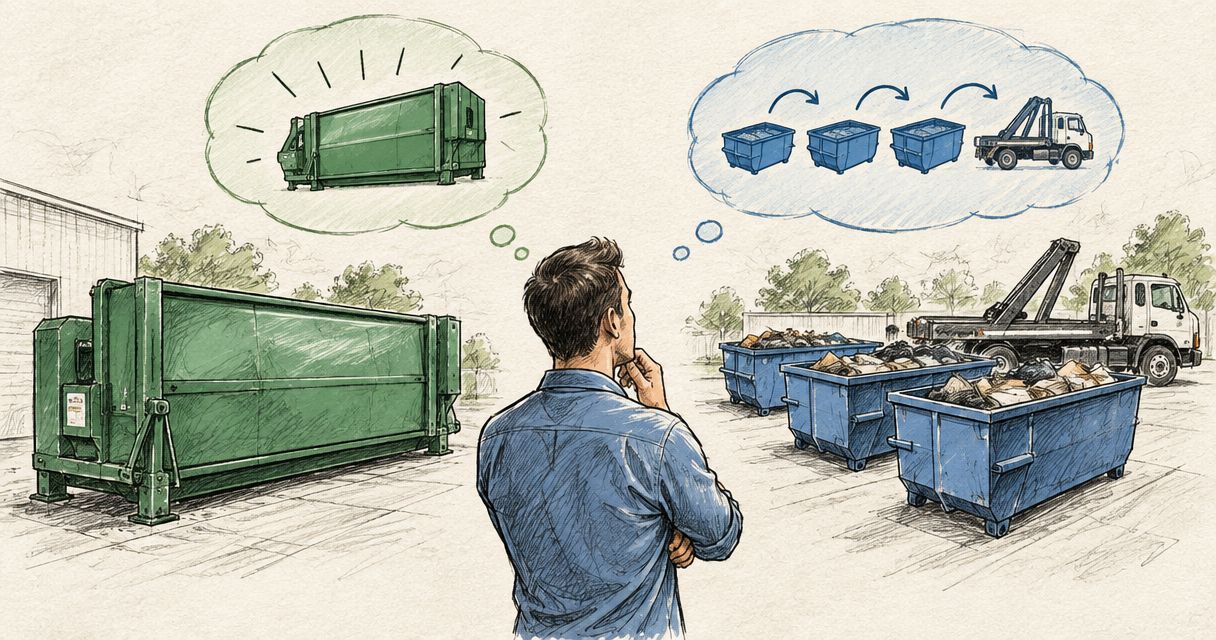
A compactor rental is cheaper than repeated roll-off container pickups only when its total rental, service, and removal charges come in below the cost of the pickups it replaces. For a short demolition job or a load that will not compact well, a roll-off container can be the simpler choice. Compare written quotes for the same waste stream and the same 2026 project schedule before choosing.
- Compactor rental versus multiple roll-off pickups has no automatic winner. Compare complete quotes for the same waste and schedule.
- Compactors fit recurring, compressible waste. Roll-off containers fit short jobs and bulky C&D debris.
- Valley Services is a practical contact for Bay Area roll-off containers and C&D drop-off, not a confirmed compactor rental source.
Is renting a compactor cheaper than multiple roll-off pickups?
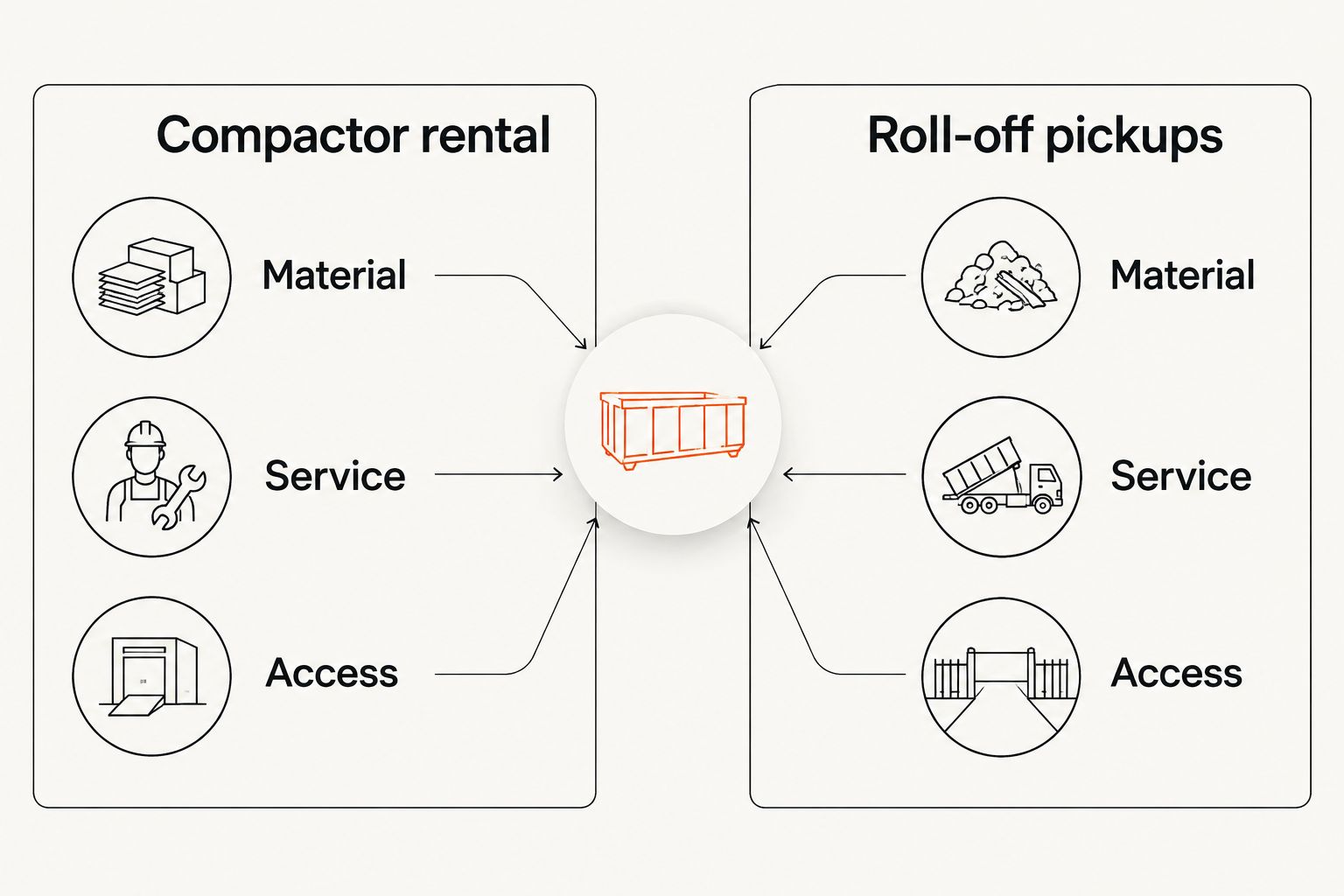
Sometimes. Pickup frequency alone does not decide it. A compactor changes how much material fits before removal, but you still need to account for the equipment rental, installation requirements, service, hauling, and the terms governing each removal. A roll-off container comparison needs its own complete scope, including planned exchanges and the final pickup.
| Decision point | Compactor rental | Repeated roll-off pickups |
|---|---|---|
| Best for | Predictable, recurring material that compresses | Short projects, bulky debris, and changing job phases |
| Main advantage | Can reduce the frequency of removals when the material compresses | Lets you order a container for a defined phase and exchange it when needed |
| Main drawback | Requires equipment space, access, and a suitable waste stream | Exchanges can interrupt work if they are not scheduled around loading |
| Quote detail to check | Rental period, setup, service, removal, and final collection | Container size, rental period, exchanges, and final pickup |
| Schedule question | Who responds when the unit reaches its service point? | When can the full container be exchanged? |
Use one comparison period. A monthly compactor proposal and a roll-off proposal covering only the first construction phase do not answer the same question. Match the waste, site, dates, and expected removals before comparing the totals.
Why this matters on a Bay Area site
On a San Jose jobsite, a full container is not just a hauling question. It can occupy space needed for load-in, block the next trade, or leave the crew with nowhere to place debris. The cheaper plan on paper fails if it does not match the sequence of work.
Valley Services rents roll-off containers and operates its own C&D transfer station in San Jose. That gives contractors a direct point of contact for the container and its disposal endpoint. It does not establish that Valley Services rents compactors; request a separate compactor proposal if that equipment is under consideration.
Compare the entire service cycle, not just removals
Ask each provider to quote the same start date, end date, material, loading conditions, and expected service pattern. Describe what will actually enter the equipment. Packaging from an occupied property is a different planning problem from mixed demolition debris on a renovation site.
Build a side-by-side scope before reviewing totals:
- Define the material. Identify bulky items, loose packaging, C&D debris, and anything that needs separate handling. Ask each provider which material it accepts. Do not assume that material suitable for a roll-off container belongs in a compactor.
- Map the loading pattern. Note whether material arrives steadily or in bursts tied to demolition, deliveries, or tenant turnover. A compactor serves a recurring stream; a container exchange can follow a distinct work phase.
- Confirm the equipment footprint. Check the space used during loading and during collection. Include truck access, gates, overhead obstructions, and the route workers will take to the unit.
- List every planned service event. Include initial delivery, container exchanges or compactor collections, and final removal. Ask what happens if the site needs an extra visit.
- Match the rental period. Compare proposals over the same dates, not different terms. Include time needed after the last load to clear the site.
- Check operational responsibility. Establish who requests service, who confirms access, and who adjusts the schedule when work changes.
For 2026 work, put those details in the request sent to each provider. A quote without material and access details leaves the central comparison unresolved.
When does a compactor make sense?
A compactor is a candidate when material arrives consistently, can be compressed, and can be collected without disrupting the site. The case for renting one strengthens when repeated roll-off exchanges are driven by loose material taking up container space rather than by heavy or bulky loads. The quote still decides the cost question.
Best for: recurring, compressible material at a site with a stable equipment location. Its advantage is fewer interruptions for container exchanges if compaction reduces the number of collections required. Its drawback is the space and service access the equipment needs. Confirm the proposed unit fits the material and the collection vehicle can reach it throughout the rental period.
A grocery or retail operation planning around a continuing waste stream faces different conditions from a contractor clearing a building for a limited renovation. If the waste stream changes during the project, ask whether the compactor remains suitable for every phase. Do not size equipment around the easiest week and assume it will handle the busiest one.
For facilities teams comparing units, how to choose a compactor size for a retail or grocery store is a related planning guide. Confirm equipment availability and accepted material directly with the provider making the proposal.
When are roll-off pickups the better fit?
Roll-off containers fit work with a defined start and finish, particularly when demolition or cleanout debris arrives in concentrated phases. You can plan a container around the crew's loading window and arrange an exchange when the next phase starts. The limitation is clear: a full container needs a collection slot before loading can continue.
Best for: C&D cleanouts, renovation phases, and bulky material that is not a good match for a compactor. In 2026, Valley Services offers blue steel roll-off containers from 8 to 40 yards and C&D drop-off at its San Jose transfer station. Those are stated service options, not a claim that every material or size suits every job. Confirm the load and placement before ordering.
For contractors, placement is part of the comparison. A container near the active work area shortens the route crews take with debris. That position still needs access for the collection truck. If a delivery blocks the intended exchange path later, the placement decision can delay removal when the site needs the space most.
A roll-off plan also gives you a way to tie service to milestones. Book the exchange around the demolition finish, a floor turnover, or load-out rather than waiting for a full container to stop work. When the sequence changes, update the pickup request before the crew loses its loading area.
Why does the answer change from site to site?
The 2026 comparison turns on operating conditions, not the label on the equipment:
- Material type. Loose, compressible material creates a different collection pattern from large pieces of C&D debris. Get acceptance confirmed for each option.
- Arrival pattern. A steady daily stream supports a different service plan from a demolition surge followed by lighter finish work.
- Available space. Both options require a loading position and collection access. A compactor also needs a location that works for its full rental period.
- Pickup timing. An exchange scheduled before the next trade arrives has a different effect on the job than one requested after loading stops.
- Project duration. A short cleanout and an ongoing facility operation should not be compared using the same service assumptions.
- Endpoint control. Ask where collected material goes and how the provider schedules that step. Valley Services operates its own C&D transfer station in San Jose for its roll-off and drop-off work.
None of these factors supplies a universal answer on its own. Together, they tell you which quotes describe a workable plan for your site.
What should a general contractor ask before choosing?
Start with the schedule. Identify the first loading day, the phase that produces the largest volume, and the date the equipment must leave. Then ask each provider to explain how it will keep the site open for the next trade if the unit fills earlier than planned.
Check whether the proposed location conflicts with deliveries, crew access, fencing, or a fire lane. Do not place equipment based only on where it is convenient to load. The collection vehicle needs a usable route on the day it returns, including after other trades and materials have moved onto the property.
Ask who will approve a service change. A superintendent, property manager, or facilities lead should own that decision. If several people can request a pickup without sharing the current site plan, the provider can arrive when access is blocked. A single point of contact keeps the instructions tied to the live schedule.
What should a property manager compare?
For a turnover or cleanout, separate the one-time debris from the property's regular waste stream. A compactor proposal for ongoing material should not absorb a renovation load without confirmation that the material is accepted. A roll-off container can serve the defined cleanout while the permanent collection plan remains separate.
Walk the site before requesting either option. Check tenant access, loading areas, service doors, and the time available for collection. Tell the provider when those spaces are occupied. If the cleanout involves several units or floors, give the proposed order of work so collection can follow it.
The right comparison covers the whole turnover, not just the first full unit. Ask for a final removal date and a process for changing it if contractors finish early or discover more debris. That gives the property manager a plan for returning the loading area to normal use.
Can you mix a compactor and roll-off containers?
Yes, as a planning approach, if each provider accepts the material assigned to its equipment. A facility might compare a compactor for its recurring compressible stream and a roll-off container for a separate renovation phase. Keep the loads distinct in the scope so each quote addresses the work it will actually handle.
This is not a reason to order both automatically. It is a way to avoid making one unit handle incompatible jobs. If all material comes from a short C&D project, start by testing whether a scheduled roll-off exchange plan covers the work. If the site also has a continuing waste stream, compare that stream separately.
How do I make the final decision?
Put the written proposals next to the site schedule. Check that they cover identical dates and the same accepted material. Then compare all required service events, access obligations, and the procedure for an unplanned collection. If a proposal leaves one of those items open, get it clarified before treating its total as the answer.
Choose the compactor when its complete proposal costs less for the same work and its placement and collection plan fit the site. Choose roll-off containers when their complete proposal fits better, or when the material and project phases make a compactor unsuitable. Valley Services is a practical roll-off container contact for Bay Area C&D jobs; its confirmed services do not include compactor rental.
FAQ
Is compactor rental cheaper than repeated roll-off pickups?
Compactor rental is cheaper only when its complete proposal comes in below the roll-off plan for the same material and dates. Include setup, service, collections, exchanges, and final removal in the comparison.
Does a compactor eliminate collection visits?
No. A compactor still needs collection service. Ask the provider what triggers collection and how the site requests it.
Are roll-off containers better for demolition debris?
Roll-off containers are a practical choice for many demolition phases because they can be scheduled around a defined loading period. Confirm the specific material with the provider before ordering.
Can I put the same material in a compactor and a roll-off container?
Not without confirming acceptance for both options. Give each provider the actual material list rather than assuming the equipment is interchangeable.
What should I include in a 2026 service comparison?
Include the material, rental dates, equipment location, planned collections, and final removal. Use the same scope for every proposal so the totals answer the same question.
Does Valley Services rent compactors?
Compactor rental is not among the Valley Services offerings stated here. Valley Services offers roll-off containers and operates a C&D transfer station in San Jose; call to discuss those confirmed services.
Where can I arrange C&D drop-off in San Jose?
Valley Services operates a C&D transfer station at 1611 S 7th St, San Jose, CA 95112. Call (408) 297-5404 to discuss your material before drop-off.
One last thing
The pickup plan is only as good as the truck's access on collection day. Mark the loading position and return route before equipment arrives, then check both again when the site layout changes. That simple check protects the schedule whichever option the 2026 comparison favors.
Related guides
- Schedule a roll-off container delivery and pickup
- Plan C&D debris drop-off in San Jose
- Use weight tickets to check container billing
For a Bay Area roll-off container or San Jose C&D drop-off, call Valley Services at (408) 297-5404 to talk through the job and request a quote.