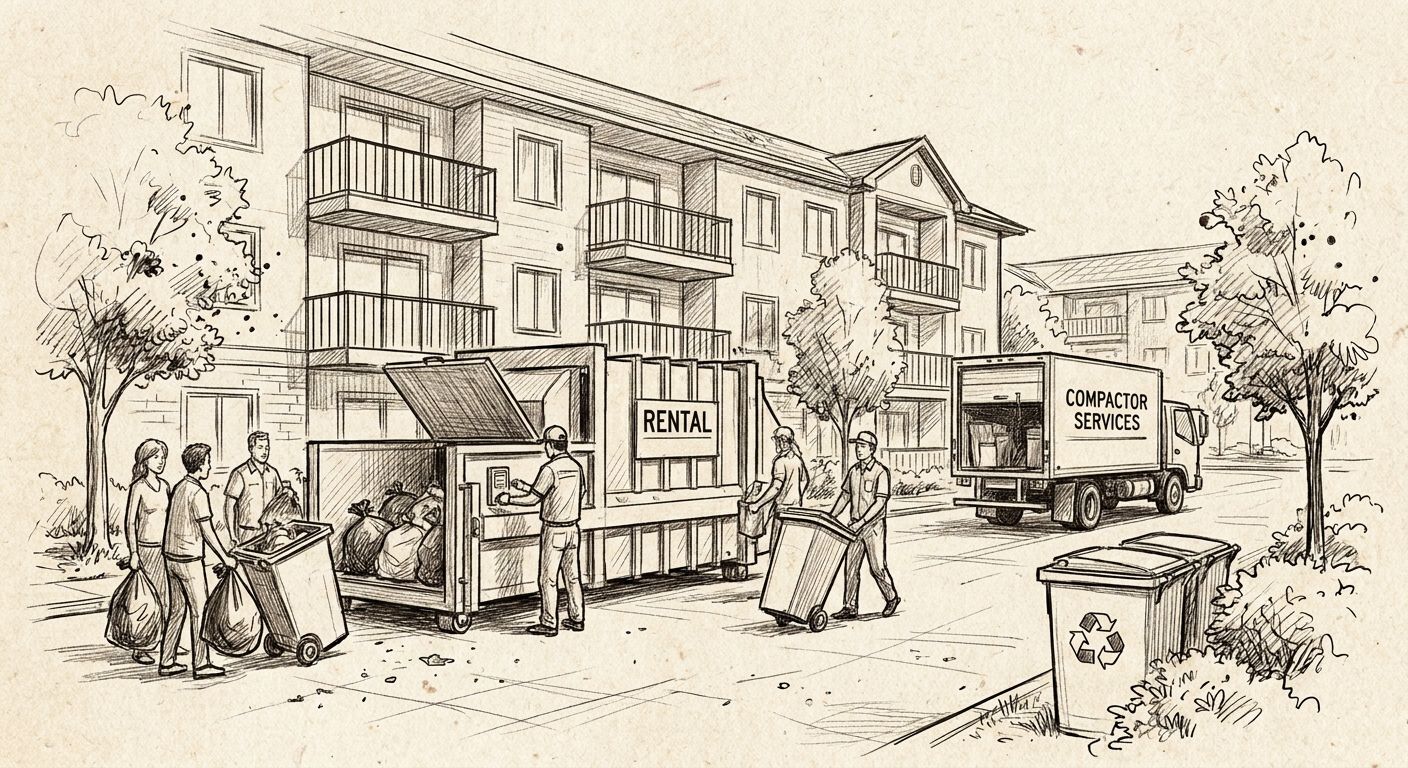
Apartment communities in San Jose and across the South Bay do not generate a flat, predictable trash stream. Move-out week in a 200-unit complex looks nothing like a quiet March, and the compactor that handles a 350-unit property will sit half-empty at a 30-unit building. This guide ranks the compactor and container options that actually work for multifamily properties in 2026, not the one-size pitch a broker reads off a script.
- Front-load dumpster service fits most Bay Area apartment communities better than a leased compactor: buy.
- Self-contained compactors solve liquid and odor problems at high-volume properties: consider, not a default.
- Roll-off containers cover move-out surges and turnover cleanouts without a permanent compactor lease: buy.
- A provider that runs its own transfer station controls pickup schedules instead of depending on a third party's dump hours.
Why this matters
Property managers do not lose sleep over container size. They lose sleep over enclosure overflow on the Monday after a holiday weekend, odor complaints logged in the resident portal, and a hauler that can't explain why a pickup slipped two days.
The compactor-versus-dumpster decision gets treated like a single choice, but it is really five decisions: waste volume, liquid handling, enclosure footprint, turnover surge capacity, and who controls the disposal schedule once the truck leaves the property. A site service provider that also runs its own transfer station, like Valley Services, controls that schedule directly instead of relying on a third-party dump's hours and backlog.
Get those five variables wrong and a community either overpays for compaction it doesn't need or runs an open-top dumpster that floods every August.
How we ranked these options
Each option below is scored against what actually breaks at apartment properties in the Bay Area: enclosure odor and liquid complaints, HOA and city permitting friction, move-out and renovation surges, and how much footprint the equipment eats from parking or landscaping.
The ranking also weighs schedule reliability. A compactor or dumpster program is only as good as the pickup calendar behind it, and that calendar depends on whether the hauler owns its own disposal endpoint or brokers the load out. Valley Services has operated the same San Jose yard since 1986, now under third-generation family ownership, and runs its own construction and demolition transfer station rather than hauling to someone else's site.
The ranked list
1. Front-load dumpster service: the flexible standard
The hook: this is the workhorse most communities actually need, not the compactor a sales rep upsells. Front-load containers in the 2 to 8 cubic yard range, serviced two to three times a week, cover the daily waste stream of most mid-size apartment properties without a permanent compaction unit taking up enclosure space.
The container sits in the existing trash enclosure, so there's no new pad, no drainage retrofit, and no added permitting layer. Front-load dumpster service built for apartment communities scales pickup frequency up during summer lease turns and back down in slower months.
Verdict: Buy. This is the right starting point for the majority of Bay Area apartment properties before anyone talks about a compactor.
2. Self-contained compactor: the wet-waste specialist
The hook: this is the fix for an enclosure that floods every summer. Self-contained compactors seal waste and liquid inside a closed unit instead of an open-top box, which matters at properties with heavy food waste from clubhouse events, on-site cafes, or high resident turnover generating spoiled food.
The tradeoff is real: these units need a dedicated concrete pad, drainage consideration, and a hauler who can service them on a hauled-when-full basis rather than a fixed weekly stop.
Verdict: Consider. Reach for this only after right-sizing dumpster pickup frequency fails to solve the odor or liquid problem. It is not the default answer.
3. Stationary compactor with a detachable container: the mid-size step up
The hook: the middle ground between an open dumpster and a full self-contained unit. A stationary compactor head crushes waste and pushes it into a detachable roll-off style container, which gets hauled off and swapped when full.
This setup works for larger complexes that are outgrowing dumpster service but don't have the liquid problem that pushes a property toward a fully sealed self-contained unit. It still needs a pad and clear truck access for the swap.
Verdict: Consider for large complexes scaling volume, not for anything under roughly 150 units.
4. Roll-off container: the turnover surge tool
The hook: the answer to move-out week, not the daily trash stream. Regular compactor or dumpster service is sized for baseline waste, and baseline sizing gets crushed the week 40 units turn over at once and residents leave furniture, mattresses, and full apartments of debris at the curb.
A roll-off container for apartment complex cleanouts drops in for the surge and pulls out when the cleanout is done, without disrupting the property's regular compactor or dumpster contract.
Verdict: Buy. Every property running a compactor or dumpster program should have a standing plan for surge roll-off service during turnover months, not a scramble call.
5. One provider, one schedule: the small-property fix
The hook: for a 20 to 60 unit property, a compactor is often overkill. The fix is coordinating dumpster size and pickup frequency with a single site service provider instead of splitting trash, turnover cleanouts, and occasional fencing needs across three vendors with three schedules.
Smaller HOA-managed communities in particular run into scheduling gaps when a compactor lease locks them into a service window that doesn't match actual occupancy swings.
Verdict: Buy for properties below the volume threshold that justifies compaction equipment and its footprint cost.
“If your enclosure floods every summer, the problem is liquid, not size.”
Comparison table
| Option | Best for | Footprint | Service pattern | Verdict |
|---|---|---|---|---|
| Front-load dumpster | Most apartment communities | Fits existing enclosure | 2-3x weekly | Buy |
| Self-contained compactor | High wet-waste volume, odor issues | Dedicated pad, drainage | Hauled when full | Consider |
| Stationary compactor | Large complexes scaling volume | Mid to large pad | Hauled when full | Consider |
| Roll-off container | Move-out surges, renovation debris | Temporary pad | On-demand | Buy |
| Single-provider scheduling | Smaller properties, HOA sites | Existing enclosure | Coordinated calendar | Buy |
Where to source it right
Three rules before signing anything in 2026:
- Ask who owns the disposal endpoint. Most haulers broker the load to a third-party site they don't control, which means their schedule bends to someone else's backlog. A provider running its own transfer station, like Valley Services in San Jose, sets its own timeline.
- Size the contract to the turnover calendar, not the lease-signing month. A property that adds compactor capacity in January and then gets flooded by an August move-out surge has solved the wrong problem.
- Put regular service and surge cleanouts under one contract when possible. Coordinating dumpster service for property management turnover cleanouts with the standing trash program avoids the scheduling gap that shows up every lease-turn season.
Talk through your property's setup
Call to size dumpster or compactor service for your community.
FAQ
What's the best compactor rental for apartment communities in 2026?
Most Bay Area apartment communities do better with front-load dumpster service than a leased compactor in 2026. Compactors make sense only when a property has confirmed liquid or odor problems that right-sized dumpster pickup frequency hasn't fixed.
Is a self-contained compactor better than a front-load dumpster for apartments?
A self-contained compactor is better only when a property has a heavy wet-waste stream, such as food waste from a clubhouse or cafe, causing enclosure flooding or odor complaints. For standard household trash, a front-load dumpster costs less footprint and less permitting friction.
How often should an apartment community schedule trash pickup?
Two to three pickups per week is standard for mid-size front-load dumpster service, adjusted up during summer lease turns and down in slower months. Pickup frequency should track the occupancy and turnover calendar, not stay fixed year-round.
Do apartment communities need a permit for a compactor enclosure in San Jose?
Compactor pads and enclosures typically require review under local building and site permitting rules, since a stationary or self-contained unit needs a dedicated concrete pad and drainage consideration. Check with the San Jose permitting office before committing to equipment that changes the site's footprint.
What causes dumpster odor complaints at apartment complexes?
Odor and liquid complaints usually trace to pickup frequency mismatched to actual waste volume, not container size. Before adding a compactor, confirm whether more frequent dumpster pickups solve the problem first.
Can one provider handle both regular trash service and move-out cleanout surges?
Yes, and coordinating both under one contract avoids the scheduling gap that shows up every turnover season. A roll-off container for the surge period sits alongside standing dumpster or compactor service without disrupting either.
Who controls the pickup schedule, the property or the hauler?
The hauler controls the schedule in practice, especially if it doesn't own its own disposal endpoint and has to work around a third-party site's hours. A provider running its own transfer station sets the timeline directly instead of passing along someone else's delays.
How much space does a compactor enclosure need compared to a dumpster?
A self-contained or stationary compactor needs a dedicated concrete pad with drainage, which is more footprint than a front-load dumpster that fits into an existing enclosure. That extra footprint is the main tradeoff a property gives up for compaction.
One last thing
The single biggest driver of enclosure complaints at Bay Area apartment communities in 2026 isn't container size. It's pickup frequency that never got adjusted after the property's occupancy or resident mix changed. Before signing a compactor lease, audit the last six months of pickup logs against the turnover calendar. Half the time, the fix is a schedule change, not new equipment.
Call (408) 297-5404 or reach out through valleyservices.biz to talk through what your property actually needs before committing to a compactor.