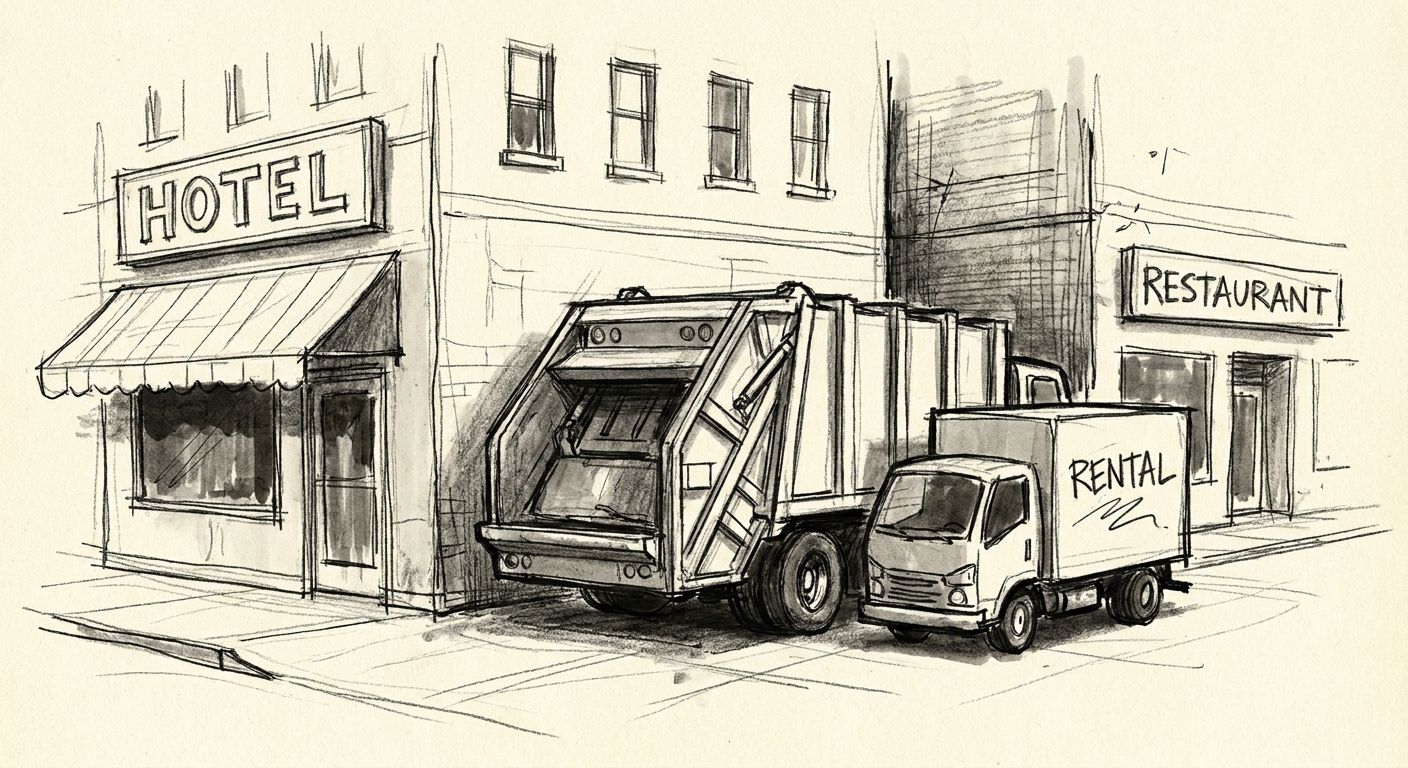
Hotels and full-service restaurants in San Jose and the South Bay generate wet food waste and flattened cardboard at a volume no 4-yard dumpster on a twice-weekly pickup can absorb without overflow, odor, and a call from the health inspector. A compactor rental changes the math: fewer hauls, tighter dock footprint, less standing waste behind the kitchen. This guide ranks the compactor configurations that actually work for hospitality properties in 2026 and tells you which one fits your building.
- A 4-yard self-contained compactor is the right call for most full-service hotels and mid-size restaurants in 2026: Buy.
- 2-yard units fit tight downtown loading docks but need pickup roughly twice as often as a 4-yard unit.
- 6-yard self-contained compactors suit banquet kitchens and convention hotels running back-to-back events.
- Chute-fed stationary compactors only make sense for high-rise hotel towers with an existing trash chute already in place.
- The best compactor rental for hotels in 2026 depends on kitchen volume and dock access, not on the biggest unit available.
Why this matters
A hotel kitchen running breakfast, banquet, and room service off one back-of-house corridor produces a different waste stream than a quick-service counter. Wet food waste rots fast. Cardboard from linen and amenity deliveries piles up between hauls. Get the compactor size wrong and you're either paying for empty hauls or dealing with a compactor that's full by Thursday.
Valley Services operates its own C&D transfer station in San Jose, which matters for compactor scheduling the same way it matters for roll-off containers: the haul-out date isn't dependent on a third-party site's hours or intake backlog. That's the difference between a compactor emptied on schedule and one sitting full over a weekend banquet.
How we ranked these compactor rentals
The ranking below runs on operational fit, not on unit size for its own sake. Each configuration is scored against three factors that actually determine whether a compactor works on a hospitality site in 2026: dock footprint, waste type match (wet kitchen waste versus dry cardboard), and how the haul frequency lines up with event or occupancy swings.
No configuration wins across every property. A boutique 40-room hotel and a 300-room convention property need different equipment, and a quick-service restaurant sharing a strip-mall pad has constraints neither of those two face. The list below sorts by property type first, capacity second.
The ranked compactor picks for hotels and restaurants in 2026
1. 2-yard self-contained compactor: the tight-alley pick
The smallest self-contained unit in common hospitality use, sized for roughly 2 cubic yards of compacted waste before haul-out. It fits loading docks and rear alleys where a 4-yard footprint physically won't clear the turning radius, which describes a lot of downtown San Jose and Santa Clara storefront restaurants.
The tradeoff is haul frequency. A busy full-service kitchen fills a 2-yard unit fast, and if your haul schedule can't flex to match, you're back to overflow. Verdict: Consider for boutique hotels under roughly 60 rooms and single-location restaurants with tight rear access, Skip for anything running banquet or event volume.
2. 4-yard self-contained compactor: the standard back-of-house pick
This is the default size for a full-service hotel with one main kitchen and a standard twice-weekly to three-times-weekly haul schedule. It handles mixed wet and dry waste without the odor buildup you get from an undersized unit sitting past capacity, and the footprint still fits most standard hotel dock pads.
Restaurants sizing a compactor for the first time should look at how compactor rental for retail and grocery stores handles a comparable volume problem: steady daily waste generation rather than event spikes. Hotel back-of-house kitchens run the same steady pattern most of the year. Verdict: Buy for the majority of full-service hotels and mid-size restaurants in 2026.
3. 6-yard self-contained compactor: the banquet-kitchen pick
Convention hotels and properties running regular banquet business need the extra capacity a 6-yard unit provides, particularly on weeks stacked with back-to-back events. This size absorbs the volume spike from a 400-plate banquet without forcing an emergency haul mid-week.
The cost of that headroom is a bigger footprint and a unit that sits partly empty during slow weeks. Properties without consistent event volume are better served by a 4-yard unit and a flexible haul schedule. Verdict: Buy for convention and event-heavy hotels, Consider for properties with seasonal banquet business only.
4. Chute-fed stationary compactor: the high-rise tower pick
High-rise hotel towers with an existing trash chute system feed waste directly into a stationary compactor at the base of the building rather than hauling bagged waste through the lobby or service elevator. This only works where the chute infrastructure already exists.
Retrofitting a chute system into a building that doesn't have one is a construction project, not a rental decision, and it's rarely worth it against a well-scheduled self-contained unit on the loading dock. Verdict: Buy if the chute already exists, Skip as a retrofit project for anything else.
5. Wheeled front-load compactor: the shared-pad quick-service pick
Quick-service restaurants and small hotel food courts sharing a single trash pad with neighboring tenants often end up on a wheeled front-load compactor serviced on a shared contract. It's a workable option when floor space is limited and volume is moderate.
The downside shows up when one tenant's waste generation spikes and the shared unit fills faster than the group schedule anticipated. Verdict: Consider for shared-pad quick-service locations, Skip for any single-tenant hotel or full-service restaurant that can size its own unit.
Compactor rental comparison for hotels and restaurants
| Configuration | Capacity | Best fit | 2026 Verdict |
|---|---|---|---|
| 2-yard self-contained | ~2 yards | Boutique hotels, tight alley access | Consider |
| 4-yard self-contained | ~4 yards | Full-service hotels, mid-size restaurants | Buy |
| 6-yard self-contained | ~6 yards | Convention hotels, banquet kitchens | Buy |
| Chute-fed stationary | Building-dependent | High-rise towers with existing chute | Buy (if chute exists) |
| Wheeled front-load | ~2-4 yards | Shared-pad quick-service locations | Consider |
Where to rent a compactor for your property
Confirm the provider controls its own disposal endpoint. A compactor rental is only as reliable as the haul-out schedule behind it. Valley Services owns and operates its own C&D transfer station in San Jose, so scheduling doesn't depend on a third-party site's intake hours.
Match haul frequency to your compaction ratio, not the calendar. A self-contained compactor at a 3:1 to 4:1 ratio still fills faster during banquet weeks. Ask for a haul schedule that flexes around event calendars rather than a fixed weekly date.
Check dock access and any local placement requirements before committing to a footprint. A restaurant renovation or kitchen buildout changes dock clearance temporarily, and commercial dumpster rental for restaurants covers the same access questions worth answering before a compactor lands on site.
Talk through your kitchen's waste volume
Call to size a compactor against your haul schedule and dock access.
FAQ
What size compactor does a hotel need?
Most full-service hotels run on a 4-yard self-contained compactor in 2026. Convention hotels with regular banquet volume size up to 6 yards, and boutique properties with tight dock access often size down to 2 yards.
Is a compactor rental better than a dumpster for a restaurant?
A compactor rental beats a standard roll-off dumpster once wet food waste and cardboard volume outgrow a twice-weekly pickup schedule. Restaurants under that volume threshold are often better served by a standard dumpster with a flexible haul schedule.
How often does a hotel compactor need to be emptied?
Haul frequency depends on capacity and occupancy, typically two to three times a week for a 4-yard unit at a full-service hotel. Banquet weeks push that frequency up regardless of unit size.
What is the difference between a self-contained and stationary compactor?
A self-contained compactor is hauled away whole when full and swapped for an empty unit. A stationary compactor stays on site permanently and only the waste inside gets hauled out, which requires an existing chute or feed system.
Can restaurants share a compactor with neighboring businesses?
Yes, shared-pad wheeled front-load compactors work for quick-service restaurants and small food courts on a shared service contract. The risk is one tenant's volume spike filling the shared unit ahead of schedule.
Do hotels need a permit for a compactor placement in San Jose?
Placement requirements depend on where the unit sits relative to the property line and public right of way. Confirm placement details with your rental provider before the unit arrives.
How much does compactor rental cost for a hotel?
Pricing depends on capacity, haul frequency, and site access, so figures vary by property. Call (408) 297-5404 or visit valleyservices.biz for a quote based on your kitchen's volume.
What is the best compactor rental for hotels with limited dock space?
A 2-yard self-contained compactor is the best compactor rental for hotels with tight alley or dock access, provided the haul schedule flexes to match faster fill times. Boutique properties under roughly 60 rooms fit this profile most often.
One last thing
The compactor size that looked right on a spec sheet in January often stops fitting by summer, when banquet bookings and occupancy climb. Revisit the haul schedule at least once a year rather than locking in a size and forgetting about it. A 4-yard unit that worked fine in 2025 can run short the first convention week of 2026 if event volume grew and the schedule didn't.
Call (408) 297-5404 or visit valleyservices.biz to talk through your kitchen's actual waste volume before picking a size.