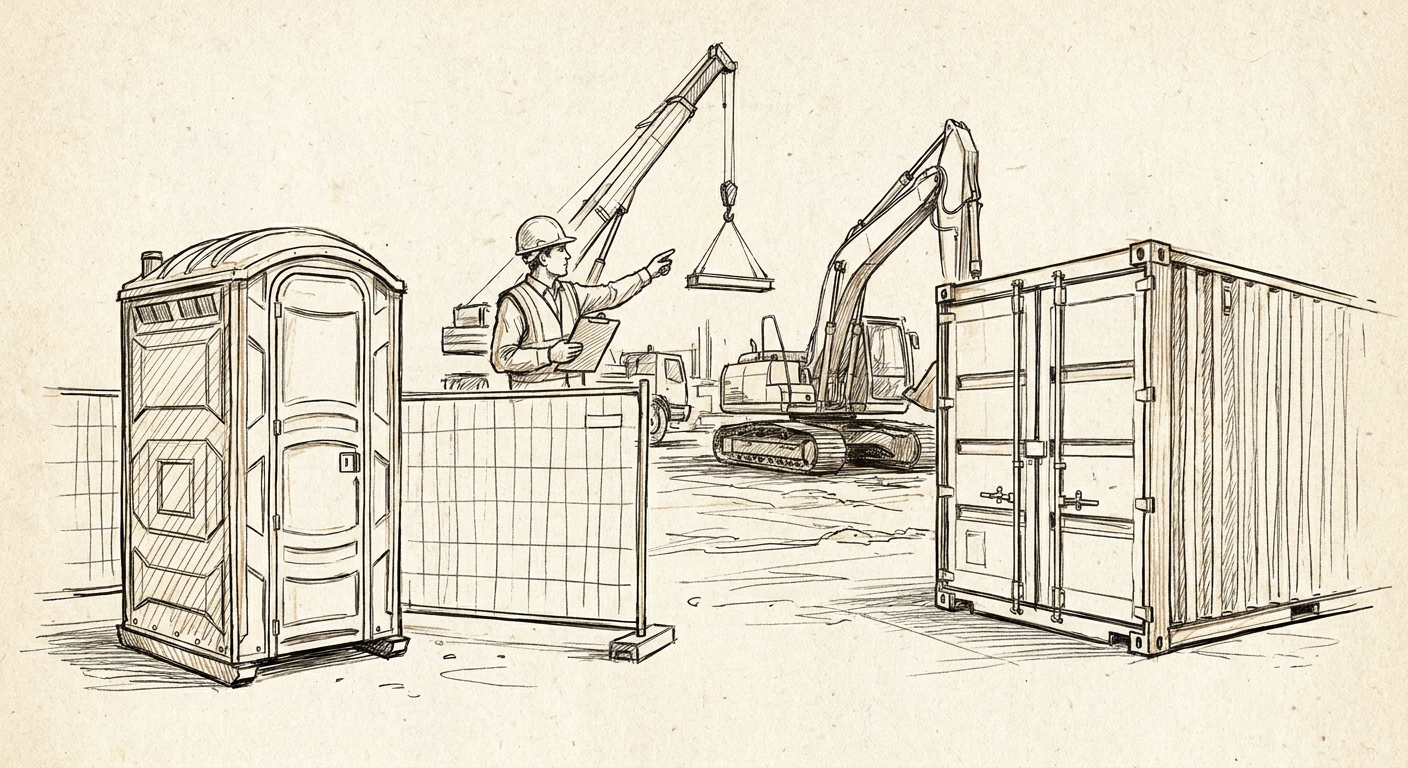
General contractors running multi-phase Bay Area jobs don't need five vendors and five delivery windows. They need one phone call that puts a container, a restroom, and fencing on site before the crew shows up. This guide ranks the site service rental packages that actually hold up on active jobsites in 2026.
- The one-call standard package (container plus restroom plus rotating swap) is the best site service rental for general contractors running multi-phase jobs in 2026. Buy.
- New home construction pairs a 30 yard container with a restroom and full-perimeter fencing. Buy.
- Commercial demolition needs a 40 yard container plus K-rail, not a residential-size bin. Buy.
- Landscaping-only site prep rarely needs fencing or a restroom bundle for a GC's crew size. Skip the full package here.
Why this matters
A GC juggling framing, roofing, and finish work across three sites doesn't have time to track separate vendors for containers, restrooms, and fencing. Every extra vendor is another call, another invoice, another chance the delivery misses the load-in window.
Valley Services runs its own C&D transfer station and container fleet out of the same San Jose yard the family has operated since 1986. Owning the disposal endpoint means the schedule doesn't depend on a third-party site's hours. That's the difference between a package that works and a stack of separate rentals that don't talk to each other.
How we ranked the packages
Each package is scored on four things a GC actually cares about: container size fit for the debris stream, restroom count against crew size, whether fencing or K-rail is needed for site control, and how well the pieces line up on one delivery schedule. Packages that force a second call for permits, extra swaps, or mismatched drop-off windows lose points fast.
Site duration matters as much as site size. A two-week remodel and a six-month new build need different container rotation math, even if the debris volume looks similar on paper. The rankings below assume Bay Area jobsites: San Jose, Santa Clara, Sunnyvale, Mountain View, and Milpitas, where access and permit rules vary block to block.
The ranked packages
1. The one-call standard package: the default for active multi-phase jobs
This pairs a rotating roll-off container with a single restroom unit, swapped on the same visit whenever the container gets pulled. No separate scheduling, no gap between disposal and sanitation.
It fits jobs running eight weeks or longer with a crew of six to twelve. Container size typically starts at 20 yard and steps up as demo phases ramp. Verdict: Buy. This is the package most GCs should default to unless the job has a specific reason to deviate.
2. New home construction package: the long-haul pick
Ground-up builds run months, not weeks, and debris volume climbs as framing gives way to finish work. A 30 yard container handles the framing and drywall phase without daily hauls, and full-perimeter fencing keeps the site secured overnight.
Pair it with a restroom rated for daily crew use, not a weekend-event unit. See the 30 yard dumpster rental for new home construction breakdown for swap timing. Verdict: Buy.
3. Kitchen and bath remodel package: right-sized, not oversized
A single-trade remodel doesn't need a 40 yard container sitting half empty for three weeks. A 15 to 20 yard unit and one restroom cover most kitchen and bath jobs without wasting driveway space.
Fencing is usually unnecessary here since the crew is small and the site isn't a security risk overnight. Verdict: Hold for GCs running multiple small remodels at once. Confirm size against actual debris volume before locking it in.
4. Roofing tear-off package: fast in, fast out
Tear-offs generate a dense, heavy debris stream in a short window, often a single day or two. The container needs to handle shingle weight without hitting load limits, which rules out undersized units.
A restroom isn't always necessary for a one-day crew working near their trucks, but it's worth confirming with the property manager on occupied buildings. Verdict: Buy for anything beyond a single-day residential tear-off.
5. Commercial demolition package: control the perimeter, not just the debris
Demo sites carry real safety and liability exposure. A 40 yard container paired with K-rail and full fencing keeps the public out and keeps the site defensible if an inspector shows up unannounced. See the 40 yard dumpster rental for commercial demolition specs before ordering.
Restroom count scales with crew size here, usually one unit per ten workers minimum. Verdict: Buy. Skipping the fencing on a demo site is the most common mistake GCs make, and it's the one that gets flagged first on a site visit.
6. Warehouse and tenant improvement cleanout package: security over sanitation
TI cleanouts generate bulk debris but often run with a smaller crew over a shorter window. Fencing matters more here than a restroom bundle, especially on vacant or partially occupied buildings where site security is the actual risk.
Verdict: Hold. Order the container and fencing together, but skip the restroom add-on if the building has working facilities the crew can use.
7. Landscaping and site prep package: usually overbuilt for a GC's crew
Landscaping-only phases rarely need a restroom or fencing bundle when the GC's crew is small and working during daylight hours near an occupied structure. A standalone container covers the debris without the extra line items.
Verdict: Skip the full package here unless the site prep runs alongside active demo or framing work on the same lot.
“Skipping the fencing on a demo site is the most common mistake GCs make, and it's the one that gets flagged first on a site visit.”
Package comparison
| Package | Container size | Restroom | Fencing / K-rail | Verdict |
|---|---|---|---|---|
| One-call standard | 20 yard, rotating | 1 unit | Optional | Buy |
| New home construction | 30 yard | 1 daily-use unit | Full perimeter | Buy |
| Kitchen/bath remodel | 15-20 yard | 1 unit | Not needed | Hold |
| Roofing tear-off | 20-30 yard | Situational | Not needed | Buy |
| Commercial demolition | 40 yard | 1 per 10 crew | K-rail + fencing | Buy |
| Warehouse/TI cleanout | 20-30 yard | Optional | Full perimeter | Hold |
| Landscaping/site prep | 10-15 yard | Not needed | Not needed | Skip |
Where to source your package
- Call before you book online. Container access, street permit rules, and crew size vary block to block across San Jose, Santa Clara, and Sunnyvale. A phone call at (408) 297-5404 sorts sizing faster than a web form.
- Bundle the order, not just the invoice. Ask for container, restroom, and fencing on the same delivery ticket so load-in day doesn't turn into three separate appointments.
- Confirm the disposal endpoint. A vendor that hauls to a third-party site can't control your swap schedule the way one that owns its own transfer station can. Valley Services runs its own C&D transfer station in San Jose, and that's what keeps the rotation on time when a job runs long.
Talk through your job's package
One call sets container, restroom, and fencing on the same delivery schedule.
FAQ
What's the best site service rental package for general contractors in 2026?
The one-call standard package, a rotating roll-off container paired with a single restroom on the same delivery schedule, fits most active multi-phase jobs in 2026. It scales up to larger container sizes and fencing as the job phase changes.
Do general contractors need fencing on every jobsite?
No. Fencing matters most on demolition, vacant property, and multi-week new construction sites where overnight security is a real risk. A short kitchen remodel with an occupied home rarely needs it.
What container size do most GCs need for a multi-phase job?
20 yard containers cover most active framing and remodel phases, stepping up to 30 or 40 yard for new construction and commercial demolition. Debris weight, not just volume, drives the right size.
How many portable restrooms does a jobsite need?
Plan on roughly one restroom per ten crew members for daily-use construction sites. Larger demolition crews or multi-trade sites need more units scheduled on the same rotation as the container.
Is it better to rent containers, restrooms, and fencing from one vendor?
Yes, for scheduling reasons. One vendor controlling the delivery calendar avoids the gaps that happen when three separate companies each set their own drop-off and pickup windows.
Does Valley Services serve the whole Bay Area?
Valley Services serves San Jose, Santa Clara, Sunnyvale, Mountain View, Milpitas, and the surrounding Bay Area, with the C&D transfer station located in San Jose only.
What's the biggest mistake GCs make when ordering a site service package?
Undersizing the container for the debris weight, not just the volume, and skipping fencing on sites that need overnight security. Both mistakes show up fast during a job-site inspection.
How far in advance should a GC book a site service package?
Book as soon as the job schedule is confirmed, ideally one to two weeks ahead for standard packages and further out for large new construction jobs needing 30 or 40 yard containers.
One last thing
The package detail GCs overlook most isn't size, it's timing. A container swap that lands a day late on a demolition site stalls the whole crew, and a vendor hauling to someone else's disposal site can't always control that timing. Valley Services has run its own San Jose yard since 1986, three generations in, which is the actual reason the rotation stays on schedule when a job runs long.
Related guides
- Best temporary fence rental for construction sites
- Best portable toilet rental companies for construction sites
Call (408) 297-5404 or visit valleyservices.biz to talk through the package that fits your next job.