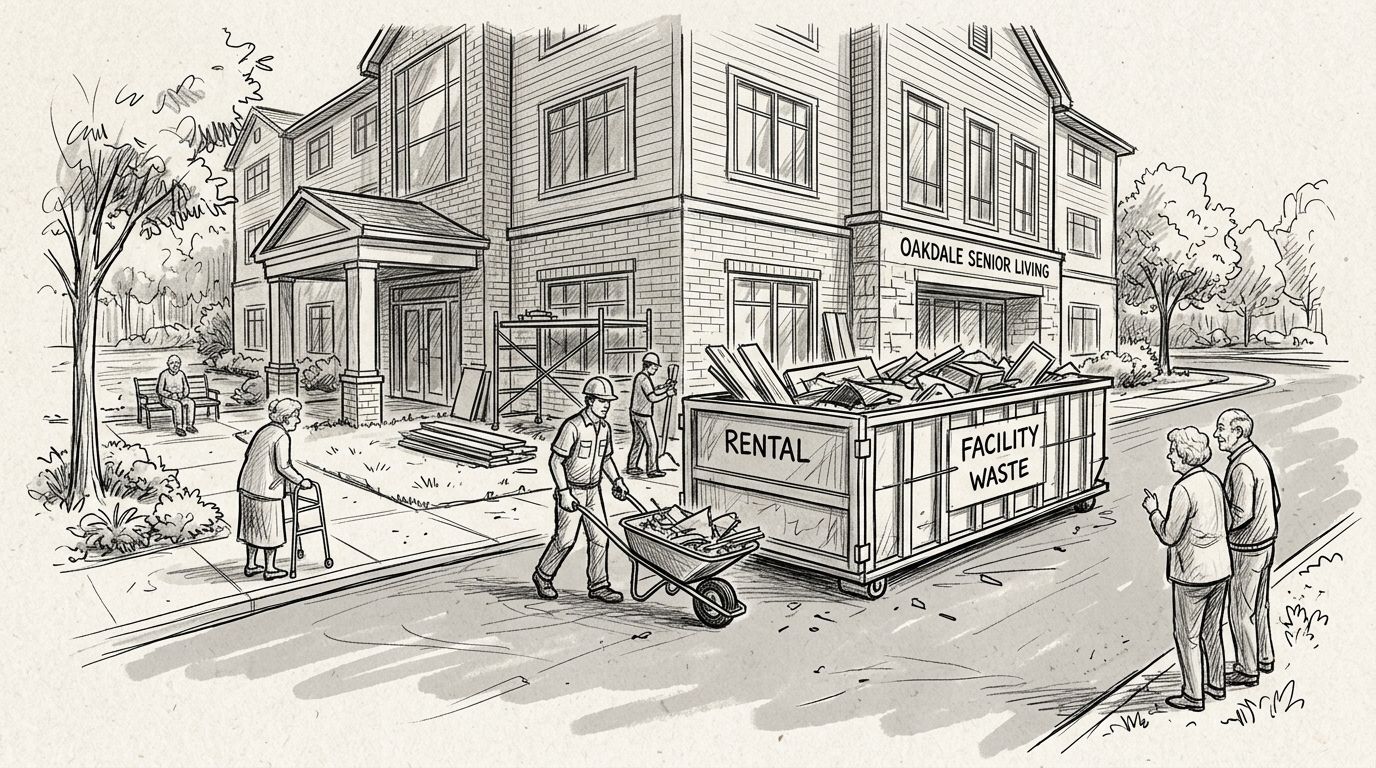
Renovating an occupied senior living facility is not the same job as gutting a vacant commercial building, and the container that works for one will jam up the other. Best overall for a senior living facility renovation in 2026: a 20-yard roll-off container, sized for a full unit turnover without blocking a hallway or fire lane. Best for a single bathroom or flooring retrofit: a 10-yard roll-off container. Best for common area or dining hall work: a 30-yard roll-off container. Best for a full wing renovation or building-wide demolition: a 40-yard roll-off container.
Valley Services has run site services out of the same San Jose yard since 1986, third generation, same family, and owns its own C&D transfer station rather than brokering disposal to a third party. That matters on a phased senior living job because container swaps run on the vendor's own schedule, not on a broker's timeline.
- A 20-yard roll-off container is the default pick for renovating one occupied senior living unit in 2026.
- 10-yard containers fit tight courtyards and single-room bathroom or flooring retrofits.
- 30-yard and 40-yard containers cover common area buildouts and full-wing demolition without a mid-job swap.
- Valley Services runs its own San Jose transfer station, so container swaps for phased senior living work happen on its own schedule, not a broker's.
Why senior living renovation sites are different
Senior living facilities operate differently from a vacant commercial shell. Residents live on site while crews demo cabinets, flooring, and fixtures a few doors down. Egress paths need to stay clear at all times, and a roll-off container placed in the wrong spot blocks a fire lane or an ADA-compliant path faster than it fills with debris.
Most renovations run in phases, one wing or one unit at a time, so the container size has to match the phase in front of the crew, not the whole project scope. Pull a 40-yard container for a single unit turnover and it sits mostly empty for two weeks, taking up parking that residents and staff need every day. Pull a 10-yard for a common area gut and the crew is calling for a second haul by day three.
Facility managers on this kind of job need one phone call to cover containers, restrooms, and temporary fencing, not three vendors coordinating three separate schedules around the same occupied building.
What makes the best roll-off container choice for a senior living renovation
- Sizing that matches the phase, not the whole job: a single unit teardown needs a different container than a wing-wide gut.
- Placement that keeps fire lanes and ADA-compliant paths clear at all times.
- A vendor who also handles restrooms and temporary fencing under one schedule.
- Same-day or next-day swaps tied to a transfer station the vendor actually controls.
- Permit handling for any container sitting on a public street or right-of-way.
- Delivery and pickup windows that respect resident routines, not just crew convenience.
At a glance
| Container | Best for | Standout feature | Key limitation |
|---|---|---|---|
| 10-yard roll-off | Single bathroom or flooring retrofit | Fits tight courtyards and narrow service drives | Fills fast on a full bathroom gut, needs a swap plan |
| 20-yard roll-off | Full unit turnover | Handles cabinets, flooring, and drywall from one apartment in a single haul | Tight for two occupied units running in parallel |
| 30-yard roll-off | Common area or dining hall renovation | Covers a full common space gut without a mid-job swap | Needs more footprint, plan around resident traffic |
| 40-yard roll-off | Full wing renovation or building-wide demolition | Highest volume per haul for multi-unit demo | Space-hungry and unnecessary for single-unit work |
1. 10-yard roll-off container: best for single-room and bathroom retrofits
A 10-yard roll-off container is the blue steel unit sized for one room at a time: a bathroom retrofit, a flooring swap, a single-unit fixture upgrade. It fits in a single parking stall or a narrow service drive without crossing an ADA path.
10-yard pros:
- Smallest footprint on site, easiest for staff and residents to work around.
- Low enough profile to sit under most covered entries and carports.
- Matches the pace of one-room-at-a-time renovation work.
10-yard cons:
- Fills fast when tile, a vanity, and a tub all come out at once.
- Not enough volume for a phase running longer than a few days without a swap.
Best for: a single bathroom or flooring retrofit inside one occupied unit. Verdict: Book it for single-room work, skip it for anything touching more than one unit.
2. 20-yard roll-off container: best for a full unit turnover
A 20-yard roll-off container handles a complete apartment turnover: cabinets, flooring, drywall, and fixtures, all in one haul. It stays narrow enough for most senior living parking lots and service corridors, and it matches the pace of a one-unit-at-a-time renovation schedule. Crews that load a container safely and avoid overage fees get more volume out of each haul before calling for a swap.
20-yard pros:
- Handles a full apartment turnover in a single container.
- Still narrow enough for most senior living lots and corridors.
- Matches occupied-unit renovation pacing without idle space.
20-yard cons:
- Tight if two units are being turned over in parallel.
- Needs a clear placement plan near occupied units to avoid blocking resident walkways.
Best for: a full unit turnover in an occupied senior living facility. Verdict: Book it. This is the default size for occupied-unit renovation work in 2026.
3. 30-yard roll-off container: best for common area and dining hall renovations
A 30-yard roll-off container covers a full common space gut, a dining hall, lobby, or activity room, without a mid-job swap. It cuts down on the number of truck trips moving through a site with resident foot traffic during the workday.
30-yard pros:
- Covers a full common area renovation in one container.
- Fewer truck trips through occupied hallways and lots.
30-yard cons:
- Needs more footprint than most unit-level placements allow.
- Wastes space and access if used for single-unit work.
Best for: common area, dining hall, or lobby renovation. Verdict: Book it for common area scope, hold off for single-unit jobs.
4. 40-yard roll-off container: best for full wing renovation or building-wide demolition
A 40-yard roll-off container carries the highest volume per haul, which means fewer trucks moving through a site with residents present during a multi-unit or wing-wide demolition phase.
40-yard pros:
- Highest volume per haul for multi-unit or wing-scale demolition.
- Fewer total deliveries and pickups over a long demolition phase.
40-yard cons:
- Footprint and height rule it out for tight senior living lots and covered drives.
- Overkill for anything smaller than a multi-unit phase.
Best for: full wing renovation or building-wide demolition. Verdict: Book it for wing-scale work, skip it for single-unit or common-area jobs.
How we ranked these
The ranking above runs on phase-matched sizing, placement that respects ADA and fire lane clearance, and access to a same-day swap when a phase runs long. Every size on this list gets used somewhere on a senior living renovation. The mistake most facility managers make is picking one container size for the whole project instead of matching it to the phase directly in front of the crew.
Which roll-off container fits your senior living facility renovation?
If you are renovating one occupied unit at a time in 2026, the 20-yard roll-off container is the default. Step down to a 10-yard for a single bathroom or flooring job, and step up to a 30-yard once the scope hits a dining hall, lobby, or activity room. Save the 40-yard for a wing that is fully vacated for demolition.
Whatever size you land on, book placement early. Senior living sites in San Jose usually need a permit placement in San Jose for anything sitting on a public street, and that paperwork should be settled before the container shows up, not after.
FAQ
What size roll-off container do I need for a senior living facility renovation?
Most single-unit turnovers use a 20-yard roll-off container in 2026, moving up to a 30-yard for common areas and a 40-yard for a full wing. A single bathroom or flooring retrofit usually fits a 10-yard container.
Can a roll-off container sit in a senior living facility parking lot?
Yes, as long as placement keeps fire lanes and ADA-compliant paths clear at all times. Sites placing a container on a public street in San Jose typically need a placement permit before delivery.
How long can a container stay on site during a phased renovation?
Rental length should match the renovation phase in front of the crew, not the whole project timeline. Confirm the swap schedule with the vendor before demo starts so a full container never sits waiting on a pickup.
Do senior living renovations need separate service for restrooms during the project?
Yes, if interior restrooms go out of service during a phase, portable restrooms keep the site functional for the crew without disrupting resident routines elsewhere in the building.
How does temporary fencing factor into a senior living facility renovation?
Temporary fencing separates the active work zone from resident areas, which matters more on an occupied campus than on a vacant lot where nobody is walking through mid-demo.
Is a 10-yard or 20-yard container better for a single unit renovation?
A 20-yard container handles a full unit turnover, cabinets, flooring, and drywall, in one haul. A 10-yard fits a narrower scope like a single bathroom or flooring swap.
Why does the disposal endpoint matter for a senior living renovation schedule?
A vendor that owns its own transfer station controls the swap schedule directly, which matters on a phased renovation where a delayed haul can stall the next unit's start date.
How far in advance should a senior living facility book container service?
Book placement as soon as the renovation phase and unit sequence are set, especially if the container needs a public street permit before delivery.
One last thing
Most senior living renovation quotes focus on the container size and skip the site plan. The bigger risk on an occupied campus is not undersizing the container, it is placing it where a resident, a wheelchair, or a fire truck needs to pass. Walk the placement spot with whoever manages resident and maintenance access before the container shows up, not after.
Plan your senior living renovation site
One call covers containers, restrooms, and fencing for the whole project.