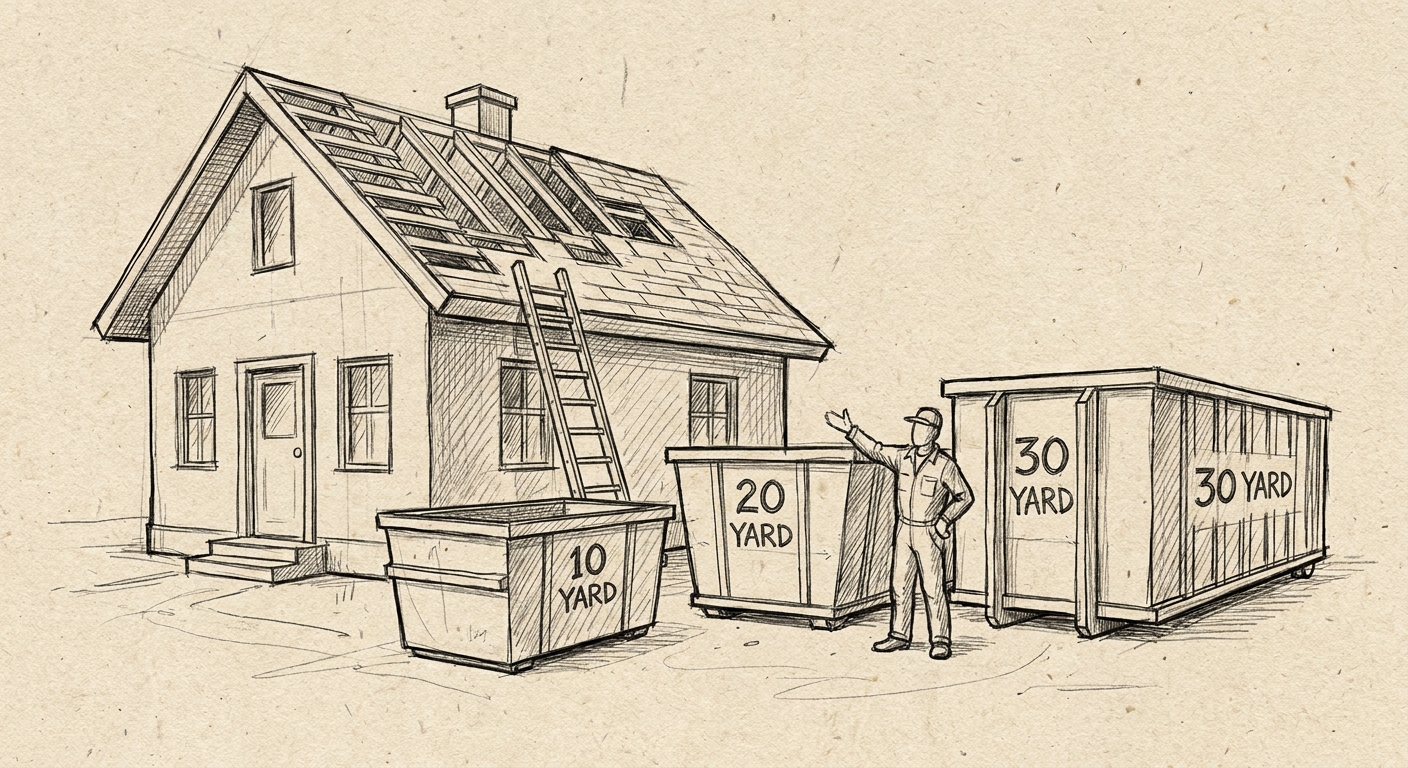
Roof tear-offs are a weight problem disguised as a volume problem: the container fills by pounds long before it fills by yardage, and the wrong size means a mid-job swap or a crew standing around waiting on a haul. This guide ranks the roll-off container sizes that actually work for roof replacements in 2026 and tells you which one fits your tear-off.
- A 15-yard roll-off container is the best dumpster size for roof replacement on most single-family homes up to 2,500 sq ft, single layer. Buy it.
- A 10-yard fits tight driveways and roofs under 1,500 sq ft with one layer of shingles. Buy for small jobs only.
- A 20-yard covers two-layer tear-offs or roofs past 2,500 sq ft. Buy for bigger or double-layer jobs.
- 30-yard and 40-yard containers hit weight limits before they fill on a straight shingle tear-off. Skip unless the job includes deck or structural replacement.
Why This Matters
Roofing debris is dense in a way that drywall, framing scraps, and yard waste are not. A single layer of asphalt shingles runs roughly 250 to 400 pounds per square, which is why a roofing container hits its weight cap long before it hits the rim.
Order by yardage alone in 2026 and you either sit on wasted space or run out of container mid-tear-off with the crew still stripping deck. The right call starts with roof square footage and layer count, not with whatever size feels standard.
Valley Services runs its own C&D transfer station in San Jose and weighs every load that comes off the scale, and roofing tear-offs consistently post some of the highest per-yard weight numbers of any job type. The roofing tear-off roll-off rental breakdown covers sizing in more depth if your job mixes tear-off with other debris.
How We Sized This List
This ranking runs on three inputs: roof square footage, number of shingle layers, and the weight ceiling every roll-off container carries regardless of how much air space is left inside it. Valley Services has pulled roll-off containers off Bay Area roofing jobs since 1986, third generation, same yard, and the pattern holds year over year: single-layer jobs stay volume-limited, two-layer jobs go weight-limited fast.
None of these sizes are guesses. They map directly to the square footage and layer counts that show up on actual tear-off jobs across San Jose, Santa Clara, Sunnyvale, Mountain View, and Milpitas.
Best Dumpster Sizes for Roof Replacement, Ranked
10-Yard Roll-Off Container: The Tight-Driveway Pick
A 10-yard roll-off container holds roughly 3 tons of tear-off debris, which covers a single-layer shingle tear-off up to about 1,500 square feet. It fits in one driveway parking space, the right call on a townhouse or a small single-story home where street placement isn't an option.
Order the 10-yard if the roof runs under 1,500 square feet with one layer of shingles. Buy for that job. Push past that footprint or into a second layer and this size caps out on weight before the crew finishes stripping the deck.
15-Yard Roll-Off Container: The Standard Tear-Off
A 15-yard roll-off container covers most single-family roof replacements in the Bay Area, up to roughly 2,500 square feet of single-layer shingle removal. It's the size that shows up most often on standard tear-off jobs because it matches the weight profile of one layer without leaving unused capacity.
Buy for the majority of 2026 tear-off jobs on standard single-family roofs. If the crew finds a second layer under the first once they start pulling shingles, plan on a swap rather than trying to force it into this container.
20-Yard Roll-Off Container: The Two-Layer Call
Order a 20-yard roll-off container when the roof carries two layers of shingles or the footprint runs past 2,500 square feet. A second layer roughly doubles the debris weight without doubling the volume, which is exactly the situation this size is built for.
Buy for two-layer tear-offs and larger single-family or small commercial roofs. This is also the size most general contractor roll-off rentals default to when a roofing subcontractor is one of several trades on a multi-phase job.
30-Yard and 40-Yard Roll-Off Containers: The Oversized Mistake
A 30-yard or 40-yard roll-off container has the volume to swallow a whole roof's worth of shingles, but volume was never the constraint on a tear-off. Weight limits hit before the container fills, which means most of that extra yardage sits empty while the crew still needs a second haul.
These sizes earn their keep on jobs that include deck replacement, structural repair, or a full re-roof with framing work, not a straight shingle tear-off. Skip the 30-yard and 40-yard for a standard tear-off. Consider the 30-yard only if deck or structural work is part of the same job.
Size Comparison Table
| Size | Best For | Single-Layer Coverage | Layers Supported | Verdict |
|---|---|---|---|---|
| 10-yard | Tight driveways, small roofs | Up to 1,500 sq ft | 1 layer | Buy for small jobs |
| 15-yard | Standard single-family tear-off | Up to 2,500 sq ft | 1 layer | Buy |
| 20-yard | Two-layer or larger roofs | Up to 3,000 sq ft | Up to 2 layers | Buy |
| 30-yard | Tear-off plus deck or structural work | Weight-limited, not volume-limited | N/A | Consider |
| 40-yard | Full re-roof with structural replacement | Weight-limited, not volume-limited | N/A | Skip for straight tear-off |
“If the tear-off is two layers, order for the weight, not the yardage.”
Where to Rent a Roll-Off Container for a Roof Tear-Off
Three things matter more than the size chart once you're actually booking:
- Confirm the yard owns its own disposal endpoint. A company that hauls to a third-party site is scheduling around someone else's yard. Valley Services runs its own San Jose transfer station, which is why swap timing and weight tickets don't depend on another operator's calendar.
- Ask about same-day or next-day swap availability. Two-layer tear-offs go over the ordered size more often than crews expect, and a same-day swap keeps the job moving instead of stalling on the roof deck.
- Check street placement rules before delivery day. San Jose, Santa Clara, Sunnyvale, Mountain View, and Milpitas each handle right-of-way permits differently if the driveway can't hold the container. Confirm this before the truck shows up, not after.
For debris that's mixed with old flashing, gutters, or decking material, the disposing of construction debris in San Jose guide covers what's allowed in a standard C&D load versus what needs separate handling.
Get the right size before tear-off day
Call to talk through roof square footage, layers, and delivery timing.
FAQ
What is the best dumpster size for roof replacement?
A 15-yard roll-off container is the best dumpster size for roof replacement on most single-family homes with one layer of shingles, covering roofs up to about 2,500 square feet in 2026. Roofs with two layers or larger footprints need a 20-yard instead.
Is a 10-yard dumpster big enough for a roof tear-off?
A 10-yard roll-off container works for roofs under about 1,500 square feet with a single layer of shingles. Anything larger or with a second layer underneath will hit the weight limit before the tear-off is done.
How much does a roof tear-off weigh?
A single layer of asphalt shingles runs roughly 250 to 400 pounds per 100 square feet, so a 2,000 square foot single-layer tear-off lands around 2.5 to 4 tons. A second layer roughly doubles that weight.
Do I need a bigger dumpster for a two-layer roof?
Yes. A second layer of shingles roughly doubles the debris weight without adding meaningful volume, which is why two-layer tear-offs typically need a 20-yard container instead of a 15-yard.
Can a 30-yard dumpster be used for a roof replacement?
A 30-yard roll-off container can be used, but it's usually overkill for a straight shingle tear-off since weight limits hit before the container fills. It makes more sense when the job also includes deck or structural replacement.
What size dumpster do I need for a 2,000 square foot roof?
A 2,000 square foot roof with a single layer of shingles fits a 15-yard roll-off container in most cases. If there's a second layer underneath, move up to a 20-yard.
How long can I keep a roll-off container for a roofing job?
Rental duration depends on the job schedule and the provider's terms, so confirm timing when you book. Most roof tear-offs finish within a day or two, which keeps the container on site for a short window.
Does Valley Services deliver roll-off containers for roof tear-offs in San Jose?
Yes. Valley Services delivers roll-off containers for roofing tear-offs across San Jose, Santa Clara, Sunnyvale, Mountain View, and Milpitas, and runs its own C&D transfer station for disposal.
One Last Thing
The single most common miscall on a roofing job isn't picking too small a container, it's forgetting to check for a second layer before ordering. A roof that looks like a straightforward single-layer tear-off from the ground sometimes turns up a second layer once the crew starts pulling shingles, and that second layer roughly doubles the weight without adding much volume. Ask the crew to check for layers before the container gets ordered, not after it's already on site.
Call (408) 297-5404 or reach out through valleyservices.biz to talk through square footage, layer count, and delivery timing before tear-off day.