A crew of twenty on a six-week job needs a different holding tank than a food truck running weekends at a farmers market. Gallon capacity is the number that decides how often a pump truck has to show up, and getting it wrong means either overpaying for pickups or running dry mid-shift. Here's how holding tank rental options stack up by gallon capacity, from smallest add-on units to the tanks built for remote, off-grid sites.
- Best overall for job sites: the 1,000-gallon holding tank, sized for a full week of restroom trailer service without a mid-week pump-out.
- Best for remote and agricultural sites: the 2,000-gallon-plus holding tank, built for long stretches between service runs.
- Best for small events and single-unit add-ons: the 250-gallon holding tank, the smallest footprint in this holding tank rental lineup.
- Capacity should match crew size and service frequency, not just job length.
- Valley Services matches holding tank rental by gallon capacity to restroom count, crew size, and site access across the Bay Area.
Why this matters
A holding tank that's too small forces extra pump-out trips, which means extra scheduling headaches and crews standing around waiting for a truck to clear a full tank. A holding tank that's too big sits mostly empty and wastes yard space on a tight urban lot where every square foot counts.
Capacity math isn't guesswork. It comes down to number of restroom units connected, headcount using them daily, and how many days pass between service visits. Get that math right once and the same sizing carries through the rest of the job, whether it runs two weeks or two years. For a full walkthrough of that math, see how to choose the right holding tank size for a job site.
What makes the best holding tank rental
- Capacity matched to crew size and unit count, not just job duration
- Realistic pump-out interval for the site's access and schedule
- Site access clearance for the pump truck, especially on tight urban lots
- Compatibility with restroom trailers or standalone units, since trailers often carry their own built-in tanks
- Winterization readiness for jobs running into cold months
- Coverage across the job site's actual location, since not every rental yard services every corner of the Bay Area
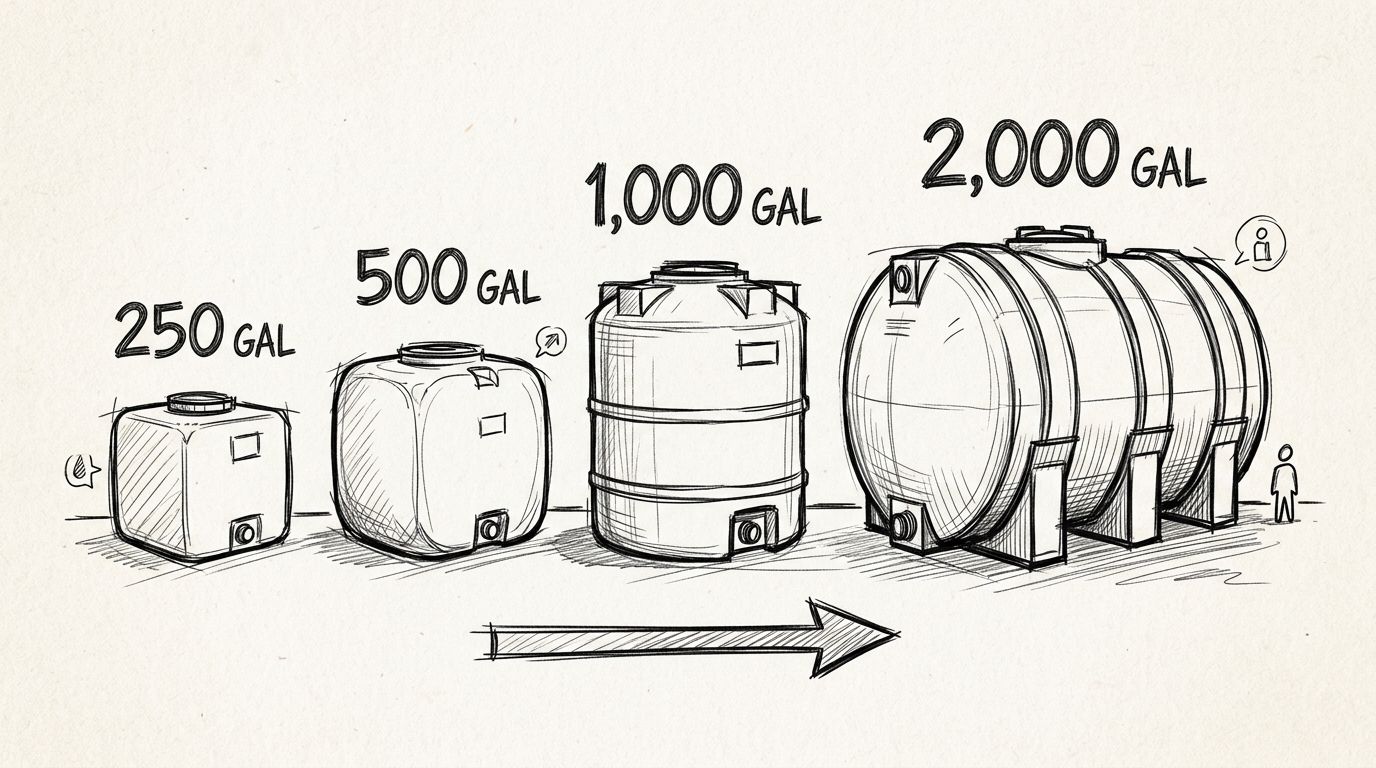
Holding tank capacity at a glance
| Capacity | Best for | Standout feature | Key limitation |
|---|---|---|---|
| 250-gallon | Single-unit restroom add-ons, small events | Smallest footprint, fits tight lots | Needs frequent pump-outs on multi-day use |
| 500-gallon | Small job sites with 1-3 restrooms | Standard tow-behind size, fast placement | Undersized once crew count climbs past a handful |
| 1,000-gallon | Mid-size crews, restroom trailer banks | Stretches the interval between pump-outs | Needs a level pad and a clear access lane |
| 1,500-gallon | Multi-unit restroom banks, week-long events | Covers peak flow from luxury restroom trailers | Heavier footprint, needs pump truck clearance |
| 2,000-gallon and up | Remote, agricultural, oil and gas field sites | Longest run between service visits | Overkill for a short residential cleanup |
1. 250-gallon holding tank: best for single-unit restroom add-ons
A 250-gallon holding tank is the smallest capacity in regular rotation, built to pair with a single restroom unit or top off a small event where a full-size tank would sit half empty. It's the tank a property manager reaches for when one extra restroom covers a weekend turnover.
250-gallon holding tank pros:
- Smallest footprint of any option on this list, fits driveways and tight urban lots
- Fast to place and connect, minimal site prep
- Matches single-unit and low-headcount jobs without overpaying for unused capacity
250-gallon holding tank cons:
- Needs the shortest interval between pump-outs of any tier here
- Not built for multi-unit restroom banks
- Wrong choice once daily headcount climbs past a small crew
Best for: single restroom add-ons, weekend events, small property turnovers.
Verdict: Buy if you're running one restroom unit and don't want a tank that outsizes the job.
2. 500-gallon holding tank: best for small job sites with 1-3 restrooms
A 500-gallon holding tank is the standard entry point for active construction sites. It handles a small crew across a handful of restrooms without demanding daily service, and it's compact enough to place on most residential and light-commercial lots.
500-gallon holding tank pros:
- Handles a small crew across multiple restroom units
- Tow-behind sizing keeps delivery and placement simple
- Sits comfortably between the 250-gallon minimum and the mid-size 1,000-gallon step up
500-gallon holding tank cons:
- Runs short once crew size climbs past roughly a dozen workers
- Still needs regular pump-out scheduling on longer jobs
- Not sized for restroom trailer banks with multiple units feeding one tank
Best for: small general contractor crews, short-duration remodels, light-commercial builds.
Verdict: Buy for a small crew running a handful of restrooms over a job lasting a few weeks.
3. 1,000-gallon holding tank: best for mid-size crews and restroom trailer banks
The 1,000-gallon holding tank is the workhorse size for active Bay Area job sites. It's built to feed a bank of restroom units or a restroom trailer through a full work week without forcing a mid-week pump-out call.
1,000-gallon holding tank pros:
- Stretches the pump-out interval further than the 500-gallon option
- Pairs cleanly with restroom trailers running multiple stalls
- Sized for the crew counts most general contractors actually run
1,000-gallon holding tank cons:
- Needs a level pad and a clear lane for delivery and pickup
- Larger footprint than the 500-gallon tier, not ideal for the tightest lots
- Still requires scheduled service on longer jobs, it doesn't eliminate pump-outs
Best for: mid-size construction crews, restroom trailer support, multi-week jobs.
Verdict: Buy. This is the size most general contractors across San Jose, Santa Clara, and Sunnyvale settle on for standard jobsite service. Details on booking one are in how to rent a holding tank for a construction project.
4. 1,500-gallon holding tank: best for multi-unit restroom banks and week-long events
A 1,500-gallon holding tank steps up for jobs where several restroom units or a larger restroom trailer feed one tank at once. Event producers running a multi-day festival or a general contractor running a large crew across several trailers land here.
1,500-gallon holding tank pros:
- Covers peak flow from several restroom units without daily service calls
- Reduces the number of pump-out trips across a multi-day event
- Scales with luxury restroom trailer setups that see heavier use
1,500-gallon holding tank cons:
- Heavier footprint, needs clearance for the pump truck on delivery and pickup
- Oversized for a standard small job site
- Placement takes more site planning than the smaller tiers
Best for: multi-day events, restroom trailer banks, larger job sites.
Verdict: Hold for this tier until unit count or event headcount actually justifies it. Otherwise the 1,000-gallon tank covers most mid-size needs.
5. 2,000-gallon and up: best for remote, agricultural, and field-site operations
At 2,000 gallons and above, holding tanks are built for sites where a pump truck can't show up on short notice, meaning agricultural operations, oil and gas field sites, or man camps running remote workforce housing. Longer runs between service visits matter more than footprint out here.
2,000-gallon-plus holding tank pros:
- Longest interval between service visits of any tier on this list
- Built for sites where access is limited or remote
- Reduces total truck trips across a long-running field operation
2,000-gallon-plus holding tank cons:
- Overkill for a residential cleanout or short remodel
- Larger footprint requires real site planning before delivery
- Not the right call for a job measured in days rather than months
Best for: agricultural operations, oil and gas field sites, remote workforce housing.
Verdict: Buy only if the site is remote, long-running, or genuinely can't support frequent pump-out visits. See holding tank rental for agricultural operations for sizing specifics on farm and vineyard sites.
How we ranked these
Each tier was measured against the criteria above: capacity relative to restroom count and crew size, realistic pump-out interval, site access, and whether the tank pairs cleanly with a restroom trailer or stands alone. The ranking runs smallest to largest because that's how most buyers actually shop, starting from "how many restrooms am I running" and working up from there.
Which holding tank rental should you choose?
For a standard Bay Area construction crew running a bank of restroom units, the 1,000-gallon holding tank is the default choice for 2026 jobs. Drop to the 500-gallon tier for a small crew and a short timeline, or step up to 1,500 gallons once you're feeding several units or a busy restroom trailer. Reserve the 2,000-gallon-and-up tier for agricultural, field, or remote sites where pump trucks can't get out often.
Get the right tank size the first time
Call to match holding tank capacity to your restroom count and crew size.
FAQ
What size holding tank do I need for a job site restroom?
Match capacity to restroom count and crew size: a single unit fits a 250-gallon or 500-gallon tank, while a bank of restrooms or a restroom trailer usually needs 1,000 gallons or more. Job duration matters too, since longer jobs benefit from the larger tiers that stretch the interval between pump-outs.
Is a 1,000-gallon holding tank big enough for a construction crew?
Yes, for most mid-size general contractor crews running a standard bank of restroom units. Larger crews or restroom trailers with heavier daily use may need to step up to 1,500 gallons.
Can a holding tank pair with a restroom trailer?
Yes, holding tanks are commonly used alongside restroom trailers to extend capacity beyond the trailer's built-in tank. This is standard on multi-day events and longer job sites in the Bay Area.
What's the difference between a holding tank and a restroom trailer's built-in tank?
A restroom trailer's built-in tank is fixed to the unit and sized for its own stalls. A standalone holding tank adds separate capacity, useful when a trailer's built-in tank can't cover the crew size or event length on its own.
Do I need a permit for a holding tank rental in San Jose?
Permit requirements depend on placement location and job type. Check with the local jurisdiction before delivery, particularly for street or right-of-way placement.
What size holding tank works for an RV park or campground?
Sizing depends on the number of hookups and seasonal occupancy. See holding tank rental for RV parks and campgrounds for site-specific sizing guidance.
How does capacity affect pump-out scheduling?
Smaller tanks need shorter intervals between pump-out visits, while larger tanks stretch that interval out. Matching capacity to actual daily usage avoids both overpaying for size and running short between service calls.
Can Valley Services deliver a holding tank on short notice?
Call (408) 297-5404 to check current availability and delivery windows for your site location across the Bay Area.
One last thing
The biggest sizing mistake isn't picking too small a tank, it's sizing for the job's peak day instead of its average day. A festival with a Saturday crowd spike doesn't need a tank built for that one day if the rest of the week runs light. Size for the realistic weekly average, and use a shorter pump-out interval to cover the peak instead of renting a tank two tiers too big for the other six days.
Valley Services has sized holding tank rentals for Bay Area job sites, farms, and field operations out of the same San Jose yard since 1986. Call (408) 297-5404 or visit valleyservices.biz to talk through the right capacity for your site.