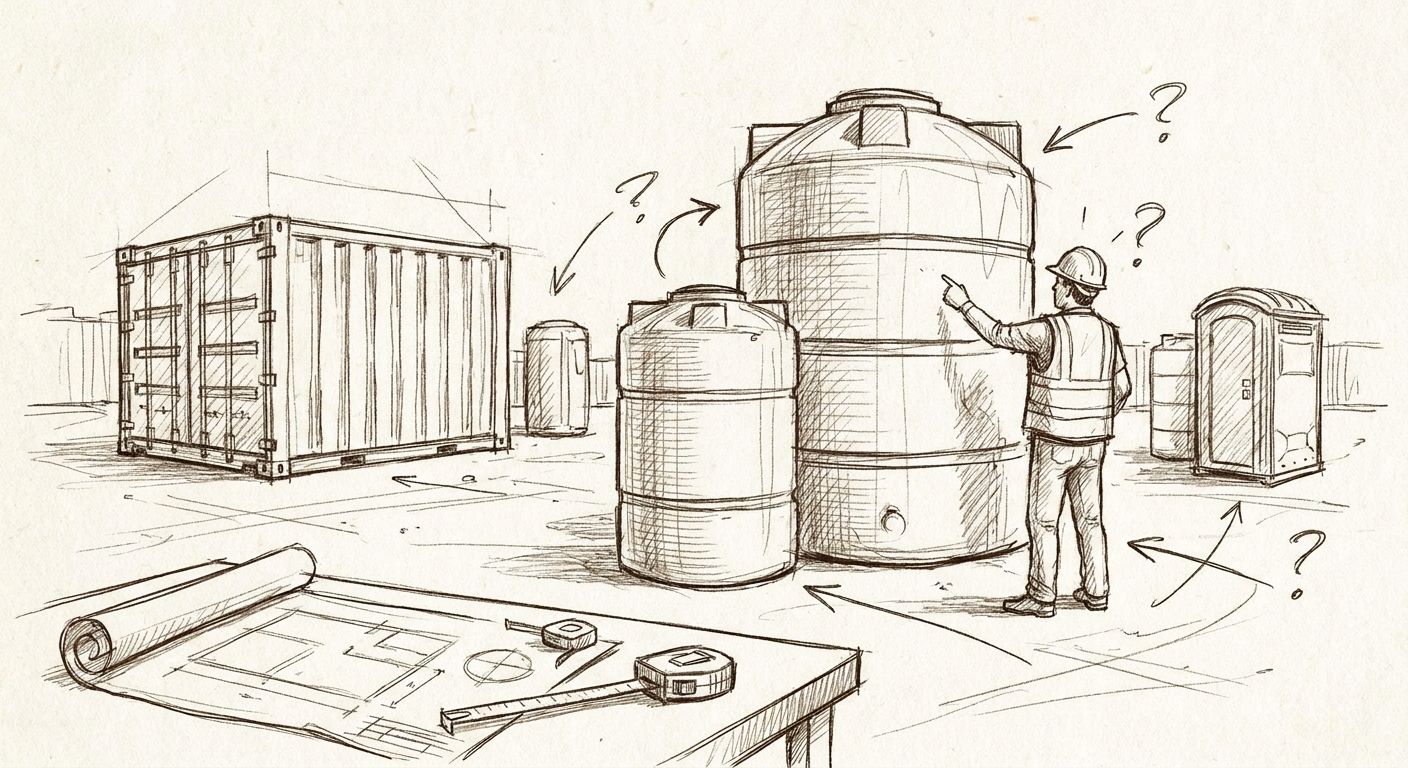
A holding tank that's too small means a pump truck rolling back onto your San Jose job site mid-week to catch up. Too big and you're hauling capacity you never use. Here's how contractors, property managers, and event producers size holding tanks correctly for a 2026 job site.
- Match holding tank size to worker count, shift length, and pump-out schedule, not just job duration.
- A standard portable restroom's built-in tank holds roughly 55 to 70 gallons; standalone holding tanks run from 250 up to 1,000 gallons or more.
- Undersized tanks force mid-week pump-out visits that stall load-in and load-out schedules.
- Site access, not just crew size, decides whether a pump truck can reach a tank without tearing up the yard.
- Choosing the right holding tank size in 2026 comes down to crew count, duration, and how often a truck can service the unit.
Why Tank Sizing Matters
A holding tank is not an accessory. It's the reservoir that determines how often a service truck needs to visit your site. Size it wrong and you either pay for extra pump-out trips or you get a call from your foreman about an overflow on a Friday afternoon.
Valley Services has run holding tanks and restroom units out of the same San Jose yard since 1986, third generation, same family. Sizing a tank correctly the first time keeps a crew working instead of waiting on a truck.
Getting sizing wrong also has a compliance angle. Cal/OSHA sets sanitation minimums tied to crew size and shift length, and an undersized tank that runs dry or overflows puts you out of compliance fast, not just out of convenience.
What You'll Need
- Accurate headcount for the busiest shift on site, not the average
- Expected job duration in weeks or months
- Site access notes: gate width, ground surface, distance from the street for pump truck access
- Number of restroom units or restroom trailer stalls connected to the tank
- A call to the rental yard before delivery day, not after
The Steps
1. Count your crew by shift, not by roster
A 20-person roster spread across two shifts doesn't need the same tank as 20 workers on one shift. Count the peak number of people using restrooms at any single point in the day. That peak number, not the total headcount for the job, drives tank sizing.
Common mistake: sizing off the general contractor's full subcontractor list instead of the actual bodies on site on a given day. Framing crews and pouring crews are rarely on site the same week, so the tank rarely needs to handle both at once.
2. Set your pump-out interval before you pick a tank
Decide how often a service truck can realistically reach your site. A downtown San Jose lot with tight street parking might only get weekly service. A rural Santa Clara County site with open access can support a tighter interval if needed.
A smaller tank on a weekly service schedule works fine for a 5-person crew. The same schedule on a 40-person crew overflows before the truck shows up. Match capacity to the interval you can actually commit to, not the interval you'd prefer.
3. Match tank capacity to crew size and duration
Built-in tanks on a standard portable restroom typically hold in the range of 55 to 70 gallons. That's fine for a small crew on a short punch-list job with regular service. For larger crews or multi-week jobs, a standalone holding tank in the 250 to 1,000-gallon range extends the interval between pump-outs and reduces how often a truck needs site access.
Read the full breakdown on renting a holding tank for a construction project before you commit to a size, especially if the job runs longer than 30 days.
Verdict: undersized tanks are the most common and most expensive mistake on multi-week jobs.
4. Check site access before delivery day
A tank is only as useful as the truck's ability to reach it. Gate widths under 10 feet, soft ground, or a unit placed behind a fenced perimeter all slow down or block a pump-out. Walk the delivery and service path with the same eye you'd use for a roll-off container placement.
Common mistake: placing the tank for crew convenience near the trailer, then discovering the pump truck can't back in without crossing active work.
5. Plan for multi-shift or multi-phase jobs
A job that runs demo one month and framing the next doesn't need the same tank both times. Crew size changes by phase. Reassess tank size at each phase change instead of locking in one size for the entire project. A property manager running a multi-building turnover should size per active building, not per portfolio.
6. Account for weather and season
South Bay winters bring overnight temperatures near freezing on some sites, especially at elevation or in shaded lots. Cold weather slows tank turnover and can affect service scheduling. Review winterizing a holding tank rental before a job runs into December or January 2026.
7. Confirm your restroom-to-tank ratio
If a holding tank is feeding more than one restroom unit or a restroom trailer with multiple stalls, capacity needs scale with stall count, not just crew headcount. A trailer with four stalls under heavy daily use drains a tank faster than four standalone units spread across a site, because usage concentrates in one location.
Troubleshooting
- Tank fills faster than expected mid-week. Recount peak shift headcount. A schedule change or added subcontractor crew often explains the gap.
- Pump truck can't reach the unit. Move the tank closer to the access road before the next service date, not on service day.
- Odor complaints from a neighboring tenant or property. Confirm service frequency matches actual crew size. Odor is almost always a sizing or scheduling problem, not a tank defect.
- Tank runs low during a cold snap. Check for line freeze on connected units before assuming it's a capacity issue.
- Restroom trailer tank alarms trip early at an event. Event-day usage spikes fast. Size trailer tanks for peak attendance hour, not average attendance across the day.
Tools and Resources
- Cal/OSHA sanitation minimums: see how to meet OSHA sanitation requirements with portable toilets for the compliance side of crew counts
- A site walk-through before delivery, focused on gate width and ground surface
- A direct call to the yard: (408) 297-5404
Get your holding tank sized right
Call the San Jose yard to match tank size to crew count and schedule.
What to Do Next
Once you've settled on a rough size, compare it against the options built specifically for restroom pairing. See the best holding tank rental for job site restrooms to confirm the tank size lines up with the restroom count you're already planning for 2026.
FAQ
How do I choose holding tank size for a small crew?
For a crew under 10 people on a short job, a standard portable restroom's built-in tank, roughly 55 to 70 gallons, is usually enough with weekly service. Larger or longer jobs need a standalone tank sized to the pump-out interval you can commit to.
What size holding tank do I need for a construction site?
Size depends on peak shift headcount, job duration, and how often a pump truck can reach the site. A 250 to 1,000-gallon standalone tank covers most multi-week construction jobs with weekly or biweekly service.
Is a bigger holding tank always better?
No. A bigger tank costs more to place and service if the crew doesn't need it. Match tank size to actual peak crew use, not the largest option available.
How often does a holding tank need to be pumped out?
It depends on tank size and crew count. A correctly sized tank on a weekly service schedule should not run low before the next scheduled pump-out. If it does, the tank is undersized for the crew.
Do I need a holding tank if I already have portable restrooms?
Standard portable restrooms have their own built-in tank. A standalone holding tank is added when crew size, restroom trailer stall count, or job duration pushes past what a built-in tank can hold between services.
Can weather affect holding tank sizing?
Cold snaps in the South Bay can affect connected lines and service timing more than tank capacity itself. Jobs running through winter 2026 should plan for winterization ahead of the first freeze.
What happens if a holding tank is too small for the job?
An undersized tank runs low or overflows before the next scheduled pump-out, which forces an emergency service call and can stall the job. Right-sizing upfront avoids this.
Does Valley Services size holding tanks for job sites in San Jose?
Valley Services sizes holding tank rentals out of its San Jose yard for job sites across San Jose, Santa Clara, Sunnyvale, Mountain View, and Milpitas, based on crew count and schedule.
One Last Thing
The number one sizing mistake isn't picking too small a tank, it's picking the right tank for the wrong shift count. Crews change week to week on most jobs. Reassess tank size at every phase change in 2026, not just once at the start of the contract.
Related Guides
Call (408) 297-5404 or visit valleyservices.biz to talk through tank sizing for your next job.