Construction sites in San Jose, Sunnyvale, and across the South Bay need perimeter control that matches the phase of work, not a one-size fence order. The right temporary fence rental for a construction site in 2026 depends on what you're securing: equipment, a demolition zone, a vacant lot, or a sidewalk closure next to active foot traffic.
- Standard 6-ft chain link panels are the baseline pick for most active construction sites in 2026.
- K-rail concrete barrier is the right call for demolition and heavy equipment perimeters, not chain link alone.
- Anti-climb fencing is the correct spec for vacant lots and off-hours security, not standard panels.
- Valley Services runs containers, restrooms, and temporary fencing from one San Jose yard, which simplifies delivery scheduling.
Why this matters
A fence that looks adequate on paper can fail an inspection or a Cal/OSHA walk-through if it doesn't match the site's actual risk. Demolition debris fields need barrier weight that chain link doesn't have. Vacant lots need anti-climb hardware, not standard mesh. Sidewalk-adjacent sites need panels that don't create a pinch hazard for pedestrians.
Getting the fence type wrong costs you a callback, a delayed inspection, or worse, a site breach that shows up in an incident report. The picks below are ranked by how well each fencing type solves a specific site condition in 2026, not by which one looks the most substantial.
How this list is ranked
Each fencing type below is scored against three site conditions that come up constantly on Bay Area jobs: perimeter security, crew and pedestrian safety, and how fast the fence goes up and comes down between phases. Types that solve all three for a given job earn a Buy. Types that solve one condition but create a gap in another earn a Consider or a Skip, with the specific gap named.
This isn't a ranking of brands. It's a ranking of fencing configurations, because the configuration is what actually determines whether your site passes inspection and stays secure overnight.
The ranked list
1. Standard 6-ft chain link panel fencing
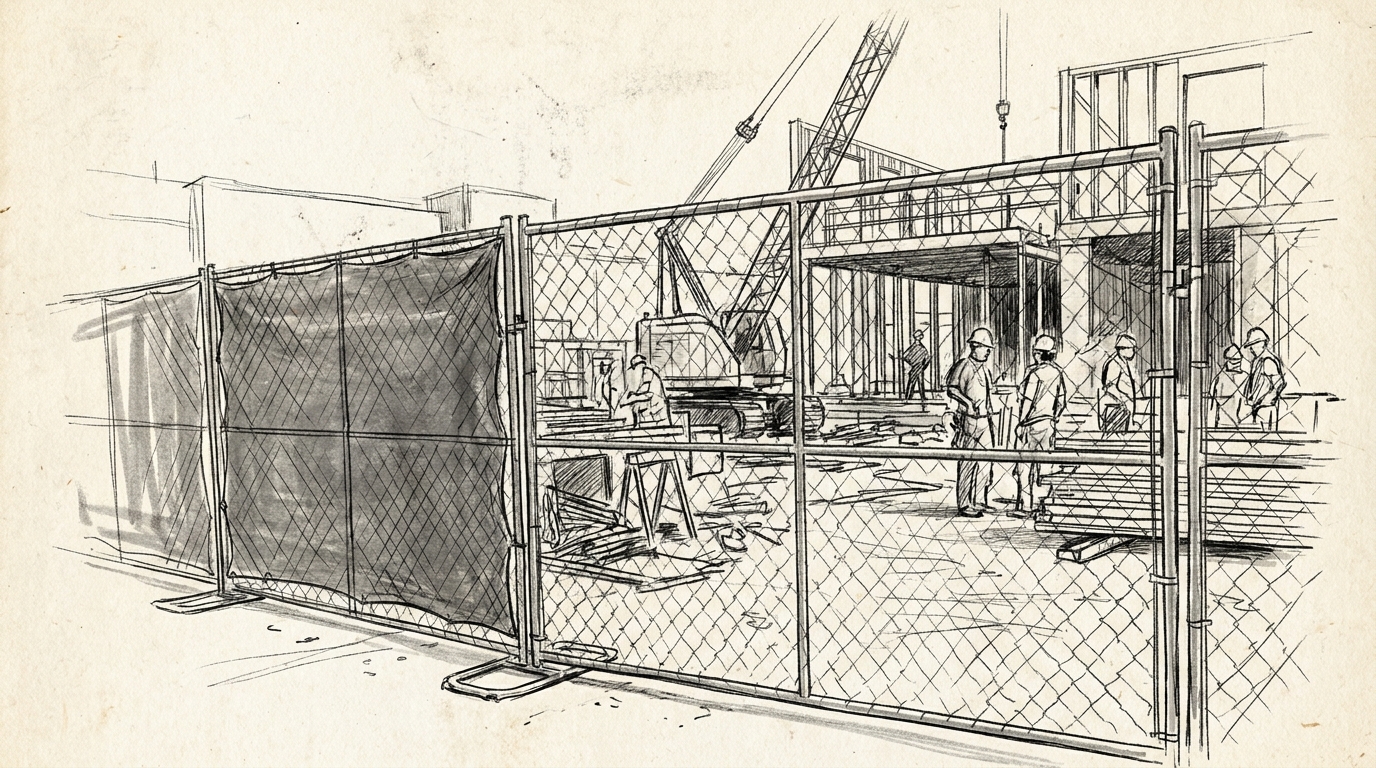
The baseline pick for active construction sites. Panels run 6 feet tall by roughly 8 feet wide, freestanding on rubber feet, no post-hole digging required. This is the fastest fence to install and remove between phases, which matters on multi-week jobs where the perimeter shifts as work zones change.
It gives you a visible boundary and keeps casual foot traffic out, but it does not stop someone determined to climb it, and it does not block sightlines or dust. For active work zones with daytime supervision, that's usually enough. Read the full breakdown on temporary fencing for construction sites. Buy for standard active job sites in 2026.
2. Chain link with privacy screening
Same panel system, with mesh fabric or solid screening zip-tied to the fence. This adds sightline control and knocks down dust migration onto adjacent sidewalks or neighboring properties, which matters on infill lots in dense San Jose and Santa Clara neighborhoods.
The screening does add wind load, so panels need proper base weight or they'll tip in a gust. On a site with no adjacent pedestrian traffic, screening is optional. On a site next to a sidewalk or storefront, it's close to mandatory. Buy for sites with pedestrian sightlines nearby, Consider everywhere else.
3. K-rail concrete barrier
Concrete barrier segments, typically 6 to 10 feet each, interlocking to form a rigid perimeter. This is the correct spec for demolition zones and any site running heavy equipment near a public right of way. Chain link will not stop a loaded skip loader or contain debris scatter from a demolition swing. K-rail will.
K-rail is heavier to place and remove, so it suits sites with a longer footprint on one location rather than sites cycling through phases weekly. Full detail lives on temporary fencing for demolition sites. Buy for demolition and heavy equipment perimeters in 2026.
4. Anti-climb fencing
Solid or near-solid panel fencing with no foothold gaps, sometimes topped with additional height extensions. This is the right call for vacant lots, sites sitting idle overnight or over a weekend, and any property with a history of trespass or material theft.
Standard chain link gets climbed. Anti-climb panels are built specifically so they don't. If the site has no on-site supervision after hours, this is not optional gear, it's the baseline. See temporary fencing for vacant property security for the full spec. Buy for unattended sites and vacant lots.
5. Combination fencing and K-rail perimeter
A mixed system: K-rail along the vehicle and equipment side of the site, chain link or anti-climb panels along the pedestrian and neighbor-facing side. This shows up on large multi-phase jobs where one edge of the site faces active traffic and another faces a demolition or grading operation.
It costs more coordination to plan since two systems have to line up at the corners without gaps. On a site over roughly half an acre with mixed activity, it's worth the coordination. Consider for large or multi-phase sites, Skip on anything under a quarter acre where one system covers the whole perimeter.
6. Pedestrian walkway panels
Lightweight fencing built to channel foot traffic around a closed sidewalk or partial lane closure, rather than to secure a full site perimeter. This solves an access problem, not a security problem, and it shouldn't be the only fencing on a site with material or equipment exposure.
Use it alongside one of the perimeter options above, not instead of one. Consider as a supplement on sites with sidewalk closures, Skip as a standalone security fence.
“If a fence needs an anti-climb top, chain link alone will not do the job.”
Comparison table
| Fencing type | Best for | Security level | Typical duration |
|---|---|---|---|
| Standard 6-ft chain link | Active supervised sites | Moderate | Days to months |
| Chain link with screening | Sites near sidewalks or neighbors | Moderate, plus sightline control | Weeks to months |
| K-rail concrete barrier | Demolition, heavy equipment | High, vehicle-rated | Months |
| Anti-climb fencing | Vacant lots, unattended sites | High | Weeks to months |
| Combination fencing and K-rail | Large multi-phase sites | High, mixed | Months |
| Pedestrian walkway panels | Sidewalk or lane closures | Low, access control only | Days to weeks |
Where to source it
Measure the actual perimeter before calling, not an estimate. Panel counts and gate placement change if you're off by even one side of the lot.
Coordinate fence delivery with your roll-off container and restroom schedule if you're setting up a new site from scratch. One delivery window for containers, restrooms, and fencing keeps load-in from turning into three separate site visits.
Confirm gate width against your largest piece of equipment before the fence goes up. A 10-foot gate opening does nothing for a piece of gear that needs 12 feet of clearance to swing through.
Line up fencing for your next job
One call covers containers, restrooms, and temporary fencing for your San Jose site.
FAQ
What is the best temporary fence rental for a construction site in 2026?
Standard 6-ft chain link panels cover most active, supervised construction sites in 2026. Demolition zones and vacant lots need K-rail or anti-climb fencing instead, since chain link alone doesn't stop equipment or climbing.
Is K-rail better than chain link fencing for construction sites?
K-rail is better for demolition and heavy equipment perimeters because it's a rigid vehicle-rated barrier. Chain link is better for active sites needing a fast, removable boundary without heavy equipment exposure.
How tall are standard temporary construction fence panels?
Standard chain link panels run 6 feet tall and roughly 8 feet wide per section. Anti-climb panels sometimes add height extensions beyond that for vacant lot or theft-prone sites.
Do I need anti-climb fencing for a vacant lot in San Jose?
Yes, if the lot sits unattended overnight or on weekends. Standard chain link gets climbed, while anti-climb panels are built specifically to eliminate footholds.
Can temporary fencing and roll-off containers be delivered together?
Yes, Valley Services coordinates fencing, roll-off container, and restroom delivery from one San Jose yard. That single delivery window cuts down on separate site visits during load-in.
What's the difference between privacy screening and standard chain link?
Privacy screening adds fabric or mesh to standard chain link panels to block sightlines and cut dust migration. It's close to mandatory on sites next to sidewalks or storefronts, optional on sites with no adjacent pedestrian traffic.
How do I size a temporary fence for a demolition site?
Measure the full perimeter and plan for K-rail rather than chain link on any edge facing heavy equipment or debris scatter. Chain link doesn't stop a loaded skip loader; K-rail does.
Does Valley Services serve construction fencing outside San Jose?
Valley Services covers San Jose, Santa Clara, Sunnyvale, Mountain View, Milpitas, and the surrounding Bay Area. The C&D transfer station itself is San Jose only.
One last thing
Most site fence complaints in 2026 aren't about the fence itself, they're about the corners. A perimeter with three solid sides and one gap at a gate or a property line seam is functionally no perimeter at all. Walk the full loop before signing off on install, not just the street-facing side.
Valley Services has run containers, restrooms, and temporary fencing out of the same San Jose yard since 1986, third generation, same family. One call covers all three for a single jobsite. Reach out at (408) 297-5404 or valleyservices.biz to talk through your perimeter before the next phase starts.