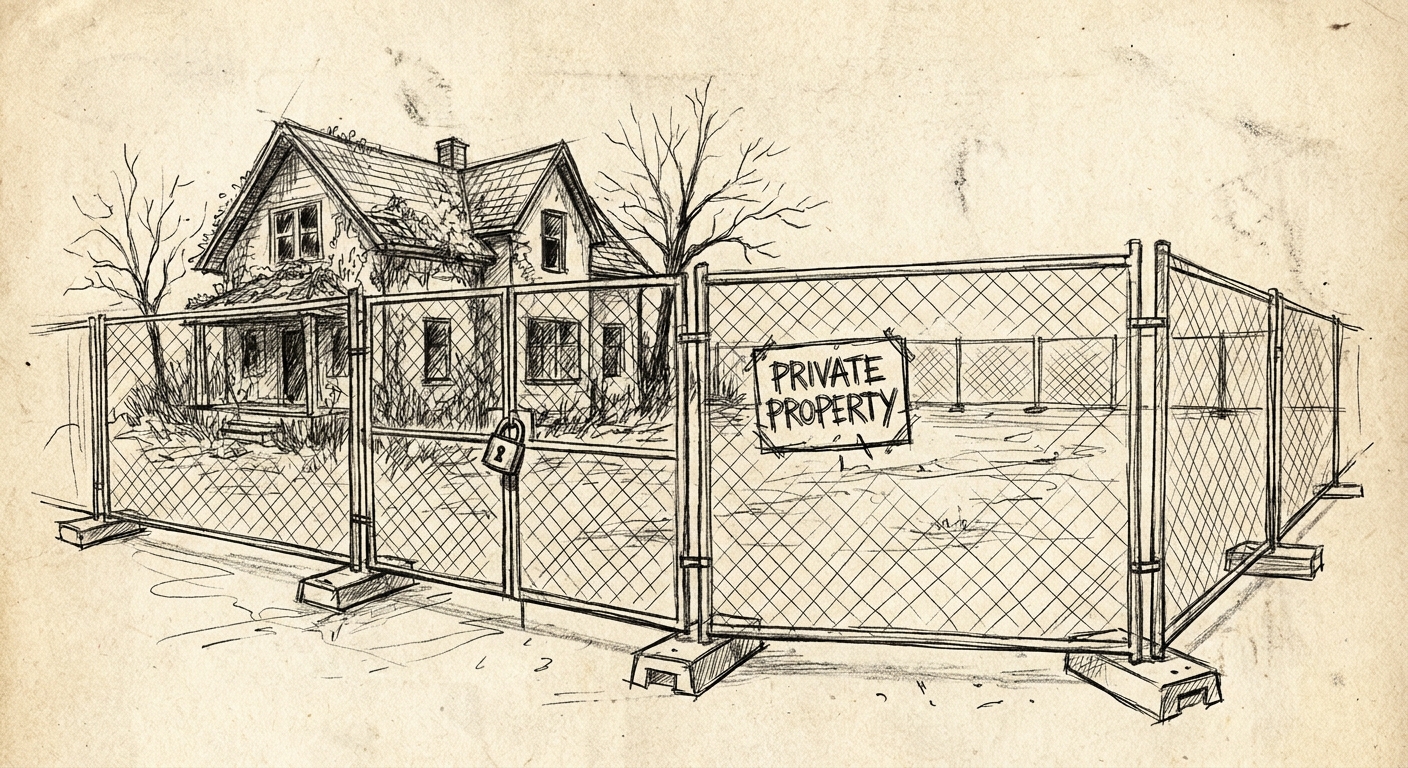
A vacant property without a secured perimeter turns into a liability fast: squatters, illegal dumping, scrap theft, and liability exposure if someone gets hurt on the lot. Temporary fence rental for vacant property is the fastest way to establish a controlled perimeter while a building sits empty, whether that's for 30 days or 18 months.
- Standard 6-foot chain-link with privacy screens is the baseline pick for vacant property security in 2026, buy it.
- K-rail perimeter fencing is the heavy-duty option for corner lots with vehicle access risk, worth considering.
- Decorative or short picket fencing is a skip for vacant lot security, it does not stop entry or scouting.
- Gate hardware and lock quality matter more than fence height for most theft and vandalism cases in San Jose and the South Bay.
Why this matters
A vacant lot or empty building is an attractive nuisance in the eyes of insurers and, in some cases, local code enforcement. Property managers, banks holding foreclosed assets, and general contractors between phases all carry liability the moment a site sits unsecured.
Valley Services has supplied temporary fencing and K-rail on Bay Area jobsites since 1986, including large-footprint work for Super Bowl LX and the San Jose Marathon. That same fencing inventory covers vacant property security across San Jose, Santa Clara, Sunnyvale, Mountain View, and Milpitas.
The fence itself is only part of the job. Gate placement, screening, and anchoring determine whether the perimeter actually stops entry or just marks a boundary.
Who this is for
This guide is for property managers holding a vacant unit between tenants, banks and asset managers with foreclosed or REO properties, general contractors with a paused or multi-phase jobsite, and homeowners securing a lot during a long renovation or estate clear. If you're already scheduling a dumpster for an estate cleanout, the same vacant lot usually needs a perimeter fence before the property sits empty overnight.
What to look for in fencing for a vacant property
Full perimeter coverage, no gaps
A fence with a gap at the back corner or along a shared alley is not a fence, it's a suggestion. Every access point, including utility easements and shared driveways, needs a panel or a locked gate. Scrap thieves and squatters find the weak point in under a day.
Panel height and wind rating
Standard chain-link fence panels for vacant lot security run 6 feet tall in 12-foot sections. Anything shorter invites easy climb-over. In wind corridors common across the South Bay, panels need proper footing blocks or they go down in the first storm, which is worse than no fence at all because it signals the site is unmonitored.
Privacy screening to block sightlines
A see-through chain-link fence still lets people scout the interior of a vacant building for copper, HVAC units, or anything else worth stripping. Privacy screen fabric on the fence blocks that view and cuts down casual foot traffic testing the perimeter.
Gate placement and lock hardware
Most break-ins on vacant lots happen at the gate, not the fence line. A single, reinforced gate with a padlock hasp beats three convenient gates with standard latches. Fewer access points mean fewer things to check.
Anchoring for corner and high-traffic lots
A lot on a busy corner or adjacent to a public sidewalk carries higher risk of vehicle intrusion or crowd pressure during events. K-rail sections anchor the perimeter in a way that fence panels alone cannot, and they double as a physical barrier against vehicles pulling onto the lot.
Response time when something goes wrong
A fence panel gets knocked down by wind, a vehicle, or vandalism. The question is how fast it gets back up. A property sitting with a downed section for a week is functionally unsecured for that whole stretch, in 2026 that's enough time for a site to get tagged, dumped on, or entered.
Top picks for vacant property security
Standard 6-foot chain-link with privacy screens, the baseline pick. Panels run 6 feet tall in standard 12-foot sections with mesh or fabric screening blocking sightlines into the property. This covers most vacant residential lots and small commercial parcels across San Jose and Santa Clara through 2026. Buy.
K-rail perimeter for corner lots and vehicle access risk, the heavy-duty pick. Concrete K-rail sections weigh close to 4,000 pounds each and stop vehicle intrusion in a way chain-link cannot. This matters on corner lots, lots adjacent to public parking, or vacant sites near active roadwork. General contractors juggling multiple jobsite phases often pair K-rail with fencing when a lot sits partially open to public foot traffic. Consider.
Fencing with a reinforced, single-point gate, the anti-theft pick. One locked gate location instead of several convenient ones cuts the number of points a thief has to test. Pair this with privacy screening for the full perimeter. Buy.
Decorative or short picket-style fencing, the wildcard that doesn't fit. It marks a boundary line but does nothing to stop entry, doesn't screen sightlines, and won't hold up against wind or a vehicle bump. It looks better in a listing photo, it does not secure a vacant property. Skip.
What to avoid
- Fencing without privacy screening. A see-through perimeter still lets scrappers case the property from the sidewalk, screening is not optional for a vacant building.
- Short-term rentals with no scheduled check. A fence installed once and never inspected drifts out of position, panels get walked off, and gaps open up within weeks.
- Skipping K-rail on a windy corner lot to save on footprint. Panels without proper anchoring go down in the first strong wind event, and a downed fence section is worse for security than an open lot because it signals nobody is watching.
Verdict comparison
| Configuration | Height / Weight | Best for | Verdict |
|---|---|---|---|
| 6-ft chain-link with privacy screen | 6 ft, 12-ft sections | Standard vacant residential or commercial lot | Buy |
| K-rail perimeter | ~4,000 lb per section | Corner lots, vehicle access risk | Consider |
| Reinforced single-gate fencing | 6 ft, one access point | Sites with theft or vandalism history | Buy |
| Decorative picket fencing | Under 4 ft | Boundary marking only, not security | Skip |
Secure a vacant lot before it sits empty
Talk through fencing, K-rail, and gate placement for your property.
FAQ
What's the best fence height for vacant property security?
6 feet is the standard height for vacant lot security fencing in 2026, tall enough to discourage casual climb-over while staying practical to install fast. Taller sections exist but add cost and installation time without much added deterrent for most residential or small commercial lots.
Is temporary fencing better than a security guard for a vacant property?
A secured fence perimeter with a locked gate handles routine deterrence at far lower ongoing effort than a guard rotation. For high-risk sites, contractors and property managers often pair fencing with periodic drive-by checks rather than full-time guard coverage.
How much does temporary fence rental for vacant property cost?
Cost depends on linear footage, screening, gate count, and rental length. Contact Valley Services at (408) 297-5404 or valleyservices.biz for a quote specific to your lot size and duration.
Do I need a permit for temporary fencing around a vacant lot in San Jose?
Permit requirements vary by jurisdiction and by whether the fence sits on a public right-of-way or entirely on private property. Check with the local building department before installation, especially for sidewalk-adjacent fencing.
How long can I rent temporary fencing for a vacant property?
Fencing rentals run from short-term jobs of a few weeks to open-ended terms covering a vacant building for a year or more. Rental length is set at the start and can typically be extended if the property stays unoccupied longer than planned.
Does K-rail work better than fencing for vacant lot security?
K-rail stops vehicle intrusion in a way chain-link fencing cannot, which matters on corner lots or sites near active roadwork. Most vacant properties do fine with fencing alone, K-rail earns its place on higher-risk perimeters.
What's the difference between chain-link and privacy screen fencing?
Chain-link alone is see-through, privacy screen fabric attached to the same fence blocks sightlines into the property. For vacant property security, the screening is the part that stops casual scouting, not the fence panel itself.
Can temporary fencing be installed the same week as a cleanout or demolition?
Fencing installation typically runs alongside cleanout or demolition scheduling rather than after it. Coordinating the fence perimeter with a [home renovation cleanout](https://blog.valleyservices.biz/roll-off-dumpster-rental-for-home-renovations) or demo phase keeps the lot secured from day one instead of leaving a gap between vacancy and fencing.
One last thing
The gate gets tested before the fence line does. Most vandalism and theft reports on vacant lots trace back to a weak gate latch, not a cut fence panel, so if the budget forces a tradeoff between taller panels and a reinforced single gate, take the gate every time.
Call Valley Services at (408) 297-5404 or visit valleyservices.biz to talk through fencing, K-rail, and scheduling for a vacant property in the San Jose and South Bay area.