Solar farm construction sites sit on open, exposed acreage with no existing perimeter security, and every phase of the build, from grading to panel install to commissioning, needs something different at the fence line. This ranks the five temporary fencing setups Bay Area solar contractors actually use, from full chain link perimeter runs to K-rail traffic separation, so you match the right configuration to each phase instead of guessing.
- Chain link fence panels are the best temporary fencing for solar farm construction perimeters in 2026.
- Windscreen privacy screen panels cut dust and screen active work zones from public roads and neighbors.
- K-rail concrete barrier separates heavy equipment traffic from crews installing panels on the same site.
- Double-wide rolling gate panels control access to laydown yards storing modules and inverters overnight.
- Valley Services rents fencing, K-rail, and roll-off containers from one San Jose yard operating since 1986.
Why this matters
Solar construction sites in the Bay Area often sit on former agricultural land or open parcels with no fence line to start from. Panel and copper wire theft targets unsecured solar sites, and a gap in the perimeter is an open invitation once modules and inverters start staging on site. Cal/OSHA also expects site control: controlled access points and separation between vehicle traffic and foot traffic once grading and installation overlap.
Get the fencing wrong and it costs a re-mobilization: pulling panels back out, re-trenching a gate location, adding a screen run after the county flags a dust complaint from a neighboring parcel. Valley Services has run temporary fencing and K-rail out of the same San Jose yard since 1986, alongside the roll-off containers already needed on most solar job sites, so one call sets up more than one service line before mobilization.
What makes the best temporary fencing for a solar site
Solar farm perimeters get scored against six things before a contractor commits to a configuration:
- Linear-foot coverage without gaps. Open acreage means long runs, and panel spacing matters more here than on a half-acre commercial lot.
- Wind load and dust control. Wind gusts across open Central Valley and East Bay parcels push against bare chain link differently than a solid screen panel.
- Traffic separation. Grading crews, panel crews, and delivery trucks need physical separation once the site is active.
- Access control for high-value equipment. Modules, inverters, and racking sit in laydown yards for weeks before install, and theft risk is real.
- Phase flexibility. A solar build moves through grading, racking, module install, and commissioning, each with a different footprint.
- Cal/OSHA site control. Inspectors expect marked, controlled access points, not open gaps in the line.
Temporary fencing for solar farm construction, at a glance
| Fencing type | Best for | Standout feature | Key limitation |
|---|---|---|---|
| Chain link fence panels | Full-perimeter security on open acreage | Fast linear-foot coverage with standard 6 ft panels | Open mesh does little for dust or wind screening |
| Windscreen/privacy screen panels | Dust control and visual screening | Solid screen fabric cuts wind load and blocks sightlines | Slower to install than bare chain link |
| K-rail concrete barrier | Separating equipment traffic from panel crews | Sits on grade, no stakes or footings needed | Doesn't stop foot traffic or theft on its own |
| Double-wide rolling gate panels | Laydown yard access control | Single controlled entry point for deliveries | Needs a level surface to swing clean |
| Combination fence + K-rail package | Multi-phase builds with rolling perimeter changes | Reconfigures section by section as the site plan shifts | More components to track across a long schedule |
1. Chain link fence panels: best temporary fencing for full-perimeter security on open acreage
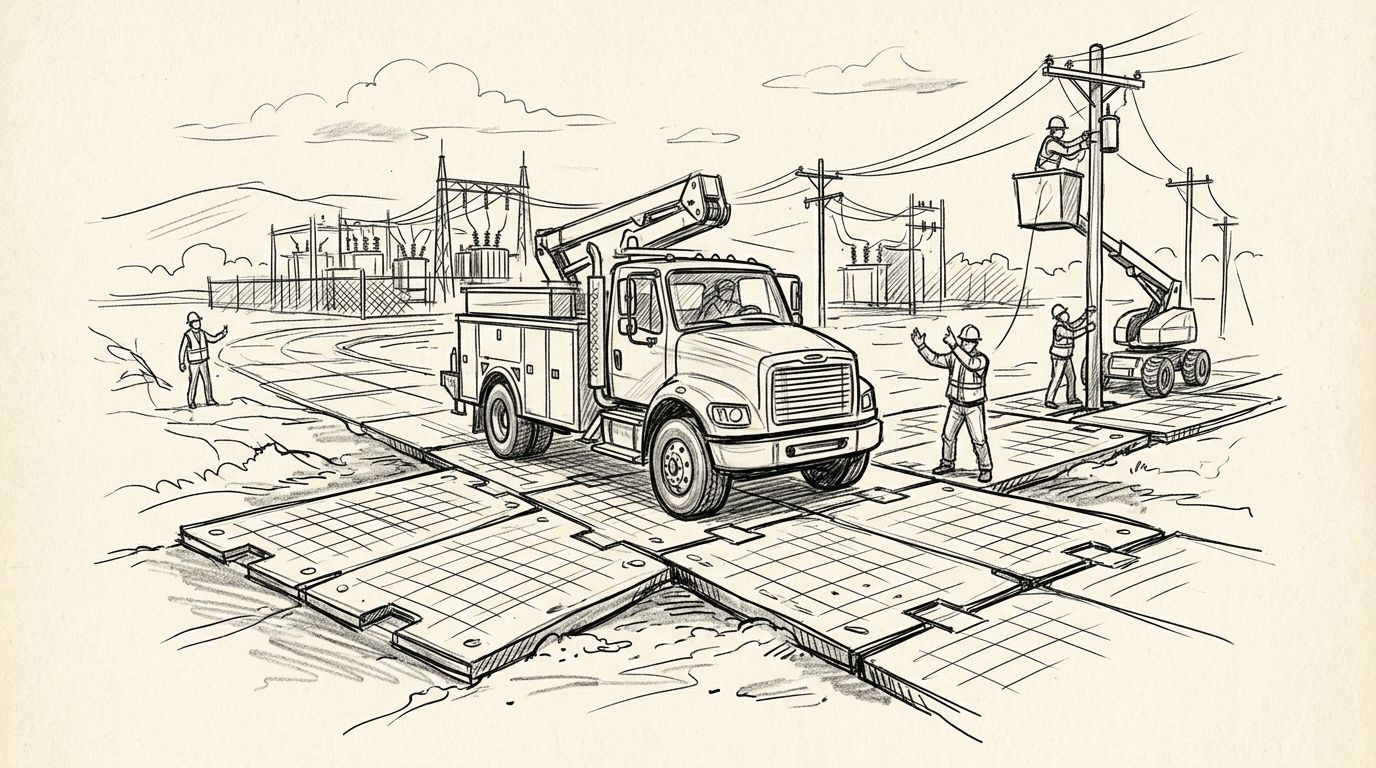
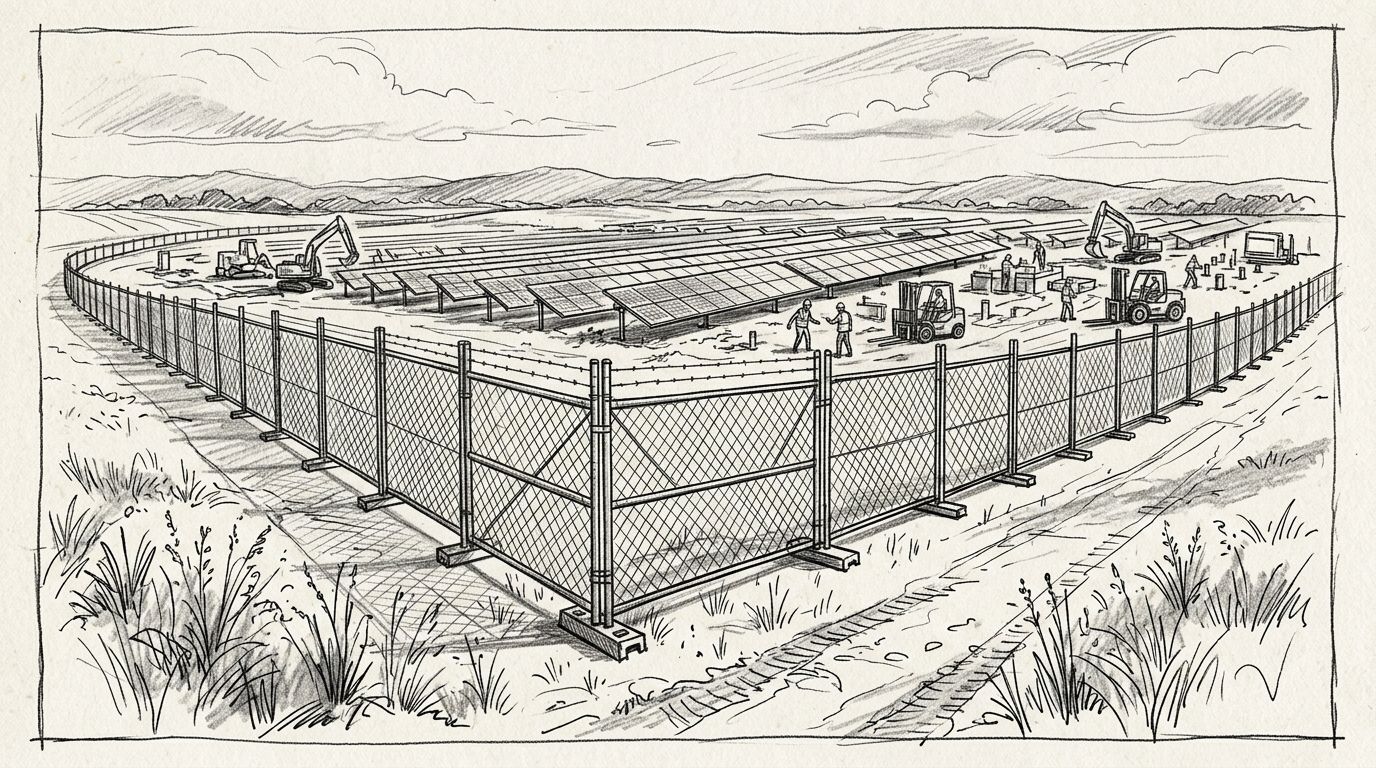
Chain link panels are the backbone of temporary fencing for solar farm construction. Standard panels run 6 feet tall in 10 to 12 foot sections, clip together without digging footings, and cover open acreage fast because crews aren't trenching for posts. The same setup used for temporary fence rental for utility companies works for solar sites because both need long, unbroken perimeter runs across open ground.
Chain link fence panel pros:
- Covers long, straight perimeter runs quickly
- No excavation, so panels move as the site plan shifts
- Holds up across a multi-phase build running months
Chain link fence panel cons:
- Open mesh doesn't block wind-driven dust
- Doesn't screen the site from a public road or adjacent parcel
- Needs base blocks or ballast on uneven graded ground
Best for: the main perimeter run around a solar site once grading starts.
Verdict: Rent it first. Every solar project needs a chain link perimeter before it needs anything else on this list.
2. Windscreen/privacy screen panels: best for dust control and visual screening
Windscreen panels are chain link fence with a solid fabric screen laced onto the mesh, the same configuration used in windscreen fence rental for construction sites projects near dust-sensitive areas. They cut wind load on exposed sites and keep grading dust from drifting onto a neighboring parcel or public road, which matters on solar builds sited near agricultural land or residential edges.
Windscreen panel pros:
- Cuts dust complaints from neighboring parcels
- Reduces wind load on long, exposed fence runs
- Screens equipment and material staging from the road
Windscreen panel cons:
- Adds wind resistance the fence line has to hold against
- Takes more labor to install than bare chain link
- Fabric needs periodic inspection for tears after storms
Best for: perimeter sections facing a public road, residential edge, or agricultural neighbor.
Verdict: Pair it with chain link, not instead of it, along the sections that face outward.
3. K-rail concrete barrier: best for separating equipment traffic from panel crews
K-rail is the same concrete barrier used on California highway projects, run in 12 to 20 foot sections that sit on grade with no stakes or anchors. On a solar site it separates the haul road, where trucks and heavy equipment move racking and panels, from the rows where crews are actively installing modules.
K-rail pros:
- Sits on grade, no footings or anchoring needed
- Withstands equipment contact without failing
- Repositions section by section as the haul road shifts
K-rail cons:
- Does nothing to stop foot traffic or site access on its own
- Heavier to relocate than fence panels
- Needs equipment to place and move sections
Best for: the line between active haul roads and panel installation rows.
Verdict: Rent it for any site running heavy equipment past active install zones.
4. Double-wide rolling gate panels: best for laydown yard access control
Modules, inverters, and racking stage in a laydown yard for weeks before install, and that's the highest-theft-risk footprint on a solar site. Double-wide rolling gate panels give one controlled entry point instead of a dozen places a fence line could be lifted or cut.
Rolling gate panel pros:
- Single point of entry for deliveries and staging
- Padlocks or chains restrict after-hours access
- Swings wide enough for flatbed deliveries
Rolling gate panel cons:
- Needs a level surface to swing without dragging
- Can bottleneck if delivery volume is high
- Doesn't help without a solid perimeter fence around it
Best for: the laydown yard entrance where high-value equipment stages overnight.
Verdict: Rent it for any laydown yard holding modules or inverters overnight.
5. Combination fence + K-rail package: best for multi-phase builds
A utility-scale solar build moves through grading, racking, module install, and commissioning, and the perimeter that made sense during grading isn't the one you want during commissioning. A combination package pairs chain link runs with K-rail sections positioned to move as the site plan changes.
Combination package pros:
- Reconfigures section by section as phases change
- One rental relationship instead of separate vendors per phase
- Matches fencing to the actual footprint at each stage
Combination package cons:
- More components to track across a multi-month schedule
- Needs a site plan update each time the fence line moves
- Not worth it for a single-phase, short-duration site
Best for: multi-phase utility-scale sites running months, not weeks.
Verdict: Rent it if the project timeline runs past a single phase.
How this list was ranked
Each fencing type was scored against the same six criteria: linear-foot coverage, wind and dust control, traffic separation, access control, phase flexibility, and Cal/OSHA site control. No single configuration wins on every axis, which is why solar sites end up running two or three of these together instead of picking just one. Valley Services stages chain link panels, windscreen sections, and K-rail out of the same San Jose yard so a contractor can add a piece mid-project without waiting on a new vendor.
Which temporary fencing should you rent for a solar farm build?
Start with chain link fence panels for the main perimeter. Add windscreen sections on any run facing a road, a residence, or a neighboring farm. Bring in K-rail once equipment traffic and panel crews are working the same site at the same time, and lock down the laydown yard with a rolling gate panel before the first module delivery lands.
For a single-phase site running a few months, chain link plus one gated laydown yard usually covers it. For a multi-phase utility-scale build running into 2026 and beyond, the combination package keeps the fence line matched to whichever phase is active.
Plan fencing for your solar site
Talk through perimeter, K-rail, and laydown yard needs before mobilization.
FAQ
What's the best temporary fencing for solar farm construction?
Chain link fence panels handle the main perimeter on most solar sites, with windscreen panels added along any section facing a road or neighboring parcel. K-rail separates equipment traffic once grading and panel install run at the same time, and a rolling gate panel locks down the laydown yard where modules and inverters stage.
How tall does temporary fencing need to be on a solar site?
Standard chain link fence panels used on construction and solar sites run 6 feet tall, which meets most county and Cal/OSHA site control expectations. Taller screening isn't typically required unless a local permit specifies otherwise.
Is K-rail or chain link fence better for a solar farm?
They solve different problems: chain link fence secures the perimeter against unauthorized access, while K-rail separates vehicle and equipment traffic from active work zones. Most solar builds run both once grading and installation overlap on the same site.
How long are K-rail sections?
K-rail concrete barriers typically run 12 to 20 feet per section and sit directly on grade without stakes or footings. Sections can be repositioned as the haul road or work zone shifts through a project.
Do solar construction sites need windscreen or privacy fencing?
Windscreen panels aren't required everywhere, but they're worth adding on any perimeter section facing a public road, a residence, or an agricultural neighbor. They cut dust complaints and wind load compared to bare chain link.
How do you secure a laydown yard on a solar project?
A rolling gate panel gives the laydown yard a single controlled entry point instead of multiple places a fence line could be breached. Padlocking that gate after hours addresses the highest-theft-risk footprint on most solar sites, where modules and inverters stage before install.
Can temporary fencing be reconfigured as a solar project moves through phases?
Yes. Chain link panels and K-rail sections both move without excavation, so the fence line can shift from the grading footprint to the installation footprint to the commissioning footprint without new permits in most jurisdictions.
Who rents temporary fencing and K-rail for Bay Area solar projects?
Valley Services rents temporary fencing and K-rail out of its San Jose yard, along with roll-off containers for the same job site. The company has operated in the South Bay since 1986.
One last thing
The laydown yard, not the perimeter line, is where most solar site theft actually happens. A gap in chain link along a back fence line gets noticed slower than a missing inverter, so the rolling gate panel at the equipment yard earns its keep before the rest of the perimeter is even finished.