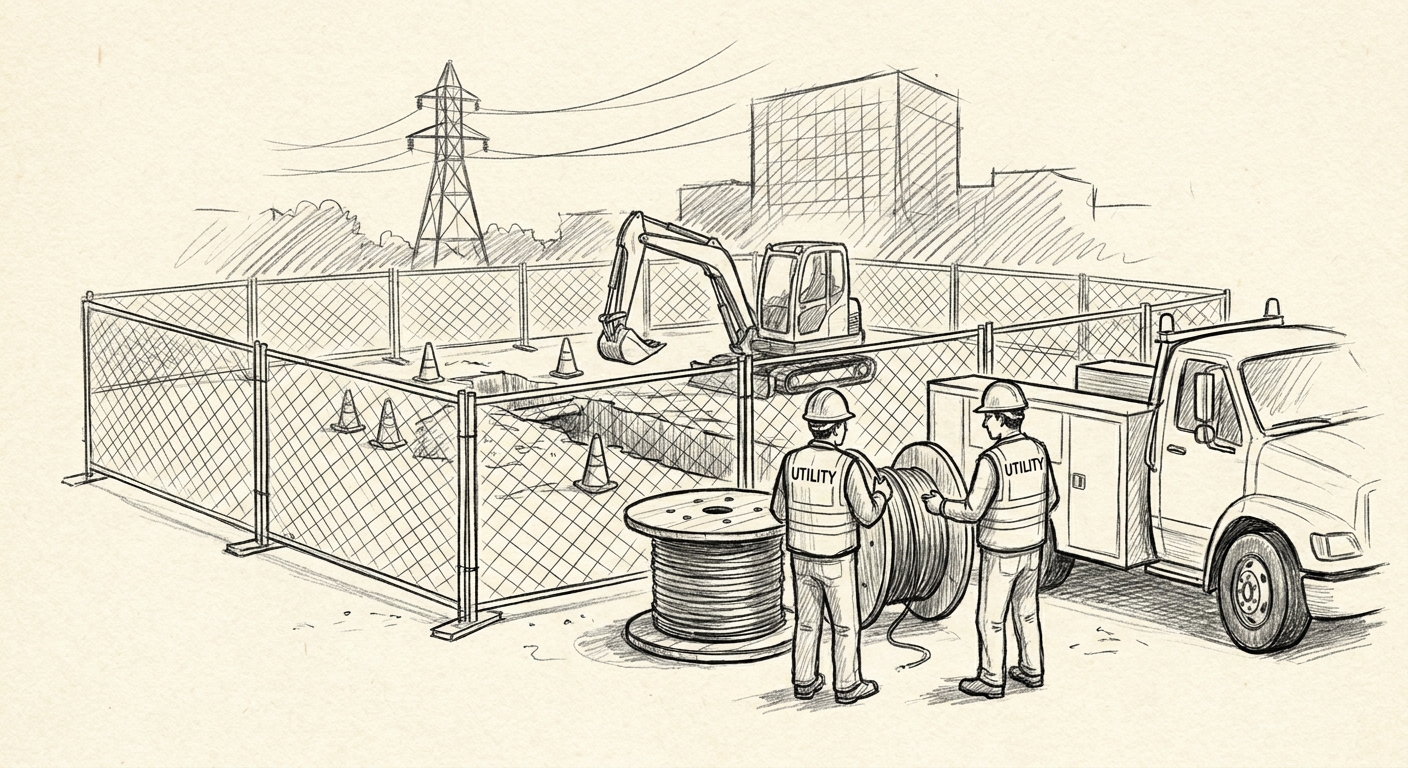
Utility crews trenching a gas main or fencing off a substation need a perimeter that moves as fast as the job does. This guide ranks the temporary fence configurations Bay Area utility companies actually rent in 2026, covers what Cal/OSHA expects around open trenches, and gives a verdict on each setup.
- Standard 6-foot chain link panel fencing is the best temporary fence rental for utility companies running linear pipeline or trenching work: Buy.
- K-rail concrete barrier in standard 12-foot sections at roughly 32 inches tall is the right call for trenches open to traffic: Buy.
- Windscreen mesh added to panel fencing cuts sightlines at substations and switching stations: Consider it for any energized equipment site.
- Storm and disaster recovery fencing needs same-week deployment, not a standard multi-day lead time: Buy for outage restoration crews.
- Standalone vacant lot security fencing does not meet Cal/OSHA trench barricading needs on its own: Skip it for active trenching.
Why this matters
Utility contractors working San Jose, Santa Clara, Sunnyvale, Mountain View, and Milpitas trench lines through public right-of-way, fence off live substations, and stage crews on multi-week jobs. Fencing on these sites is not decoration. It is what keeps a pedestrian from stepping into an open trench overnight and what keeps the public away from energized equipment.
Cal/OSHA requires trenches and excavations that stay open near public access to be barricaded, guarded, or fenced until backfilled. A temporary fence rental for utility and pipeline projects has to match the pace of the crew, not sit behind it. That is the standard this list ranks against.
How we ranked
Every configuration below is scored against five operational questions that come up on real utility jobs in 2026: how fast the fence reconfigures as trenching advances, whether it controls sightlines near energized equipment, whether it meets Cal/OSHA barricading expectations for open excavations, how fast it deploys for emergency and storm work, and whether one vendor can also supply restrooms and containers for the same crew.
These criteria come from how utility contracts actually run across San Jose, Santa Clara, Sunnyvale, Mountain View, and Milpitas: phased trenching, public right-of-way work, and substation or switching station perimeters that stay in place for months at a time.
The ranked list
1. Standard 6-foot chain link panel fencing: the workhorse for linear runs
The default setup for pipeline and utility trenching in 2026. Panels run 6 feet tall on freestanding rubber base plates, so they go up and come down without concrete footings or fasteners into pavement.
On a linear job, panels get pulled and reset in sections as the trench moves forward, which is the whole point. Buy for gas, water, and telecom trenching along a defined alignment.
2. K-rail concrete barrier: the choice for trenches next to traffic
K-rail sections run 12 feet long at roughly 32 inches tall, heavy enough to hold a lane split without anchoring. On any trench that sits within a few feet of moving traffic, chain link alone does not stop a vehicle.
K-rail does. It is slower to place and pick up than panel fencing, so it fits phases where the trench stays open for days, not hours. Buy for any excavation adjacent to an active traffic lane.
3. Windscreen and privacy mesh: the screen for substations and switching stations
Mesh clipped to standard chain link panels blocks sightlines into a site, which matters more at a substation than at a trench line. Public curiosity around energized equipment is a real liability, and a solid screen removes the temptation to look, photograph, or approach the fence line.
Windscreen fence rental also cuts wind load on the panels themselves, which matters on exposed sites around the Bay. Consider it standard equipment for any substation, switching station, or transformer yard perimeter, not an upgrade.
4. Progressive reconfiguration panels: the fence that moves with the crew
On a multi-block pipeline job, the fence line has to lead the excavation, not trail behind it. That means panels get pulled from the completed, backfilled section and reset ahead of the open cut, sometimes in half-day increments depending on how fast the crew trenches.
“If the fence can't move as fast as the trench, it isn't doing its job.”
Buy this as a standing arrangement for any job running longer than a single week, so panel counts and pickup schedules are set before the crew starts moving.
5. Rapid-deployment storm and outage restoration fencing
Outage restoration and storm damage work does not run on a standard delivery schedule. Crews mobilize the same day power lines come down or a main breaks, and the fence around the work zone has to show up on the same timeline.
Temporary fencing for storm and disaster recovery sites needs a vendor that can turn a delivery around fast, not one running a standard multi-day lead time. Buy for any crew on emergency restoration standby in 2026.
6. Pedestrian walk-gate chain link for public right-of-way work
Urban trenching next to sidewalks means the fence line has to include a walk-gate that keeps pedestrian traffic moving without cutting through the work zone. This is a standard chain link panel setup with gate sections built in at the right intervals, not a separate product.
Skipping this on a sidewalk-adjacent job means pedestrians walk into the street to get around the fence, which is its own liability. Buy for any trench that runs along an active sidewalk.
7. Standalone vacant lot security fencing
This configuration is built for keeping people out of an empty lot or staging yard, not for barricading an open trench. It is the right call for a laydown yard or equipment staging area next to a utility job, but it does not meet Cal/OSHA trench barricading expectations on its own.
Skip it as a substitute for panel or K-rail fencing on an active excavation. Consider it for the staging yard sitting next to the job.
Comparison table
| Configuration | Height / Spec | Best For | Reconfigure Speed | Verdict |
|---|---|---|---|---|
| Chain link panel fencing | 6 feet | Linear trenching | Fast, hours | Buy |
| K-rail concrete barrier | 12 ft sections, ~32 in tall | Trenches near traffic | Slow, days | Buy |
| Windscreen mesh add-on | Clips to panels | Substations, switching stations | N/A (add-on) | Consider |
| Progressive reconfiguration panels | 6 feet | Multi-block pipeline jobs | Half-day increments | Buy |
| Storm/outage fencing | 6 feet | Emergency restoration | Same-day deployment | Buy |
| Walk-gate panel sections | 6 feet w/ gates | Sidewalk-adjacent trenching | Fast | Buy |
| Vacant lot security fencing | 6 feet | Staging yards | Slow, static | Skip for trenches |
How to source temporary fencing for utility work
Three rules matter more than which vendor has the most panels sitting in a yard:
- Confirm one call covers the whole site. Utility crews on multi-week jobs need fencing, restrooms, and containers on the same schedule. Valley Services runs all three under one dispatch, which matters when a trench moves and the fence, the restroom, and the container all have to move with it.
- Confirm service area coverage before you schedule. Valley Services covers San Jose, Santa Clara, Sunnyvale, Mountain View, Milpitas, and the surrounding Bay Area. Confirm the job address falls inside that footprint before locking in a delivery window.
- Ask about emergency turnaround separately from standard lead time. A scheduled trenching job and a storm restoration call run on different clocks. Ask specifically what same-day or next-day deployment looks like before you need it, not after.
Need fencing for a utility job site?
Call to talk through panel counts, K-rail lengths, and delivery windows.
FAQ
What's the best temporary fence rental for utility companies?
Standard 6-foot chain link panel fencing is the best temporary fence rental for utility companies running linear trenching work in 2026, because it resets in sections as the trench advances. K-rail is the better call once the trench sits next to moving traffic.
Is chain link fencing or K-rail better for pipeline trenching?
Chain link panel fencing works for linear trenching away from traffic and moves fast as the crew advances. K-rail, in standard 12-foot sections at roughly 32 inches tall, is the better choice once the open trench sits within a few feet of an active traffic lane.
Do utility companies need permits for temporary fencing in San Jose?
Fence placement in a public right-of-way in San Jose typically requires coordination with the city, separate from any container placement permit. Confirm requirements for the specific street segment before the crew mobilizes.
How much notice does temporary fence rental need before a utility project starts?
Scheduled trenching jobs run on a standard delivery lead time set at booking. Storm and outage restoration work is different: ask a vendor specifically about same-day or next-day deployment before an emergency call comes in.
Can temporary fencing be reconfigured as trenching progresses?
Yes. Chain link panels on rubber base plates get pulled from the completed, backfilled section and reset ahead of the open cut, often in half-day increments on active multi-block jobs.
What height fence do Cal/OSHA rules require around open utility trenches?
Cal/OSHA requires trenches and excavations open to public access to be barricaded, guarded, or fenced until backfilled. Standard 6-foot chain link panels meet that expectation on most linear trenching jobs.
Does Valley Services provide fencing across the Bay Area for utility crews?
Valley Services covers San Jose, Santa Clara, Sunnyvale, Mountain View, Milpitas, and the surrounding Bay Area for temporary fencing rentals. Confirm the job site address falls inside that service area before scheduling.
Can one company handle fencing, restrooms, and roll-off containers for the same utility job site?
Yes. Valley Services runs fencing, portable restrooms, and roll-off container rentals under one dispatch, which matters most on multi-week utility jobs where all three have to move together as the trench progresses.
One last thing
The detail most contractors miss: Cal/OSHA barricading expectations apply the moment a trench opens, not once the fence crew finally shows up. On a multi-block pipeline job, the panel line has to lead the excavation by a section, not trail behind it. Valley Services has moved large-scale panel counts for crowd control at events including the San Jose Marathon and Super Bowl LX, which is the same skill a multi-block utility trench needs: enough panels staged and enough crew to keep the fence line ahead of the work, not behind it.
Valley Services has run the same yard in San Jose since 1986, now in its third generation. Call (408) 297-5404 or reach out through valleyservices.biz to talk through panel counts and delivery windows for the job.