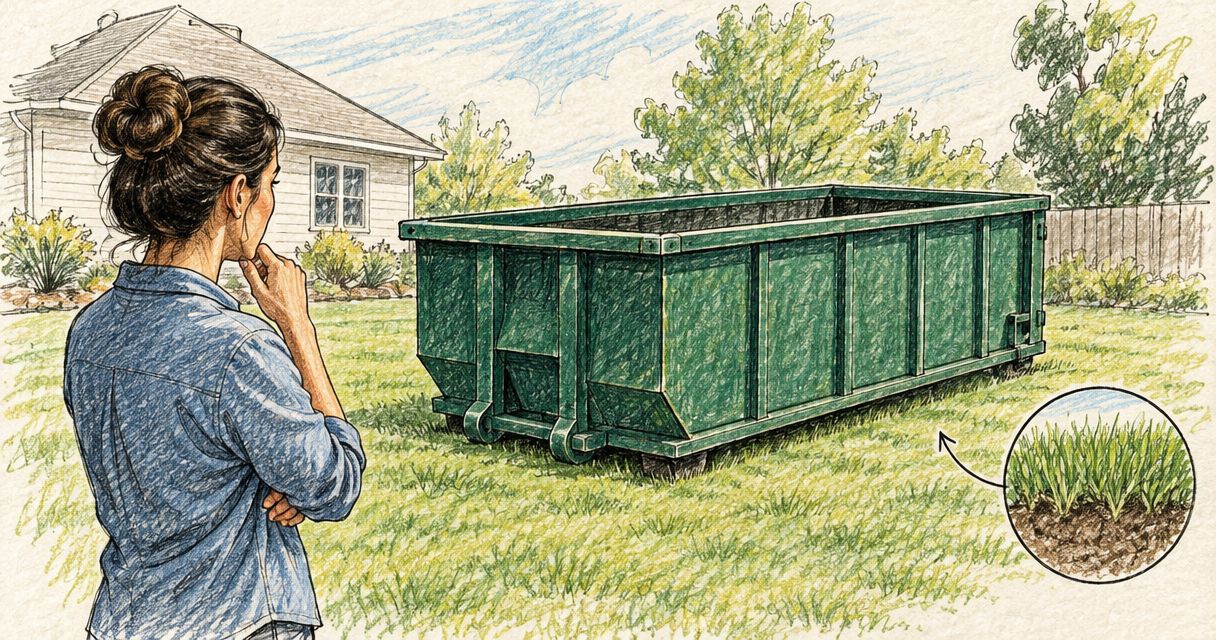
A roll-off container can sit on grass only if the rental company approves the location, but you cannot count on an undamaged lawn. The container can compress the soil and block sunlight, while the delivery truck can leave ruts before the container is even unloaded.
- Grass placement does not guarantee an undamaged lawn. Check the truck route as well as the container footprint.
- Use suitable pavement when available. It still needs a surface and access review before delivery.
- Ground protection reduces some pressure damage. It does not prevent grass from losing sunlight.
- Valley Services offers Bay Area roll-off container rentals and operates its own C&D transfer station in San Jose.
Why this matters
A lawn beside the driveway looks like convenient staging space. It keeps parking open and puts the container close to the work. But grass is not a load-bearing surface specification, and a firm-looking lawn does not establish that the ground can support a loaded container or a truck.
Choose the placement around the loaded pickup, not just the empty delivery. Your renovation debris adds weight after the driver leaves. Rain and irrigation can also change ground conditions between those visits.
For a 2026 Bay Area renovation, compare the lawn with an accessible paved location before committing. The guide to preparing a driveway for a roll-off container covers the alternative that deserves a surface review first.
Can a roll-off container sit on grass without damaging the lawn?
Yes, grass placement is physically possible at an approved location. No, it is not a damage-free arrangement. Soil compression, wheel tracks, crushed grass, and loss of sunlight are separate problems, and one protective measure does not address all of them.
The placement decision needs to cover both the container and the truck. A protected container footprint does little for an unprotected approach across soft turf.
| Placement option | Suitable use | Practical advantage | Limitation |
|---|---|---|---|
| Suitable paved surface | Projects with accessible, load-bearing pavement | Avoids placing the container directly on turf | Pavement can crack, mark, or fail if unsuitable for the load |
| Firm grass with approved protection | Sites where pavement is unavailable and the rental company accepts the location | Provides a placement option close to the work | Grass still loses sunlight; soil and truck-route damage remain possible |
| Bare grass without protection | Not recommended when preserving the lawn matters | Requires no protective material setup | Offers no load-spreading protection and exposes turf directly to contact |
| Wet or soft grass | Not recommended for delivery or pickup access | No lawn-protection advantage | Increases the risk of sinking, rutting, and loss of traction |
Use suitable pavement before treating lawn protection as a substitute for firm ground. If pavement is unavailable, discuss the full access route with the rental company. Do not assume the driver can safely use a location because an empty container fits there.
What actually damages grass under a container?
Contact pressure compresses the soil
A roll-off container transfers weight through its supporting contact points. That pressure can flatten turf and compact the soil beneath it. Compacted soil has less pore space for air and water, which affects the roots below the visible grass.
Load-spreading protection can reduce concentrated pressure. It does not turn soft ground into a dependable foundation. The ground beneath the protection still carries the load.
The container blocks sunlight
Grass needs light. A steel container shades the area beneath it, and protective boards or mats also cover turf. Protection against physical pressure does not eliminate the effects of covering a living lawn.
A shorter placement reduces the time grass stays covered. It does not establish a guaranteed safe duration. Grass condition, weather, season, and the way the area is covered all affect the result.
Truck movements damage a larger area
The truck needs a route to set down and retrieve the container. Tires can compress soil, and turning or braking on turf can disturb it further. The damaged area can extend well beyond the container footprint.
Walk the route from the property entrance to the placement spot. Include gate openings, driveway edges, slopes, and the transition from pavement to grass. The last few feet matter as much as the final location.
Why lawn damage varies
These factors explain why one grass placement leaves flattened turf while another leaves deep tracks:
- Soil moisture. Rain, irrigation, and poor drainage soften the ground and increase the risk of rutting.
- Loaded weight. The container's contents add weight after delivery. Dense C&D material changes the load substantially.
- Contact area. Supporting points concentrate pressure. Approved protection spreads some of that pressure across a larger area.
- Time covered. Longer placement keeps grass shaded and compressed for longer.
- Truck access. Travel, turning, and pickup movements expose more turf than the container alone.
- Existing ground condition. Recently disturbed soil, fresh sod, uneven ground, and buried infrastructure need separate attention.
For your 2026 placement plan, treat these as site checks rather than a scoring system. A dry-looking surface does not cancel out an unknown buried line or a weak access route.
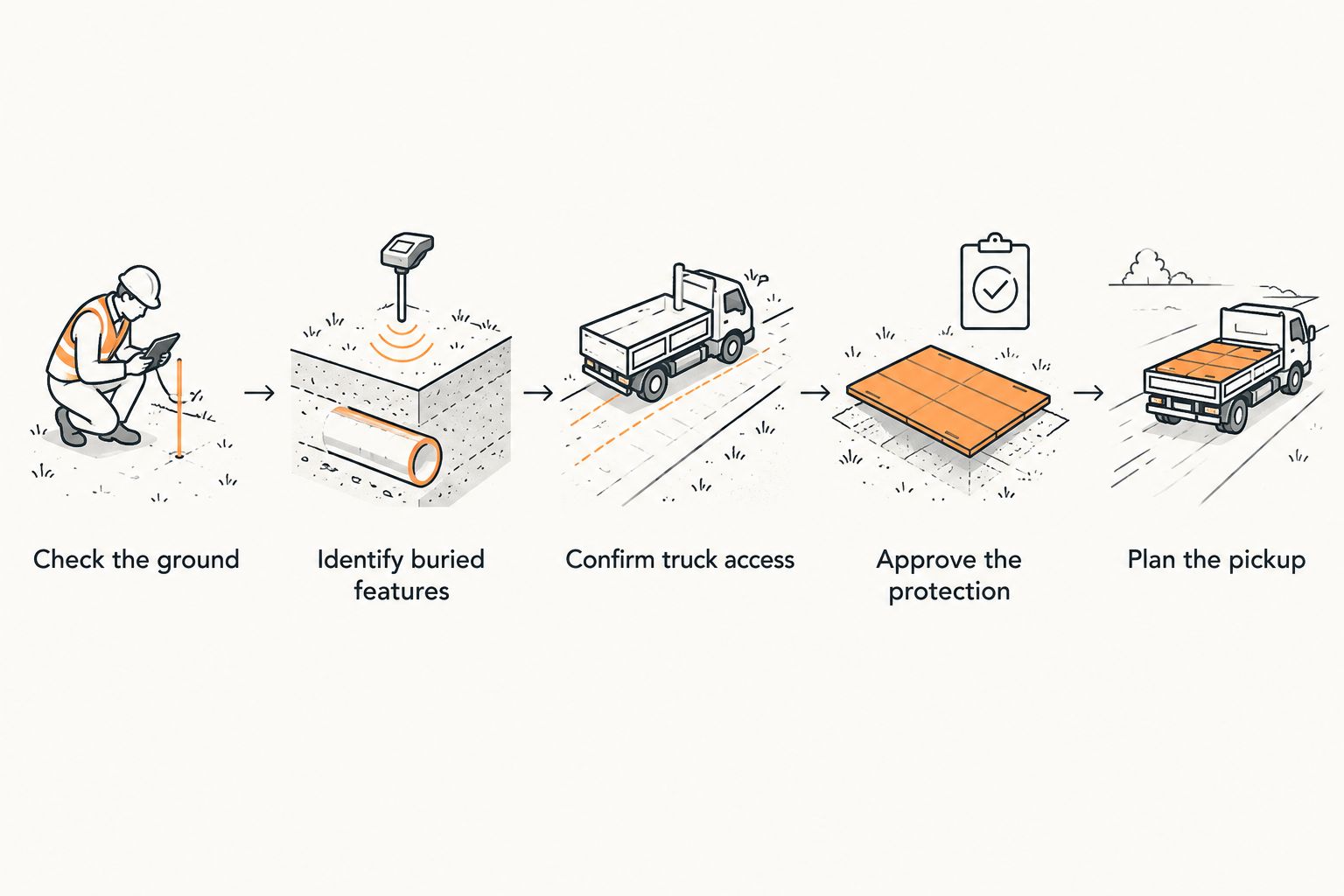
How should you prepare a grass placement location?
Resolve placement before delivery day. A driver arriving at an unsuitable lawn should not have to redesign your staging plan while other crews wait.
Check the ground
Walk the proposed location and approach. Note soft areas, standing water, recent excavation, settlement, and steep changes in grade. Tell the rental company about irrigation and recent rain.
Do not water the placement area immediately before delivery. Also, do not assume turning off irrigation makes saturated soil ready for a truck. Ground conditions need assessment, not a fixed waiting period.
Identify buried features
Locate irrigation heads, valve boxes, drainage features, utility covers, and known buried lines. Keep the container and truck route away from features that are not designed to carry those loads.
A visible sprinkler head is only part of the system. Pipes can extend beyond it. Where buried infrastructure is uncertain, resolve the uncertainty before choosing the location.
Confirm truck access
Send photographs of the entrance, approach, proposed footprint, and overhead conditions. Explain where the truck would leave pavement and enter grass. Ask the rental company what access and working clearance its equipment requires.
Do not estimate those requirements from the container's size alone. The truck needs operating space that the parked container does not.
Approve the protection
Ask the rental company which protective materials and arrangement it accepts. Confirm whether protection is needed under the container, along the access route, or both.
Do not select board thickness, mat capacity, or spacing from a generic online rule. Protection must suit the equipment, ground, and load. A sheet that protects against a scrape is not automatically suitable for supporting heavy equipment.
Plan the pickup
Keep the approach clear through load-out. Do not let parked vehicles, material stacks, or temporary fencing close the route after delivery.
Recheck the ground before pickup, especially after rain. If the container settles or the access route becomes soft, contact the rental company before the truck arrives. Do not drag or reposition the container yourself.
Does plywood or a ground protection mat prevent lawn damage?
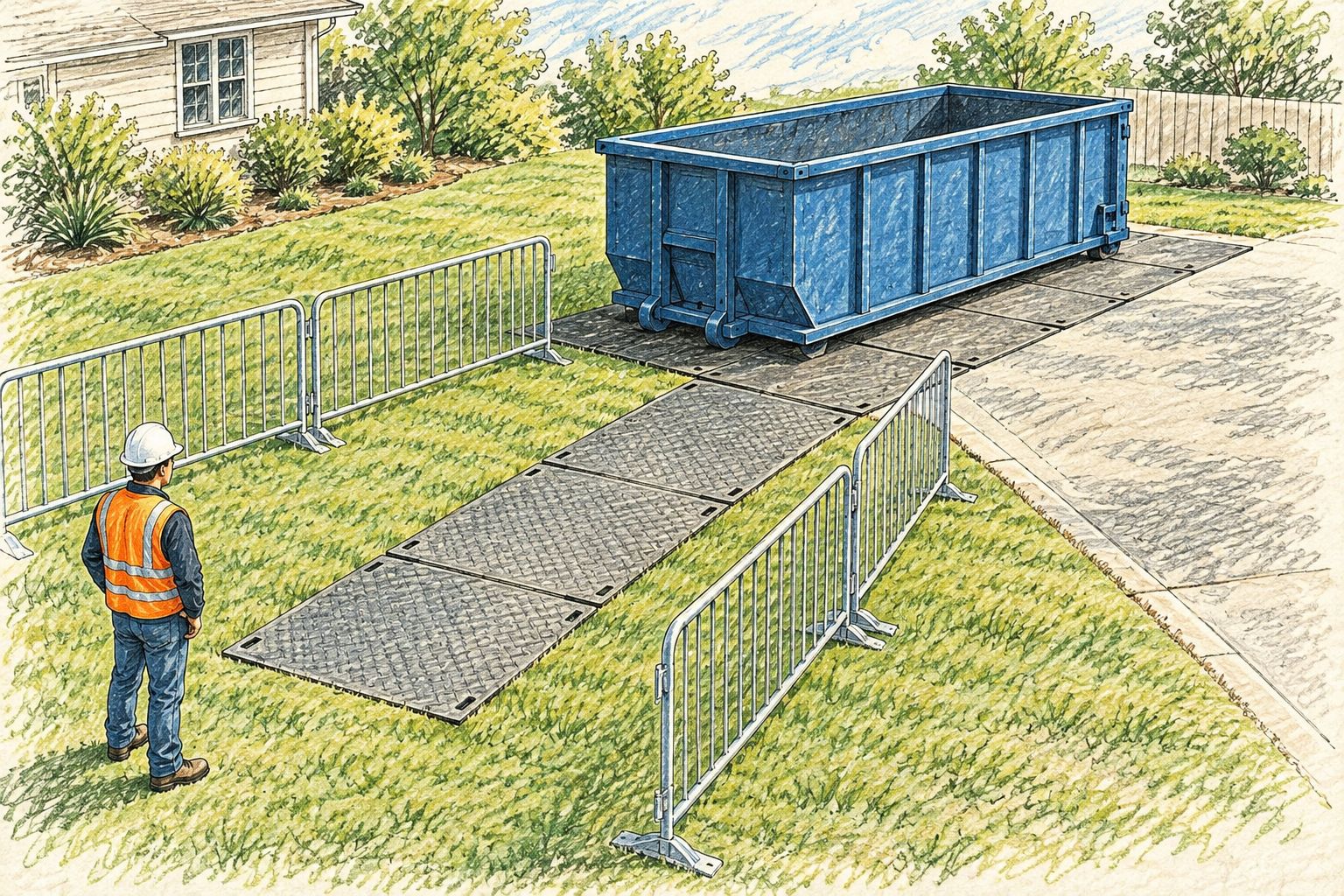
Neither material guarantees an undamaged lawn. Both cover grass, and their suitability depends on the specific load and installation. The rental company should approve the protection before delivery.
| Protection option | Suitable use | What it addresses | What it does not establish |
|---|---|---|---|
| Approved boards or plywood | Contact protection where the rental company accepts the arrangement | Separates steel contact points from the surface and can spread pressure | Truck access capacity, soil strength, or damage-free grass coverage |
| Load-rated ground protection mats | Equipment routes or placement areas reviewed for the intended load | Distributes pressure across a larger contact area | Guaranteed turf survival or safe use over unknown buried features |
| No protective material | Suitable pavement only when the rental company approves direct placement | Avoids a separate protection setup | Protection from surface marking or concentrated pressure |
Protection belongs in an approved placement plan. It is not permission to use wet ground. Do not stack loose scraps to level a container or create a truck crossing.
For a 2026 project with a lawn access route, distinguish the protective footprint from the travel lane. They serve different purposes. A driver needs to review both.
Does a smaller container make grass placement safe?
A smaller container does not establish that a lawn is suitable. Container volume describes space for debris. It does not tell you the loaded weight, soil strength, or truck requirements.
Valley Services roll-off container rentals span 8 cubic yards to 40 cubic yards. An 8-cubic-yard container and a 40-cubic-yard container still require placement review. Choosing less volume is not a substitute for checking access and the ground beneath it.
Describe the material as well as the project. Concrete, soil, and masonry are different loading decisions from bulky cleanout items. Ask the rental company to match container sizing and loading instructions to your actual debris.
Do not fill a container beyond the rental company's instructions because the lawn looks firm. The pickup must remain workable after loading, not just before it.
How long can a container stay on grass?
There is no universal damage-free duration. A brief placement still exposes grass to pressure, and longer coverage extends the period without sunlight. Schedule the container around the work rather than leaving it in place while demolition waits to start.
For your 2026 schedule, finish access preparation before delivery and identify the pickup trigger in advance. That trigger might be completion of a cleanout or the end of a demolition phase. Keep it tied to the actual work.
Use the guide to scheduling container delivery and pickup to coordinate those visits. Ground conditions can change between them, so retain a workable alternate location or access plan.
What if grass is the only available location?
Do not book grass placement without disclosing it. Give the rental company photographs, the debris type, the proposed route, and any known buried features. Ask whether it accepts the location and what preparation it requires.
If the location is rejected, discuss another placement arrangement. Public street or right-of-way placement needs a separate check with the local authority. Do not assume moving the container off the lawn removes permission or access requirements.
Valley Services roll-off container rentals fit Bay Area projects that need container service and a company-owned C&D disposal endpoint. The company operates its own transfer station in San Jose. That controls the disposal endpoint, but it does not remove the need for a suitable delivery and pickup location.
FAQ
Will a roll-off container kill the grass underneath it?
A roll-off container can damage the grass underneath it by compressing turf and blocking sunlight. Whether the grass recovers depends on its condition, the ground, and how long it stays covered.
Can I put plywood under a roll-off container on my lawn?
Use plywood only if the rental company approves the material and arrangement for your location. It does not establish that the lawn can support the container or delivery truck.
Is dry grass safe for a loaded container?
Dry grass alone does not establish a safe placement location. The underlying soil, buried features, loaded weight, and truck route still need review.
Will the delivery truck drive across my lawn?
The delivery truck needs an approved route to the placement location. If that route crosses your lawn, discuss ground conditions and protection before booking delivery.
Can I move the container if it starts sinking?
Do not move a sinking container yourself. Stop adding material and contact the rental company to review the ground and arrange the next step.
Does driveway placement guarantee no damage?
Driveway placement does not guarantee no damage. The pavement must be suitable for the load, and the rental company should review access and any required surface protection.
What should I send before a grass delivery in 2026?
For a grass delivery in 2026, send photographs of the entrance, truck route, placement area, and overhead conditions. Identify irrigation, buried features, soft ground, and the material you plan to load.
One last thing
Photograph the lawn and approach before delivery, then inspect the same areas after pickup. Record existing depressions, sprinkler locations, and pavement edges. A clear record also helps the driver understand where the site needs care.
The container's parking spot is only half the decision. Keep a workable exit route for the loaded pickup. That is the detail most likely to get overlooked once work starts.
Related guides
- Using ground protection mats on grass
- Loading a roll-off container safely
- Checking placement permissions in San Jose
For your 2026 project, call Valley Services at (408) 297-5404 to talk through the container location, access route, and debris before delivery.