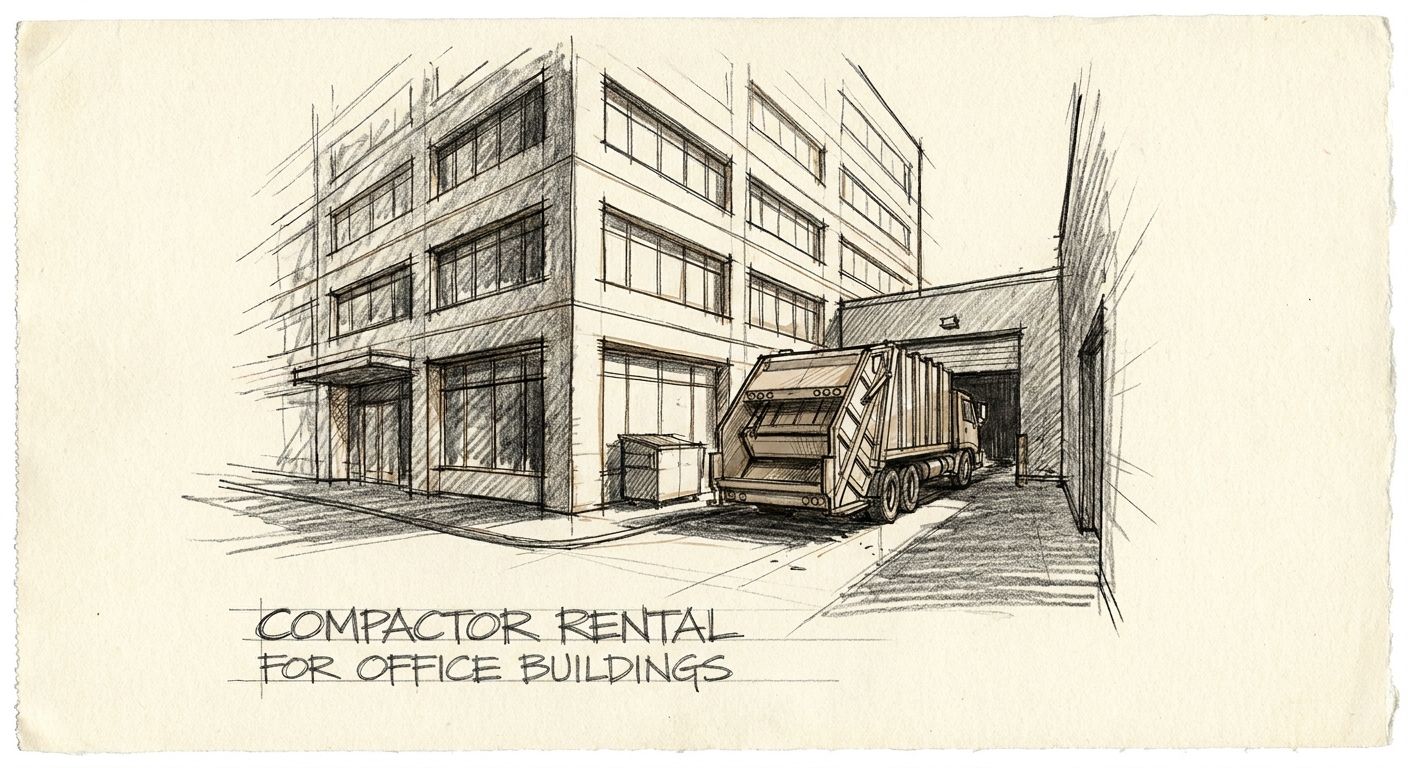
Compactor rental for multi-tenant office buildings replaces a row of individual tenant trash bins with one shared collection point, with the aim of cutting hauling trips and keeping the loading dock clear. A single-tenant office can run on a front-load dumpster and call it done. A building with a dozen tenants, a shared lobby, and one loading dock needs a compactor sized for combined volume and a pickup window that doesn't collide with tenant deliveries or move-in trucks.
- Compactor rental for office buildings works best with a unit sized to combined tenant volume, not per-suite square footage.
- Valley Services coordinates compactor service alongside roll-off containers and restrooms for the same property.
- Mixing C&D debris from tenant improvement work into a trash compactor is the most common overage trigger in multi-tenant buildings.
- Loading dock swing radius, not building square footage, usually decides which compactor model fits.
Why compactor rental matters for multi-tenant office buildings
A single tenant generates a predictable trash stream. A multi-tenant building generates ten or twenty unpredictable streams that all land in the same dumpster room. Property managers who size compactor service off one big tenant's habits end up with overflow every time three other suites clear out desks on the same week.
Most office buildings share one loading dock and one service elevator. A hauling truck that shows up mid-morning to service a compactor blocks the same dock a moving crew needs for a tenant improvement delivery. That conflict, not compactor size, is what generates most complaints from tenants in 2026.
Valley Services runs compactor service alongside roll-off containers, restrooms, and temporary fencing out of the same San Jose yard. That matters when a building has a compactor running daily trash and a roll-off container running tenant improvement debris on the same dock at the same time. One contact managing both schedules beats two separate vendors guessing at each other's timing.
Measure your building's actual waste volume
Don't size a compactor off gross square footage. Size it off what's actually leaving the dock each week.
- Pull the last six months of hauler invoices and count pickup frequency, not just tonnage.
- Walk the trash room during a normal Tuesday and a normal Monday after a weekend of vacancy.
- Ask building engineering how often the current bin overflows before scheduled pickup.
- Flag any tenant running a kitchen, café, or break room that generates wet waste separate from paper and cardboard.
- Note seasonal swings: tenant move-outs, holiday cleanouts, and fiscal year-end office purges all spike volume without warning.
Match compactor type to your loading dock
Dock geometry decides more than tenant count does. A self-contained compactor needs a level pad, a power hookup, and enough clearance for a roll-off style hauling truck to back in and pull the unit. A stationary compactor with a separate receiver box needs less truck clearance but more square footage on-site.
- Measure dock height against the compactor's loading chute height before ordering.
- Confirm electrical service exists near the pad; self-contained units need power for the compaction cycle.
- Check overhead clearance for the hauling truck's hoist arm, not just the compactor footprint.
- Ask whether the dock is shared with a freight elevator lobby that needs to stay clear during business hours.
- Rule out vertical compactors in buildings where trash chutes feed from upper floors; they need a different chute alignment than horizontal units.
Set a collection schedule that doesn't block dock access
The schedule matters as much as the equipment. A compactor pickup scheduled at 9 a.m. on a Monday collides with every tenant's delivery truck and every moving crew working a weekend turnover.
- Push routine pickups to early morning or after 6 p.m. when the dock sees less delivery traffic.
- Coordinate pickup timing with building engineering's freight elevator reservation calendar.
- Build in a buffer week between scheduled tenant move-outs and the next routine pickup, since move-outs spike volume fast.
- Confirm the hauler's pickup window in writing so building staff aren't guessing which day the truck shows.
Coordinate access across every tenant, not just the anchor
A compactor room that only the anchor tenant's janitorial crew has keyed access to turns into a bottleneck for every other suite. Every tenant needs a clear, simple way to get bagged trash into the compactor without a facilities request.
- Post signage at the compactor room stating what goes in and what doesn't.
- Set consistent access hours and communicate them in the tenant handbook, not just a hallway memo.
- Restrict compactor access to daily trash; route bulk furniture and demo debris to a separate container.
- Loop in each tenant's individual janitorial vendor so nobody stages trash in the hallway waiting for a key.
Keep C&D debris out of the compactor during tenant improvement work
This is where most overage charges and jammed compactors come from. A tenant improvement crew tearing out a suite generates drywall, ceiling tile, carpet, and lumber. None of that belongs in a compactor built for bagged office trash.
- Order a separate roll-off container for any suite running demolition or renovation work.
- Brief the TI contractor's crew directly; they default to the nearest dumpster if nobody tells them otherwise.
- Keep the roll-off container staged away from the compactor's dock zone to avoid confusion.
- Check the compactor for construction debris before every scheduled pickup during active TI projects.
If your compactor fills with drywall on a Tuesday, you paid for a roll-off you didn't order.
“If your compactor fills with drywall on a Tuesday, you paid for a roll-off you didn't order.”
Track fill rate and adjust frequency as occupancy shifts
Occupancy in a multi-tenant building changes every lease cycle. A compactor sized for 80% occupancy overflows fast once a new tenant fills the vacant suite.
- Check fill level at every service visit and log it, not just when the compactor jams.
- Renegotiate pickup frequency at lease turnover rather than waiting for a complaint.
- Watch for one tenant's business change, like adding a kitchenette or café counter, that quietly doubles their trash output.
- Adjust before summer and before December, the two periods that consistently spike office cleanout volume.
Run compactor service, container swaps, and site logistics through one contact
A building running a compactor for daily trash often also needs a roll-off container for a tenant buildout, a restroom trailer for a lobby renovation crew, or temporary fencing around a laydown area. Coordinating that through separate vendors means separate schedules that don't talk to each other.
Valley Services has run compactor service, roll-off containers, and restrooms out of the same San Jose yard since 1986, third-generation, same family. One call at (408) 297-5404 covers the compactor and whatever else the property needs that week.
Coordinate compactor service for your property
One call covers compactor service, containers, and site logistics.
Compactor options for multi-tenant office buildings
| Option | Best for | Key limitation |
|---|---|---|
| Self-contained compactor | Buildings with steady daily trash volume and dock power access | Needs a level pad and electrical hookup on-site |
| Stationary compactor with receiver box | Buildings with limited dock clearance for truck hoist arms | Larger footprint than a self-contained unit |
| Front-load dumpster swap-out | Smaller multi-tenant buildings with lighter volume | Requires more frequent pickups than a compactor |
| Roll-off container (best for hotel and restaurant compactor rental style comparisons apply here too) | Tenant improvement debris running parallel to compactor service | Not built for daily bagged trash, sized for one-time or phased loads |
Verdict: a self-contained compactor rented alongside a separate roll-off container for tenant improvement debris is the setup that avoids overage charges in multi-tenant office buildings in 2026.
Common mistakes multi-tenant buildings make with compactor rental
- Sizing off the anchor tenant only. A 40,000-square-foot anchor's habits don't predict what six other suites generate combined.
- Letting TI contractors use the compactor for demo debris. This is the single biggest cause of jammed units and surprise overage.
- Scheduling pickups during peak dock hours. A truck blocking the dock at 10 a.m. creates more tenant complaints than a full compactor does.
- Skipping fill-rate checks between lease turnovers. Occupancy changes fast in office buildings; compactor frequency rarely gets adjusted to match.
- Ignoring odor and appearance standards near lobby-adjacent docks. A compactor room visible from a tenant entrance needs a different service rhythm than one tucked in a rear alley.
FAQ
What size compactor does a multi-tenant office building need?
Size depends on combined tenant trash volume, not building square footage. Pull six months of hauler invoices and count actual pickup frequency before choosing a self-contained or stationary unit.
Can a trash compactor take construction debris from a tenant improvement project?
No. A compactor built for bagged office trash jams and overflows fast when drywall, carpet, or lumber goes in. Run a separate roll-off container for any suite doing demolition or buildout work.
How often does a compactor need pickup in an office building?
Frequency depends on occupancy and tenant mix, not a fixed schedule. Check fill rate at every service visit and adjust after lease turnovers or seasonal cleanout spikes.
Is a self-contained compactor better than a stationary compactor for office buildings?
A self-contained compactor works best where dock power and truck clearance for a hoist arm both exist. A stationary compactor with a separate receiver box fits buildings with tighter truck access but needs more floor space.
Who coordinates compactor pickup timing with dock access in a multi-tenant building?
Building engineering or the property manager should set pickup windows around delivery and freight elevator traffic, then confirm the schedule in writing with the hauler.
Does Valley Services handle compactor rental for office buildings in San Jose?
Valley Services runs compactor service alongside roll-off containers and restrooms for properties across San Jose, Santa Clara, Sunnyvale, Mountain View, and Milpitas. Call (408) 297-5404 to set up service for a specific building.
What causes overage charges on an office building compactor?
Overage charges usually come from construction debris mixed into daily trash, or from fill rates exceeding the scheduled pickup frequency after occupancy or tenant mix changes.
How does compactor access work when a building has multiple tenants?
Access should be consistent across every tenant, not limited to the anchor's janitorial crew. Set posted hours, clear signage on what goes in, and a separate container for bulk or construction waste.
One last thing
The schedule conflict, not the compactor size, is what actually generates tenant complaints in most multi-tenant office buildings. A property running compactor service, a roll-off container for TI work, and restroom service for a renovation crew on the same dock in the same week needs one vendor tracking all three windows, not three separate trucks guessing at each other's timing. Valley Services controls its own C&D transfer station in San Jose, which means the disposal endpoint and the pickup schedule are set by the same operation, not brokered out to a third party.
Call (408) 297-5404 or reach out through valleyservices.biz to talk through compactor service for a specific property.