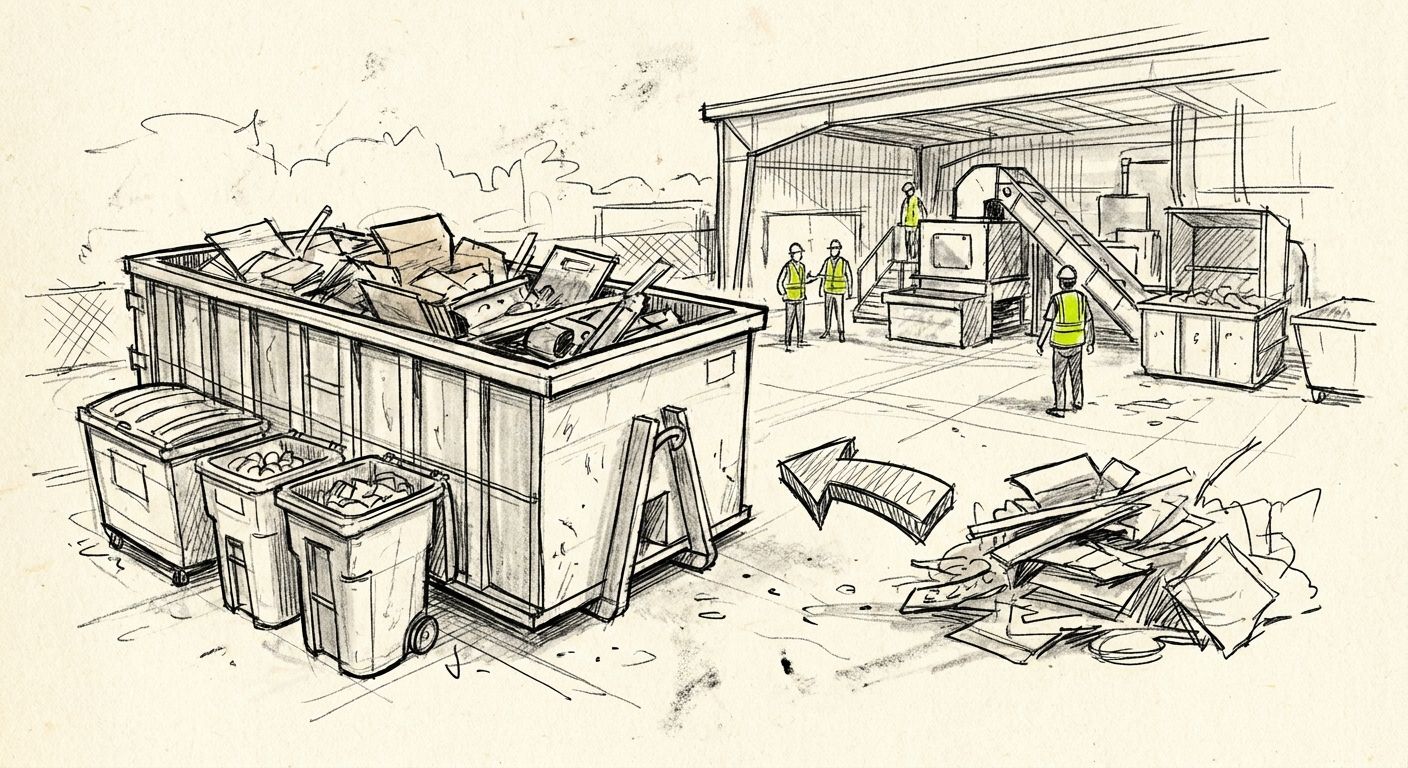
Container rental for recycling centers and transfer stations fills the gap when a facility's own floor, baler, or scale house hits capacity before the next scheduled haul. The problem is not the same as a construction jobsite ordering one container for a remodel. A recycling center or transfer station runs continuous intake, so overflow capacity has to match shift-by-shift volume, not a fixed weekly pickup.
- Recycling centers need overflow container capacity sized to peak-shift volume, not average weekly tonnage.
- Blue steel roll-off containers from 8 to 40 yards handle different overflow streams: cardboard needs cube, scrap metal needs axle-weight control.
- Valley Services operates its own San Jose transfer station, which shortens the wait for a standby swap when a baler goes down.
- Dedicated containers per material stream cut reclassification delays caused by mixed or contaminated loads.
- Container rental for recycling centers works best on a throughput-based schedule, not a generic weekly rotation.
Why overflow container rental matters for recycling centers
A recycling center or transfer station operates on a tight physical footprint. Tipping floors, baler bays, and scale houses only hold so much material before intake has to slow down or stop. When that happens, the facility loses throughput, and lost throughput on a permitted site is a scheduling problem, not a convenience problem.
Most transfer stations and material recovery facilities in the Bay Area run close to their permitted storage limits by design. There is no room to stack pallets of overflow cardboard next to the scale house or leave a mixed load sitting on the yard overnight. An extra blue steel roll-off container, placed and swapped on a schedule that matches actual intake, is the practical fix.
Valley Services has run its own transfer station in San Jose since 1986, third generation, same yard. That matters here specifically because container rental companies that broker disposal to someone else's site can't move as fast when a facility calls for a same-day standby container. Valley controls its own endpoint, so a swap doesn't depend on a third party's schedule.
Valley Services works with facilities across San Jose, Santa Clara, Sunnyvale, Mountain View, and Milpitas that need overflow container capacity on short notice, not a standing weekly contract they don't need.
How to plan container rental for recycling center overflow
Audit your overflow points before you call anyone
Walk the site and mark exactly where material backs up. Most facilities already know the answer but haven't written it down.
- Track daily tonnage by stream for two weeks minimum
- Note which shift hits capacity first and why
- Flag any stream running without a dedicated container
- Mark spots where overflow currently blocks fire lane clearance
- Log baler downtime and how it correlates with backups
Match container size to the material stream, not to guesswork
Different streams behave differently in a container. Cardboard and mixed paper are light and bulky, so they need cube, which points toward a 30 or 40 yard container. Mixed C&D and heavier construction debris fill up on weight long before they fill up on volume, so a 10 or 20 yard container often makes more sense. Scrap metal is dense enough that oversizing the container just wastes yard space.
- Use 30 to 40 yard containers for cardboard and light mixed paper
- Use 10 to 20 yard containers for mixed C&D and heavier debris
- Use smaller containers for scrap metal to keep axle weight in check
- Never size a container off average monthly volume alone
- Recheck sizing after any change in intake mix
Plan swap-out timing around your permit, not a default rotation
A fixed weekly pickup rarely matches how a recycling center actually fills containers. Peak season, equipment downtime, and seasonal volume swings all move the real number.
- Confirm container placement doesn't block emergency access or scale house sightlines
- Set a call-ahead window that matches your gate hours
- Coordinate swap timing with your highest-intake shift, not your lowest
- Keep a standby container ready during known peak months
- Build a backup swap plan for holiday and weekend gaps
Separate streams at the container level
Mixing streams inside one container is the fastest way to slow down processing at the far end. A load that arrives contaminated gets reclassified, and reclassification costs time the facility doesn't have.
- Dedicate one blue steel container per material stream
- Label containers clearly at the point of use
- Keep wet or bagged material out of clean cardboard containers
- Route heavy metal into its own smaller container to control weight
- Schedule dirty-load hauls separately from clean-stream hauls
Load containers to control weight and avoid overage charges
How a container gets loaded affects both safety and cost. Loading a container safely without overage fees starts with weight distribution, not with how much visual space is left.
- Put heavy material like concrete or metal at the floor of the container
- Break down cardboard flat before loading to save cube
- Keep material below the marked fill line on the container wall
- Never toss wet or bagged loads on top of dry stock
- Check for prohibited items before a load ships out
Build standby capacity for peak season and downtime
A baler doesn't fail on a convenient schedule. Facilities that keep a rotating spare container on-site avoid the scramble that happens when intake keeps coming and processing stops.
- Keep one spare blue steel container staged during peak months
- Plan around known baler maintenance windows in advance
- Confirm your hauler's holiday and weekend coverage before you need it
- Track seasonal volume swings year over year so sizing improves
“If you're sizing a container off last month's average tonnage, you're already behind on the next peak.”
Options for recycling center overflow capacity
| Option | Best for | Key limitation |
|---|---|---|
| Single standing container | Facilities with steady, predictable overflow volume | Doesn't flex for peak-season spikes |
| Multiple dedicated stream containers | Sites separating cardboard, metal, and mixed C&D | Requires more yard footprint |
| Rotating standby container | Facilities managing baler downtime or seasonal peaks | Needs advance coordination with the hauler |
| Broker-managed disposal | Facilities without a local endpoint preference | Swap speed depends on a third party's schedule |
Valley Services fits the multiple-stream and standby-rotation columns best, because Valley owns the San Jose transfer station where the material ends up. That ownership is what shortens the call-to-swap window when a facility hits capacity mid-shift.
Need overflow container capacity fast
Call to talk through sizing, swap schedule, and standby coverage for your site.
Common mistakes recycling centers make with overflow containers
- Sizing for average volume instead of peak volume. A container that handles a normal Tuesday doesn't handle the week after a holiday closure.
- Mixing contaminated loads into clean-stream containers. One bad load can force reclassification of an entire container at the transfer station.
- Placing containers where they block fire lanes or scale house sightlines. This creates a permit problem on top of a capacity problem.
- Rotating on a generic weekly schedule. Facilities that swap on a fixed calendar instead of actual throughput either run out of room or pay for pickups they don't need.
- Waiting until the baler goes down to look for standby capacity. By the time equipment fails, there's no time left to source an extra container same-day.
FAQ
What size container works best for recycling center overflow?
It depends on the material stream. Cardboard and light mixed paper need cube, so 30 to 40 yard containers work best. Mixed C&D and heavier debris fill up on weight first, so 10 to 20 yard containers usually make more sense.
How fast can a recycling center get a standby container in San Jose?
Timing depends on the hauler's schedule and whether they control their own disposal endpoint. Valley Services operates its own San Jose transfer station, which removes one scheduling dependency when a facility needs a same-day swap.
Should recycling centers use one container for all overflow material?
No. Mixing streams in a single container leads to reclassification delays at the transfer station. A dedicated container per material stream keeps loads clean and processing on schedule.
Is container rental for recycling centers different from standard construction dumpster rental?
Yes. Recycling centers need overflow capacity tied to continuous intake and peak-shift volume, not a single project timeline. Swap frequency and standby planning matter more than a one-time delivery.
What causes overage fees on a recycling center's rented container?
Overage usually comes from exceeding the container's weight limit, not the visual fill line. Loading heavy material like scrap metal or wet debris without checking weight distribution is the most common cause.
Can a recycling center rent containers only during peak season?
Yes. A rotating standby container brought in ahead of known peak months or planned baler downtime avoids paying for capacity the facility doesn't use the rest of the year.
What areas does Valley Services cover for recycling center container rental?
Valley Services serves San Jose, Santa Clara, Sunnyvale, Mountain View, Milpitas, and the surrounding Bay Area. The transfer station itself is located in San Jose only.
One last thing
Most recycling centers size overflow containers off tonnage reports from the last full month. That number smooths out the exact days that actually caused the backup. Pull the data by shift instead of by month, and the real peak usually shows up as a two-or-three-day spike, not a steady average, which changes how much standby capacity actually gets ordered.
Call (408) 297-5404 or reach out through valleyservices.biz to talk through container sizing and standby coverage for your site in 2026.