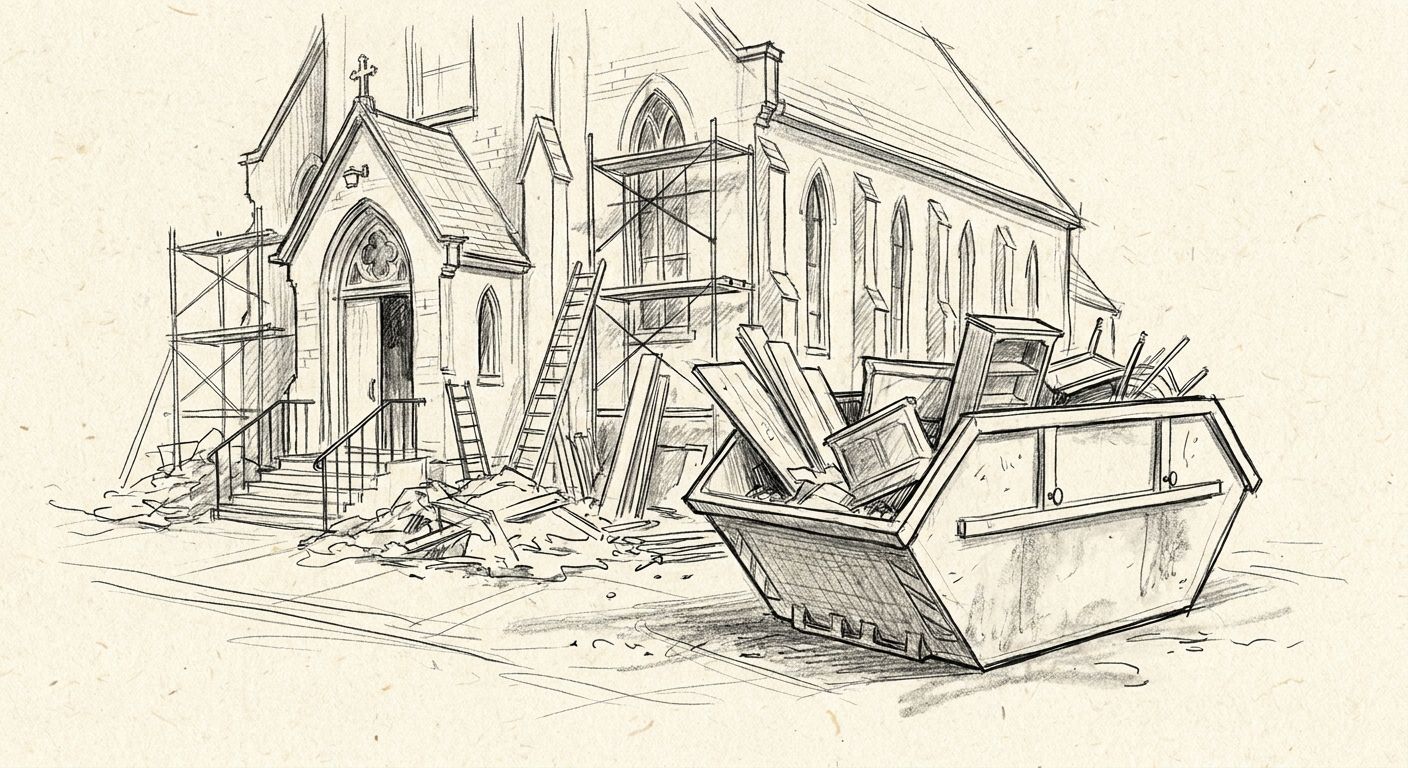
Church and nonprofit renovation projects run on a schedule that has nothing to do with construction. Sunday services, weekday food pantries, preschool programs, and volunteer work days all keep happening while crews tear out flooring, replace a roof, or gut a fellowship hall, so the container has to fit around the congregation's calendar, not the other way around.
- Dumpster rental for church renovations usually calls for a 20 or 30 yard roll-off scheduled around service days, not a standard weekday drop.
- Valley Services delivers blue steel roll-off containers across San Jose and the South Bay for church, nonprofit, and school renovation work.
- Placement on a paved lot away from sanctuary doors and ADA paths avoids the most common church-site complaint in 2026: a blocked entrance.
- Multi-phase renovations, common in older sanctuaries, usually need more than one container swap, not one oversized unit.
Why dumpster rental matters for church and nonprofit renovation projects
A church or nonprofit building rarely closes for a renovation the way a retail store might. Services continue, a school or daycare shares the property, and volunteer crews come and go on evenings and weekends instead of a fixed contractor schedule. That means the roll-off container has to sit somewhere it won't block a Sunday parking lot, an accessible entrance, or a loading zone a food pantry uses twice a week.
Budgets are the other constraint that's different here. Nonprofit renovation budgets are usually fixed by a building committee or a grant, with little room for a surprise second haul because nobody planned for the plaster and lath weight coming out of a 1960s sanctuary. Getting the container size and the swap schedule right on the first call matters more for a church renovation in 2026 than it does on a standard commercial job with more budget flexibility.
Size the container to the actual renovation scope
Most church and nonprofit renovation jobs fall into a narrow range of container sizes. Guessing high wastes yard space in a parking lot the congregation still needs; guessing low means a second delivery mid-project.
- 10-yard: single-room refresh, office or nursery remodel, small cosmetic update.
- 20-yard: fellowship hall remodel, sanctuary flooring replacement, kitchen renovation in a church hall.
- 30-yard: gut renovation involving pews, drywall, and flooring together, or a roofing tear-off on a mid-size building.
- 40-yard: full interior demolition, additions, or combined roofing and structural work on a larger campus.
Schedule delivery and pickup around the service and program calendar
A roll-off dropped in the wrong window creates more disruption than the renovation itself. Nail down the calendar before you set a delivery date.
- Avoid Sunday morning and Wednesday evening delivery windows if those carry regular services.
- Confirm daycare, preschool, or food pantry hours that use the same parking lot or entrance.
- Schedule pickup ahead of Easter, Christmas, or any high-attendance event, not the week of.
- Ask about the swap window for multi-phase work so a full container doesn't sit through a weekend service.
- Build in a buffer day between the last debris load and any major event on the calendar.
Choose a placement spot that protects access and pavement
Where the container sits matters as much as its size on church and nonprofit property, since the lot usually serves multiple groups.
- Place on paved surface whenever possible to avoid rutting a grass lot or gravel drive.
- Keep the unit clear of any ADA-compliant path to an entrance.
- Leave distance from doors used for regular services, staff access, or fire egress.
- Confirm the container won't sit in a fire lane or block a hydrant.
- Note any low-hanging trees or power lines near the drop zone before delivery.
Separate debris types to control loading and avoid overage
Older church buildings often mix debris types that need to be handled differently, and dense material adds weight fast.
- Keep plaster, lath, and drywall separate from metal fixtures and pews where possible.
- Route concrete, tile, or masonry to its own load if the volume is significant.
- Flag any suspected asbestos-containing material in pre-1980s buildings before demo starts; that material does not go in a standard roll-off. See how to dispose of hazardous construction materials safely before work begins.
- Load flat and even; don't stack above the container's rim.
- Confirm what a container can accept before mixed loads go in, since acceptance varies by material.
Confirm permit requirements before the container lands
Permit rules depend on where the container sits, and a church parking lot usually avoids the issue entirely.
- Placement fully on private property, including the church's own lot, typically doesn't require a city permit.
- Placement on a public street or right-of-way does, and lead time varies by city.
- Nonprofit properties in dense neighborhoods sometimes face additional zoning notice requirements; check with the local building department early.
- Build permit lead time into the renovation schedule, not the week before the demo crew shows up. Read how to permit a dumpster placement in San Jose if the job sits in that jurisdiction.
Budget for the full waste stream, not one container swap
A single roll-off line item rarely covers a full church renovation. Building committees that budget for one swap often get surprised by a second.
- Multi-phase renovations, common in sanctuaries done in stages, usually need more than one delivery cycle.
- Roofing tear-offs and plaster demo run heavier per cubic yard than framing lumber; factor that into container count, not just size.
- Get a written scope of work from the contractor before locking in container count for the whole project.
- Review how to estimate dumpster rental costs for a remodel before the budget goes to the finance committee.
Cover restrooms if the renovation takes working bathrooms offline
A bathroom renovation or a demo crew working near the only accessible restroom means the congregation needs an alternative during service hours.
- Place a standard restroom unit near the work zone for the crew, separate from congregation use.
- Add an ADA-compliant unit if the only accessible restroom is out of service during Sunday attendance.
- Service frequency should match attendance days, not a flat weekly schedule, during active renovation.
- See portable restroom rental for church events and gatherings for sizing guidance tied to attendance.
“A roll-off delivered on a Sunday morning blocks the same lot the deacons need for parking.”
Container size comparison for church and nonprofit renovation work
| Container | Best for | Key limitation |
|---|---|---|
| 10-yard | Single room, office, or nursery refresh | Fills fast on any job with flooring or drywall demo |
| 20-yard | Fellowship hall remodel, sanctuary flooring | Not enough for a full gut with pews and plaster |
| 30-yard | Gut renovation, roofing tear-off | Needs paved, clear access for delivery and pickup |
| 40-yard | Full interior demo, additions | Takes more lot space, may need a permit if placed near a street |
Talk through your renovation schedule
Call to size the container and set delivery around your service calendar.
Common mistakes church and nonprofit renovation projects make
- Scheduling delivery on a service day. A container dropped Sunday morning blocks the exact lot the congregation needs at the exact hour it needs it.
- Underestimating debris weight from older buildings. Plaster, lath, and tile from a 1960s or older sanctuary weigh more per yard than drywall and framing, and that adds up fast in a 20-yard unit.
- Placing the container on grass or gravel without protection. Unpaved placement on a church lawn or gravel lot leaves ruts that cost more to fix than the container swap.
- Budgeting for one swap on a multi-phase job. Renovations done in stages, which is common for sanctuaries that stay in partial use, usually need more than one delivery cycle.
- Forgetting accessible restroom coverage. Taking the only ADA-compliant bathroom offline during a renovation without a replacement unit creates a real problem on a Sunday with full attendance.
FAQ
What size dumpster do I need for a church renovation?
Most church renovations use a 20 or 30 yard roll-off container. A single-room refresh fits a 10-yard unit, while a full sanctuary gut with pews, flooring, and plaster usually needs a 30-yard or a second swap.
Can a dumpster sit on church property without a permit?
Placement fully on private property, including a church's own parking lot, typically does not require a city permit. Placement on a public street usually does, and lead time varies by city.
How do we schedule delivery around Sunday services?
Set delivery and pickup for weekdays whenever possible and avoid dropping a container the day before a high-attendance service. Confirm any daycare or food pantry hours that use the same lot before locking in a date.
Does a church renovation dumpster need to separate debris types?
Yes. Older buildings often mix plaster, drywall, metal fixtures, and pews, and dense material like plaster and tile fills a container faster than framing lumber. Keeping loads separated where possible controls weight and access.
What about asbestos in an older church building?
Pre-1980s buildings sometimes contain asbestos in plaster, tile adhesive, or insulation. That material does not go into a standard roll-off container and needs to be flagged and handled separately before demo starts.
Do we need a separate restroom rental during a bathroom renovation?
If the renovation takes the only working or ADA-compliant restroom offline, a portable restroom unit covers the gap during services and programs. Service frequency should match attendance days, not a flat weekly schedule.
How many container swaps does a multi-phase renovation need?
Sanctuaries renovated in stages, which is common when the building stays in partial use, usually need more than one delivery cycle rather than one oversized container sitting for the whole project.
Is dumpster rental for a nonprofit different from a standard commercial job?
The container sizing and debris rules are the same. The difference is scheduling around a building that stays partly in use and a budget that's usually fixed, so getting size and swap count right the first time matters more.
One last thing
Valley Services runs its own C&D transfer station in San Jose, so a church or nonprofit renovation job gets one point of contact for the container, the schedule, and the drop-off endpoint instead of a broker passing debris to a third-party site. That matters most on multi-phase church jobs, where a swap date slipping by even a day can land on a service that draws the biggest crowd of the month. Valley Services has run the same San Jose yard since 1986, now in its third generation.
Related guides
- Dumpster rental for school and campus renovation projects
- How to load a dumpster safely and avoid overage fees
For a church or nonprofit renovation on the calendar for 2026, call Valley Services at (408) 297-5404 or reach out through valleyservices.biz to work out container size and a delivery schedule that fits around your services.