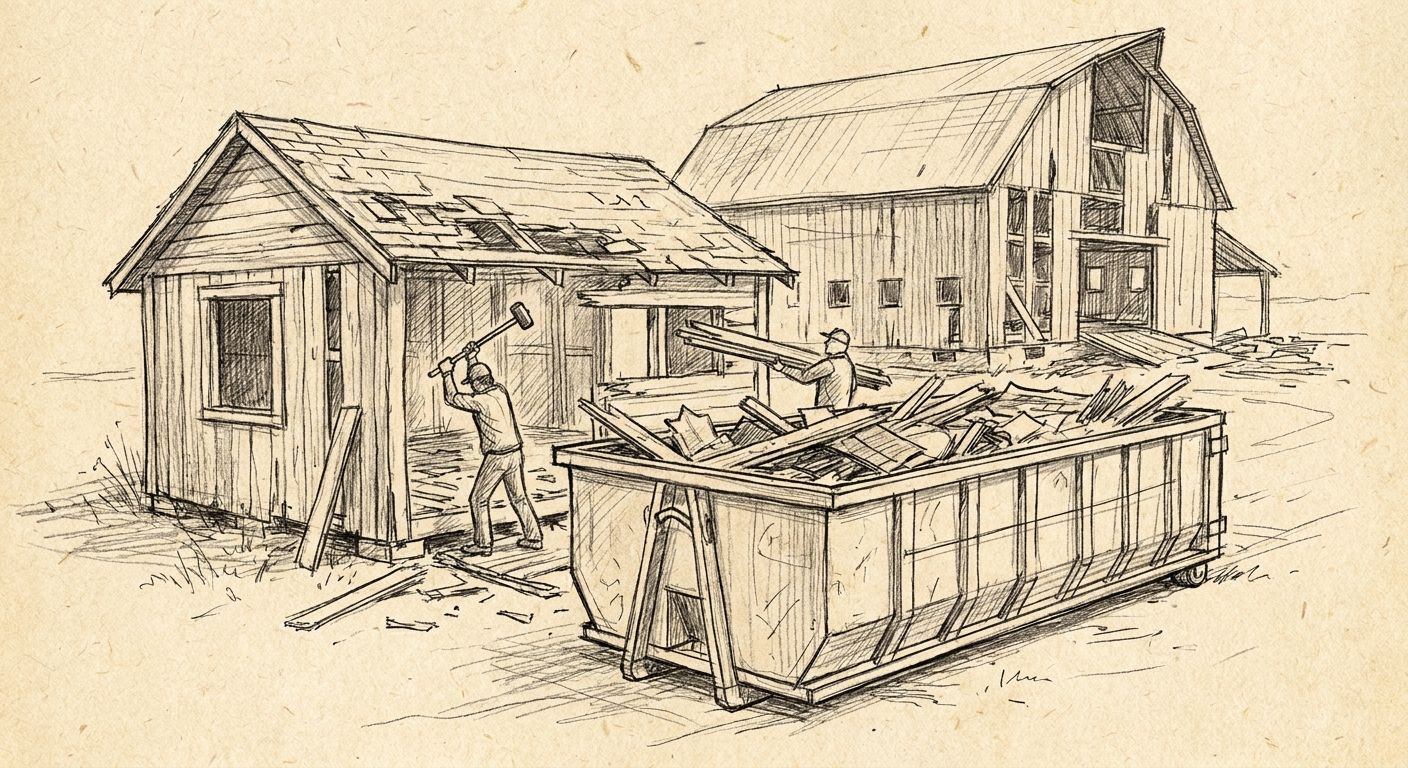
Old sheds and barns don't tear down clean. You get splintered lumber, rusted nails, asphalt shingles, corrugated metal, and sometimes a slab of concrete underneath that nobody mentioned. A dumpster rental for shed demolition or barn teardown has to handle weight, not just volume, and that changes which container size actually works for the job.
- A 10 yard container handles most single sheds under 120 square feet in 2026 pricing terms of load capacity, not just space. Buy.
- Barn teardowns with roofing and framing debris need a 30 yard roll-off container. Consider it standard, not oversized.
- Weight limits stop lumber and shingle debris before the container looks full. Overage fees hit here more than on volume.
- Driveway access and street permits matter more for barn sites than size selection does. Check both before delivery day.
Who this is for
This guide is for homeowners tearing down a backyard shed or old barn, contractors handling a demolition phase on a residential or ag property, and property owners clearing structures ahead of new construction. If you're hauling a mix of dimensional lumber, roofing material, and hardware in one pass, the sizing logic here applies whether the structure is 80 square feet or a full two-story barn.
Why this matters
Demolition debris weighs more per cubic yard than household junk. A shed full of dry lumber, plywood, and asphalt shingles can hit a container's weight limit before it looks full, and that's where overage fees start. Barn teardowns add complexity: larger footprints, sometimes lead paint or old roofing that needs separate handling, and site access that a driveway dumpster never has to deal with.
Getting the container size wrong on a one-day teardown means a second truck trip, a delayed haul-off, or a swap mid-project. None of that is cheap in time, even when it's not in dollars.
What to look for in dumpster rental for shed demolition
Container size matched to structure footprint
A shed under 120 square feet with simple stick-frame construction usually fits in a 10 yard container. A full barn, especially one with a hayloft or multiple stalls, generates enough framing and roofing debris to fill a 30 yard unit. Match the container to the structure, not to a guess.
Weight capacity, not just cube capacity
Lumber, shingles, and hardware are dense. A 20 yard container rated for a typical remodel can hit its weight ceiling on a shed teardown well before the bin looks full. Ask what the weight allowance is before delivery, not after the overage invoice.
Debris type restrictions
Older barns sometimes have treated lumber, asbestos siding, or lead paint on trim. Standard C&D containers are not built for hazardous material. Confirm what's excluded before the container lands on site, because a rejected load costs you a second haul.
Delivery access and driveway clearance
Preparing the driveway for a roll-off truck matters more on a barn site than a garage cleanout. Overhead branches, narrow gates, and soft ground near a barn foundation can all block delivery. Walk the access route before you schedule.
Permit requirements for placement
If the container sits on a street or shared driveway instead of private property, San Jose and most Bay Area cities require a placement permit. Permitting a dumpster placement takes a day or two to process, so confirm it early if the teardown site has no on-property spot.
Rental window length
A single-day shed teardown might only need the container for 48 hours. A barn project spanning framing removal, roofing strip, and foundation work needs a longer window or a scheduled swap. Match the rental term to the actual demolition timeline, not a flat default.
Plan your teardown container
Call to size the container for your shed or barn job.
Top picks by structure size
10 yard container: the small-shed pick. Handles roughly 3 tons of mixed lumber and hardware debris, which covers most single-bay backyard sheds. Fits on most residential driveways without a permit. Verdict: Buy for sheds under 120 square feet.
20 yard container: the workhorse. Rated for heavier loads than the 10 yard and still fits standard driveway access. Right size for a two-car-garage-sized shed or a small outbuilding with a shingled roof. Verdict: Buy for mid-size structures with roofing material in the mix.
30 yard container: the barn pick. Built for framing, siding, and roofing debris from a full barn teardown. Takes up more driveway or yard space, so confirm access before delivery. Verdict: Consider for any structure over 400 square feet or with a second story.
40 yard container: the big teardown. Highest volume available, but weight limits on dense demolition debris can max out before the container fills. Best reserved for mixed-material commercial demolition rather than a residential barn. Verdict: Consider only when a contractor is managing load weight actively; Skip for a straightforward homeowner barn project where a 30 yard unit with a swap covers it.
What to avoid
- A yard-waste dumpster for a shed teardown. Yard debris containers are sized and priced for green waste, not lumber and shingles, and most won't take mixed demolition material at all.
- Skipping the weight check on a 40 yard container. Bigger doesn't mean cheaper if the load hits its weight cap at 60% full. Size for weight first, volume second.
- Assuming a barn has no hazardous material. Older structures built before the 1980s can carry lead paint or asbestos siding. Confirm before demolition starts, not after the container is loaded.
Verdict comparison
| Container | Best for | Debris weight tolerance | Verdict |
|---|---|---|---|
| 10 yard | Single small shed | Lower, fits most sheds under 120 sq ft | Buy |
| 20 yard | Mid-size shed, garage-sized structure | Moderate, handles shingles and framing | Buy |
| 30 yard | Full barn teardown | High, built for framing and roofing volume | Consider |
| 40 yard | Commercial-scale demolition | Highest volume, weight caps out fast | Consider or Skip |
FAQ
What size dumpster do I need to tear down a shed?
A 10 yard container handles most sheds under 120 square feet in 2026. Larger sheds with shingled roofs or attached decks often need a 20 yard unit instead.
What size dumpster do I need for a barn teardown?
A 30 yard roll-off container covers most full barn demolitions. Barns with a second story or multiple stalls sometimes need a swap partway through the job.
Can I put shed roofing shingles in a regular dumpster rental?
Yes, standard C&D containers take asphalt shingles along with lumber and framing. Confirm the weight allowance first since shingles are dense and add up fast.
Do I need a permit for a dumpster on my driveway for shed demolition?
No permit is required if the container sits entirely on private property like a driveway. Placement on a street or public right-of-way in San Jose requires a placement permit.
How long can I keep a dumpster rental for a barn teardown?
Rental windows are set at booking and can run from a couple of days for a small shed to a couple of weeks for a full barn project. Multi-phase teardowns often use a scheduled swap instead of one long rental.
What can't go in a dumpster rental for shed or barn demolition?
Hazardous material like asbestos siding, lead paint debris, and certain chemical containers are excluded from standard C&D containers. Confirm exclusions before the teardown starts if the structure predates the 1980s.
Is a 20 yard or 30 yard dumpster better for a large shed?
A 20 yard container covers most large sheds including two-car-garage-sized structures. Move up to 30 yard only if the shed has a second story or an attached workshop adding to the debris volume.
Does concrete under a shed need a separate dumpster?
Concrete and dirt are heavy enough to need their own container in most cases, separate from wood and roofing debris. Mixing concrete into a standard C&D load will hit the weight limit almost immediately.
One last thing
Most shed and barn teardown jobs don't fail on container size. They fail on weight math, because a load that looks half full can already be at capacity once the shingles and hardware settle. Valley Services runs its own transfer station in San Jose, third generation, same yard since 1986, which means the endpoint for that debris isn't a third-party broker's schedule. That's what keeps a swap or a same-week pickup on your timeline instead of someone else's.
Call (408) 297-5404 or reach out through valleyservices.biz to size the container for your teardown before delivery day.