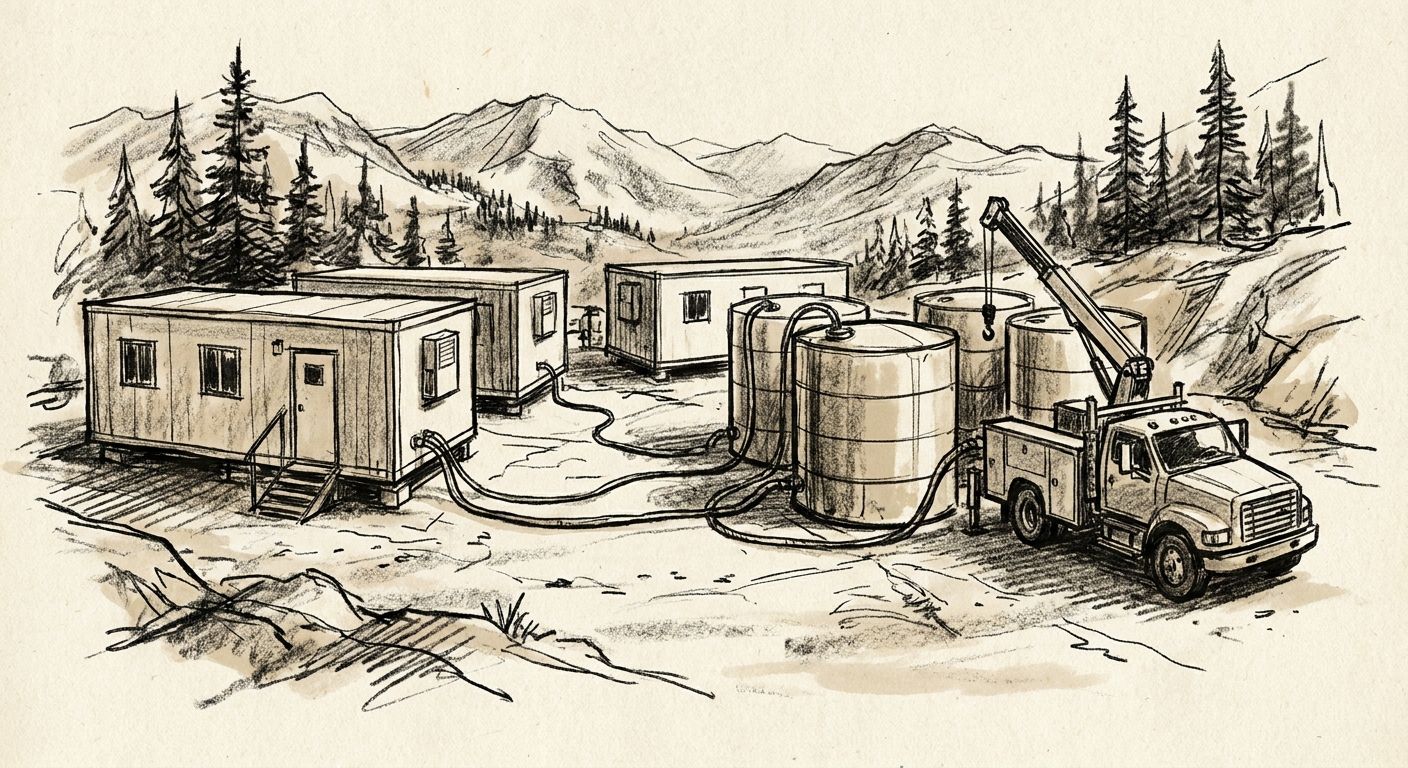
Holding tank rental for man camps and remote workforce housing keeps sewage contained at temporary crew housing sites that sit off municipal sewer lines, sized to headcount and pump-out interval so the camp doesn't go dark over a full tank. A construction camp, utility crew housing, or agricultural labor site runs on a different rhythm than a single job trailer: more people, longer stays, and roads a pump truck may only reach on a set schedule.
- Holding tank rental for man camps sizes to crew count and stay length, not just site square footage.
- Valley Services pairs holding tanks with restroom units for full sanitation coverage on remote sites.
- Winterizing and pump-truck access are the two failures that shut a camp down mid-job.
- Multi-month camps need a locked recurring pump-out schedule, not a call-when-full plan.
Why this matters
A remote crew housing site has no sewer hookup and often no easy return trip for a pump truck. If the holding tank runs out of capacity between scheduled services, restrooms go offline and the crew stops working, not because of the job, but because of sanitation logistics nobody planned for. Valley Services treats holding tank rental for man camps as a scheduling problem first and a plumbing problem second.
Why holding tank rental matters for man camps and remote workforce housing
Man camps and remote workforce housing sites run longer stays than a typical renovation job, often weeks to months, with crews rotating shifts around the clock. That changes the math on tank capacity: a 20-person crew on a 2-week stay needs a different pump-out cycle than a 50-person camp running six months.
Remote access adds a second variable most job sites don't deal with. A pump truck that can't get a level, straight approach to the tank valve on an unpaved road turns a routine service into a missed one, and a missed pump-out on a full tank means restrooms offline for the whole crew.
Size the holding tank to crew count and length of stay
Tank size for a man camp isn't a guess. It's a calculation built on headcount, shift pattern, and how many days pass between pump-outs.
- Match tank capacity to peak crew count during shift overlap, not average daily headcount
- Set pump-out frequency (weekly or biweekly) based on capacity and headcount together
- Add buffer capacity for stays over 30 days so a delayed pump-out doesn't overflow the tank
- Pair tank capacity with the number of restroom units on site, not just the tank alone
- Review how to choose the right holding tank size for a job site before locking in an order
Set a pump-out schedule before the crew arrives
A recurring schedule set before move-in beats a reactive call-when-full approach on a remote site.
- Lock a recurring pump-out date range tied to expected fill rate
- Build in a buffer day for weather or road delays on remote routes
- Confirm gate codes, lock combinations, and site contact for the pump truck driver
- Set a backup contact who can approve access if the site supervisor is off shift
Plan tank placement for access and freeze protection
Where the tank sits determines whether the pump truck can reach it on schedule.
- Place the tank on a level pad with a straight approach for the pump truck, not a tight turn around a trailer
- Keep distance from housing walkways and any site drainage path
- Confirm the unpaved road grade holds up under a loaded pump truck in wet weather
- Add insulation or heat protection on lines and valves for camps at elevation or in cold snaps
Pair holding tanks with restroom units for full sanitation coverage
A holding tank without enough restroom capacity just moves the bottleneck. Man camps need both sized to the same headcount.
- Set restroom-to-worker ratios based on total camp population, not just day-shift count
- Decide between standalone restroom units feeding one shared tank or combo units with tanks built in
- Add handwash stations near restroom clusters for crews working food-adjacent or medical-adjacent tasks
- Recheck the ratio any time headcount grows mid-project
Confirm site sanitation requirements before crews move in
Remote workforce housing still answers to the same sanitation rules as any job site, even without a city inspector nearby.
- Keep pump-out and service records on file for the length of the camp
- Post restroom and tank location signage where crews can find it in the dark
- Set restroom ratios that meet required minimums for the total headcount on site
- Review OSHA sanitation basics with your site supervisor before the first shift starts
Plan for cold weather and remote road access
Camps at elevation or in winter conditions lose service days to frozen lines more than any other single cause.
- Winterize tank valves and connecting lines before temperatures drop
- Confirm the pump truck route stays passable in snow or heavy rain
- Schedule a backup service window if the primary date falls through
- Check tank and restroom units for freeze damage at the start of each cold snap
Set up long-term service for multi-month camps
Longer camps run better on a locked service contract than a rolling series of one-off calls. Remote oil and gas field operations run this way for the same reason: a fixed schedule beats reactive dispatch when the site is hard to reach. See how that plays out on holding tank rental for oil and gas field operations for a comparable long-stay setup.
- Set a fixed monthly or biweekly pump-out cadence for the full camp duration
- Consolidate holding tank, restroom, and any temporary fencing under one service contract
- Build in a headcount-change clause so the schedule adjusts if crew size shifts
- Confirm 2026 site access rules haven't changed if the camp runs into a new season
Comparison: holding tank setups for man camps
| Option | Best for | Key limitation |
|---|---|---|
| Standalone holding tank feeding existing restrooms | Camps that already have restroom trailers and need added capacity | Needs a separate restroom fleet, more pieces to track on site |
| Holding tank and restroom combo units | Crews under roughly 20 with a simple, compact site layout | Fixed capacity, less flexible if headcount grows |
| Restroom trailer with built-in holding tank | Longer-stay man camps needing more comfort per unit | Needs a larger level pad and closer truck access |
| Multiple staged holding tanks across a wide camp | Camps of 50 or more spread over a large footprint | More pump-out stops to schedule and confirm each cycle |
The verdict: for any man camp running longer than 30 days, a locked recurring pump-out schedule paired with tanks sized to peak headcount beats a call-when-full setup every time.
Common mistakes man camps make with holding tank rental
- Sizing the tank to average headcount instead of peak shift-overlap headcount
- Skipping a winterization plan until the first freeze already knocked out a line
- Placing the tank without confirming the pump truck can actually reach it on an unpaved road
- Running restroom counts that don't match total camp population, only day-shift numbers
- Locking a pump-out schedule with zero buffer for weather or road delays
Set up your site services
Call to size holding tanks and restrooms for your crew.
FAQ
What is holding tank rental for man camps and remote workforce housing?
It's a sealed wastewater tank placed at a temporary crew housing site without sewer access, sized to headcount and pump-out interval. It keeps restrooms running through the length of the camp.
How big a holding tank do I need for a 50-person crew?
Size the tank to peak headcount during shift overlap, not the average daily count, and pair it with a pump-out schedule that matches that fill rate. A supervisor working through the sizing steps above will land on the right capacity for a specific stay length.
How often does a holding tank need pump-out at a remote camp?
Weekly or biweekly, depending on tank size and headcount. Longer stays over 30 days need a locked recurring schedule with a buffer day built in for weather or road delays.
Can holding tanks freeze in cold weather?
Yes, lines and valves can freeze at elevation or during cold snaps if they aren't insulated. Winterizing before the first freeze avoids losing restroom service mid-camp.
Do I need a holding tank if I already have restroom trailers?
Restroom trailers still need somewhere for wastewater to go if there's no sewer tie-in, so a holding tank feeding those units is standard for remote sites.
What access does a pump-out truck need at a remote site?
A level, straight approach to the tank valve, confirmed road grade for a loaded truck, and gate codes or contact info set before the scheduled date. A tight turn around a trailer corner is the most common access failure.
How long can a man camp holding tank stay in service?
As long as the camp runs, provided the pump-out schedule matches fill rate and the tank and lines are winterized for the season. Multi-month camps run this on a fixed recurring contract rather than one-off calls.
Is a combo restroom and holding tank unit better than separate units?
Combo units work for smaller crews under roughly 20 people on a compact site. Larger or growing camps do better with a standalone tank feeding multiple restroom units so capacity scales independently.
One last thing
The detail crews forget most often: the pump truck needs a straight, level shot to the tank valve, not a tight turn around a housing trailer. Confirm that access before delivery day, not after the truck already can't reach it. Call (408) 297-5404 or reach out through valleyservices.biz to talk through tank sizing and pump-out scheduling for your crew.