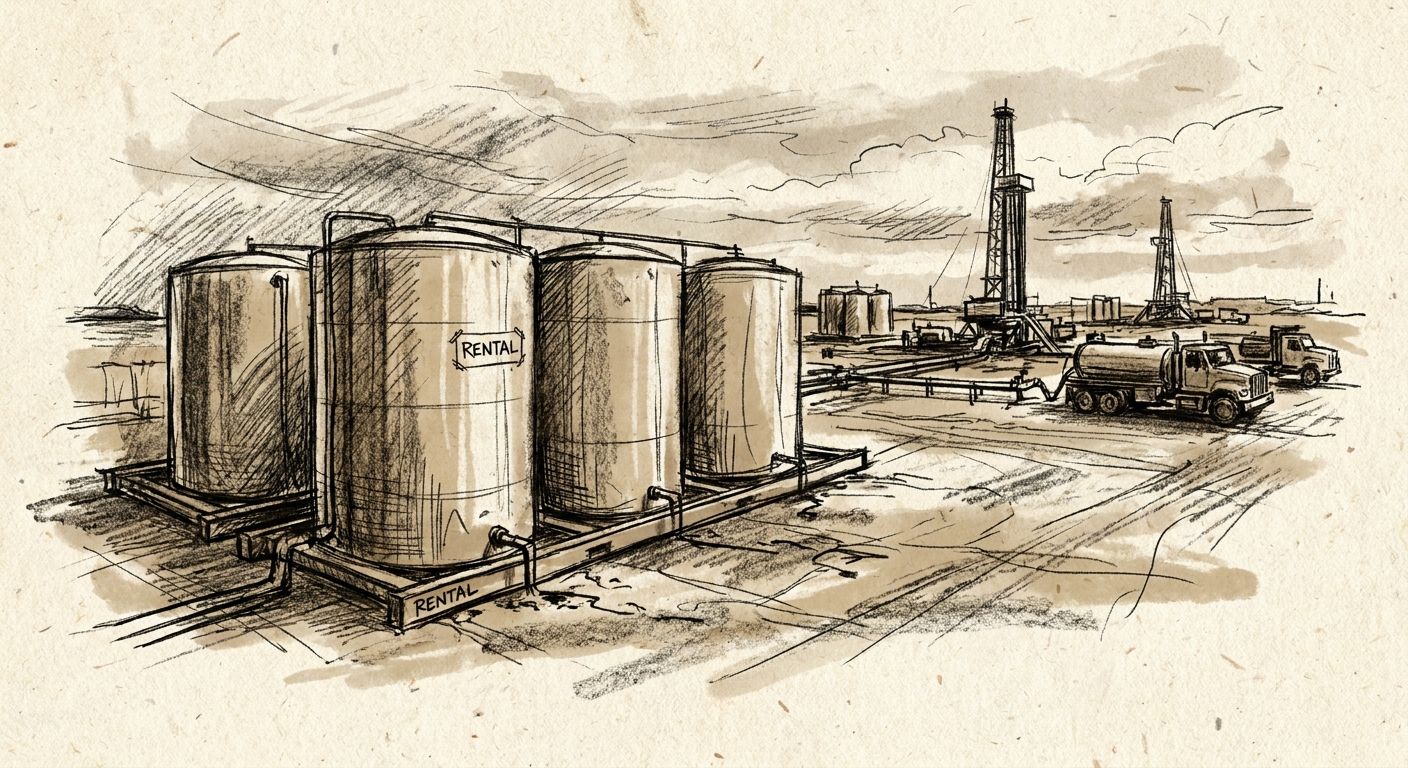
Field crews running oil and gas operations don't get a sewer line at a well pad, compressor station, or pipeline right-of-way. Every gallon of wastewater has to sit in a tank until someone pumps it out, and getting the tank size and schedule wrong stalls a crew faster than a broken pump. This guide covers what to check before you sign a holding tank rental agreement for an oil and gas field site in 2026.
- Match tank capacity to crew size and pump-out access before you sign, not after the truck can't reach the pad.
- Standard 400-500 gallon holding tanks work for small crews on short jobs. Buy.
- 1,000-gallon-class tanks cover multi-week well-pad work without daily pump-out trips. Buy.
- Winterized tank packages matter for any site running through freeze conditions. Consider before cold season, not during it.
- Makeshift plastic totes are not built for oilfield holding tank duty. Skip.
Why this matters on an oil and gas field site
A holding tank on a well pad isn't a convenience item. It's the only wastewater containment on a site with no municipal hookup, and if it overflows or freezes solid, the crew stops working until it's fixed.
Cal/OSHA requires accessible sanitation facilities on active work sites, and a holding tank is what keeps a restroom functional when there's no sewer connection for miles. Get the sizing or the pump-out schedule wrong and you're either paying for emergency service calls or shutting down a crew mid-shift.
Who needs holding tank rental for oil and gas field operations
This is for field supervisors, drilling contractors, pipeline crews, and compressor station operators managing remote sites with no sewer access. It's also for the site services coordinator juggling multiple crews across different well pads who needs one vendor handling tanks, restrooms, and fencing instead of three separate contracts.
Valley Services has run its own yard in San Jose since 1986, third generation, same family. That matters here because a holding tank rental on a multi-week field job depends on the same crew showing up for every pump-out, not a rotating cast of subcontractors.
What to look for in a holding tank for an oil and gas field site
Capacity vs. crew size and pump-out access
Match the tank to how many people are on site and how often a pump-out truck can reach the pad. A crew of six on a two-week job burns through a 400-gallon tank faster than most people expect, especially with washdown water added in.
If the site sits at the end of a long access road with limited truck turnaround windows, oversize the tank rather than schedule more frequent pump-outs. Read how to rent a holding tank for a construction project before you lock in a capacity, since the same sizing logic applies to any remote job.
Tank construction for well-pad conditions
Holding tanks on an oilfield site take a beating from uneven ground, vibration from nearby equipment, and constant vehicle traffic. A tank built for a suburban backyard job isn't rated for that.
Look for a unit designed for repeated relocation and rough terrain, not a tank that cracks the first time a forklift clips the corner.
Winterization and freeze protection
A holding tank that freezes solid stops working exactly like a frozen sewer line. Field sites at elevation or in colder counties need a winterized setup before the first hard freeze, not after a crew finds ice in the tank on a Monday morning.
Insulated or heated tank packages cost more to set up but avoid a shutdown that costs an entire shift.
Placement and ground stability on unpaved pads
A well pad is rarely flat, graded, and paved. Tank placement on soft or sloped ground risks tipping or uneven settling that stresses the tank shell over a multi-week job.
Walk the pad before delivery and flag any spot that pools water after rain. That's where a tank sinks first.
Pump-out scheduling and route access
A holding tank is only as good as the truck that empties it. Confirm the access road width, turnaround space, and any locked-gate procedures before the first delivery, not on the day the pump-out truck gets turned away.
Multi-week jobs need a standing pump-out schedule, not a call-when-full arrangement that leaves the tank guessing.
Talk through your field site setup
Call to plan holding tank sizing, pump-out routing, and restroom pairing for your job.
Top picks for oil and gas field holding tanks
The workhorse pick: standard single-crew holding tank. A tank in the 400- to 500-gallon capacity class covers a crew of four to six on a job running one to two weeks with regular pump-out access. It's the default choice for most short-duration well work. Buy.
The long-haul pick: high-capacity multi-week tank. For jobs running three weeks or more, or sites where the pump-out truck can only reach the pad every seven to ten days, a tank in the 1,000-gallon class avoids constant refill calls. Buy if the job outlasts a single month.
The cold-weather pick: winterized tank package. Insulated or heated holding tanks matter on any site running through freeze conditions, especially at elevation. Set this up before the season changes. Consider for any job spanning a winter window; skip it for summer-only work.
The full setup: paired restroom and holding tank. Most field crews need both a restroom and a tank sized to match it, and running them as one order avoids a mismatch between restroom output and tank capacity. Check portable restroom rental for oil and gas field sites for how the pairing works. Buy for any crew of four or more on a multi-day job.
The one to skip: makeshift plastic tote tanks. Repurposed IBC totes or agricultural totes aren't built for the vibration, temperature swings, and repeated relocation an oilfield site demands. They crack, they leak at the fittings, and they void any liability protection a proper holding tank rental carries. Skip.
What to avoid
- Undersizing to save on delivery fees. A tank that runs out mid-week costs more in emergency pump-out calls than starting one size up.
- Skipping the winterization conversation until it's already cold. Retrofitting a tank for freeze protection mid-job is slower and more disruptive than planning it before delivery. Review winterizing a holding tank rental before the season turns.
- Assuming any pump-out vendor works the same route as your rental company. A tank and a pump-out schedule managed by two different companies creates gaps when one side doesn't know the other's timeline.
Verdict comparison
| Tank Option | Capacity Class | Best For | Verdict |
|---|---|---|---|
| Standard single-crew tank | 400-500 gallon class | Crews of 4-6, jobs under 2 weeks | Buy |
| High-capacity multi-week tank | 1,000 gallon class | Jobs running 3+ weeks, limited access | Buy |
| Winterized tank package | 400-1,000 gallon, insulated | Cold-season or elevation sites | Consider |
| Paired restroom + tank setup | Sized to crew | Full-crew sanitation compliance | Buy |
| Makeshift plastic tote | Non-standard | Any oilfield job | Skip |
FAQ
What size holding tank do I need for an oil and gas field site?
Most crews of four to six on a job under two weeks fit a tank in the 400- to 500-gallon class. Jobs running three weeks or longer, or sites with limited pump-out access, need a 1,000-gallon-class unit instead.
How often does a holding tank need to be pumped out on a remote well pad?
Pump-out frequency depends on crew size, tank capacity, and how many restrooms tie into the tank. A standing weekly or biweekly schedule works for most multi-week jobs rather than a call-when-full arrangement.
Can a holding tank freeze in winter on a job site?
Yes, a standard holding tank can freeze solid in cold conditions, especially at elevation. A winterized or insulated tank package prevents this, and it should be arranged before the freeze season starts, not after.
Is a holding tank required by Cal/OSHA on an oil and gas field site?
Cal/OSHA requires accessible sanitation facilities on active work sites, and a holding tank is what makes a restroom functional where there's no sewer hookup. Confirm current requirements for your specific site conditions.
What's the difference between a holding tank and a septic tank rental?
A holding tank stores wastewater until it's pumped out and hauled away. A septic system treats and disperses wastewater on site. Remote field sites almost always use holding tanks since there's no permanent leach field.
Do I need a separate restroom if I rent a holding tank?
Yes, a holding tank and a portable restroom are typically two separate units that connect together. Ordering them as a paired setup avoids a mismatch between restroom output and tank capacity.
How much ground clearance does a holding tank rental need on an unpaved pad?
The tank needs level, stable ground that doesn't pool water after rain, plus enough clearance for the pump-out truck to access it directly. Soft or sloped spots risk tipping over a multi-week job.
How far in advance should I schedule a holding tank rental for a field site?
Book as soon as the job schedule is set, especially for multi-week jobs or winter work that needs a winterized tank package. Same-week requests are harder to fill once a crew is already mobilized.
One last thing
A holding tank rental on a multi-week field job depends less on the tank itself and more on who shows up to pump it out, week after week. Valley Services has run the same yard at 1611 S 7th St in San Jose since 1986, third generation, same family, which is the kind of continuity that keeps a pump-out schedule from slipping on week four of a well-pad job in 2026.
Call (408) 297-5404 or reach out through valleyservices.biz to talk through tank sizing, restroom pairing, and pump-out scheduling for your site.