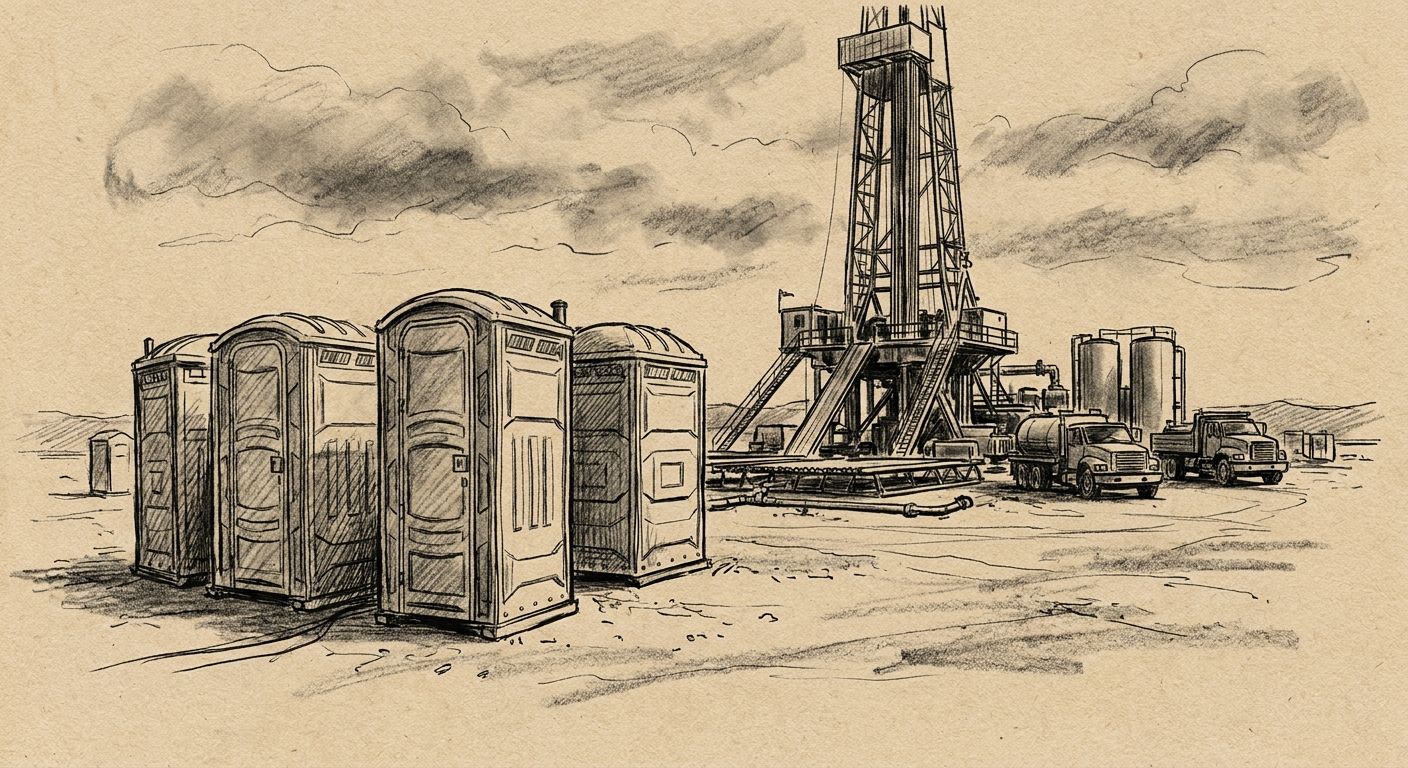
Oil and gas field crews work in places with no water main, no sewer line, and sometimes no cell signal for ten miles, which turns restroom planning into a logistics problem as much as a compliance one.
- Holding tank restroom units win portable toilet rental for oil and gas sites with no water hookup: Buy for pads running longer than two weeks between service.
- ADA-compliant units are required whenever inspectors or mixed crews rotate through a pad: Buy for any multi-crew site.
- Standard single units fail on remote pads without paved, all-weather access roads: Skip unless the service truck can reach the unit year-round.
- Monthly service contracts beat one-off weekly rentals once a drilling or pipeline program runs past 30 days: Buy for extended programs.
Why this matters
OSHA's construction sanitation standard, 29 CFR 1926.51, sets hard numbers: one facility for 20 or fewer workers, one per 40 workers when the crew runs 20 to 249, and one per 50 plus an additional unit per 40 once you pass 250. A well pad or pipeline right-of-way that scales from a 6-person survey crew to a 40-person completions crew inside a month can blow past its original unit count fast, and an inspector doesn't care that the site is 40 miles from the nearest paved road.
Remote sites add a second layer most job-site guides skip: access. A standard portable restroom needs a pump-out truck reachable on a normal service cycle, usually every 5 to 7 days. A well pad on a dirt lease road that turns to mud in winter or a pipeline corridor crossing agricultural ditches doesn't always get that truck through on schedule. That's a site-planning problem, not just a rental order.
Who this is for
This guide is for site supervisors and HSE coordinators on exploration and production sites, pipeline construction foremen managing right-of-way crews, and land services companies coordinating multi-well pad programs where crew size and site access change week to week. If your project sits within the South Bay service footprint, Valley Services applies the same holding tank and OSHA-compliant setups it runs for agricultural operations and remote construction sites without water or sewer access, and a call to (408) 297-5404 gets unit counts and service intervals worked out before mobilization.
What to look for in portable toilet rental for oil and gas sites
Water and sewer access at the pad
If the site has no water line and no sewer tie-in, a standard flush-style unit is off the table and a self-contained holding tank restroom becomes the default. Get this wrong and you're either scheduling emergency pump-outs mid-shift or shutting down a crew for a sanitation violation.
OSHA sanitation ratios
29 CFR 1926.51 sets the unit-per-worker math described above. Crew counts on drilling and completions programs swing fast between mobilization, active operations, and demobilization, so the unit count needs to track headcount at peak, not average.
Access road and terrain
A pump-out truck needs a clear path to every unit on every service visit. Gravel lease roads, seasonal mud, and locked gates all change how often a unit can realistically be serviced, which pushes remote pads toward higher-capacity tanks over standard units.
Temperature extremes
Units sitting on an exposed pad through a summer heat spike or a hard winter freeze need different handling than a unit tucked next to a job trailer. Freeze protection and ventilation both matter more on an exposed site than in town.
Service interval versus tank capacity
A standard unit built for weekly service will overflow fast on a site that can only get serviced every two or three weeks. Match tank capacity to the realistic service interval, not the other way around.
Contract length and crew fluctuation
A 10-day workover job and a 9-month drilling program need different contract structures. Locking into a short-term rental for a long program means renegotiating terms every month; locking into a long-term contract for a 10-day job means paying for capacity you don't use.
Top picks for oil and gas field sites
Standard portable restroom unit is the baseline. One occupant, hand sanitizer dispenser built in, sized for the 5 to 7 day service cycle most metro job sites run on. It works fine for short-duration well tie-in work when the access road is paved or graded and a truck can reach it every week without fail. Verdict: Buy for short jobs under 30 days with reliable access. Skip for anything past that or on a site with seasonal road conditions.
ADA-compliant restroom rental is the compliance requirement, not the upgrade. Wider door, interior turning space, and grab bars matter the moment an inspector shows up or a mixed-gender crew rotates onto the pad, and retrofitting a standard unit after the fact isn't an option. Details on unit specs and placement sit in this ADA-compliant restroom rental guide. Verdict: Buy for any pad running more than a handful of workers or expecting a site visit from a regulator.
Holding tank restroom system is the remote-site workhorse. Larger waste capacity stretches the gap between service visits from a week to two or three, which is the difference between a workable schedule and a truck fighting mud twice a month. The same setup used on agricultural operations without water hookups applies directly here, covered in this holding tank rental for agricultural operations breakdown. Verdict: Buy for any pad without water or sewer access and a service interval past 7 days.
Hand-wash station is the line item crews cut first and shouldn't. 1926.51 treats hand-washing facilities as a separate requirement from restroom units whenever workers handle chemicals, fuel, or drilling additives, which describes most oil and gas field work. Verdict: Buy anytime the crew is handling anything beyond hand tools.
Plan Restrooms for a Remote Site
Same family-run yard since 1986. One call covers units, tanks, and service schedules.
What to avoid
- Standard units on unpaved lease roads that flood in winter. The truck can't reach the unit, service gets skipped, and the crew is stuck with an overflow situation on a working pad.
- Guessing at unit count instead of running the OSHA math. A pad that grows from 15 workers to 45 during completions needs more than one added unit; run 1926.51's ratio at peak headcount, not day-one headcount.
- Weekly service schedules on sites that can only be reached every two or three weeks. Match the tank to the interval you can actually deliver, not the interval you'd prefer.
Verdict comparison
| Unit type | Best for | Service interval | Verdict |
|---|---|---|---|
| Standard restroom | Short jobs, paved access | 5-7 days | Buy for jobs under 30 days |
| ADA-compliant unit | Mixed crews, inspections | 5-7 days | Buy whenever inspectors or mixed crews rotate through |
| Holding tank system | No water/sewer, remote pads | 14-21 days | Buy for long service gaps |
| Hand-wash station | Chemical or fuel handling | Paired with restroom service | Buy whenever chemicals are on site |
FAQ
What's the best portable toilet rental for oil and gas field sites?
A holding tank restroom system is the best fit for most oil and gas field sites because it stretches the service interval to 14-21 days on pads without water or sewer access. Standard units still work on shorter jobs with reliable, paved access roads.
How many portable restrooms does OSHA require on a well pad?
29 CFR 1926.51 requires one unit for 20 or fewer workers, one per 40 workers for crews of 20-249, and one per 50 plus an additional unit per 40 above 250. Run this math at peak crew size, since drilling and completions crews scale up fast.
Can portable restrooms freeze in winter on a remote site?
Yes, units exposed on an open pad through a hard freeze need freeze protection that an in-town job site unit usually doesn't require. Ask about winter setup before placing units on an exposed pad in 2026.
How often do holding tank restrooms need to be pumped on a job site?
Holding tank units typically stretch service intervals to 14-21 days depending on crew size and tank capacity, compared to 5-7 days for standard units. Match tank size to the interval the site's access road can actually support.
Are ADA-compliant portable restrooms required on oil and gas sites?
An ADA-compliant unit is required whenever a site expects a regulatory inspection or runs a mixed-gender crew. Standard units don't meet the door width and interior turning space requirements ADA units are built for.
What happens if a portable restroom isn't serviced on schedule?
A missed service visit on an overloaded unit leads to overflow and a sanitation violation risk under 1926.51. Sites with unreliable road access should size up to a holding tank instead of pushing a standard unit's service interval.
Is a monthly service contract better than a short-term rental for a drilling program?
Monthly contracts fit better once a program runs past 30 days because they lock in a consistent service schedule instead of renegotiating terms every week. Short-term rentals make more sense for jobs under a month.
Do hand-wash stations count separately from restroom units under OSHA?
Yes, 1926.51 treats hand-washing facilities as a distinct requirement from restroom units whenever workers handle chemicals, fuel, or similar materials. Most oil and gas field work falls under that requirement.
One last thing
Crews budget for the restroom unit and forget the hand-wash station, even though 1926.51 lists it as a separate requirement the moment chemicals or fuel are on site in 2026. That's the line item that gets flagged on an inspection more often than unit count.
Valley Services has run the same yard in San Jose since 1986, third generation, one family. For sites within the South Bay service area needing restroom units, holding tanks, or a longer service contract worked out before a program starts, call (408) 297-5404 or reach out through valleyservices.biz.