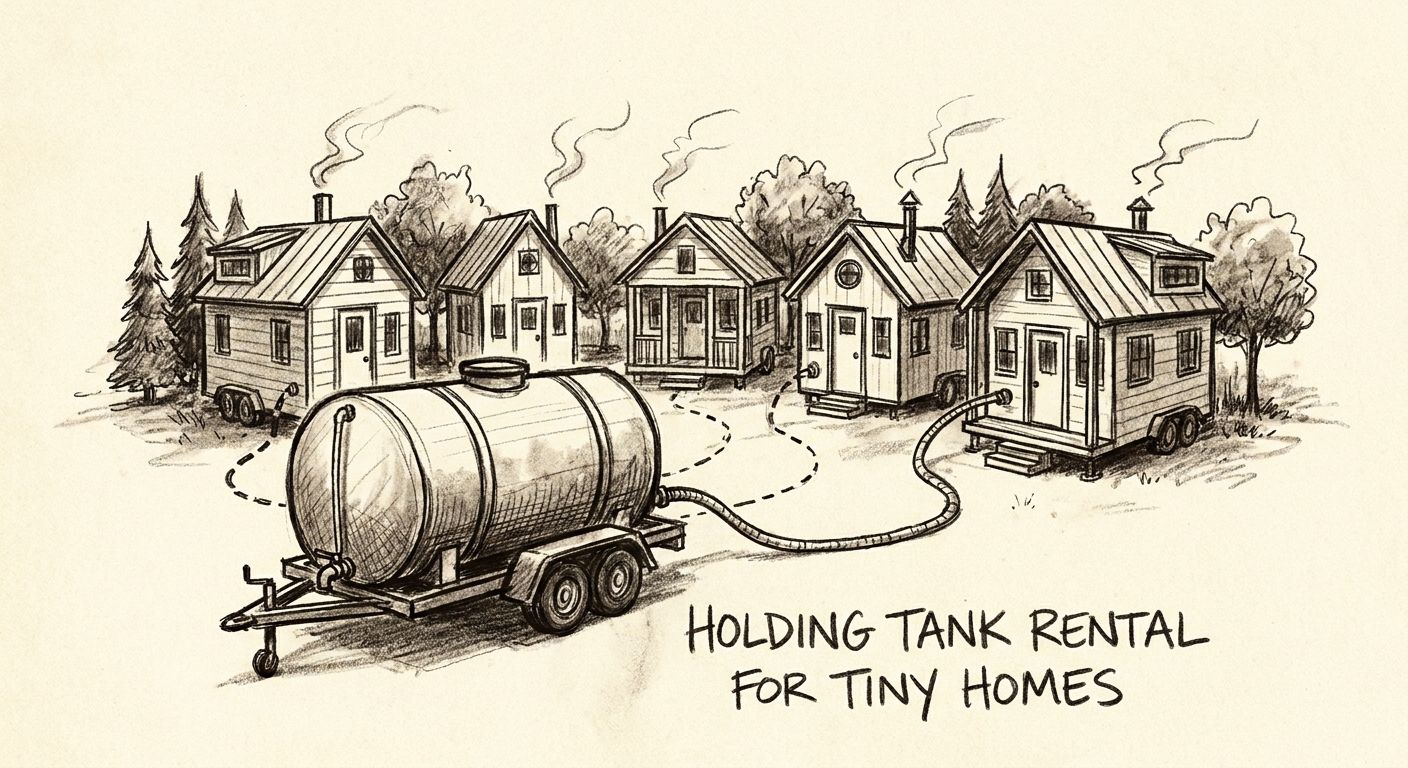
Tiny home communities in the South Bay run for months without a sewer tap while permits catch up, and the holding tank you choose during that stretch decides whether pump-out day is routine or a scramble. Holding tank rental for tiny homes has to match resident count, not lot count, and it has to survive a Bay Area winter without freezing solid.
- A 750-gallon holding tank covers a 10-to-15-unit tiny home cluster on a weekly pump-out. Buy for mid-size South Bay communities.
- Under 10 units, a 300-gallon tank on a weekly schedule handles the load without paying for capacity nobody uses.
- Communities over 30 units need two or three 1000-to-1500-gallon tanks staged on a rotation, not one oversized tank. Consider it.
- Full-time residency roughly doubles pump-out frequency compared to weekend-use lots of the same size. Plan around 2026 occupancy, not the 2024 site plan.
- Skip single-tank setups with no containment on sloped South Bay parcels. That's the fastest route to a spill and a stop-work order.
Why this matters
A tiny home community isn't a single-family lot and it isn't a construction site either. It's occupied full time, often by residents who work from home, which means water use doesn't stop at 5 p.m. the way it does on a job site.
Undersize the tank and you get overflow calls on Sunday night when the pump truck doesn't run. Oversize it and you're paying for capacity that sits half empty between services. Get the sizing wrong on a 20-unit development in 2026 and the property manager fields complaints for the life of the permit review.
The fix is matching tank size and pump-out frequency to actual resident count, not the number the site plan assumed before people moved in.
Who this is for
This guide is for developers and property managers running tiny home communities, accessory dwelling unit clusters, or transitional housing pods anywhere in San Jose, Santa Clara, Sunnyvale, Mountain View, or Milpitas that don't have a sewer connection yet. It's also for anyone managing a phased build-out where units come online in batches over several months rather than all at once. If your community has permanent sewer service already, you don't need this. If it doesn't, and won't for a while, the tank you pick now is the one you'll live with through at least one winter. Valley Services runs holding tank rentals across the South Bay alongside restrooms and fencing, which matters once you start stacking site services on the same lot.
What to look for in holding tank rental for tiny homes
Resident count and daily wastewater load
Size the tank to the number of people living on site full time, not the number of lots. A four-person household generates meaningfully more daily volume than a single-occupant unit, and tiny home communities mix both. Count heads, not doors, before you pick a tank.
Pump-out frequency and truck access
A tank that's the right size on paper still fails if the pump truck can't reach it. Confirm the access route for a full-size vacuum truck before the tank goes in, especially on infill lots with tight driveways common in Santa Clara and Sunnyvale. Weekly service is standard for occupied communities; twice weekly kicks in once resident count climbs past what a single 750-gallon tank can hold for seven days.
Placement and containment on sloped or paved sites
South Bay hillside parcels and paved infill lots both create placement problems. A tank set on an unlevel pad drains unevenly and can overflow on one side well before it reads full. Confirm the pad is level and has containment before residents move in, not after the first pump-out reveals a problem.
Winterization for inland and elevation sites
Bay Area winters are mild at sea level but inland and elevated South Bay sites see nights near or below 32°F. A tank and its lines need insulation or heat trace before the first hard freeze, not after a line splits. Winterizing a holding tank rental covers what that prep actually involves.
Pairing with a potable water tank
Residents need clean water in and a place for wastewater to go. Running both from the same provider means one delivery schedule, one point of contact, and no gap between the two services. A potable water tank rental paired with the holding tank keeps both on the same truck route.
Contract flexibility for phased build-out
Most tiny home communities don't open at full capacity on day one. Units come online in batches over several months, sometimes over more than a year. A contract that lets you step up tank size or add a second unit as occupancy grows beats locking into one configuration for the full build-out.
Top tank configurations for tiny home communities
Small pod, under 10 units. The starter setup. A single 300-gallon tank on a weekly pump-out covers a small cluster without paying for capacity that sits unused. This works for pilot communities and early-phase developments where occupancy is still climbing toward 10 units. Verdict: Buy.
Mid-size community, 10 to 30 units. The workhorse. A 750-gallon tank on a weekly to twice-weekly schedule, paired with a potable water tank on the same delivery route, is the configuration most South Bay tiny home communities land on once they're past the pilot phase. Reviewing how to rent a holding tank for a construction project covers the same sizing math even though that guide is written for job sites, not residential clusters. Verdict: Buy.
Large phased development, 30-plus units. The rotation play. One tank can't keep up here. Two or three 1000-to-1500-gallon tanks staged around the property, pumped on a staggered twice-weekly rotation, prevent any single tank from running past capacity between services. This costs more coordination than a single tank but avoids the overflow risk that comes with undersizing a large occupied community. Verdict: Consider.
Seasonal or temporary tiny home cluster, under 90 days. The short-term fix. For pop-up or transitional housing that's only on site for a season, a single 300-gallon tank on a twice-weekly schedule handles the load without the overhead of a larger rotation. This isn't a fit for anything expected to run past a few months. Verdict: Consider.
One tank for a 40-unit site. The corner cut. Stretching a single tank, even a 1500-gallon unit, across 40 occupied units on a weekly schedule looks like savings on paper and fails in practice. The math doesn't hold once full-time residency is factored in, and the first overflow costs more in cleanup and resident complaints than the second tank would have. Verdict: Skip.
What to avoid
- Sizing by lot count instead of resident count. A community with 20 lots and 45 residents needs the tank sized for 45 people, not 20 units.
- Skipping the containment check on sloped ground. A tank that looks fine on a flat rendering can sit at a real grade once it's delivered to a South Bay hillside parcel.
- Treating weekend-occupancy math as full-time math. A lot planned around weekend use and the same lot occupied 24/7 need very different pump-out schedules, even at the same headcount.
Verdict comparison
| Community Size | Tank Configuration | Pump-Out Frequency | Verdict |
|---|---|---|---|
| Under 10 units | One 300-gal tank | Weekly | Buy |
| 10-30 units | One 750-gal tank | Weekly to twice weekly | Buy |
| 30+ units, phased | Two to three 1000-1500 gal tanks | Twice weekly, staggered | Consider |
| Under 90 days, seasonal | One 300-gal tank | Twice weekly | Consider |
| 40+ units, single tank | One tank stretched past capacity | Attempted weekly, frequently fails | Skip |
Talk through your tank sizing
Call to size holding tanks and water tanks for your community before occupancy climbs.
FAQ
What size holding tank does a tiny home community need?
Size depends on resident count, not lot count. Communities under 10 units typically run on a single 300-gallon tank, 10-to-30-unit communities move to a 750-gallon tank, and developments over 30 units need two or three tanks in the 1000-to-1500-gallon range staged on a rotation.
How often does a holding tank need pump-out service for a tiny home community?
Weekly service covers most occupied communities under 30 units. Larger communities or full-time residency at high density often need twice-weekly service to stay ahead of overflow.
Is a holding tank different from a septic system for tiny homes?
Yes. A septic system treats and disperses wastewater on site permanently, while a holding tank stores wastewater until a pump truck removes it. Tiny home communities without a sewer connection use holding tanks as an interim or long-term solution depending on the permit timeline.
Can one holding tank serve a whole tiny home community?
Only for small clusters under about 10 units. Beyond that, stretching a single tank across a larger occupied community leads to overflow between pump-outs, which is why larger developments run multiple tanks on a staggered schedule.
Does a tiny home community need a separate potable water tank?
Yes, if the site doesn't have a water connection. A potable water tank supplies clean water in while the holding tank manages wastewater out, and running both on the same delivery schedule keeps the logistics simple.
What does holding tank rental cost for a tiny home community?
Cost depends on tank size, pump-out frequency, and how many tanks the community needs. Contact a provider directly with your resident count and site access details for an accurate figure.
What happens if a holding tank freezes at a tiny home site?
A frozen tank or line stops pump-out service and risks a cracked line once temperatures rise. Inland and elevated South Bay sites that see nights near 32°F need insulation or heat trace installed before the first freeze, not after.
Is holding tank rental legal for permanent tiny home communities in California?
Holding tanks are commonly used as an interim solution while permanent sewer connections or septic systems go through permitting, but requirements vary by jurisdiction. Check with your local building department for how long a holding tank setup is allowed to run before a permanent connection is required.
One last thing
The number that trips up most tiny home community managers isn't tank size, it's occupancy type. A lot sized and permitted as weekend or transitional housing and the same lot occupied full time by the same headcount need noticeably different pump-out schedules, because full-time residents generate wastewater every day of the week instead of two or three. Size the schedule for how the community actually lives in 2026, not how the original site plan assumed it would be used.
For sizing help on a specific unit count and site layout, call Valley Services at (408) 297-5404 or reach out through valleyservices.biz.