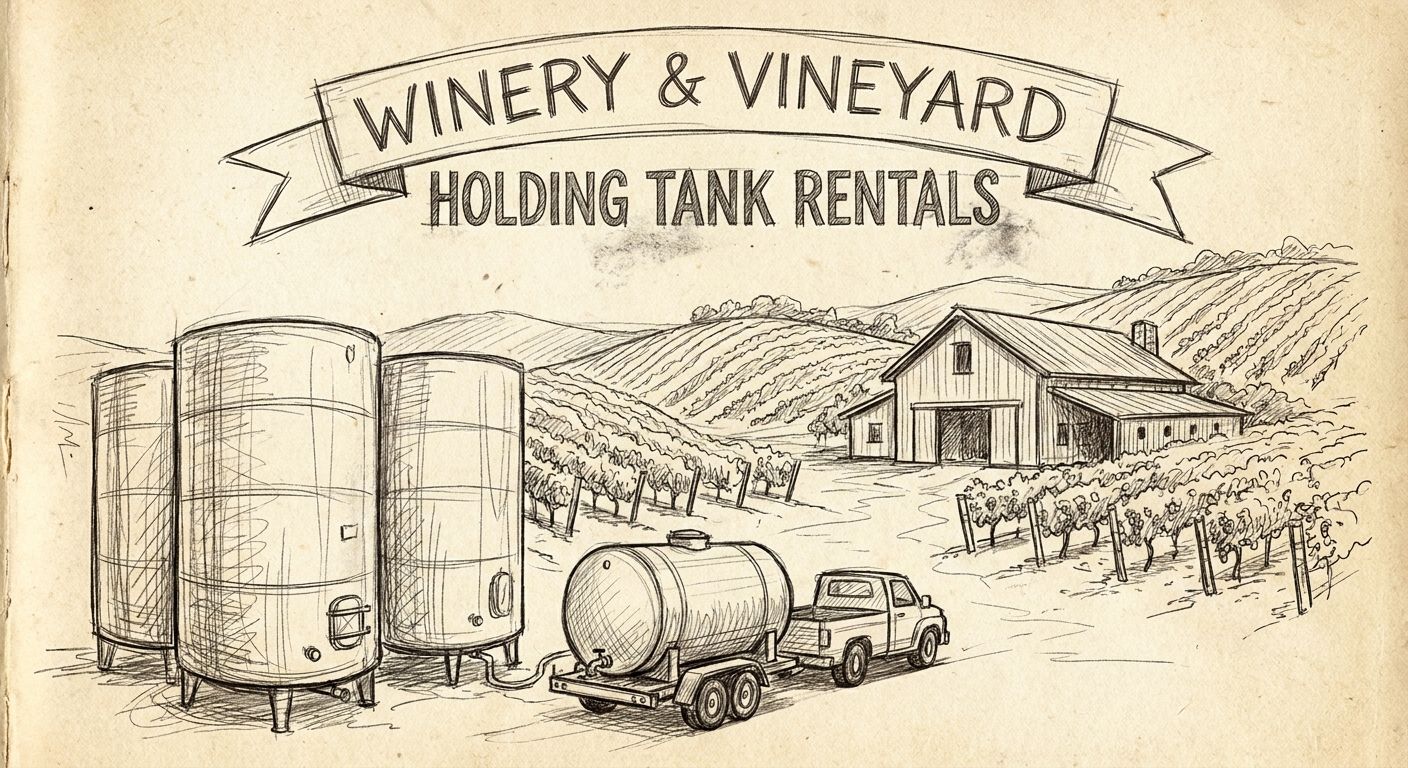
Crush season turns a quiet vineyard into a work site overnight, and most rural wine properties do not have the septic capacity or restroom count to handle it. A holding tank rental for wineries covers crush pad wash water, crew sanitation, and event-weekend overflow without gambling on a septic system built for a tasting room, not a harvest crew.
- Holding tank rental for wineries pairs waste capacity with crush pad wash water; standalone poly tanks in the 250 to 1,000 gallon range are the standard: Buy for the 2026 harvest.
- Field crew restroom pairing meets the Cal/OSHA field sanitation ratio of one restroom per 20 outdoor agricultural workers: Buy.
- A handwash station add-on covers food-contact wash-down for tasting rooms and certified kitchens: Consider.
- Relying on an existing septic system for crush season surge volume is the most common mistake: Skip it from August through October.
Why this matters
A vineyard septic system is sized for a tasting room bathroom and maybe a small production crew, not for a 40-person crush crew running twelve-hour shifts for six weeks straight. Push crush pad wash water and restroom waste through that system in September and you get backups, odor complaints from neighbors, and a shutdown at the worst possible time in the harvest calendar.
County health departments and Cal/OSHA both have requirements that apply the moment you bring on seasonal labor or host a public event on ag land. A holding tank rental for agricultural operations gives you a documented, separate system for wastewater that does not touch your septic drain field, and it scales up or down as crush volume changes week to week.
Who this is for
This guide is for vineyard managers and winery owners in the South Bay and greater Bay Area running crush operations, harvest labor crews, or public events on a property without municipal sewer access. It also applies to tasting rooms adding a fall event series, U-pick weekends, or a harvest dinner series that pushes guest counts past what the existing restroom count can handle. If your winery sits inside San Jose, Santa Clara, Sunnyvale, Mountain View, Milpitas, or the surrounding valley, Valley Services runs holding tank rental for wineries in that footprint.
What to look for in holding tank rental for wineries
Capacity matched to crush volume and crew size
A standalone waste holding tank for a vineyard operation typically runs in the 250 to 1,000 gallon range, and the right size depends on crew headcount and how many days pass between pump-outs. A five-person production crew running a small crush pad needs far less capacity than a 40-person harvest crew working double shifts during peak fruit intake.
Placement access for gravity flow and vineyard terrain
Hillside vineyards and unpaved crush pads change where a tank can sit and how a pump truck reaches it. A tank placed at the bottom of a slope with no truck access at pump-out time is a tank that does not get emptied on schedule, so placement gets decided before delivery, not after.
Pump-out frequency around crush shifts
Crush season runs long hours with no natural break in the schedule, so pump-out timing has to work around active crush pad operations, not the other way around. A tank that needs servicing mid-shift creates a bottleneck at the exact moment fruit is coming in.
Cal/OSHA field sanitation compliance
Cal/OSHA's field sanitation standard requires one restroom facility for every 20 outdoor agricultural workers, located within a reasonable distance of the work area. A harvest crew of 40 pickers needs at least two restroom units on-site, paired with a holding tank sized for that count, and this is not optional once seasonal labor is on the property.
Freshwater pairing for wash-down and handwashing
Crush pad sanitation and food-contact surfaces need clean water, not just waste capacity. A hand wash station rental paired with the holding tank covers handwashing compliance for crews working fruit intake and sorting tables without running a hose from a well pump that was never designed for that draw.
Top picks for winery and vineyard operations
The crush pad workhorse
A standalone holding tank rental sized for the crush pad handles wash water from destemmer and press cleanup, kept entirely separate from restroom waste. The holding tank rental for agricultural operations covers this exact use case, with tank sizes running 250 to 1,000 gallons depending on daily crush volume. Verdict: Buy for any operation crushing fruit on-site in 2026.
The field crew standard
Pairing restroom units with a dedicated holding tank meets the Cal/OSHA ratio of one restroom per 20 outdoor workers, which matters the moment a harvest crew larger than 20 sets foot on the property. The portable toilet rental for agricultural and farm labor sites page covers unit counts and placement for exactly this labor pattern. Verdict: Buy for any crew over 20 workers.
The food-safety add-on
A handwash station rental adds compliant handwashing at the sorting table and crush pad without drawing down a well system built for irrigation, not repeated handwashing cycles. The hand wash station rental for construction sites unit works the same way on a vineyard crush pad as it does on a job site. Verdict: Consider for operations running food-contact sorting or a certified kitchen.
The tasting room upgrade
For wineries adding a fall event series or harvest dinners on top of daily crush operations, a second holding tank keeps event guest sanitation separate from crew sanitation so neither system gets overloaded on a busy Saturday. Verdict: Consider if event weekends overlap with active crush.
The off-season option
Running a full crush-season holding tank setup through the winter dormancy months, when the crew is down to a handful of people and the crush pad is idle, is more capacity than most properties need. Verdict: Skip the full setup from November through February and scale back to a single unit.
What to avoid
- Assuming the existing septic system can absorb crush surge volume. A septic system sized for a tasting room bathroom was never built for six weeks of daily wash-down water and a 40-person crew, and pushing it during peak crush is how backups happen in front of visitors.
- Mixing crush pad wash water with restroom waste in a single tank. These are different waste streams with different handling requirements, and combining them complicates pump-out and can trigger compliance issues with the county.
- Locking in one tank size for the full season. Crush volume in September looks nothing like crush volume in early August, and a tank sized for the slow ramp-up runs short once fruit intake peaks.
Verdict comparison table
| Configuration | Best for | Season | Verdict |
|---|---|---|---|
| Standalone crush pad tank | Wash water separation | Aug-Oct | Buy |
| Restroom + holding tank pairing | Crews over 20 workers | Aug-Oct | Buy |
| Handwash station add-on | Food-contact sorting tables | Aug-Oct | Consider |
| Tasting room event tank | Overlapping event weekends | Aug-Oct | Consider |
| Full setup during dormancy | Idle crush pad, small crew | Nov-Feb | Skip |
Book tank sizing before crush starts
Talk through capacity, placement, and crew count for the 2026 harvest.
FAQ
What is a holding tank rental for a winery used for?
A holding tank rental for a winery holds crush pad wash water and crew wastewater separate from an on-site septic system. It keeps a septic drain field built for tasting room use from getting overloaded during the six-week crush window.
How many restrooms do I need for a crush season crew?
Cal/OSHA's field sanitation standard requires one restroom for every 20 outdoor agricultural workers. A 40-person harvest crew needs at least two restroom units paired with a holding tank sized for that count.
Can a holding tank handle crush pad wash water and restroom waste together?
No. Crush pad wash water and restroom waste are different waste streams and should run through separate tanks. Mixing them complicates pump-out scheduling and can create compliance issues with the county.
How far in advance should a winery book a holding tank rental for 2026 crush?
Book before the ramp-up in early August, since crush season demand across the Bay Area peaks between August and October 2026. Waiting until fruit intake starts limits which tank sizes and pump-out windows are still open.
Does Valley Services serve vineyards outside San Jose?
Valley Services covers San Jose, Santa Clara, Sunnyvale, Mountain View, Milpitas, and the surrounding Bay Area. Call (408) 297-5404 to confirm coverage for a specific vineyard address.
What size holding tank does a small vineyard need?
Standard holding tank sizes run 250 to 1,000 gallons, and a small crush operation with a five-person crew usually sits at the lower end of that range. Crew size and days between pump-outs are the two factors that determine the right size.
Do I need a holding tank if my winery already has a septic system?
Yes, if crush season adds crew headcount or wash-down volume beyond what the septic system was designed for. Most vineyard septic systems are sized for tasting room use, not a seasonal harvest crew running twelve-hour shifts.
How often does a holding tank need to be pumped during crush season?
Pump-out frequency depends on crew size, tank capacity, and daily wash-down volume, and it should be scheduled around active crush shifts rather than fixed calendar dates. Coordinating pump-out timing with crush pad downtime avoids mid-shift bottlenecks.
One last thing
The detail most vineyard managers miss is tank placement relative to pump truck access, not tank size. A correctly sized holding tank parked at the bottom of a hillside block with no truck route in is a tank that misses its pump-out window during the exact week fruit intake peaks, so walk the access route before delivery day, not after.
Working through tank sizing, restroom counts, or placement for the 2026 crush season: call Valley Services at (408) 297-5404 or reach out through valleyservices.biz.