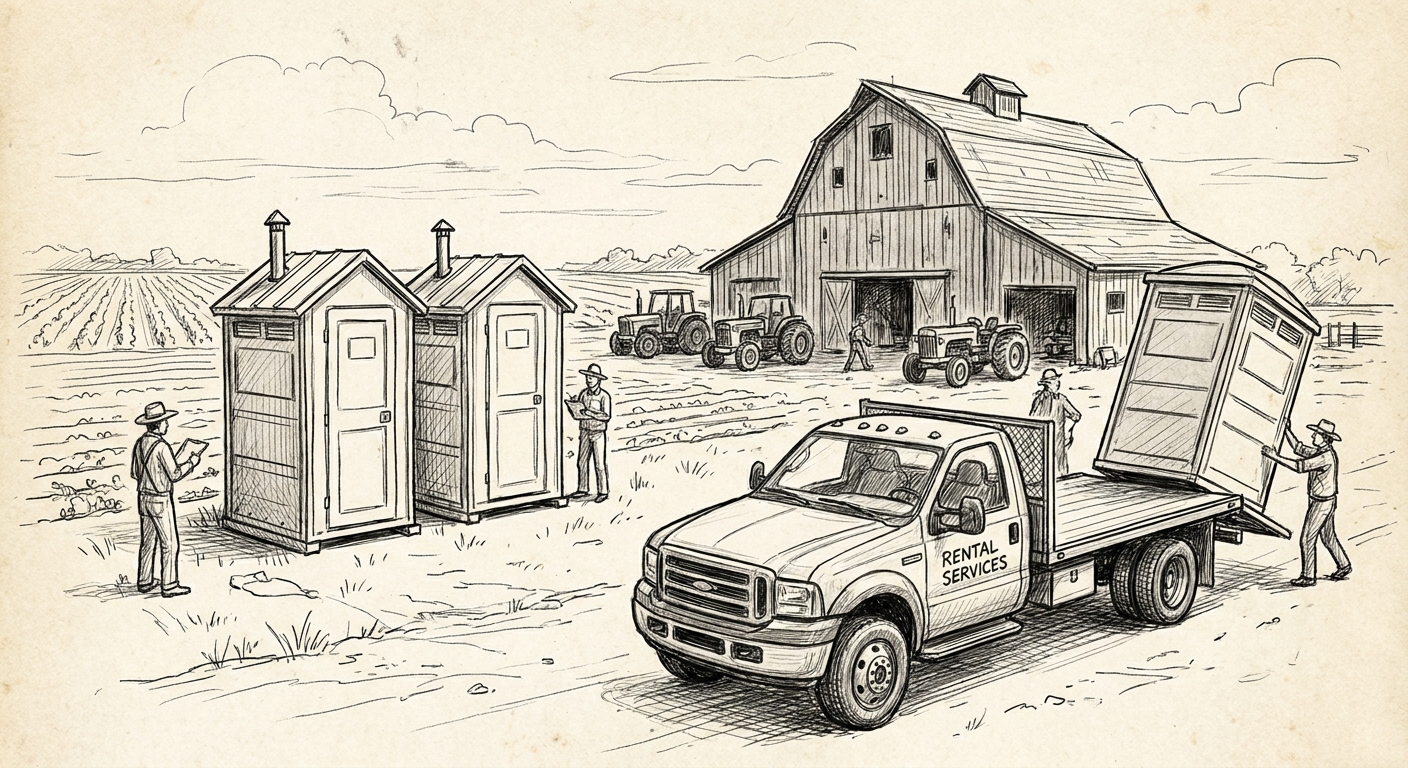
Harvest crews don't work near a bathroom. A restroom rental plan built for a construction site or a backyard remodel doesn't hold up on 40 acres of row crop or a hillside orchard block with no water line for a quarter mile in any direction.
- Standard single units cover crews under 20 on fields with truck access, service weekly during harvest.
- Holding tank restroom units answer for portable toilet rental for farms on blocks with no water or sewer nearby, buy for remote acreage.
- Hand-wash station combos are mandatory where crews handle produce, not optional, pair with every unit on packing days.
- ADA-compliant units become required once a crew or labor camp exceeds a single foreman-managed group, plan one per site minimum.
- Ratio math beats guessing: figure one restroom per 20 workers and you'll match the Cal/OSHA field sanitation standard without over-ordering.
Why this matters
Field sanitation isn't a courtesy on an agricultural site. California's Title 8 CCR 3457 field sanitation standard requires accessible restroom and hand-washing facilities for outdoor agricultural workers, generally figured at one unit per 20 employees, positioned within a quarter mile or a five-minute walk of the work area. Miss the ratio or the placement and the crew loses time walking, or the operation loses a compliance check.
Cost planning matters here too. Multi-week harvest contracts run different math than a single job-site rental, and budgeting for portable toilet rental on a job site works the same way whether the crew is framing a house or picking a block of stone fruit: know the service interval before you sign.
Most restroom vendors quote fixed placements and fixed service days. Farms need flexibility because the crew moves blocks weekly and the access road changes with the season. That's a different rental than a stationary construction trailer.
Who this is for
This guide is for farm labor contractors, ranch and orchard operators, vineyard managers, and packing house supervisors staffing outdoor crews across South Bay and Santa Clara Valley agricultural ground. It covers row crop operations, orchard blocks, vineyard rows, and seasonal labor camps where water and sewer hookups don't exist at the work site.
What to look for in portable toilet rental for farms
Distance from water and sewer hookups
Most ag ground has no hookup within reach. A holding tank restroom unit carries its own waste capacity and doesn't need a sewer connection, which matters when the nearest tie-in is a mile from the picking rows. Check tank capacity against crew size and service interval before you commit to a placement.
Crew size against Cal/OSHA field sanitation ratios
Run the math at one restroom per 20 workers before the crew arrives, not after a compliance walk-through. A 45-person picking crew needs three units minimum, split across the field so no worker walks more than a quarter mile.
Site access for service trucks
Dirt roads, irrigation ditches, and gated field entries change week to week during harvest. A unit placed at the edge of a block with truck access on service day beats one tucked mid-row that gets blocked by equipment.
Servicing frequency during harvest versus off season
Harvest crews of 30 or more push a standard unit past its service interval inside a week. Off-season crews of five or six can run two weeks between service. Match the schedule to headcount, not to a default calendar.
Hand-washing stations for food safety
On any site where crews handle produce directly, a hand-wash station isn't an add-on, it's part of the sanitation requirement. Pair one with every restroom unit on packing and harvest days, not just the main crew area.
ADA-compliant units for larger crews
Once a labor camp or crew count grows past a single foreman-managed group, at least one ADA-compliant unit is standard practice on the site, positioned on the same access path as the standard units.
Top picks for farm and agricultural crews
The baseline pick: standard single restroom unit. Covers a crew of 15 to 20 workers with weekly service during peak season, drops on a field edge with truck access. Buy for row crop and orchard crews under 20 with a clear access road.
The remote-field answer: holding tank restroom unit. Built for blocks with no water or sewer line within a mile, tank capacity sized to crew count and service interval. This is the holding tank rental for job site restrooms configuration built for exactly this gap. Buy for remote acreage and hillside blocks.
The food-safety pairing: standard unit plus hand-wash station. Two components, one placement, required wherever crews handle produce by hand. Buy for packing days and any crew working directly with harvested product.
The compliance requirement: ADA-compliant unit. One per site minimum once headcount passes a single small crew. Buy for any labor camp or multi-crew operation, Consider for a five-person crew working one block.
The wildcard: deluxe flushing unit for extended labor camps. Fits seasonal housing situations where crews stay on-site for weeks at a stretch rather than a single day's picking run. Consider for multi-week H-2A housing setups, Skip for a single-day harvest push.
Plan your farm site restrooms
Call to work out unit count, placement, and service days before crew arrival.
What to avoid
- A single unit for a 40-person crew. It looks like it covers the acreage on paper, it doesn't hold service interval past two or three days at that headcount.
- Skipping hand-wash stations to save a placement. Looks like an easy trim, isn't when produce handling is part of the job.
- Fixed weekly service on a crew that doubles during peak weeks. The interval that worked in week one falls apart the week the picking crew grows.
Verdict comparison
| Configuration | Best for | Service interval | Verdict |
|---|---|---|---|
| Standard single unit | Crews under 20, truck access | Weekly, harvest season | Buy |
| Holding tank unit | Remote blocks, no hookup | Set by tank capacity | Buy |
| Unit plus hand-wash station | Produce handling crews | Weekly, tied to unit | Buy |
| ADA-compliant unit | Multi-crew or labor camp sites | Weekly | Buy |
| Deluxe flushing unit | Multi-week housing camps | Twice weekly | Consider |
FAQ
What's the best portable toilet rental for farms with no water hookup?
A holding tank restroom unit is the standard answer for farm ground with no water or sewer line nearby. It carries its own waste capacity and doesn't need a site connection, which is why it's the default for remote row crop and orchard blocks.
How many restrooms does a farm labor crew need?
Plan on one restroom per 20 workers, the ratio set by California's Title 8 CCR 3457 field sanitation standard. A 45-person crew needs three units minimum, spaced so no worker walks more than a quarter mile.
Is a holding tank unit better than a standard restroom for agricultural sites?
For remote blocks with no hookup, yes: a holding tank unit is the only configuration that works without a water or sewer connection. For sites near an access road with a nearby hookup, a standard unit services just as reliably at lower complexity.
How far can a restroom be from the work area on a farm site?
Cal/OSHA field sanitation rules call for restrooms within a quarter mile or a five-minute walk of the work area. Placement past that distance puts the site out of compliance regardless of unit count.
Do farm crews need hand-washing stations separate from restrooms?
Yes, when crews handle produce directly, a hand-wash station is part of the sanitation requirement, not an optional add-on. Pair one with every restroom unit on harvest and packing days.
How often should restrooms be serviced during harvest season?
A crew of 30 or more will push a standard unit past its service interval inside a week during peak harvest. Match the schedule to actual headcount rather than a fixed calendar, and expect twice-weekly service on larger crews.
What restroom setup works for seasonal farm labor housing?
Multi-week labor camps, including H-2A housing situations, typically call for a deluxe flushing unit rather than a standard portable unit, since crews are on-site for extended stretches rather than a single day.
Does an ADA-compliant restroom unit matter on a small farm crew?
For a crew of five or six working one block, a standard unit generally covers the need. Once a site runs multiple crews or a labor camp, at least one ADA-compliant unit becomes standard practice.
One last thing
Field sanitation compliance checks look at placement distance first, headcount ratio second. A site with the right unit count but placed a half mile from the actual picking rows fails the same way as a site with too few units. Walk the block before you set the placement, not after.
Valley Services runs restroom rentals out of the same San Jose yard the family has operated since 1986, and coordinates delivery and service scheduling around harvest timing rather than a fixed calendar. Call (408) 297-5404 or reach out through valleyservices.biz to work out unit count and placement before the crew shows up.