For a 2026 Bay Area jobsite or event, get an ADA-compliant portable restroom rental quote based on the unit, rental dates, service schedule, and delivery location. Confirm whether delivery, pickup, servicing, and any placement work are included. Compare the complete rental scope, not the unit description alone.
- ADA portable restroom rental requires a site-specific quote covering dates, delivery, pickup, and servicing.
- Valley Services provides portable restroom rentals for Bay Area contractors and event producers who need coordinated site services.
- A wider restroom is not proof of ADA compliance. Request documentation for the proposed unit.
- Confirm the accessible route and placement before approving delivery.
How much does an ADA-compliant portable restroom cost to rent?
An ADA-compliant portable restroom rental needs a written quote for your actual site and schedule. Specify the equipment you need, when users will arrive, when the unit can be delivered, and when it can leave. Ask the rental company to identify every included service and every condition that changes the rental scope.
Valley Services offers portable restrooms and luxury restroom trailers across San Jose, Santa Clara, Sunnyvale, Mountain View, Milpitas, and the surrounding Bay Area. Confirm the specific accessible unit and its documentation before booking. A service category does not establish the specifications of an individual unit.
Use this breakdown to compare proposals for a 2026 rental. Keep the requirements identical when requesting each quote.
| Rental component | What to confirm | What an incomplete proposal leaves unresolved |
|---|---|---|
| Equipment | Exact unit type and accessibility documentation | Whether the proposed restroom meets the requested requirements |
| Rental period | Delivery date, use dates, and pickup date | Whether setup and load-out are covered |
| Delivery and pickup | Address, access route, placement, and removal arrangements | Who handles restricted gates or an inaccessible placement area |
| Servicing | Included tasks, frequency, and service access | Whether the schedule matches expected use |
| Supporting equipment | Hand-washing arrangements and any separate equipment | Whether the restroom order covers the full sanitation plan |
| Changes | Extension, relocation, cancellation, and rescheduling terms | What happens when the project schedule changes |
Approve the scope only after the equipment and placement plan agree. A quote for the wrong unit is not a useful comparison, regardless of how clearly it is written.
Why this matters on a Bay Area jobsite or event
An accessible restroom must work where you place it. A suitable unit behind a locked gate, across an obstructed route, or beside a staging area does not solve the access problem. Review the route people will actually use, not just the delivery truck's route.
Your rental decision also affects site control. Delivery competes with material drops, equipment moves, and event load-in. Servicing needs its own access. Treat these as scheduled activities, with a named site contact and clear instructions.
For a South Bay renovation, record which areas remain open to occupants and which belong to the construction zone. For an outdoor event, identify the public entrance, restroom locations, and queue areas. Those details belong in the rental request before equipment arrives.
Which restroom type should you request?
Request the equipment by its documented capabilities, not by a broad label. Terms such as accessible, wheelchair-accessible, and ADA-compliant need clarification when you review a proposal. Ask what the supplier means and which specifications support the description.
The following comparison identifies the questions to resolve. It does not establish that a particular unit is offered by any rental company.
| Option | Appropriate use | Advantage | Limitation to resolve |
|---|---|---|---|
| Portable restroom with documented ADA compliance | Projects requiring an accessible portable restroom | Gives you a specific unit to evaluate against applicable requirements | The surrounding route and placement still need review |
| Larger portable restroom without compliance documentation | Only after its suitability has been verified | Additional interior space can help users move | Size alone does not establish compliance |
| Restroom trailer | Events or projects considering a trailer arrangement | Provides a different restroom format | Verify entry, interior access, site needs, and the exact accessible configuration |
ADA-compliant portable restroom
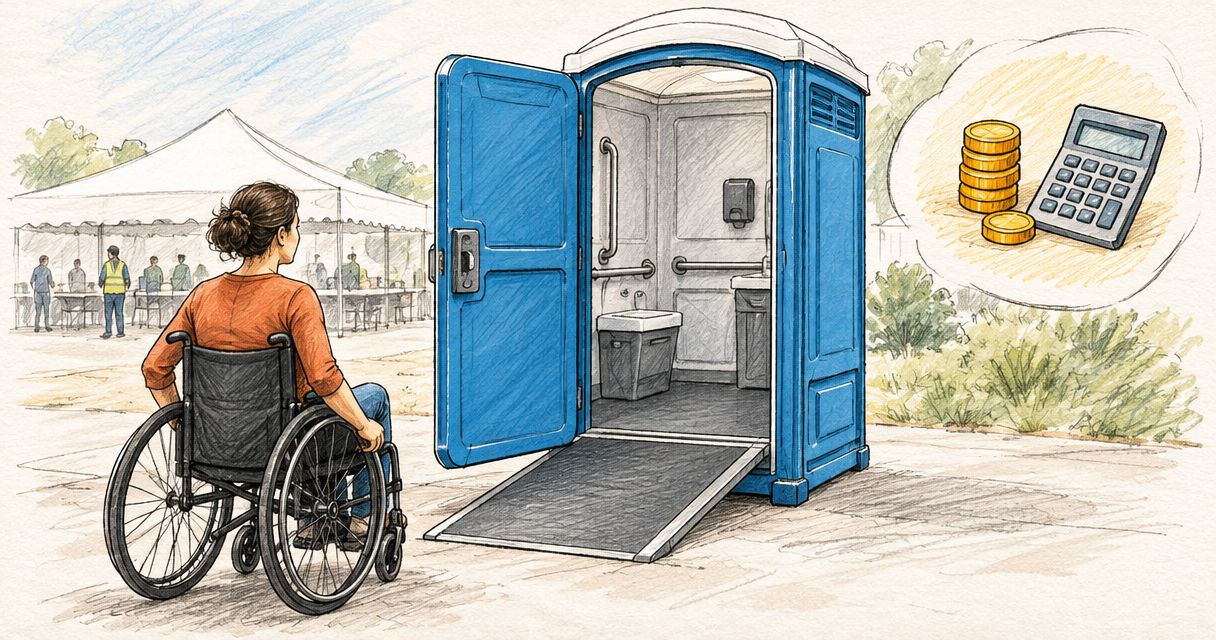
Ask for the proposed unit's specification sheet and accessibility information. Review the entrance, door operation, interior maneuvering space, fixtures, and grab bars against the requirements that apply to your project. Do not substitute a product photo for documentation.
The practical advantage is a defined equipment specification. The limitation is that equipment documentation covers only part of the installation. Your site still needs a usable approach, suitable placement, and ongoing access.
Larger portable restroom
A larger enclosure is not automatically ADA-compliant. Extra space does not answer questions about door clearance, fixture positions, hardware, or the entrance. Request the same documentation you would request for a unit explicitly described as compliant.
Do not approve a substitution described only as similar or oversized. Record the required specification on the order so the person accepting delivery knows what to check.
Restroom trailer
Evaluate a trailer as a separate layout decision, not an automatic accessibility upgrade. Ask how users enter, which compartment is accessible, and what site arrangements the proposed configuration requires. Confirm any utility requirements for that specific trailer.
A trailer can fit an event's restroom plan, but its access arrangement needs deliberate review. Steps, elevated entrances, and the approach area must be addressed before you accept the configuration.
Why ADA portable restroom rental scope varies
The rental scope changes with the work you ask the supplier to perform. For a 2026 request, give the same information to every company so the proposals describe the same job.
- Equipment specification: Identify the accessibility requirements and request documentation for the proposed unit. A generic restroom description is not enough.
- Rental dates: Include delivery, actual use, servicing access, and pickup. Separate event hours from the full time equipment remains on the property.
- Site location and access: Provide the address, gate instructions, placement area, and restrictions. Identify who can authorize entry.
- Service schedule: State expected attendance or workforce patterns, operating hours, and periods of concentrated use. Ask the supplier to explain the proposed servicing plan.
- Supporting equipment: Identify hand-washing needs and any separate restroom or site-service orders. Keep each component visible in the written scope.
- Schedule changes: Ask how extensions, relocations, and changed pickup dates are handled. Record the process before the first change occurs.
Do not assume a short event means a short equipment placement. Load-in can precede public opening, and removal can follow other vendors' load-out. Quote the entire placement period.
For construction, separate the current phase from later phases. A restroom placed correctly during demolition can interfere with deliveries once framing begins. Flag the planned move rather than leaving it for the field crew to resolve.
What makes the placement accessible?
Check the approach and the unit together. Under the federal ADA Standards for Accessible Design, Section 403 generally requires an accessible walking surface to have at least 36 inches of clear width, subject to specified exceptions. Section 304 provides a circular turning-space option with a 60-inch diameter, while also allowing a compliant T-shaped turning space.
Section 403 limits an accessible walking surface's running slope to 5 percent. Steeper routes require evaluation under the applicable ramp provisions. These are separate requirements, not a shortcut for declaring a complete portable restroom installation compliant.
The U.S. Access Board's published standards are the source for these dimensional references, checked against the applicable provisions for 2026 planning. Local requirements and the project's circumstances also need review. Ask the responsible design professional or authority having jurisdiction to resolve uncertain conditions.
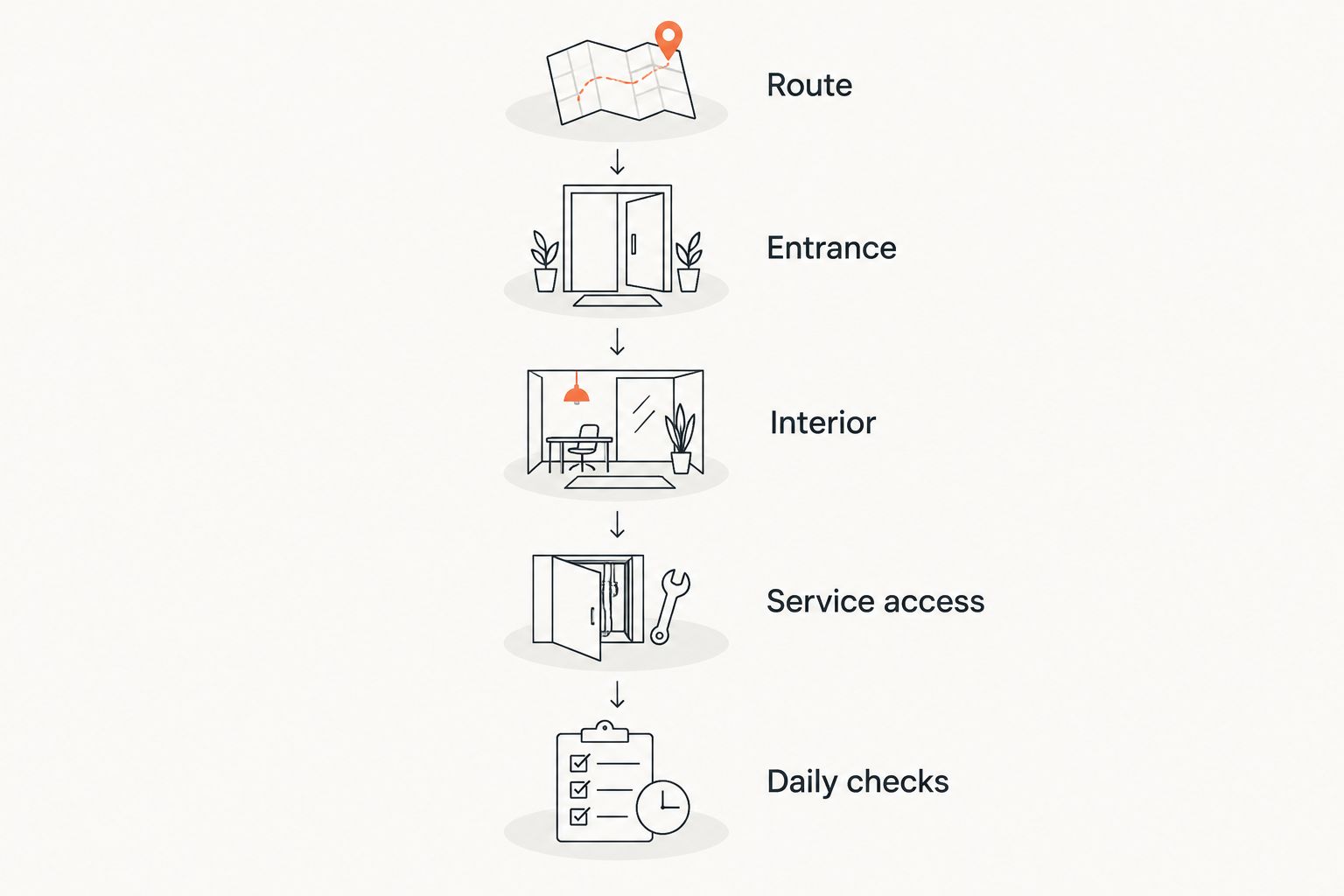
Use this placement sequence before ordering:
- Route: Identify the path from the accessible arrival point or occupied area to the restroom. Check gates, turns, surface conditions, and obstructions.
- Entrance: Review the approach to the door and the space needed to operate it. Confirm that the entrance arrangement matches the proposed unit's documentation.
- Interior: Review the unit's documented maneuvering space and fixture arrangement. Do not infer these from exterior dimensions.
- Service access: Establish how the supplier will reach the unit without blocking the user route. Keep the servicing arrangement separate from the public approach where the layout permits.
- Daily checks: Assign someone to keep the route clear and report changed conditions. Delivery acceptance is not the final access check.
On a San Jose jobsite, mark the restroom area on the same layout used for fencing, material staging, and deliveries. Check that fence gates and stored materials do not interrupt the approach. At an event, keep the route out of vendor storage and queue spillover.
What should you send with a rental request?
Send a concise site brief with enough detail to place and service the equipment. A street address alone does not tell the driver which entrance to use or tell the scheduler when the site is accessible. Attach a marked layout or clear site photographs when available.
Your 2026 rental request should include:
- The project address and exact delivery entrance.
- The site contact and the person authorized to accept delivery.
- Delivery, use, service-access, and pickup windows.
- The requested accessibility specification.
- Expected users, operating hours, and concentrated-use periods.
- The proposed placement and accessible route.
- Gate restrictions, shared loading areas, and planned site changes.
- Hand-washing arrangements and related site-service needs.
Ask the supplier to return a written scope that addresses those points. If a detail remains unresolved, resolve it before confirming placement. Do not leave the driver to choose between an accessible route and an active loading area.
For a construction-specific planning checklist, review ADA-compliant portable restroom rental for construction sites. Keep the equipment decision connected to the site layout and the project schedule.
Does delivery include servicing and pickup?
Delivery does not establish what servicing or pickup includes. The written rental scope should name each activity, its timing, and the access required. Ask who schedules removal and who approves changes.
For events, confirm that pickup follows the actual end of restroom use, not simply the advertised closing time. For construction, confirm how the order stays active when the work extends. Make sure the field contact and the person managing the rental have the same dates.
Is a wheelchair-accessible restroom always ADA-compliant?
A wheelchair-accessible description is not sufficient proof of ADA compliance. Request documentation for the exact unit, then review the installation and accessible route against applicable requirements. Do not treat the label as approval of the entire site arrangement.
Ask the supplier to identify any limitations in the proposed configuration. If the unit requires a particular entrance arrangement or placement condition, put that requirement on the site plan and delivery instructions.
Can one order cover the rest of the jobsite?
Valley Services offers roll-off containers, portable restrooms, luxury restroom trailers, temporary fencing, and K-rail. One call can cover containers, restrooms, and fencing for the same jobsite. Keep each service's placement and schedule distinct within that coordinated request.
Valley Services owns and operates its C&D transfer station in San Jose. That provides a controlled disposal endpoint for the container portion of a combined order. It does not establish restroom accessibility or replace the review of a specific unit.
The trade-off with a combined order is more layout coordination. A container delivery path, fence gate, and accessible restroom route must work together. Review the shared plan before approving separate deliveries.
FAQ
How do I get an ADA portable restroom rental quote?
Send the rental company your site address, equipment requirements, rental dates, expected use, and proposed placement. Request a written scope covering delivery, pickup, servicing, and schedule changes.
What should an ADA portable restroom rental quote include?
The quote should identify the proposed unit, rental period, delivery and pickup arrangements, servicing, and any separate equipment. Confirm accessibility documentation before approving the order.
Does a larger portable restroom meet ADA requirements?
A larger portable restroom does not establish ADA compliance by size alone. Check the exact unit's documentation, entrance, interior arrangement, and installed access route.
How wide should the accessible route to a restroom be?
An accessible walking surface generally needs at least 36 inches of clear width under Section 403 of the federal ADA Standards, subject to specified exceptions. Review gates, turns, passing requirements, and other applicable provisions separately.
How much turning space does an accessible restroom need?
Section 304 of the federal ADA Standards provides a circular turning-space option with a 60-inch diameter. A compliant T-shaped turning space is another option, so review the proposed unit's documented layout.
Can I place an accessible restroom inside temporary fencing?
Place an accessible restroom inside temporary fencing only after verifying the user route, gate access, entrance, and service access. Keep the route usable throughout the rental period.
Does Valley Services serve locations outside San Jose?
Valley Services serves San Jose, Santa Clara, Sunnyvale, Mountain View, Milpitas, and the surrounding Bay Area. Its C&D transfer station is in San Jose only.
One last thing
Check the access route again after the site changes. A correctly placed restroom can become difficult to reach when a fence moves, materials arrive, or event queues shift. Put access checks on the same 2026 site checklist as gate control and delivery coordination.
Assign that check to a named person. The rental company supplies equipment, but someone on the property needs to notice when the surrounding conditions no longer match the approved plan.
Related guides
- Budgeting for portable restroom rental on a jobsite
- Connecting restroom trailer bookings to event timelines
- Planning site services for a multi-phase construction project
To talk through your restroom requirements, placement, and rental schedule, call (408) 297-5404.