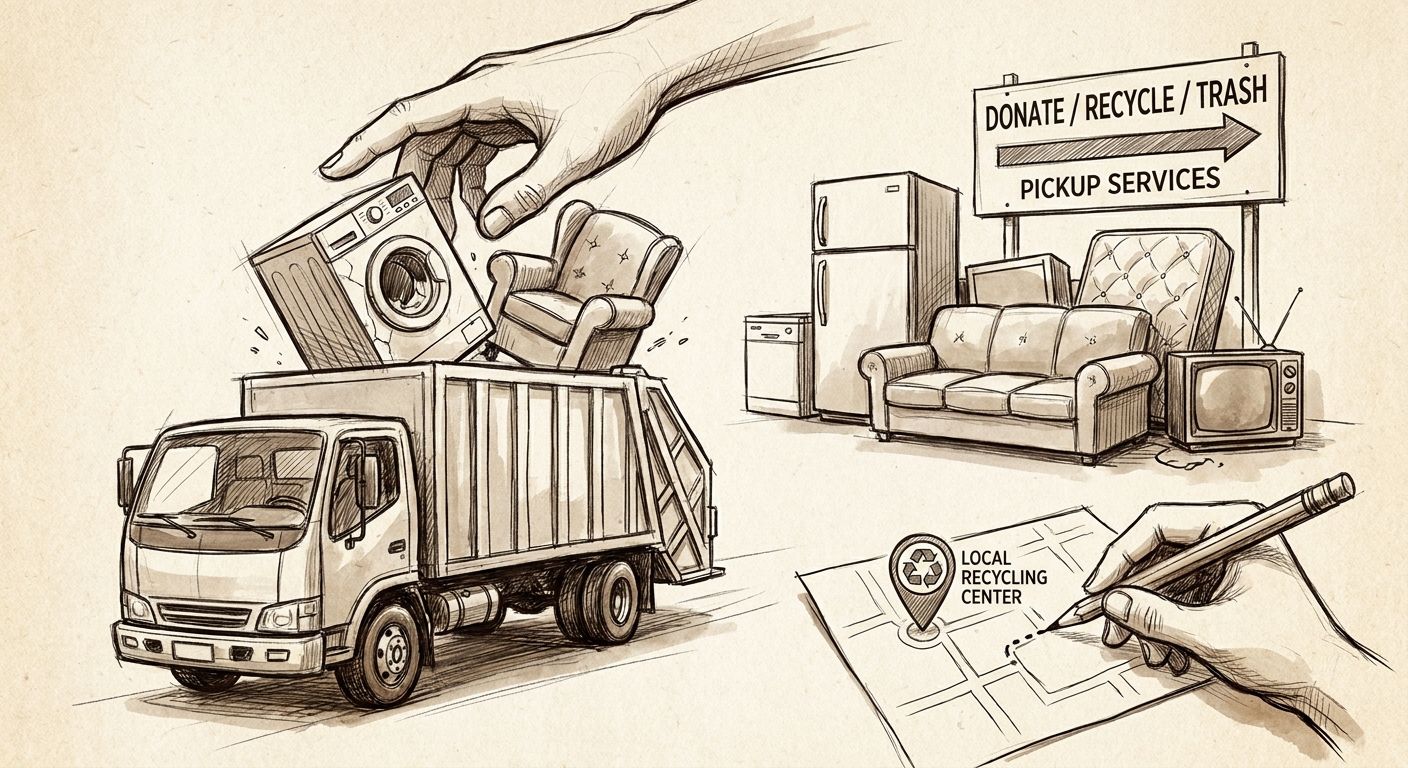
Refrigerators, sofas, and washers do not fit in a curbside trash can, and most municipal pickup services across the South Bay refuse them outright. This guide covers how to dispose of appliances and furniture in 2026, from sizing a roll-off container to handling refrigerants the right way before they leave your driveway.
- A 10 or 20 yard roll-off container clears a full house of appliances and furniture in one haul.
- Refrigerators, freezers, and window AC units need certified refrigerant recovery before disposal in 2026.
- Breaking down bed frames and sectionals before loading saves real space in the container.
- Valley Services runs its own San Jose transfer station, so container and drop-off scheduling stay under one call.
Why this matters
Appliances and furniture back up a cleanout faster than almost anything else you'll load. Curbside trash service in San Jose, Santa Clara, and Sunnyvale will not take refrigerators, washers, or mattresses on a regular collection day. Leave them at the curb without a scheduled pickup and the result is a code notice from the city, not a solved problem.
For a whole-house cleanout, an estate clear, or a property management turnover in 2026, a roll-off container sized for appliance disposal solves the volume problem. It does not solve the refrigerant problem, the disassembly problem, or the loading-order problem on its own. Get those wrong and you're looking at a rejected load or an overloaded container that has to be re-picked.
What you'll need
- A container sized to the job: 10 yard for a handful of appliances, 20 yard for a full house of furniture and appliances together
- Clear driveway or curb access, roughly 60 feet of straight approach for delivery truck placement
- An appliance dolly and moving straps for anything over 100 pounds
- Confirmation that refrigerators, freezers, and window AC units get refrigerant pulled before they go in the container
- A scheduled delivery and pickup window that matches your actual work timeline, not a guess
The steps
1. Sort what's actually leaving the property
Walk the site or the house before anything gets scheduled. Separate items into three piles: furniture, appliances with a compressor or coolant line, and appliances without one. A washer, dryer, or stove has no refrigerant and loads straight into the container. A refrigerator, freezer, or window AC unit does not, and that distinction changes your entire disposal plan.
Common mistake: treating every appliance the same and finding out at drop-off that a fridge got loaded with the Freon still inside.
2. Pull refrigerant appliances aside
California requires certified recovery of refrigerant from any appliance that holds it before that unit can be scrapped or landfilled. This applies to home refrigerators, chest freezers, and most window or portable air conditioners. Handle this step before the container ever shows up, not after it's full and blocking your driveway.
Common mistake: assuming a transfer station will pull the Freon on-site. Most will not, and a load with an unrecovered unit can get flagged and returned.
3. Match your container size to the actual volume
A single refrigerator, a sofa, and a mattress fit comfortably in a 10 yard container. A whole-house cleanout with a washer, dryer, refrigerator, three bedroom sets, and a living room's worth of furniture needs 20 yards, sometimes more if there's a second story to clear. Guessing small to save space costs more in the second haul than ordering right the first time.
4. Disconnect and prep every appliance
Unplug everything and disconnect water lines from washers, dishwashers, and refrigerators with ice makers. Drain any standing water. Pull the doors off chest freezers and upright units before they go in the container, both for space and for basic site safety around kids or crews on a jobsite.
Common mistake: loading a washer with the drain hose still attached to a wall valve, which either floods the driveway or damages the fitting.
5. Break furniture down before it goes in
A queen bed frame, headboard, and box spring take up more room assembled than they need to. Pull frames apart at the bolts, flatten headboards against a container wall, and stand mattresses on edge rather than laying them flat. A furniture and mattress disposal load that's broken down properly can fit close to double the volume of one that's tossed in whole.
Common mistake: loading a full sectional couch in one piece when it would have come apart into three sections with a screwdriver.
6. Load heavy first, flat second
Appliances go in first, along the container floor, distributed across the base rather than stacked in one corner. Furniture and lighter debris go on top. This isn't just about fitting more in: uneven weight distribution is exactly what causes overage flags and safety issues during pickup. Review the full method in how to load a dumpster safely and avoid overage fees before the container arrives, not after it's half full.
7. Close the loop at drop-off
Once the container is full, confirm your pickup window matches what was scheduled at delivery. A load with mixed appliances and furniture headed to a transfer station moves faster when refrigerant units were already handled in step 2. Valley Services controls its own San Jose transfer station, which means the schedule for delivery, pickup, and drop-off runs through one call instead of three separate vendors.
Troubleshooting
A refrigerator won't fit through the container door opening. Tip it on its side with the door facing the container wall, or remove the door entirely with a screwdriver. Standard roll-off container door openings are built for appliance widths, but tight approach angles on some driveways can still cause problems.
The container fills up before all the appliances are loaded. This usually means furniture went in unbroken down or appliances got stacked loosely instead of nested against each other. Reorder the size up rather than trying to force a second load into a full container.
A load gets flagged at the transfer station for an appliance with refrigerant still inside. This stops the whole load, not just that one unit. Recovery has to happen before the appliance leaves the property, never after.
A mattress and box spring eat more room than expected. Standing them on edge against a container wall, rather than laying them flat on top of other debris, recovers real space for the appliances that came with the same cleanout.
The container tips or shifts during pickup. Nearly always a sign of top-heavy loading, heavy appliances stacked high with lighter furniture underneath. Heavy items belong on the container floor, always.
Schedule your container for 2026
One call covers container sizing, delivery, and drop-off at Valley's own San Jose transfer station.
Tools and resources
- Appliance dolly rated for at least 300 pounds
- Moving straps or a furniture harness for two-person lifts
- A tape measure to confirm driveway clearance before delivery
- Dumpster rental sized for appliance disposal for whole-appliance loads
- Loading method notes in how to load a dumpster safely and avoid overage fees
What to do next
If your cleanout also involves paint, solvents, or other materials that don't belong in a standard container, review how to dispose of hazardous construction materials safely before you schedule delivery. Mixing hazardous materials into an appliance and furniture load is the fastest way to get a container rejected at drop-off in 2026.
FAQ
Can you put a refrigerator in a roll-off container in California?
Not with the refrigerant still inside. California requires certified recovery of Freon from refrigerators, freezers, and window AC units before the appliance goes into a container or a transfer station.
How big of a container do I need for appliance disposal?
A 10 yard container handles a handful of appliances plus some furniture. A whole-house cleanout with multiple appliances and full bedroom sets usually needs 20 yards.
Can furniture go in a roll-off container with appliances?
Yes, furniture and appliances can go in the same container. Load appliances first along the container floor and furniture on top for the best use of space.
Do mattresses need special handling before disposal?
Standing a mattress and box spring on edge against the container wall instead of laying them flat saves significant space for the rest of the load.
What does appliance and furniture disposal cost in San Jose?
Cost depends on container size, weight, and whether refrigerant recovery is needed. Call (408) 297-5404 for a quote based on your specific load.
Can a washer and dryer go in the same container as regular trash?
Yes, once disconnected and drained, washers and dryers load into a standard roll-off container alongside general debris and furniture.
What items are typically banned from a roll-off container?
Hazardous materials like paint, solvents, and certain chemicals are not permitted in a standard container. Refrigerant-bearing appliances need recovery first, not outright exclusion.
How long does appliance and furniture pickup take once a container is full?
Pickup typically happens within the scheduled window agreed at delivery. Confirming the window in advance keeps the job on track instead of waiting on a callback.
One last thing
Most people size a container by counting appliances and forget furniture volume entirely. A queen mattress and box spring, loaded flat instead of standing, can eat more usable space than an entire washer and dryer combined. Account for furniture volume first, then add appliances, and the size call gets a lot more accurate.
Call (408) 297-5404 or visit valleyservices.biz to schedule a container sized for your appliance and furniture load in 2026.