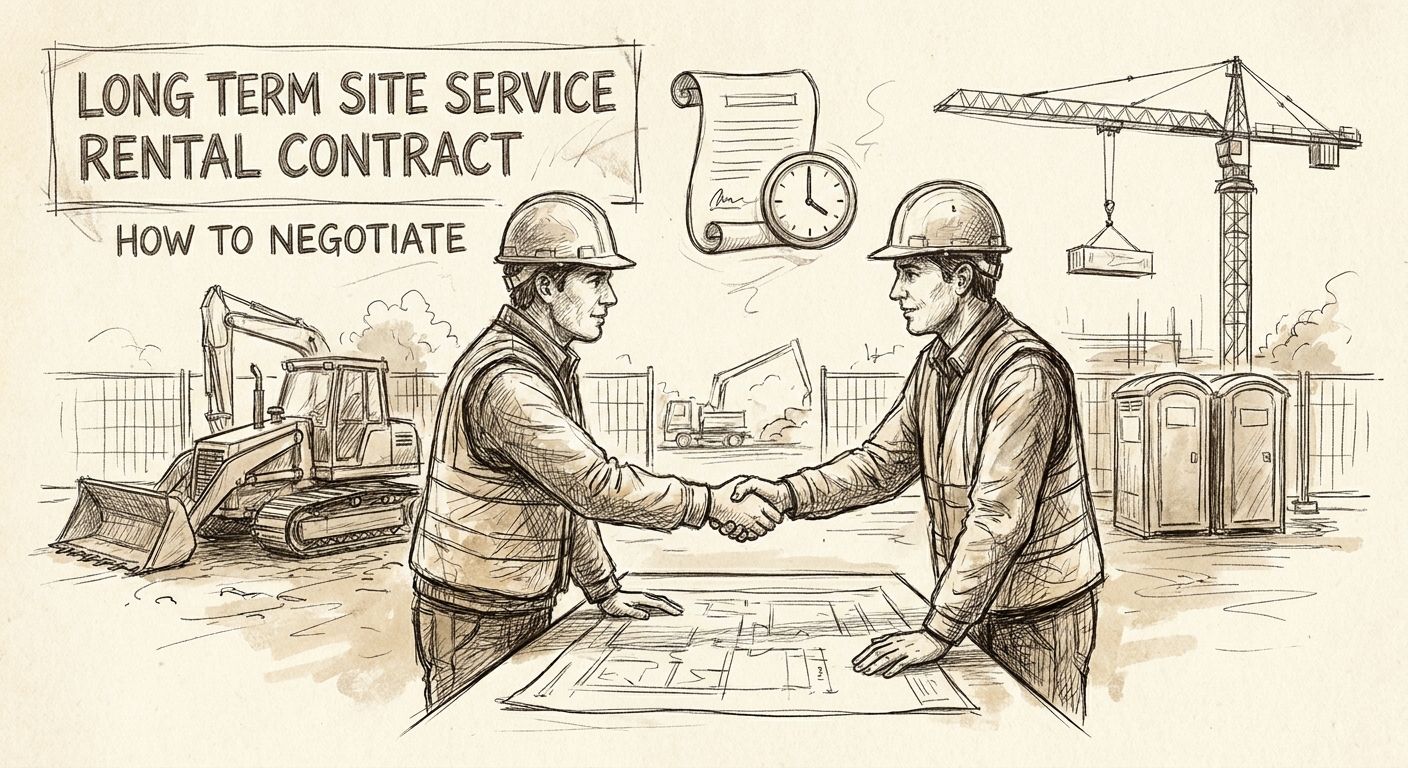
A general contractor running three job sites through 2026 doesn't want to renegotiate a roll-off container order every six weeks. A long term site service rental contract locks in pricing, swap schedules, and container availability across a full project calendar, but only if you negotiate the right terms before you sign.
- A long term site service rental contract should lock rate, swap frequency, and container size flexibility for the full project duration.
- Valley Services bundles roll-off containers, restrooms, and temporary fencing into one contract and one call.
- Get overage fees, swap windows, and transfer station access written into the contract, not left as verbal promises.
- Build an exit clause tied to permit delays or phase changes before you sign, not after a stalled site costs you a month.
Why this matters
A verbal handshake on pricing falls apart the moment a job runs long or a phase gets added. Bay Area contractors juggling multi-site schedules in San Jose, Santa Clara, and Sunnyvale lose real time chasing vendors who can't confirm a swap date or who quietly change container availability mid-project.
A written long term site service rental contract fixes that. It sets one rate structure, one point of contact, and one schedule for containers, restrooms, and fencing across the life of the job. That matters more on a 2026 multi-phase build than on a two-week cleanout, because the cost of a missed swap compounds every week the site sits idle.
What you'll need
- A project timeline with phase breaks marked (foundation, framing, finish, punch list)
- A rough headcount per phase, since restroom counts and container swap frequency both track crew size
- Site access notes: gate width, overhead clearance, ground surface for container placement
- A copy of your permit or a permit timeline if placement approval is still pending
- Contact for one vendor that can quote containers, restrooms, and fencing together, not three separate vendors
Valley Services has operated its own San Jose yard since 1986, third generation, same family. Because Valley Services owns its own C&D transfer station instead of hauling to someone else's site, contract terms on swap timing and disposal access carry more weight than a broker's promise.
The steps
1. Map the full scope before you call
List every service line the job needs across every phase: container sizes, restroom counts, fencing linear footage. A contract negotiated against a partial scope gets renegotiated at a worse rate once the missing pieces show up.
Common mistake: quoting only the demo phase container and adding restrooms and fencing as afterthoughts once framing starts. That splits your leverage across three separate conversations instead of one.
2. Ask for a rate lock across container sizes and swap frequency
A long term site service rental contract should hold pricing flat whether the job needs a 20 yard container in month one and a 30 yard in month four. Get the swap frequency (weekly, biweekly, on-call) written as a fixed term, not an estimate.
Expected outcome: one page that shows container size, swap cadence, and rate for each phase of the project, all under a single agreement.
3. Negotiate swap and pickup windows into the contract
Define the delivery window (same-day, next-day, 48-hour) in writing. On a multi-phase site, a container that sits full for three extra days blocks debris flow and slows the crew behind it.
Common mistake: accepting "we'll get to it this week" as a contract term. That's not a term, it's a guess.
4. Get transfer station access and overage terms in writing
Ask where the container actually goes. A vendor who owns a transfer station controls the disposal endpoint directly, which means fewer surprise delays from a third-party site running behind. Get the overage fee structure and weight limits documented per container size before the first load goes out.
Check how to load a dumpster safely and avoid overage fees before finalizing this section, since overage disputes are the most common line item that blows up a long-term budget.
5. Bundle restrooms and fencing into the same contract
A multi-phase site needs restrooms sized to crew count and fencing that adjusts as the site footprint changes. Negotiating these as one contract with one vendor removes the coordination gap between three separate delivery schedules.
Expected outcome: a single service calendar covering container swaps, restroom pump-outs, and fence reconfiguration, all confirmed by one point of contact.
6. Set a response-time term for service issues
A long-term contract should specify how fast the vendor responds to a full container, a restroom service request, or a fence breach. Verbal "we're usually pretty quick" answers don't hold up when a full container stops debris flow on a Friday afternoon.
Common mistake: leaving response time undefined and assuming standard service speed applies to every situation, including weekend and after-hours calls.
7. Build in an exit or pause clause for permit delays
Bay Area permit timelines shift. A contract that locks you into a fixed container count for 12 months with no adjustment clause costs you when a phase stalls waiting on inspection. Negotiate a pause or downsize option tied to documented permit delays.
Expected outcome: language that lets you reduce service frequency or pause a line item for a defined period without breaking the full contract.
Talk through your project schedule
One call covers containers, restrooms, and fencing for the full job.
Troubleshooting
Vendor won't lock a rate across container sizes. Ask for a phase-by-phase rate sheet instead of a single blended number. If they can't produce one, that's a sign they're brokering disposal and can't guarantee downstream pricing.
Overage fees aren't defined anywhere. Get the per-ton or per-load overage rate in writing before the first container ships. Undefined overage terms are the single biggest source of long-term contract disputes.
Swap windows are vague. "We'll come by soon" is not a contract term. Push for a numeric window (24, 48, 72 hours) tied to a specific notification method (call, text, portal).
One vendor can't cover restrooms and fencing. Splitting service lines across three vendors on a multi-phase site multiplies the number of schedules you have to track. A single-vendor contract for container, restroom, and fencing service removes that friction.
The contract has no exit clause. A fixed 12-month term with no pause option is a liability on a project with permit risk. Negotiate the pause clause before signing, not after a delay hits.
Permit delays stall a phase mid-contract. Document the delay with the permitting agency's own timeline and use it to trigger the pause clause you negotiated in step 7.
Tools and resources
- Best site service rental package for general contractors for how bundled contracts typically get structured
- How to plan site services for a multi-phase construction project for phase-by-phase service planning
- Monthly portable restroom service guidance for long-term job sites, which tracks crew count changes over a project's life
- A copy of your job's permit timeline from the local building department
- Your own phase-by-phase debris and crew estimates from step 1
What to do next
Once the contract terms are set, confirm container sizing against your actual phase-by-phase debris volume. Construction dumpster rental for general contractors covers sizing by project type, which keeps you from locking a long-term contract around the wrong container size.
FAQ
What should a long term site service rental contract include?
A long term site service rental contract should fix pricing by phase, define swap and pickup windows in hours, document overage fees, and include a pause clause for permit delays. Missing any one of these turns a fixed-term contract into a source of disputes by month three.
Can I negotiate one contract for containers, restrooms, and fencing together?
Yes, a single vendor that offers all three service lines can put them under one contract with one schedule. That removes the coordination gap between three separate delivery calendars on a multi-phase site.
How long should a site service rental contract run?
Match the contract term to your project's actual phase timeline, not a round number like 12 months. A contract tied to real phase dates makes the pause and exit clauses easier to enforce.
What happens if my permit gets delayed mid-contract?
A properly negotiated contract includes a pause or downsize clause tied to documented permit delays. Without that clause, you're locked into full service frequency even while the site sits idle.
Who controls disposal costs on a long-term container contract?
The vendor's disposal endpoint controls it. A company that owns its own transfer station sets its own overage and access terms directly, rather than passing along a third-party site's changing terms.
Do restroom counts need to change across project phases?
Yes, restroom counts should track crew headcount per phase, not stay fixed for the whole job. A framing crew of 20 needs a different restroom count than a five-person punch list crew.
What's the biggest mistake contractors make in these contracts?
Leaving overage fees and swap windows undefined. Both show up as disputes once the job is underway, and by then you have far less leverage to renegotiate.
Is a bundled site service contract cheaper than separate vendors?
Bundling reduces coordination overhead and the number of separate schedules you manage, though actual terms vary by project scope and should be confirmed directly with the vendor.
One last thing
The clause contractors skip most often is the pause clause tied to permit delays, and it's the one that costs the most in 2026 given how often Bay Area inspection schedules slip. Negotiate it before you sign, not after a stalled phase has already run up a month of full-frequency service charges.
Call (408) 297-5404 or visit valleyservices.biz to talk through a contract structured around your actual project phases.