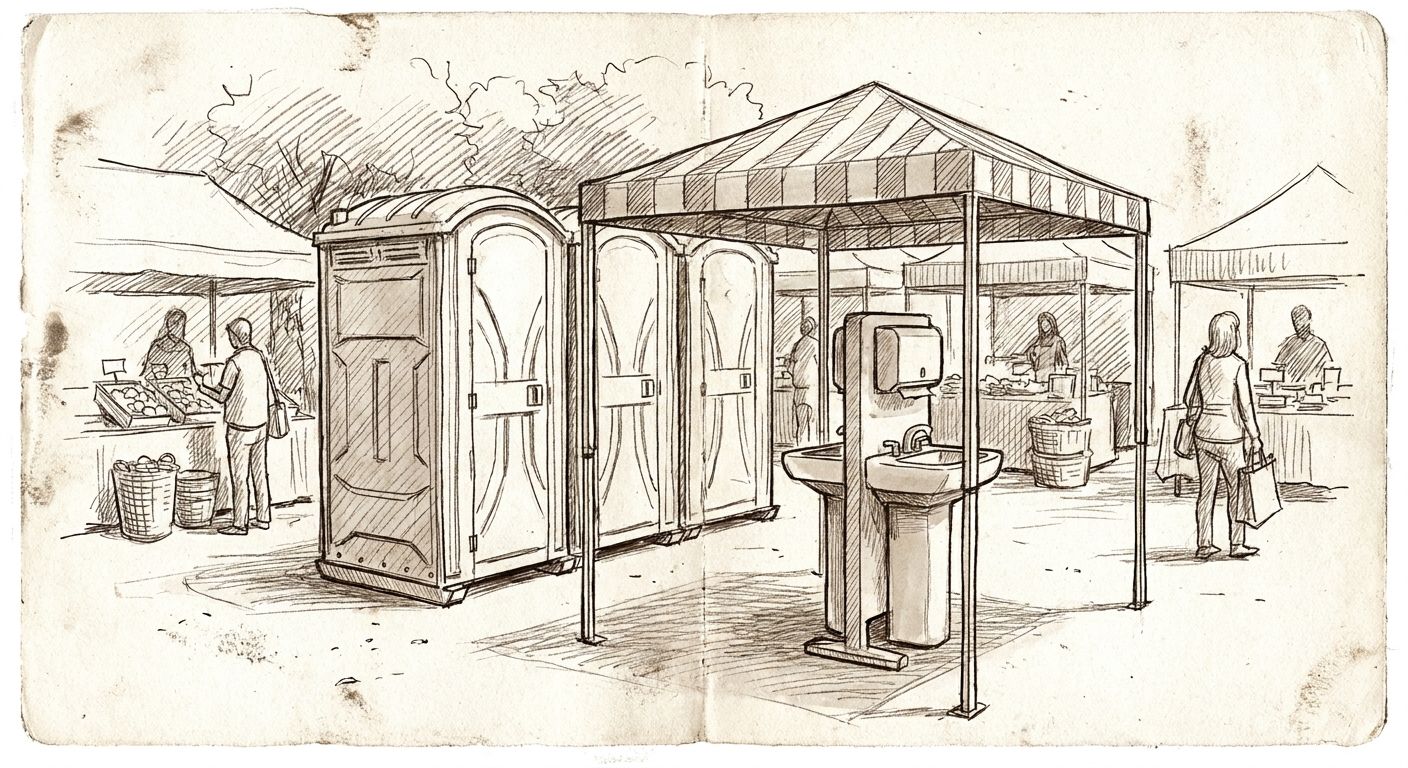
A farmers market runs on foot traffic, not permits, but sanitation planning decides whether that traffic sticks around. Get the restroom count and hand wash setup right and vendors serve food without a health inspector shutdown. Get it wrong and you spend market day fielding complaints instead of counting vendor fees.
- Plan one restroom per 250-300 shoppers for a market under four hours in 2026, doubling that for longer events.
- Every food booth handling raw or prepared items needs its own hand wash station, not a shared one across the row.
- At least one ADA-compliant restroom belongs on site regardless of market size.
- Weekly recurring markets need a standing service schedule, not a single drop-off, to keep soap and paper stocked.
- Valley Services delivers restrooms and hand wash stations together for South Bay markets, one call covers both.
Why this matters
County health departments inspect food booths on market day, and a missing hand wash station is one of the fastest ways to get a vendor pulled from the lineup. Shoppers notice restroom lines within the first hour of a busy Saturday market and they leave instead of waiting. Valley Services sets up restrooms and hand wash stations on the same delivery for market organizers across San Jose, Santa Clara, Sunnyvale, Mountain View, and Milpitas, which keeps load-in simple for a market that runs every week in 2026.
How many restrooms do you need for a farmers market?
Size the restroom count to shopper volume and market duration, not vendor count alone. A market with 40 vendors but heavy foot traffic needs more units than a 60-vendor market with light attendance.
| Market size | Typical shopper volume | Restroom count (under 4 hrs) |
|---|---|---|
| Small | Under 500 shoppers | 2 standard units |
| Medium | 500 to 2,000 shoppers | 4 to 6 standard units |
| Large | 2,000+ shoppers | 8 or more standard units |
These counts reflect a common event planning benchmark of one restroom per 250 to 300 attendees for events running under four hours. Markets that run past four hours, or that pour heavily into a hot afternoon, should add units rather than stretch the same count across more hours. The full sizing walkthrough is broken down in how to calculate portable toilets needed for an event, which applies the same math to street fairs and festivals.
Small market (under 500 shoppers): 2 restrooms
A neighborhood market running three to four hours with under 30 vendors gets by on two standard units placed near the entrance and near the far end of the vendor row. Two units is the floor, not a target to shave down. Skip below that and you get lines before the first hour ends.
Medium market (500 to 2,000 shoppers): 4 to 6 restrooms
This is the range where most weekly certified farmers markets in the South Bay land. Spread units across the footprint instead of clustering them at one end, and place at least one near the food vendor cluster where demand peaks.
Large market (2,000+ shoppers): 8 or more restrooms
A large seasonal or holiday market with multiple food trucks and a beer or wine garden needs unit counts in the double digits. At this scale, a restroom trailer alongside standard units handles peak-hour volume without a line forming at every unit.
Why restroom and hand wash needs vary
- Market duration. A four-hour Saturday morning market needs fewer units than an all-day harvest festival with the same shopper count.
- Food vendor density. More booths cooking or handling raw ingredients means more hand wash demand, independent of general shopper restroom needs.
- Weather. Hot afternoons push shoppers toward drinks and restrooms faster than a cool morning market.
- Alcohol service. A beer or wine garden adds restroom demand beyond the general shopper estimate.
- Site layout. A single-row market can serve shoppers with fewer, better-placed units than a sprawling multi-block layout.
- Recurring schedule. A weekly market needs a standing service plan, not a one-time setup, since soap and paper run out over a season.
Do farmers markets need hand wash stations by law?
Most local health departments require a hand wash station within reach of any booth that preps, cooks, or serves food, separate from general restroom counts. This applies to a single taco stand the same way it applies to a produce vendor cutting fruit samples. A hand wash station is not optional at any booth handling food, regardless of market size.
Sharing one station across a row of five booths usually fails inspection. Health inspectors expect wash access close enough that vendors actually use it between tasks, not a station parked at the far end of the row. Hand wash station rental for food truck events covers spacing and setup details that carry over directly to a farmers market vendor row.
How many hand wash stations does a food vendor booth need?
Each booth that handles raw ingredients or prepared food needs its own hand wash station, not a shared unit down the row. A market with 15 food-handling booths needs 15 wash points, or a smaller number of stations placed so no booth is more than a few steps away. Grouping food booths tighter together on the layout can reduce the total station count without cutting corners on access.
Does a farmers market need an ADA-compliant restroom?
Yes, at least one ADA-compliant restroom belongs on site regardless of market size, and larger markets need more than one spaced across the footprint. This applies whether the market runs on a street closure, a parking lot, or a park space. ADA-compliant portable toilet rental covers placement and access requirements that apply the same way at an outdoor market as they do on a job site.
Plan restrooms for your next market
Talk through unit counts, hand wash stations, and a weekly schedule.
Setting up a weekly service schedule
A one-time market and a recurring weekly market call for different plans. A single event needs a delivery before load-in and a pickup after teardown, timed around vendor arrival. A recurring market running every Saturday through a full season needs a standing schedule: restocked soap and paper on a set day, unit servicing between markets, and a delivery contact who knows the load-in window without a new conversation every week.
Organizers running the same market for months tend to underestimate how fast a hand wash station runs dry with 40 food booths using it every Saturday. Build refill checks into the weekly schedule instead of waiting for a vendor complaint to flag it.
FAQ
How many portable restrooms does a small farmers market need?
A small farmers market under 500 shoppers needs at least 2 standard restrooms for an event running under four hours. Add a third unit if the market runs past four hours or includes alcohol service.
Do food vendors at a farmers market need their own hand wash station?
Yes, every booth that preps, cooks, or serves food needs its own hand wash station, not a shared unit down the row. Health inspectors check for wash access close enough that vendors use it between tasks.
Is one ADA-compliant restroom enough for a large farmers market?
A market under 2,000 shoppers can generally cover accessibility with one ADA-compliant unit placed near the main entrance. Markets above that size should space a second accessible unit across the footprint so it's not a long walk from either end.
How far in advance should restrooms be booked for a farmers market?
Book restrooms and hand wash stations as soon as vendor counts are set, since weekend delivery windows fill fast during peak market season. A recurring weekly market should lock in a standing schedule rather than booking week to week.
Do farmers markets need more restrooms in summer than winter?
Yes, hot weather increases restroom and drink-related demand even at the same shopper count. Add a unit or two beyond the standard benchmark for markets running through summer afternoons.
Can one hand wash station serve multiple food booths?
One station can serve a small cluster of two to three adjacent booths if it's within a few steps of each. Spreading one station across five or more booths usually fails a health inspection.
What's the difference between a restroom trailer and a standard unit for a market?
A restroom trailer offers multiple stalls and sinks in one unit, useful for large markets with 2,000 or more shoppers. Standard units cost less floor space and work fine for small to medium markets under that threshold.
Who handles restroom and hand wash setup for a recurring weekly market?
Valley Services delivers restrooms and hand wash stations together and can build a standing weekly schedule for a recurring market. One contact covers delivery, servicing, and pickup instead of coordinating separate vendors.
One last thing
Most market organizers size restrooms correctly but miss the hand wash math entirely, treating it as an afterthought behind the vendor booth checklist. A market with 40 food booths and two shared hand wash stations will fail more inspections than a market with fewer booths and a station at every one. Count food-handling booths before shopper volume when you're deciding what to book first.
Valley Services has run site services out of the same San Jose yard since 1986, now in its third generation, and covers restrooms, hand wash stations, and fencing for markets and events across the South Bay. Call (408) 297-5404 or visit valleyservices.biz to work through a plan for your next market date.