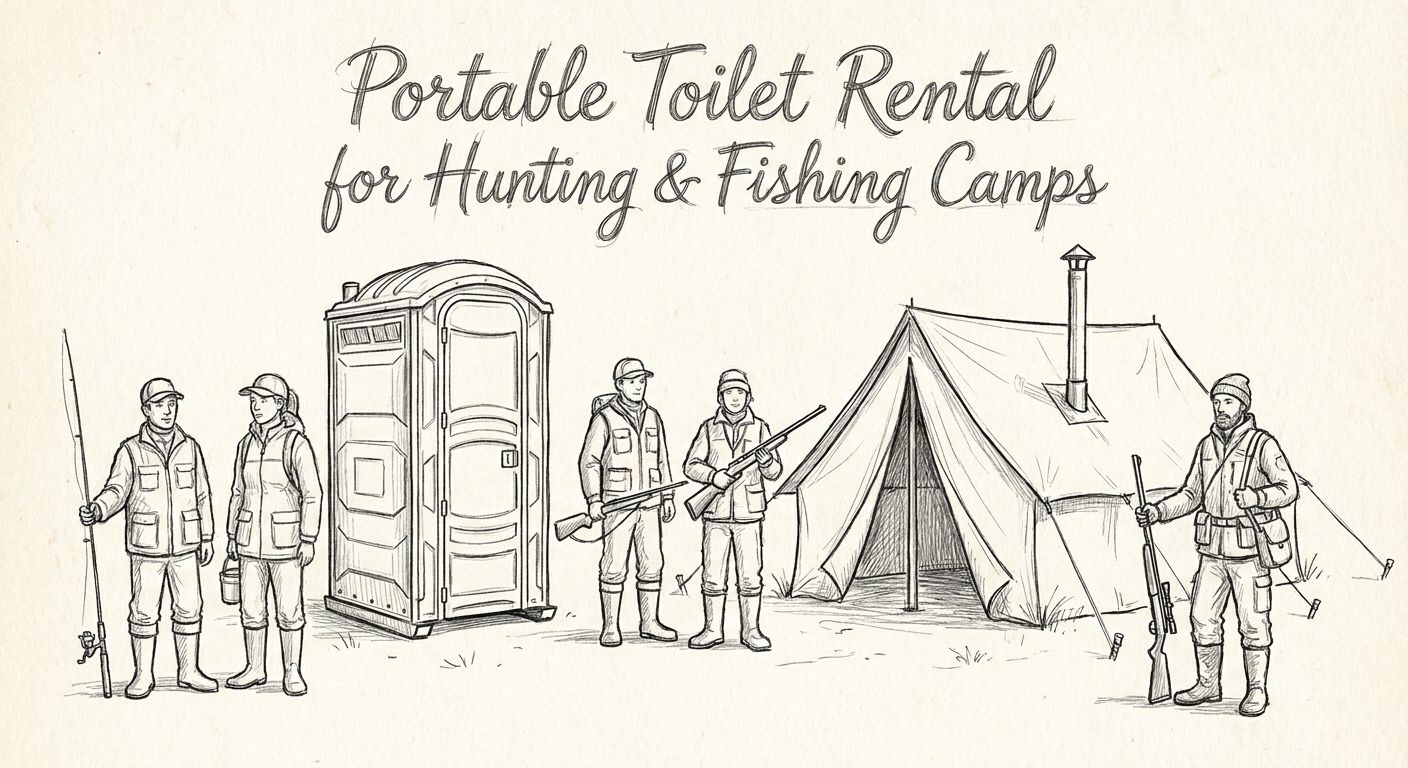
Hunting and fishing camp portable restroom rental sets up sanitary facilities at remote, seasonal sites with no water or sewer hookup, sized for the head count and access limits of camp season instead of a standard construction schedule. A weekend duck blind camp and a six-week outfitter lodge need two different setups, and freeze conditions change the equation again once late-season deer or waterfowl hunts run into December.
- A standard portable restroom covers roughly 10 hunters or anglers for a week of use before it needs servicing.
- Freeze-rated units with deicer fluid are the only workable option once camp temperatures drop below freezing overnight.
- Restroom trailers fit outfitter lodges with generator power, not tent camps reached only by ATV or boat.
- Valley Services runs season-long portable restroom service out of San Jose for Bay Area camps and outfitters in 2026.
Why portable restroom rental matters for hunting and fishing camps
A remote camp has no septic line and no city sewer to fall back on. Once a unit fills or freezes, the fix is a service truck that has to reach the site, and on a hunting lease that can mean miles of dirt road. Valley Services plans restroom delivery and servicing around camp access before the season starts, not after a truck gets stuck on a washboard road in the dark.
Land managers and outfitter permits commonly expect sanitary facilities on site during an active hunting or fishing season. A camp that runs restrooms without a servicing plan for a multi-week season usually ends up worse off than a camp with none at all, because a neglected unit near a water draw or camp kitchen becomes a bigger problem than the one it was meant to solve.
Late-season hunts add a second variable: cold. A holding tank that isn't rated for freeze conditions stops working exactly when the camp needs it most, during the November through January stretch when deer and waterfowl seasons run longest.
Count your crew and your camp days
Start with actual bodies on the ground, not license numbers. A camp that sizes off permits sold instead of daily headcount almost always comes up short on opening weekend.
- Guides and camp staff, counted separately from paying hunters or anglers
- Opening weekend surge versus the mid-season lull that follows
- Overnight guests versus day-trip crews who only need midday coverage
- Multi-week season leases versus single weekend bookings
- Any scouting or setup crew arriving days before the main group
Match the unit to no-hookup terrain
Every camp doesn't need the same unit. Terrain, guest expectations, and season length decide the call.
- Standard portable restroom for tent camps under about 10 users
- Deluxe flush unit for guided hunts with paying clients who expect more than a standard setup
- ADA-accessible unit for camps hosting guests with mobility limits
- Holding tank system for a fixed camp with no regular service-truck route
- Restroom trailer only where generator or shore power is already running
Plan for freeze and heat swings
A camp that runs from September dove season through January duck season sees both ends of the weather range in a single lease.
- Deicer fluid in the holding tank once nighttime temperatures drop below freezing
- Insulated or skirted units for late-season deer camps in cold country
- Shorter servicing intervals in July and August fishing camps to control heat and odor
- Unit placement out of direct afternoon sun where the site allows it
- A plan for what happens if a hard freeze hits before the scheduled service date
Map delivery access before the truck shows up
The single biggest reason a camp restroom setup fails is access, not sizing. A driver who reaches the gate and can't get further wastes the trip and the day.
- Dirt roads or washboard surfaces that need a flatbed instead of a standard delivery truck
- Locked gates and a plan for handing off the combination or key to the driver
- Bridge or culvert weight limits on remote forest roads
- A staging area at the nearest all-weather road if the camp itself is ATV or boat access only
- Cell coverage gaps that affect delivery confirmation calls
Schedule servicing around the season, not around convenience
A one-off weekend rental works for a single hunt. A camp running six or eight weeks needs a servicing rhythm built into the lease from day one.
- Mid-week servicing scheduled so it never lands on opening weekend
- A season-long lease instead of stitching together a string of weekend rentals
- A servicing log the camp can show a game warden or land manager on request
- A backup unit staged nearby for peak weekends when guest count spikes
- A clear point of contact for rescheduling if weather closes the access road
Set up handwashing away from the restroom
Field dressing and fish cleaning belong nowhere near the restroom unit, and camps that skip a dedicated handwash setup usually regret it by week two.
- A separate hand-wash station near the game-cleaning or fish-cleaning table
- Placement upwind and uphill from the kitchen tent
- A hard rule that field dressing stays clear of the restroom area entirely
Comparing restroom options for hunting and fishing camps
| Option | Best For | Key Limitation |
|---|---|---|
| Standard portable restroom | Weekend camps under 10 hunters or anglers | No sink, and it only empties when a service truck can reach it |
| Deluxe flush unit | Guided hunts with paying clients | Needs more frequent servicing than a standard unit |
| ADA-accessible unit | Camps hosting guests with mobility limits | Larger footprint, needs level, solid ground |
| Restroom trailer | Outfitter lodges running a multi-week season | Needs generator or shore power, hard to tow on rough roads |
| Holding tank system | Fixed camps with no regular service-truck route | The pump-out route has to be mapped before the season, not during it |
Verdict: a standard portable restroom is the right call for a weekend camp under 10 people, and a holding tank system is the right call for a fixed camp running the full season with no reliable truck access.
Common mistakes hunting and fishing camps make
- Sizing restrooms off license sales instead of actual daily headcount, then running short on opening weekend
- Setting the unit uphill from a creek or the camp's water draw point, which violates land manager rules and draws wildlife
- Skipping deicer fluid on a late-season hunt and coming back to a frozen, unusable tank
- Booking a rental company that never asks about road access, then eating a wasted trip when the truck can't reach the site
- Treating a six-week camp lease like a single weekend rental and running out of capacity by week three
Set up camp restrooms for the season
Call to plan delivery, sizing, and servicing before opening weekend.
FAQ
How many portable restrooms does a hunting camp need?
A standard portable restroom covers roughly 10 hunters or anglers for a week of continuous camp use before it needs servicing. Guided camps with paying clients often run one deluxe unit per 8 to 10 guests to keep wait times down during morning and evening peaks.
Can portable restrooms be serviced at remote hunting camps with no paved road access?
Yes, but the service route has to be mapped before the season starts. Dirt roads, locked gates, and bridge weight limits all affect whether a standard truck can reach the site or whether a flatbed delivery is required.
Do hunting camps need ADA-accessible portable restrooms?
Only if the camp hosts guests with mobility limits. An ADA-accessible unit needs a larger, level footprint than a standard restroom, so it's a decision to make during site layout, not after delivery.
How do portable restrooms handle freezing temperatures during deer season?
Standard units need deicer fluid in the holding tank once nighttime temperatures drop below freezing. Insulated or skirted units hold up better through a full late-season deer or waterfowl camp in cold country.
What's the difference between a portable restroom and a holding tank for a hunting camp?
A portable restroom is a self-contained unit that a service truck empties on a schedule. A holding tank system is a larger fixed tank built for a camp running a full season with no regular truck route, and it needs the pump-out route planned in advance.
Can a fishing camp rent portable restrooms for just a weekend?
Yes, a single weekend rental works fine for a short trip. A camp running multiple weekends back to back is usually better served by a season-long lease with scheduled servicing instead of booking each weekend separately.
How far in advance should hunting camps book portable restroom rental?
Book before opening weekend, since delivery trucks need lead time to plan remote or dirt-road routes. Waiting until the week of the hunt limits which delivery windows are still open.
Do fishing camps need handwashing stations along with restrooms?
Yes, a separate hand-wash station near the fish-cleaning table keeps field dressing away from the restroom area entirely, which matters more at a multi-week camp than a single weekend trip.
One last thing
Most camps plan the restroom and forget the teardown. Valley Services operates its own transfer station in San Jose, so the same call that sets up restroom service for a season can also line up a roll-off container for end-of-season camp cleanup, gear disposal, and debris haul-off, one point of contact instead of two vendors. Valley Services has run the same yard since 1986, third generation, same family, and that operating history is why camps running six or eight weeks trust the servicing schedule to hold through 2026's full season.
Related guides
- Man camp and remote workforce housing holding tank rental
- Farm labor site restroom rental
- Monthly restroom service for long-term job sites
Call (408) 297-5404 or reach out at valleyservices.biz to plan restroom setup for your 2026 camp season.