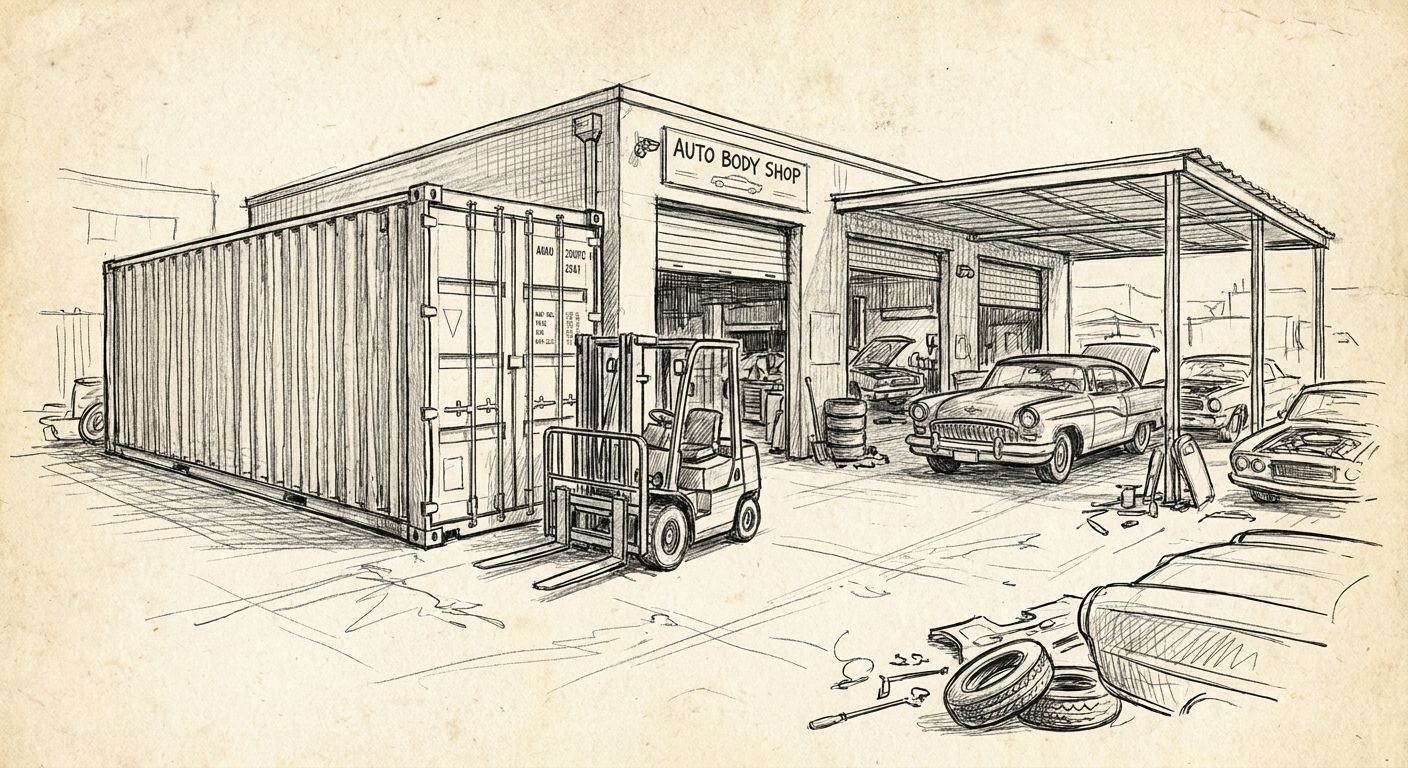
Auto body shops generate a mix of waste that most site service companies never think through: crushed steel panels, aluminum trim, shattered glass, plastic bumper covers, and paint booth filters, all moving out the back door on a schedule dictated by insurance estimates and cycle time. Getting container rental for auto body shop operations wrong means a box that fills with panels before it fills with volume, or a driver who shows up mid-repair and blocks the only bay door left open.
- A 20-yard roll-off is the standard container rental for auto body shop bays running 15 to 30 vehicles a month in 2026: Buy.
- Metal-heavy loads hit weight capacity long before the box looks full, so size for tonnage, not just cube.
- Used oil, coolant, refrigerant, and airbag components never go in a roll-off container. Keep them separated.
- Valley Services runs its own San Jose transfer station, which controls the swap-out schedule instead of a third-party hauler.
- Skip the 10-yard for anything doing frame or panel work. It's a garage cleanout size, not a collision-repair size.
Why this matters
A collision center or independent body shop doesn't have room to store a full week of scrap. Space is tight, insurance photos require a clean bay, and a container that overflows or blocks a customer drop-off lane costs more in lost throughput than any disposal decision saves. Valley Services sizes roll-off containers from 8 to 40 yards specifically for shops where weight, footprint, and turnaround matter more than raw volume.
The container itself is only half the equation. What goes in it, how fast it fills, and whether the lot even has room to stage a 40-yard box without blocking a bay door all shape the right call for 2026.
Who this is for
This guide is for independent collision shops, dealership-affiliated body shops, and multi-bay repair centers in San Jose, Santa Clara, Sunnyvale, Mountain View, and Milpitas that generate steady volumes of metal, glass, and trim debris. A shop tied to a dealership lot handling trade-in cleanout alongside collision work should also look at dumpster rental for auto dealership lot cleanouts, since the two waste streams often run on the same schedule.
Independent shops running one or two bays have different needs than a 12-bay collision center processing insurance work daily. Size and swap frequency should track the bay count, not a guess.
What to look for in container rental for auto body shop operations
Weight capacity, not just cube capacity
Steel panels, cast wheels, and frame sections are dense. A container that looks half full can already be at its weight limit while the box still has room for more debris. Sizing for a body shop means asking about weight allowance first and volume second, because metal-heavy loads are the single most common overage issue in this industry.
Hazardous fluid separation
Used motor oil, coolant, brake fluid, refrigerant, and airbag inflators cannot go into a roll-off container under any circumstance. A shop needs a documented separate stream for these materials before the container ever gets scheduled, because a hazardous load found at the transfer station stops the whole pickup.
Site footprint and bay access
Most body shops run tight lots with limited maneuvering room for a delivery truck. A 30 or 40-yard container needs roughly the length of two to three parking spaces to sit without blocking a bay door, a customer lane, or fire access. Confirm placement before delivery day, not after the truck arrives.
Swap-out frequency for busy shops
A collision center processing insurance work daily generates debris faster than a shop doing occasional dent repair. Matching the pull schedule to actual throughput, weekly for high-volume shops, biweekly or monthly for lower-volume ones, keeps a container from sitting full for days while waiting on pickup.
Permit requirements for street placement
Any container placed on a public street in San Jose needs a permit before it goes down. Shops with a private lot skip this step entirely, but any spillover placement onto the curb requires paperwork. Review how to permit a dumpster placement in San Jose before assuming curb space is free to use.
Scrap metal separation
Steel body panels, aluminum trim, and cast components have value as a separate stream from mixed C&D debris. Shops running consistent volume should ask about a dedicated scrap metal option rather than dumping everything into one mixed container.
Top picks for container rental for auto body shop bays
10-yard: the small-lot pick
A 10-yard roll-off runs roughly 14 feet long and 7 feet wide, small enough to tuck into a corner of a tight lot. It suits a single-bay independent shop doing light dent repair, upholstery work, or trim replacement without heavy panel volume. One spec that matters: this size fills fast on metal-heavy loads, often reaching its weight limit well before the box looks full.
Review how to load a dumpster safely and avoid overage fees before stacking panels, since improper loading on a small container creates the most overage risk of any size on this list. Verdict: Consider, only for low-volume shops without frame work.
20-yard: the standard bay-shop pick
The 20-yard container is the size most collision centers running 15 to 30 vehicles a month land on in 2026. It handles a mixed stream of bumper covers, glass, plastic trim, and moderate panel volume without hitting weight capacity as fast as the 10-yard. Footprint runs about 22 feet long, which fits most multi-bay lots without blocking access.
This is the size Valley Services delivers most often to body shops in the San Jose and Santa Clara service area. Verdict: Buy for any shop running a steady weekly repair volume.
30-yard: the heavy-metal pick
A 30-yard box suits shops doing frame straightening or heavy panel replacement, where steel volume outpaces plastic and glass. Weight, not cube, drives the decision here: a container this size can still hit its weight allowance on a pure-steel load faster than a lighter mixed load would fill the box.
Shops running consistent scrap steel and aluminum volume should also look at the scrap metal container option for keeping metal separate from mixed C&D debris. Verdict: Buy for frame-work shops, Skip for light trim and dent work where a 20-yard covers it.
40-yard: the multi-bay dealership pick
The 40-yard container fits dealership-affiliated collision centers running 8 or more bays with continuous insurance work. It needs the most lot space of any size, roughly the length of three parking spaces, so confirm placement against fire lanes and customer traffic before scheduling delivery.
Verdict: Buy for high-volume, multi-bay operations. Skip it for a single-bay independent shop; the footprint alone will eat too much working lot space for the volume generated.
What to avoid
- Sizing by volume alone. A box that looks like it has room left can already be over its weight allowance on a metal-heavy load. Weight governs cost and pickup risk more than the number stenciled on the container.
- Mixing hazardous fluids into the roll-off. Used oil, coolant, refrigerant, and airbag components are prohibited in any roll-off container, full stop. A shop that finds this out at pickup time loses a day of schedule.
- Placing a container on the street without checking permit rules. San Jose requires a permit for any curb placement, and a shop that skips this step risks a citation on top of the disposal delay.
Container size comparison for auto body shops
| Size | Best for | Approx. footprint | Weight risk | Verdict |
|---|---|---|---|---|
| 10-yard | Single-bay, light trim/dent work | 14 ft x 7 ft | High on metal loads | Consider |
| 20-yard | Standard multi-bay collision shop | 22 ft x 8 ft | Moderate | Buy |
| 30-yard | Frame work, heavy steel volume | 22 ft x 8 ft (taller) | High if loaded with pure steel | Buy for heavy metal, Skip otherwise |
| 40-yard | Multi-bay dealership collision center | 22 ft x 8 ft (tallest) | Moderate for mixed loads | Buy for high volume |
“Weight, not volume, is what turns a container rental for auto body shop bays into an overage problem.”
Talk through container sizing for your bay
Valley Services sizes roll-off containers 8 to 40 yards for San Jose and South Bay shops.
FAQ
What size container rental do most auto body shops need?
Most multi-bay collision shops running 15 to 30 vehicles a month land on a 20-yard roll-off container in 2026. Smaller independent shops doing light trim or dent work can size down to a 10-yard.
Can used motor oil or coolant go into a roll-off container?
No. Used oil, coolant, brake fluid, refrigerant, and airbag inflators are prohibited in any roll-off container and must be kept in a separate stream. A hazardous load found at the transfer station halts the pickup.
Do I need a permit to place a container at my body shop?
Only if the container sits on a public street. A container placed entirely on a private lot in San Jose does not require a street placement permit, but curb spillover does.
How often should a busy collision center swap containers?
High-volume shops processing insurance work daily typically need a weekly pull. Lower-volume independent shops can run biweekly or monthly depending on panel and glass output.
Why does a container rental for auto body shop debris fill up faster than expected?
Steel panels, cast wheels, and frame sections are dense, so weight capacity gets reached before the box looks visually full. Sizing for tonnage rather than cube capacity avoids this.
Is a separate scrap metal container worth it for a body shop?
Shops with consistent steel and aluminum volume benefit from keeping metal separate from mixed C&D debris rather than combining everything into one container.
What's the difference between a 30-yard and 40-yard container for a collision shop?
A 30-yard suits frame-work shops with heavy steel volume, while a 40-yard fits multi-bay dealership collision centers running continuous insurance work. The 40-yard needs more lot footprint to place safely.
Does Valley Services deliver to body shops outside San Jose?
Valley Services serves San Jose, Santa Clara, Sunnyvale, Mountain View, Milpitas, and the surrounding Bay Area, with the C&D transfer station located in San Jose.
One last thing
The shops that run into trouble aren't the ones with the wrong container size, they're the ones who never separated hazardous fluids before delivery day and lost a full pickup cycle sorting it out on the spot. Set the separation rule with the crew before the first container ever lands in 2026, not after.
Call (408) 297-5404 or reach out through valleyservices.biz to talk through sizing for your bay count and lot footprint.