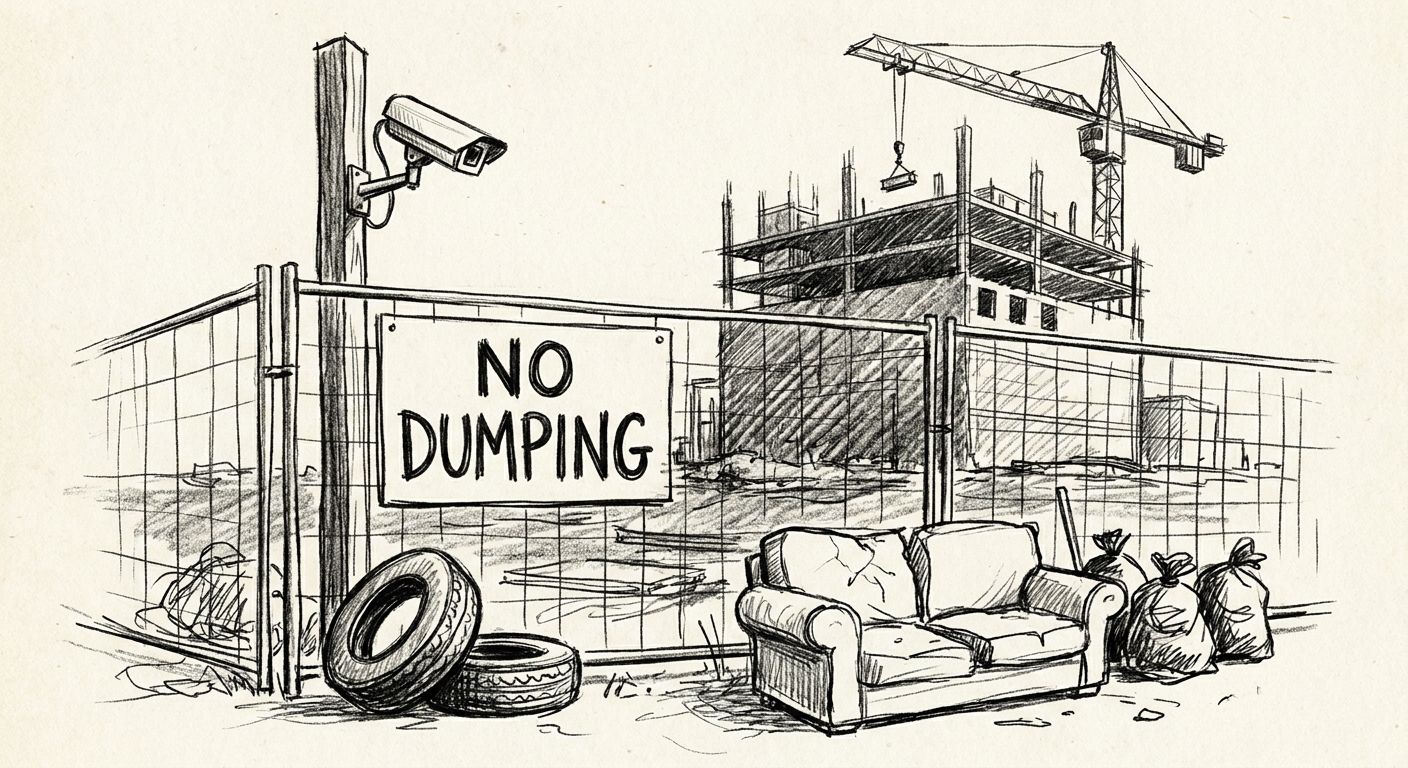
Illegal dumping at an open construction site in San Jose or anywhere in the South Bay costs contractors cleanup crews, disposal fees, and sometimes a call from code enforcement. Most of it is preventable with the same site controls you already use for safety: fencing, locked containers, and a single point of access.
- Temporary fencing around the full perimeter is the single biggest deterrent to illegal dumping construction site problems in 2026.
- Lockable, scheduled roll-off container pickup beats an open bin every time: full containers over a weekend invite more dumping.
- Valley Services runs its own San Jose transfer station, so container swaps and pickups happen on your schedule, not a broker's.
- Signage and lighting help, but they rarely stop dumping without fencing and a single controlled gate behind them.
- Document every violation the same day: photos and a police report protect the project if debris triggers a code complaint.
Why this matters
An unfenced lot with a half-full roll-off container reads as free disposal to anyone driving by after dark. Once one load of mattresses or drywall shows up, more follows within days. That debris becomes your crew's problem to clear, your budget's problem to absorb, and in San Jose, potentially a code violation tied to your address.
Site control here isn't about looking tidy. It's about who can get onto the lot, how long a container sits open, and how fast you notice when something's wrong. Temporary fencing installed correctly closes the gap between "open lot" and "controlled site" in a single afternoon, and it's the first thing to fix before anything else on this list matters.
What you'll need
- Temporary chain link or privacy-screen fencing sized to the full lot perimeter, not just the street frontage
- Locking roll-off container lids or a container placement plan that keeps bins away from public sightlines
- No Dumping signage posted at every point a vehicle could pull up to the lot
- A single gated access point with a lock, not multiple open gaps
- Site lighting at rear corners and blind spots
- A phone or tablet for photographing violations the moment they're found
The steps
1. Fence the entire perimeter, not just the street side
Most dumping happens at the back of a lot or along a side alley, not the front where the crew parks. Fence the full property line before demo starts, including rear access roads and shared driveways. A partial fence job just moves the problem to the unfenced side.
Common mistake: crews fence the street frontage for appearance and leave a rear alley open because it's "low traffic." Low traffic at 11 PM on a Friday is exactly when dumping happens.
2. Lock down container access
Roll-off containers sitting at street level with no lid are an open invitation. Use containers with locking lids where the site allows it, or position the container inside the fenced perimeter instead of curbside. A blue steel container placed 15 feet inside a locked gate gets dumped on far less than one sitting at the curb overnight.
3. Post signage at every entry point
A single No Dumping sign at the main gate does almost nothing if the rear alley and side lot line have none. Post signage everywhere a vehicle could physically pull up and unload, including any shared or unfenced access points that remain during phased construction.
4. Control site access to one gated point
Multiple open gaps mean multiple places to watch and multiple places to fail. Reduce the site to one locked, gated entry for after-hours access. This also makes it obvious who was on the lot if something does turn up, since only one path in exists.
5. Schedule pickups before containers fill past the lip
A container filled to the top looks abandoned and full, which reads as "no one's watching this." Pull pickups forward so containers never sit overflowing over a weekend. Scheduling delivery and pickup around your actual production rate, and confirming any San Jose placement permit is current, keeps a container from becoming the neighborhood's answer to a Saturday cleanout.
6. Add lighting at blind corners and rear lot lines
Dumping happens where no one can see it happen. A single work light aimed at a rear corner or an unlit side yard changes the calculation for anyone scouting the lot. This costs almost nothing next to the labor of clearing a truckload of someone else's debris.
7. Walk the perimeter at the end of each day
A five-minute walk before the crew leaves catches a cut fence panel, a propped gate, or a container that's already been hit before it becomes a weekend-long problem. Assign it to a foreman, not "whoever's last out."
8. Document and report violations the same day
Photograph any dumped material before it's cleared, note the date, and file a report with San Jose code enforcement or the non-emergency police line if it's a repeat location. Documentation matters if the debris is later flagged as belonging to the project. It also builds a pattern that helps enforcement act on a chronic dumping spot.
Troubleshooting
Dumping keeps happening at the same rear corner even with a fence up. The fence line likely has a gap where a panel meets uneven ground or a slope. Walk that specific stretch and re-stake it, since a six-inch gap at ground level is enough for someone to slide debris through.
A container fills with material your crew didn't generate over a weekend. This is a placement problem, not a container problem. Move the container inside the fenced perimeter for the next phase instead of leaving it curbside between pickups.
Neighbors complain about debris spilling onto their property line. Check whether the fence privacy screen extends the full length of the shared line. A see-through gap is often where wind-blown debris or foot traffic crosses over.
Signage gets ignored entirely. Signage alone rarely deters anyone determined to dump. Pair it with the gate and lighting steps above rather than expecting a sign to do the job on its own.
Fencing isn't up yet during early site mobilization. This is the highest-risk window. If temporary fencing installation is scheduled a few days out, keep containers off the lot entirely until the perimeter is closed.
Tools and resources
- How to secure a construction site with temporary fencing for panel spacing and gate placement
- Temporary fencing for vacant property security for lots sitting idle between phases
- How to dispose of construction debris in San Jose for legal drop-off options once material is cleared
Talk through your site security setup
Roll-off containers, fencing, and pickup scheduling from one San Jose yard.
What to do next
Once the perimeter is closed and containers are placed correctly, the remaining risk is usually a phased site with an open zone waiting on the next stage of work. Temporary fencing for vacant property security covers how to keep an idle parcel from becoming the neighborhood drop point between construction phases.
FAQ
What's the best way to prevent illegal dumping at a construction site?
Fence the full perimeter, control access to a single locked gate, and keep roll-off containers inside the fence line rather than at the curb. Signage and lighting help but rarely work without fencing behind them.
Does fencing actually stop illegal dumping, or just slow it down?
A complete perimeter fence with no gaps stops most casual dumping because it removes the drive-up access that makes dumping easy. Partial fencing that leaves a rear alley or side lot open just shifts the problem there.
Should a roll-off container sit at the curb or inside the fence?
Inside the fence whenever the site allows it. A blue steel container sitting curbside overnight with an open lid gets far more unauthorized dumping than one placed behind a locked gate.
How often should a construction dumpster be picked up to avoid dumping?
Schedule pickup before the container fills past the lip, especially before a weekend. An overflowing container signals an unmonitored site and attracts more debris than an empty one.
Is it legal to dump construction debris in someone else's dumpster?
No. Dumping debris in a container without authorization is a civil and often criminal violation in San Jose and across California, and it can create liability for the project if the debris is traced back to the site address.
What should I do if I find dumped material on my job site?
Photograph the material and the date before clearing it, then report it to San Jose code enforcement or the non-emergency police line. Documentation matters if the material is questioned later during disposal.
Do I need a permit to place a roll-off container on a San Jose street?
Yes, in most cases a placement permit is required for a container in the public right of way in San Jose. Placing the container on the private lot behind fencing avoids that requirement and reduces dumping risk at the same time.
How does temporary fencing help beyond stopping dumping?
The same perimeter fence that blocks dumping also restricts unauthorized foot traffic, protects tools and material staged on site, and satisfies site security expectations tied to insurance and Cal/OSHA site control.
One last thing
Most illegal dumping tracks back to one detail: a container or an open lot that sat unwatched over a weekend. Contractors who close the perimeter before the first container lands, rather than after the first dumping incident, almost never deal with it again in 2026. Valley Services has run roll-off containers and site fencing out of the same San Jose yard since 1986, third generation, same family, and coordinates container placement with fencing and access control on one call. Call (408) 297-5404 or visit valleyservices.biz to line up fencing and container scheduling before the next phase breaks ground.